China has told the White House it will walk away from Xi Jinping's September 24 summit with President Trump if Trump signs off on a $14 billion arms package for Taiwan before the two leaders sit down. Japan's Kyodo News reported the warning around September 13, citing diplomatic sources, and nothing has changed since. Xi is due at the White House on September 23 for his first trip to Washington in more than a decade, with a formal state dinner already being planned. Whether he actually shows up now comes down to a single decision Trump has been sitting on for months.
The threat, in plain terms
Beijing has not formally confirmed Xi's travel plans even as preparations move ahead on both sides, and reporting out this week says that gap is not an accident. China regards Taiwan as the one issue in the relationship that is not up for discussion, and it has said so directly: approve new arms sales to the island before the two presidents meet, and the meeting does not happen. The summit would be Xi's first visit to Washington since before Trump's first term ended, and a cancellation this close to the date would be a genuine embarrassment for a White House that has already scheduled a state dinner around it.
Xi made his position clear to Trump's face back in May, when the two leaders held their first 2026 summit in Beijing. He told Trump that mishandling Taiwan could lead to "clashes and even conflicts," a line multiple outlets picked up as a deliberate escalation from China's usual language.
How Trump turned Taiwan into a "negotiating chip"
The $14 billion package at the center of this fight was ready for Trump's signature months before any of this became public. Congress signed off on it, and the only thing left was formal notification from the administration. Instead, in a Fox News interview taped in Beijing at the close of the May summit, Trump described the sale as a "very good negotiating chip" with China and said he was holding it "in abeyance." He went further, telling Fox that "Taiwan would be very smart to cool it a little bit" given the state of talks with Beijing.
That remark is what turned a routine arms sale into a live diplomatic crisis. A pending weapons package is normally background noise. Tying it explicitly to leverage over Xi is not, and it is why Fox News itself reported alarm among China hawks in both parties about how far the administration might be willing to shift on Taiwan to get a deal done.
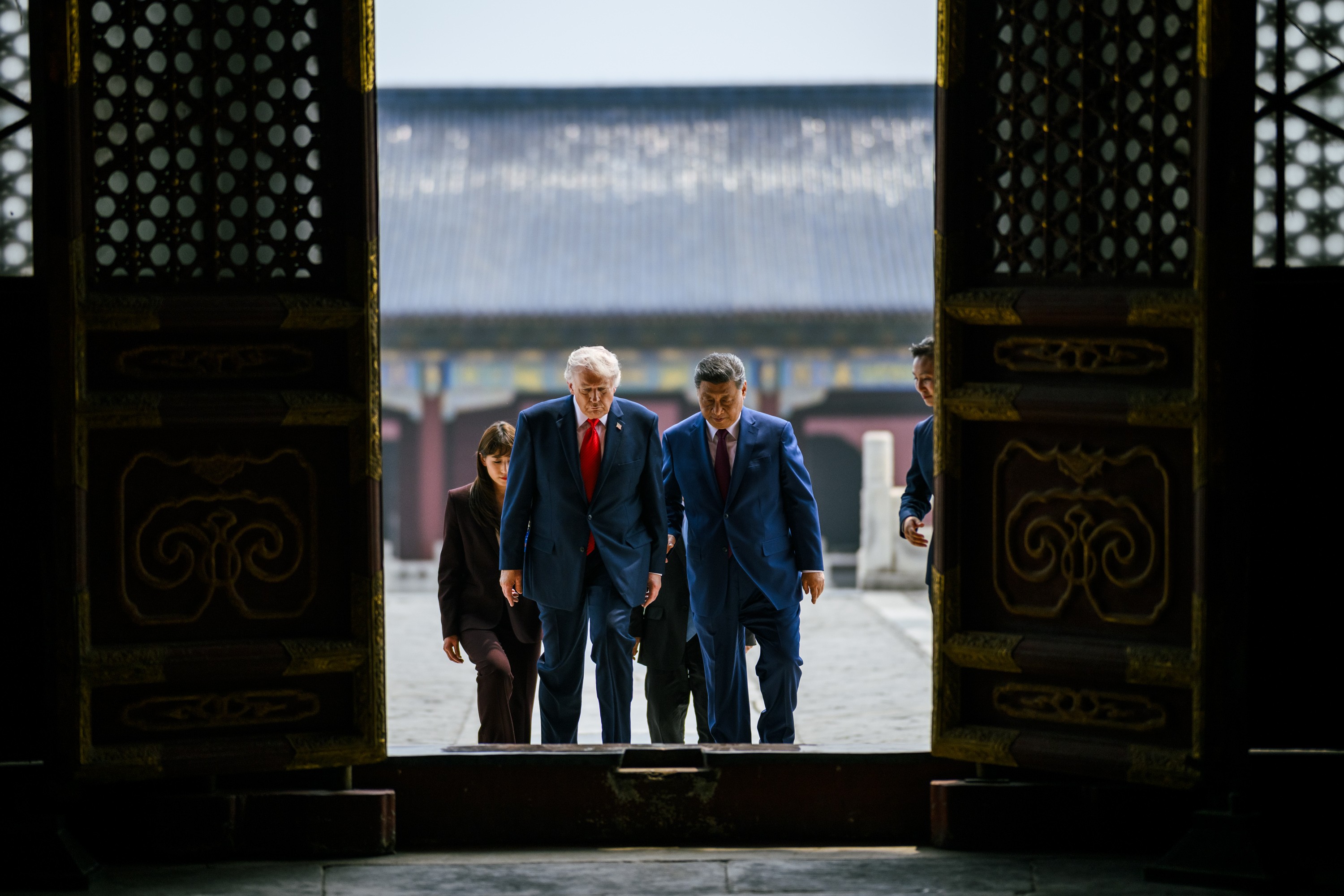
President Trump and Xi Jinping tour the Temple of Heaven during their May 2026 Beijing summit, the meeting where Trump first called the pending Taiwan arms sale a "negotiating chip." (Official White House Photo by Daniel Torok, public domain)
What's actually in the $14 billion package
The deal includes PAC-3 MSE interceptors and NASAMS air defense missiles, systems Taiwan wants specifically to blunt a Chinese missile barrage in the opening hours of any invasion attempt. It has been ready to go since Congress approved it, which the bipartisan Senate letter discussed below dates to January 2025.
The administration has not given a single consistent explanation for the delay. Acting Navy Secretary Hung Cao told a Senate Appropriations subcommittee the sale was on "pause" to preserve munitions stockpiles for the ongoing war against Iran. Defense Secretary Pete Hegseth publicly contradicted him days later, telling reporters the United States is in a "very good place" on weapons stocks and that the Taiwan pause had nothing to do with Iran, a split the Daily Caller and The Hill both flagged as an unusual public break between a service secretary and the Pentagon's top civilian. Taiwan's own defense ministry has said it was never formally notified of any pause at all.
The interceptors matter because of what Taiwan is up against. PAC-3 MSE rounds are built to hit incoming ballistic missiles, not just aircraft, and NASAMS gives a layered defense against the cruise missiles and drones that would likely open any Chinese assault on the island's air bases and ports. Taiwan's own Legislative Yuan already voted to fund its side of the purchase, approving a $25 billion special defense budget in May specifically so the money would be sitting there the moment Washington notified Congress. Taiwan did its part months ago. It is still waiting on Washington to do the same.
Bipartisan senators told Trump not to trade Taiwan away
Eight senators from both parties, led by Foreign Relations Committee Ranking Member Jeanne Shaheen and North Carolina Republican Thom Tillis, sent Trump a letter days before the May summit warning him against exactly the move he ended up making. "American support for Taiwan is not up for negotiation," they wrote. The letter also laid out what they see as the stakes for ordinary Americans if Beijing ever does move on Taiwan by force: "severe and long-term inflation, supply chain disruptions that would destroy manufacturing jobs at home and steep hikes in the cost of living."
Official record
Letter to President Trump from Sens. Jeanne Shaheen, Thom Tillis, Chris Coons, John Curtis, Tammy Duckworth, Jacky Rosen, Andy Kim and Elissa Slotkin, dated May 8, 2026, released through the Senate Foreign Relations Committee.
"You should make clear to Beijing that as you seek to level the economic playing field, American support for Taiwan is not up for negotiation." — from the senators' letter
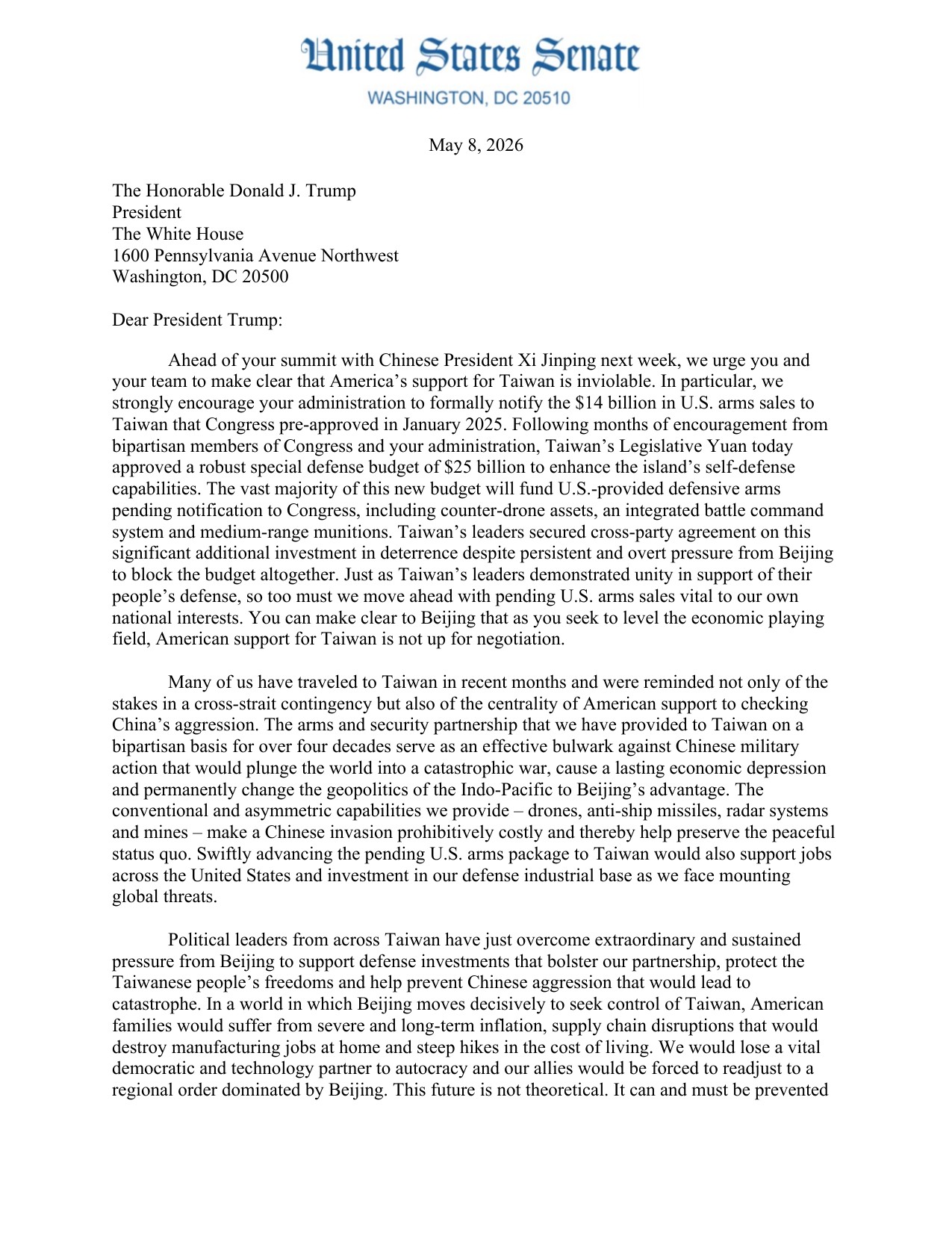
Read or download the full 2-page letter (PDF)
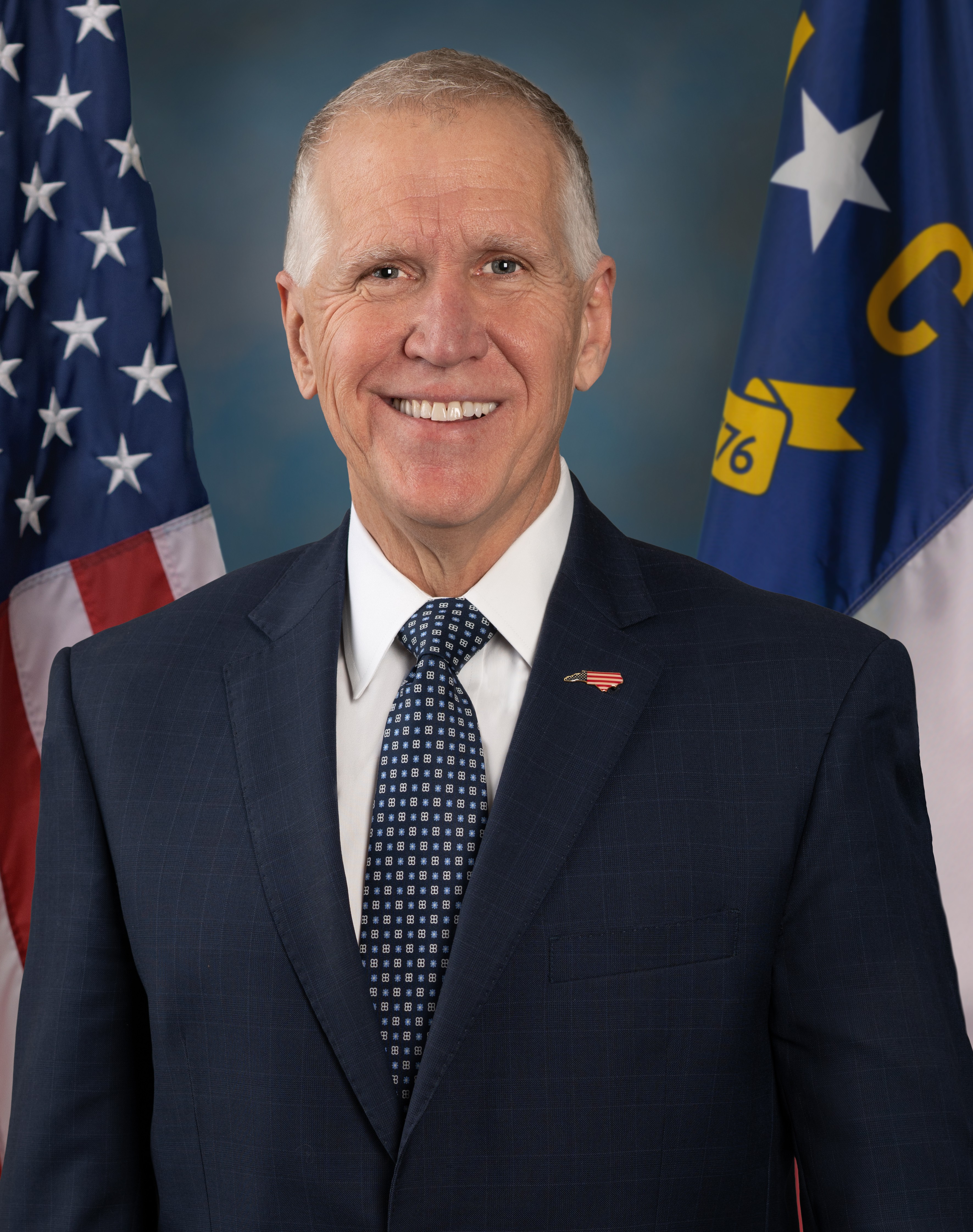
Sen. Thom Tillis, R-N.C., one of eight senators, evenly split between both parties, who told Trump in May that Taiwan's defense "is not up for negotiation." (Official U.S. Senate photo)
Rubio says nothing's changed. Beijing isn't acting like it believes him.
Secretary of State Marco Rubio told NBC News after the May summit that "U.S. policy on the issue of Taiwan is unchanged," and called it "a terrible mistake" for China to pursue reunification by force, warning of global repercussions. He also offered a blunt read on what Beijing actually wants short of an invasion: a Taiwanese "vote or referendum" that would fold the island into China "voluntarily," a fig leaf China could point to as proof it never resorted to force.
That is the backdrop for why Beijing is pressuring Trump on the arms sale right now instead of just invading outright. China would rather squeeze Washington into slow-walking Taiwan's defenses one summit at a time than absorb the global fallout of a shooting war. Every arms package Trump holds back, whatever the stated reason, is a data point Beijing can use to argue that American commitments bend under enough pressure.
Why September 24 is a real deadline, not a formality
This would be Xi's first trip to the White House in over a decade, and expectations for the substance of the meeting are already low. Craig Singleton of the Foundation for Defense of Democracies has described it as a summit built around managing an ongoing stalemate, not resolving one, pointing to commitments from May that Beijing has yet to deliver on, including promised purchases of Boeing aircraft and American farm goods. Friction has been building elsewhere too: China was the lone holdout on a joint statement at this month's G20 finance ministers meeting and separately objected to language referencing the Iran war.
None of that friction forces a cancellation on its own. The arms sale does. Beijing has drawn a specific, public line, and it has given Trump a specific window, now down to a matter of days, to decide whether he crosses it before Xi's plane is scheduled to land.
What happens next
Trump has not said publicly which way he is leaning, and the White House has not walked back its confirmation of the September 24 date. Most market and diplomatic analysts still expect the summit to happen, on the theory that neither side wants to be the one that blows it up. But that expectation rests entirely on Trump either signing the notification and calling China's bluff, or holding off and letting Taiwan's defense sit in limbo through another high-stakes meeting with the man who has spent a decade building the military he'd use to take the island.
Rubio can call U.S. policy "unchanged" all he wants. Policy is not just what a secretary of state says in an interview. It is whether the interceptors Taiwan paid for and Congress already approved actually ship, on schedule, with no summit hanging over the decision. Every day between now and September 23 is a day Beijing gets to keep testing whether that commitment survives contact with a deal Trump wants.