Austin's City Council is set to approve $854,872 on Thursday for lawyers, court coaching and filing fees for immigrants fighting deportation, and it plans to do it on the consent agenda with no debate. Conservative outlets called it a response to Sunday's ICE shooting. The city's own paperwork shows something different. This is Amendment No. 12 of a program Austin taxpayers have paid for since 2018, and Texas's highest court has already frozen a nearly identical program in Houston.
What Is Actually on Thursday's Agenda?
The September 24 council agenda lists four contract amendments, items 51, 52, 57 and 59, all handled by Austin Public Health. Catholic Charities of Central Texas would get $188,872 for "legal and counseling services" and $126,720 for "legal filing fee assistance." American Gateways would get $161,280 for "legal pro se assistance" and $378,000 for "legal services."
Add them up and you get $854,872. The four items sit in the consent section of the agenda, where the council approves dozens of items in one vote. They are listed next to a sickle cell education contract, a mobile food pantry and a maternal health program. The posting language for these four items never uses the words "immigrant" or "immigration."
The backup documents do use those words. The Recommendation for Action for item 57 says the money will "stabilize the immigration status of detained and non-detained immigrants" through "screenings, consultations, group information sessions, workshops, pro se assistance and legal representation." It also describes the council's original 2018 approval of an agreement "to provide immigration legal services and deportation defense."
Official record
City of Austin, Recommendation for Action, File #26-2553, Agenda Item #57 (American Gateways legal services), for the September 24, 2026 council meeting.
"The program's City Business Plan goal is for clients to obtain and maintain public benefits as a result of receiving services through this Health Equity Social Service Contract."
Additional Backup Information, page 1
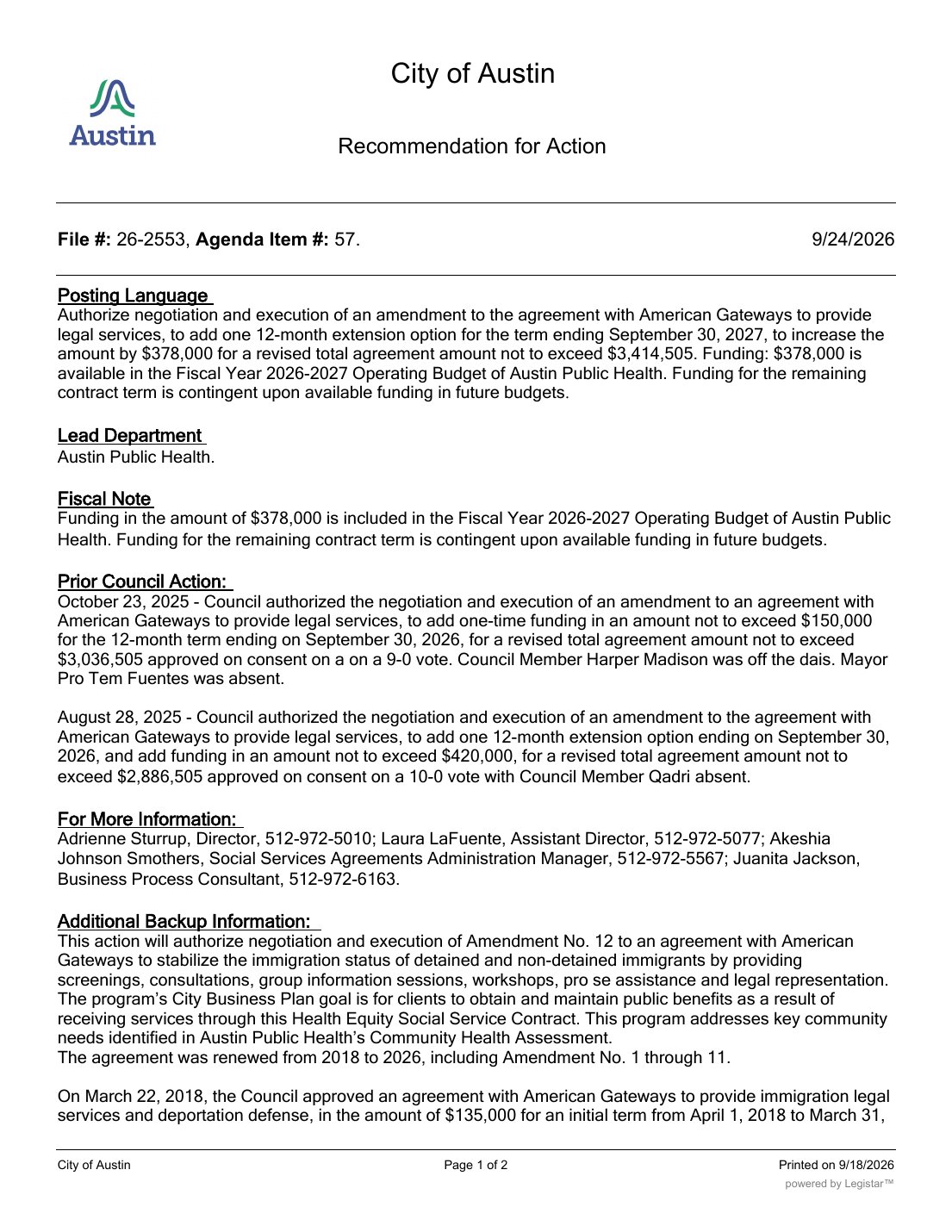
Read or download the full 2-page document (PDF) · original on austintexas.gov
Austin Files Deportation Defense Under Public Health
This is the part the city would probably rather you skip. Austin does not book this spending as legal aid or public safety. Each Recommendation for Action calls it a "Health Equity Social Service Contract" that addresses needs found in Austin Public Health's Community Health Assessment. Each one lists the same success goal: clients will "obtain and maintain public benefits."
So the city's own paperwork counts it as a win when an immigrant in removal proceedings gets onto public benefits. Breitbart Texas flagged that metric on Monday, and it is right there in the documents. The Catholic Charities filing-fee backup says the program covers "application filing fees for eligible immigrants unable to pay."
Is This a Reaction to the Austin ICE Shooting?
Headlines tied the vote to the September 20 ICE shooting of Wilber Rafael Garces Perez, which we covered this week. The dates do not support that link. Every one of the four Recommendation for Action documents is stamped "Printed on 9/18/2026," and the city's meeting page shows them posted September 18. That was two days before the shooting.
The real story is older, and for Austin taxpayers it is worse. These are annual renewals that the council has approved without much notice for years. The item 57 backup lists the prior votes. On August 28, 2025, the renewal passed "on consent on a 10-0 vote." On October 23, 2025, the council added $150,000 in one-time money to the same contract, again "on consent," 9-0.
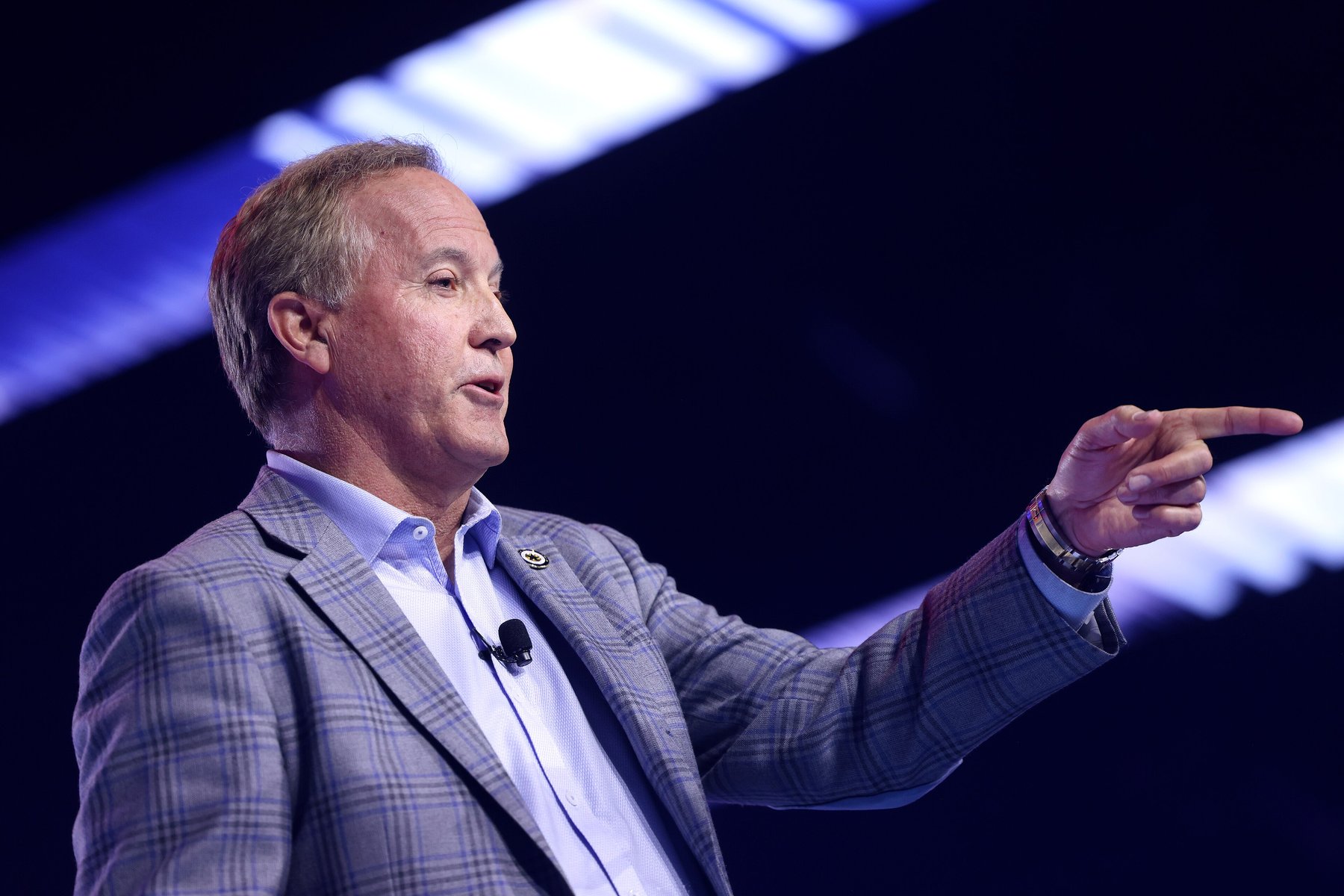
Texas Attorney General Ken Paxton has sued Harris County and Bexar County over local deportation defense funds. Bexar County's contract went to American Gateways, the same nonprofit Austin is paying. (Gage Skidmore, Wikimedia Commons, CC BY-SA 4.0)
How Big Has the Program Grown Since 2018?
The amendment tables attached to each item show the growth. American Gateways' main legal services agreement began in 2018 at $135,000. If Thursday's amendment passes, its ceiling rises to $3,414,505. The company's separate pro se agreement would reach $628,780. The two Catholic Charities agreements would reach $2,060,036 and $579,920.
Taken together, the four contract ceilings come to $6,683,241 in local tax money, matching the "more than $6.6 million" figure Texas Scorecard reported. The Catholic Charities legal services contract has gone through 11 amendments since it started in 2016. American Gateways' legal services contract has also had 11, and Thursday's would be the 12th.
The Numbers Show a 10 Percent Trim, and a Commission Wanted More
Our own review of the tables turned up something no coverage we found mentioned. Each of this year's four increases is exactly 90 percent of last year's renewal. Last year's renewals were $209,858, $179,200, $420,000 and $140,800. This year's are $188,872, $161,280, $378,000 and $126,720. The math lines up to the dollar.
The tables also show the current-year contracts already took mid-year cuts. There is a negative $57,000 amendment on the American Gateways legal contract, negative $20,986 on Catholic Charities legal services and negative $14,080 on filing fees. Each is 10 percent of that contract's current-year funding, which fits the social services cuts the city planned in late 2025 to close a budget gap.
The program's allies noticed. In March, the Asian American Quality of Life Advisory Commission voted 12-0 on a formal recommendation asking the council to restore "the 10% cut to the contract to American Gateways and Catholic Charities contracts" and to expand pro se services. The commission wrote that the program focuses on "citizenship, deportation defense, and access to public benefits." Thursday's amounts are still 10 percent below last year's, so on these four lines the cut was not restored.
The trim does not make the spending harmless. The money comes out of the $6.6 billion budget adopted August 12, which raises the typical household's city property tax by $113.76 a year. Community Impact reported that the new rate is the maximum allowed under state law without voter approval. Less than a year earlier, Austin voters rejected Proposition Q, a proposed tax rate increase, by a wide margin.
The Council Is Voting Before Its Own Review Is Done
There is another problem with Thursday's timing. A city internal audit released this summer found that Austin's nonprofit contracts often are not closely monitored. According to Community Impact, city staff reviewing more than 130 social service grants and contracts have flagged more than two dozen for compliance or performance issues. The detailed findings memo is still weeks away.
Council Member Ryan Alter raised this at a September 22 briefing. He noted that the council is set to approve millions in social service spending on September 24 without knowing which contracts were flagged. The public does not know either. We found no public statement on whether any of the four immigration contracts on Thursday's agenda are on that list.
Texas's Top Court Already Froze Houston's Version
Harris County has run a similar Immigrant Legal Services Fund since 2020. Attorney General Ken Paxton sued in November 2025 over $1.3 million the county approved, arguing that the Texas Constitution's gift clause bars local governments from giving public money to private parties without a real public purpose. On June 26, the Supreme Court of Texas ordered Harris County to stop paying out the money while the case continues.
The order found "serious doubt about the constitutionality of the" program and said "it is not clear that the County has constitutional or statutory authority to conduct the program." It also noted that once the money is spent, it "cannot feasibly be recouped." Justices Lehrmann, Bland and Huddle dissented. The court said clearly that it had not decided the merits.
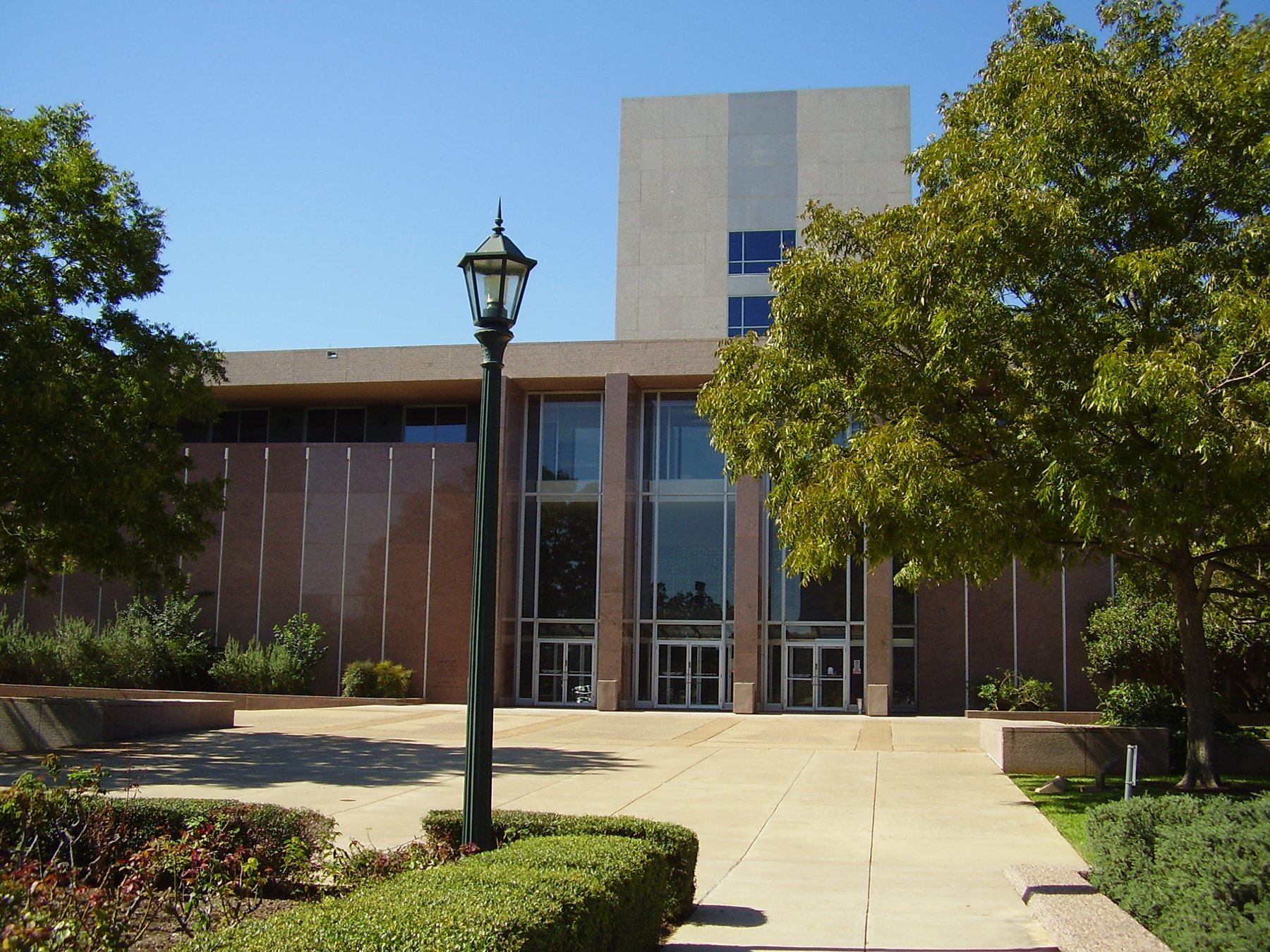
The Supreme Court of Texas building, a few blocks from Austin City Hall. Its June 26 order froze Harris County's immigrant legal services fund pending appeal. (WhisperToMe, Wikimedia Commons, public domain)
Paxton also went after Bexar County in February, suing over $566,181 approved in December 2025. The contractor in that case, according to the San Antonio Report, is American Gateways. A Bexar County district judge ruled that Paxton's office lacked authority to bring the case, and the fight moved into the appeals courts.
Austin's lawyers will likely point to one distinction. The Supreme Court's concern about Harris County centered on county authority, and Texas counties have only the powers the Legislature gives them. Austin is a home-rule city, and home-rule cities in Texas may exercise any power not prohibited by the state constitution or state law.
That argument only goes so far. The gift clause, as Texas Scorecard notes, applies to "any county, city, or subdivision of the state," so the public-purpose question applies to Austin just as it does to Harris County. No court has ruled on Austin's program, and we found no public record of Paxton challenging it.
Who Is Watching This Next?
House Speaker Dustin Burrows reacted to the Austin agenda on X, according to Texas Scorecard, saying local governments that "hike taxes to pay for non-essential expenditures" undermine the Legislature's tax relief. He pointed to the House Select Committee on Governmental Oversight's September 30 hearing on local misuse of taxpayer money. That is the same panel set to question Travis County DA José Garza's office the same day.
Thursday's vote will probably pass the same way the last several did, on consent and without a word. It shouldn't. Austin voters rejected a large tax increase last November and got a smaller one anyway. Now the council is renewing, for a 12th time, a program it files under public health and measures by how many clients get onto public benefits. A council member who wants the public to see this vote only has to pull the four items off consent and ask for a roll call. The Texas Supreme Court has already said a program like this raises serious constitutional doubts.
Top photo: Austin City Hall and its public plaza on West Second Street. (Carol M. Highsmith, Library of Congress, public domain)