Trump's Greenland deal, signed at the UN on Tuesday, has no end date, lets the English text win any dispute over meaning, and shuts China and Russia out. We read all 10 pages and set them next to the 1951 treaty they replace. The new text gives Washington more, in plainer words, than the headlines have said.
President Trump, Danish Prime Minister Mette Frederiksen and Greenland Prime Minister Jens-Frederik Nielsen signed the agreement Sept. 22 on the sidelines of the 81st UN General Assembly, hours after Trump told the assembly the U.S. would "immediately begin the process of developing a large military presence" on the island. Most coverage stopped at the base list. The treaty text, which Denmark's foreign ministry posted in full, says a good deal more.
Two New Bases, and the Door Left Open for More
Article IV is the part everyone reported. The U.S. may "modernize and expand its activities" at Pituffik Space Base, the old Thule Air Base in the far northwest, and may set up new defense areas at Narsarsuaq in the south and Mestersvig on the east coast. According to Reuters reporting carried by the Times of Israel, it is the first major increase in U.S. military infrastructure on the island since the Cold War, when America ran 17 installations there with more than 10,000 personnel.
Then comes the bigger clause. Either party can propose a new defense area, and if the Permanent Committee can't agree within 90 days, the dispute moves up to deputy ministers and then to ministers. Under the 1951 treaty, new bases needed both governments to agree "on the basis of NATO defense plans," with no deadline anywhere. Article V also puts unmanned installations, the sensors and radars a missile shield depends on, on "accelerated governmental approval procedures."
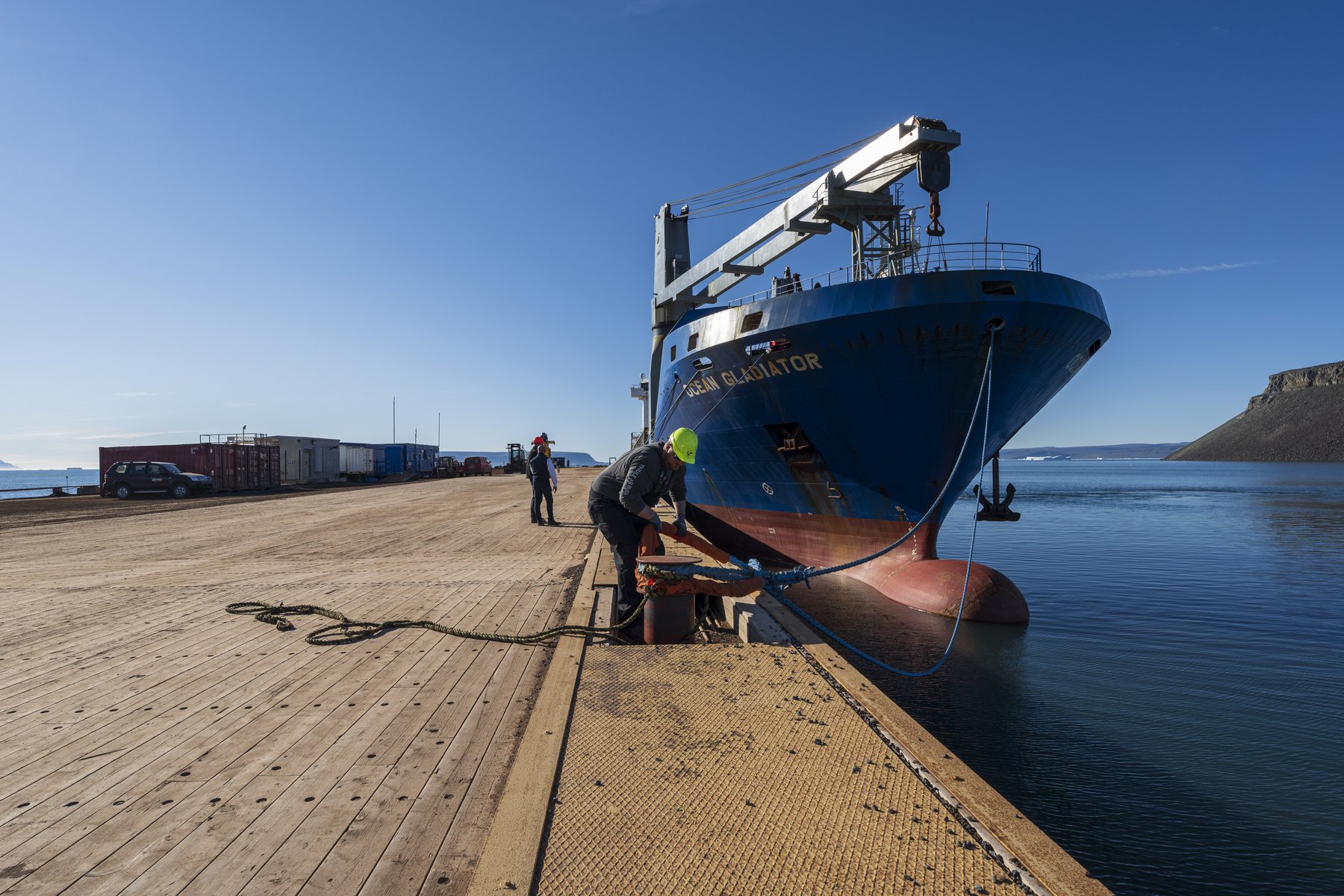
The cargo ship Ocean Gladiator at the deepwater port of Pituffik Space Base (then still called Thule Air Base) during the annual resupply mission, August 2022. Article IV of the new agreement lets the U.S. modernize and expand operations here. (U.S. Space Force photo by Paul Honnick, via Wikimedia Commons, public domain)
Golden Dome Is Written Into the Treaty Itself
The preamble says the three governments share an interest in letting the United States have military access to Greenland "to the extent necessary to defend the North Atlantic Treaty area, Greenland, and the American continent, including through establishment of a Golden Dome defense system." Denmark and Greenland signed their names under the name of President Trump's missile shield program.
The preamble also credits the United States with "significant sacrifices and billions of dollars spent over the better part of a century, dating back to before World War II," and calls the U.S. military's role in defending Greenland "irreplaceable." After years of American complaints that allies take U.S. protection for granted, two allies put the opposite in writing.
What We Found: English Now Breaks Every Tie
This is the detail we did not see in any of the coverage we reviewed. The 1951 agreement was signed "in the English and Danish languages, both texts being equally authentic," according to the State Department text preserved by Yale's Avalon Project. The 2026 agreement is done in Danish, Greenlandic and English, and then adds one sentence: "In the event of ambiguity or conflict between the versions, the English language version shall prevail."
That matters. Treaties get fought over one word at a time. For 75 years the Danish text of the Greenland defense pact carried the same legal weight as the American one. From now on, if Copenhagen or Nuuk ever reads a clause differently than Washington does, the English wording decides it.
'No End Date' Replaces a NATO Expiration Clause
Article XI is titled "Permanent nature of this Agreement," and its first sentence reads: "This Agreement does not have an end date and may only be amended by mutual consent." The old deal was different. Article XIV of the 1951 treaty said the arrangement "shall remain in effect for the duration of the North Atlantic Treaty," so the American presence in Greenland lasted exactly as long as NATO did.
Official record
Agreement between the Government of the Kingdom of Denmark together with the Government of Greenland and the Government of the United States of America to amend and supplement the 1951 Defense Agreement, done at New York, Sept. 22, 2026. Page 7, Articles XI and XII, as posted by the Danish Ministry of Foreign Affairs.
"This Agreement does not have an end date and may only be amended by mutual consent in accordance with Article XIII of the 1951 Defense Agreement." Article XI
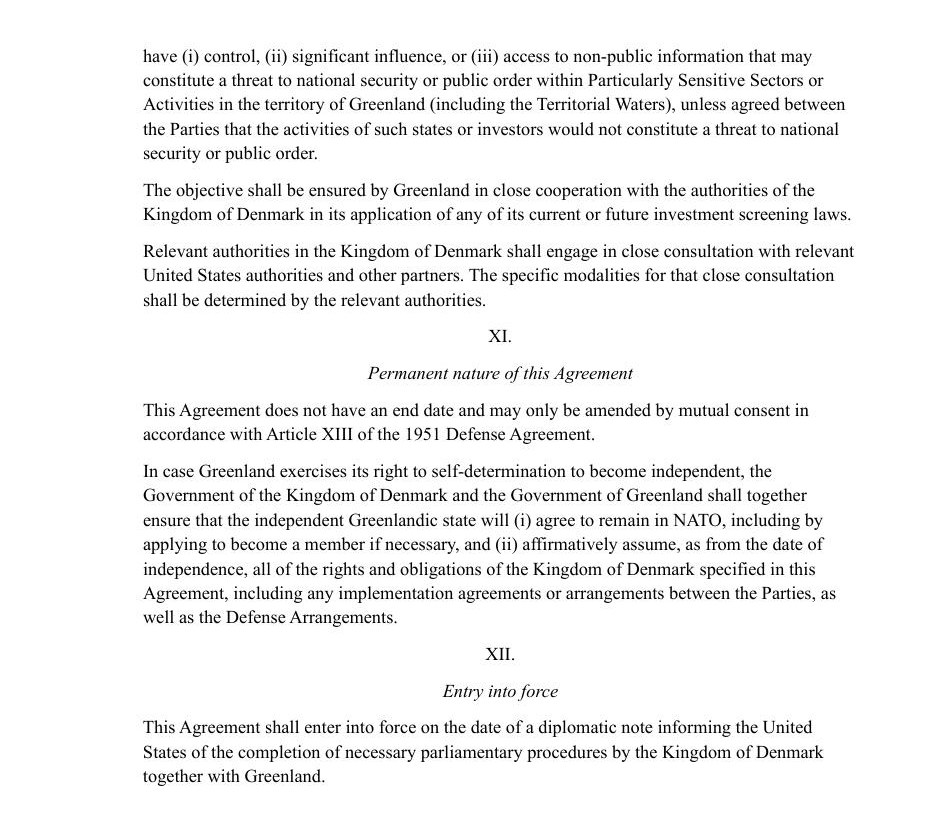
Read or download the full 10-page agreement (PDF) · original on um.dk
The second paragraph of Article XI covers what happens if Greenland breaks away. If Greenlanders choose independence, Denmark and Greenland "shall together ensure" that the new state will stay in NATO, "including by applying to become a member if necessary," and will take on every right and obligation Denmark carries under the agreement. A State Department official told ABC News the deal stays in effect "even if Greenland becomes a fully independent country." ABC noted that bringing Greenland in as a direct party, which it was not in 1951, appears designed to do exactly that.
Old Rights Restated, New Rights Added
Some of what was reported as new is really old language brought forward. Al Jazeera reported that the pact "permits US aircraft to fly over and land anywhere in Greenland." The 1951 treaty's Article V already said, nearly word for word, that "United States aircraft may fly over and land in any territory in Greenland, including the territorial waters thereof, without restriction except as mutually agreed upon."
Two changes in Article VI are new, though. The 1951 right of free movement between bases applied "in accordance with general rules mutually agreed upon and issued by the appropriate Danish authority in Greenland." That condition is gone from the 2026 text. The new text also adds that U.S. public vessels "may have undersea access to and movement within the Territorial Waters, without restriction except as mutually agreed." Put plainly, American submarines now have written permission to operate in Greenland's waters around an island that sits between North America and Europe.
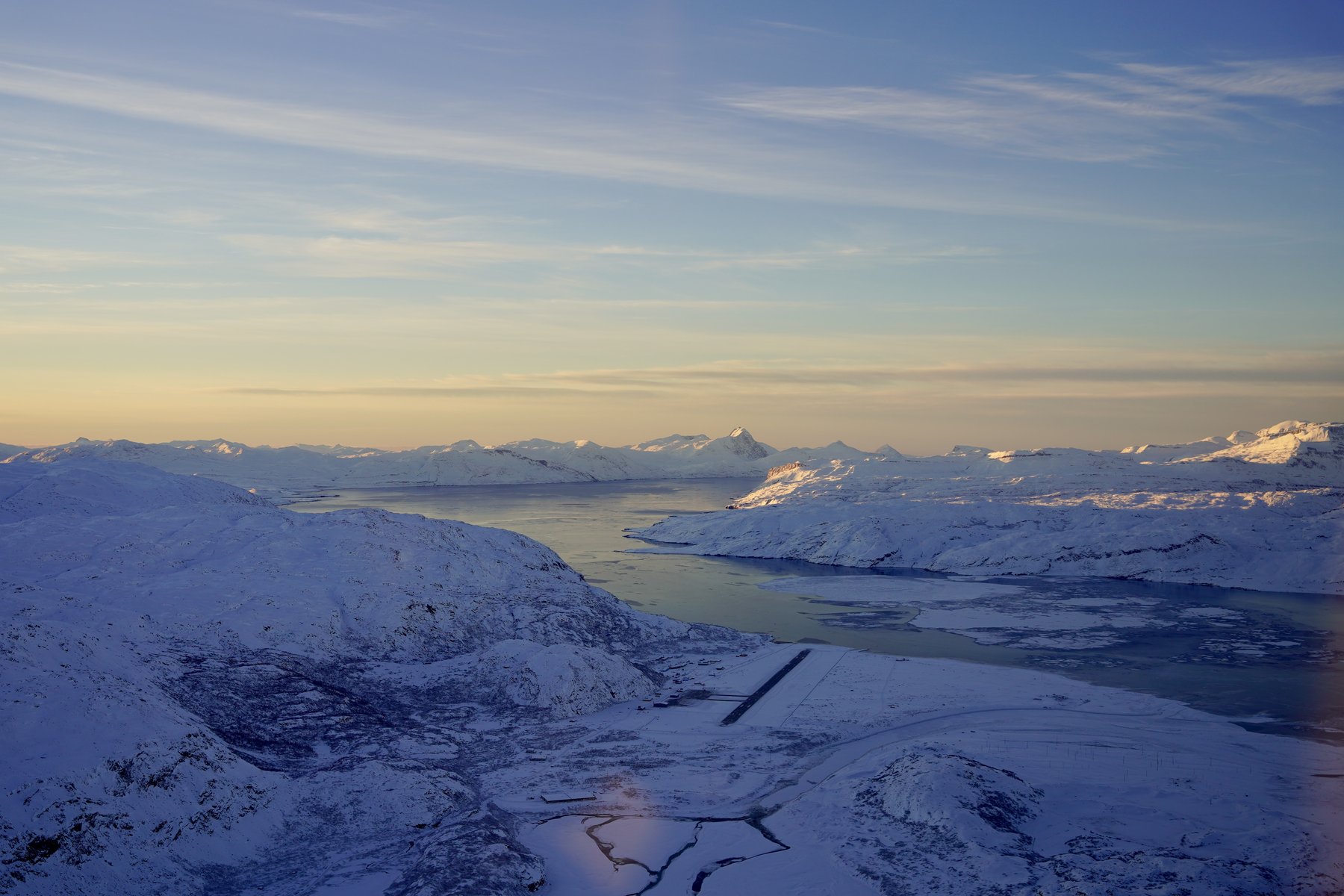
Narsarsuaq Airport in southern Greenland, a former U.S. air base and one of the two new defense areas named in the 2026 agreement, photographed in November 2020. (Photo by Mestersvig via Wikimedia Commons, CC BY-SA 4.0)
China and Russia Are Locked Out, on Paper
Article IX says no country outside NATO may build manned or unmanned military installations in Greenland, or keep a "persistent presence of military forces" there, "unless otherwise agreed by the Parties." Article X applies the same rule to money. Investors from any state that is not a NATO member, NATO partner or EU member may not gain control, significant influence, or access to non-public information in "Particularly Sensitive Sectors," a category the text defines to include critical infrastructure and resource extraction.
Article VII goes a step further on espionage. The U.S. can formally object to construction, or to a change of use, of any building near a defense area if it threatens the base, and the parties must then decide together how to deal with it. Trump summed up the effect at the signing: "No US adversary will ever be permitted to establish a military presence in Greenland any more, or make sensitive investments there without our express written approval," he said, according to Reuters. The text itself uses the phrase "unless agreed between the Parties" rather than "express written approval," but the practical result is the same: nothing gets through without Washington's consent.
Neither China nor Russia has significant active investments or a military presence in Greenland today, ABC News noted. The treaty keeps it that way.
The Catch: It Isn't in Force Yet
Article XII says the agreement takes effect only when Denmark and Greenland send the U.S. a diplomatic note confirming "the completion of necessary parliamentary procedures." The Danish and Greenlandic governments said the same in their joint statement ahead of the signing. That means votes in Denmark's parliament and in Greenland's. We could find no published date for either vote.

Greenland Prime Minister Jens-Frederik Nielsen (left) and Danish Prime Minister Mette Frederiksen at a joint press conference in the Prime Minister's Office in Copenhagen, January 2026, a file photo taken months before the deal. Both leaders must now carry the agreement through their parliaments. (Photo by Christian Ursilva via Wikimedia Commons, CC BY-SA 4.0)
Both leaders are publicly behind it. Frederiksen called it "a deal that can last forever," and Nielsen called it "a win-win-win," per Al Jazeera, which also reported that NATO Secretary-General Mark Rutte and European Council President Antonio Costa welcomed the pact. Secretary of State Marco Rubio called it "a huge win for the United States and the American people" that "permanently guarantees U.S. security interests in the Arctic at zero cost to the U.S. taxpayer," ABC reported.
Did Trump Get What He Wanted?
He did not get ownership. The preamble reaffirms "the sovereignty and territorial integrity of the Kingdom of Denmark," For months the press treated the purchase talk as the whole story, and some commentary has already asked whether the deal is more optics than substance.
Read the text and a different picture comes through. The United States gets new bases with a 90-day clock on future ones, submarine access in Arctic waters, a lock on Chinese and Russian military and investment access, a guarantee that survives Greenlandic independence, no expiration date, and the controlling language of the contract. In his UN speech the same morning, Trump said: "While others have talked, I have acted." On Greenland, the paperwork backs him up. What remains is two parliamentary votes, one in Copenhagen and one in Nuuk.