President Trump promised Monday that the United States would "hit them hard" after Iranian ballistic missiles flew at two American bases in Jordan. Hours later, in the Oval Office, he described the American military campaign as "very limited."
Both quotes are on the record, and neither is a slip. The military plan sitting unapproved on the president's desk reconciles them, and it is a far smaller thing than the first quote sounds.
What the president said, and when he said it
The first remark came by phone Monday morning to Fox News correspondent Trey Yingst, who relayed it. "We're going to hit them hard," Trump said. "There will be a response." ABC News logged the quote at 9:42 a.m. Eastern. CNBC rendered the same line as "We're going to hit them very hard."
The second came that afternoon in the Oval Office. Asked whether the resumption of American strikes meant a limited campaign or a return to full-scale war, Trump answered, "It's very limited," according to Breitbart News. NBC News reported the quote the same way. He called Iran a failed nation, said its navy and air force are gone, then added: "That doesn't mean we won't smack them. We'll see what happens."
CBS News correspondent Weijia Jiang used the same session to ask about a Washington Post report that senior officers worry a long Middle East campaign is draining American readiness elsewhere. Trump waved it off. "This is a relatively little war for us. This is not a big war," he said, in an exchange CBS filed at 5:11 p.m. Eastern.
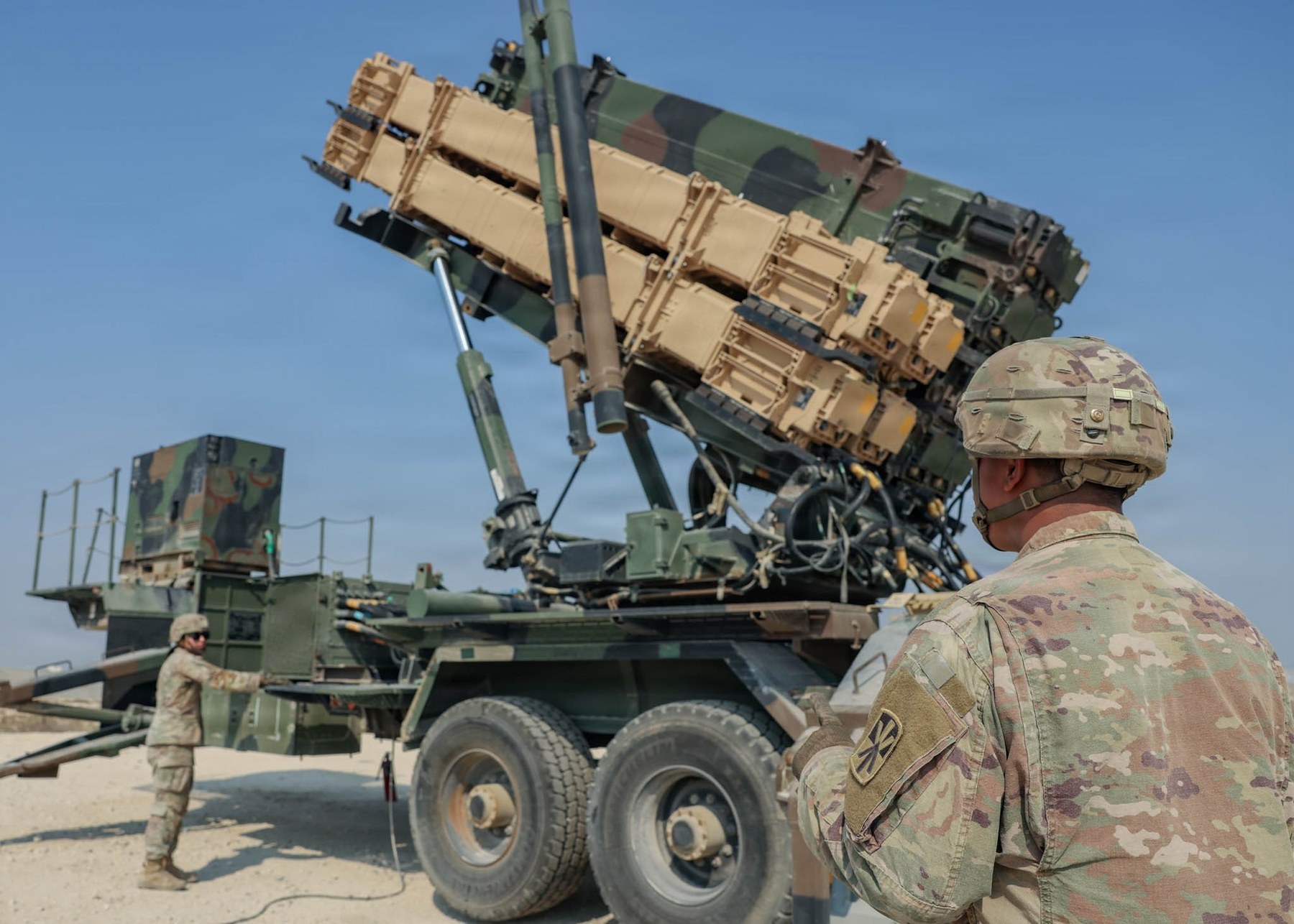
U.S. Army air defense artillerymen place a Patriot missile system into operation at an undisclosed location in the Middle East, Aug. 24, 2026. The Patriot is the Army's primary terminal-phase anti-ballistic missile system. U.S. Army photo via DVIDS, public domain.
The plan on his desk is maintenance, not punishment
Central Command spent the past week building an option for periodic strikes to stop Iran from rebuilding the radar and anti-ship missile capability it uses to threaten traffic around the Strait of Hormuz. Axios reported the plan, citing three U.S. officials, and said War Secretary Pete Hegseth backed it and sent it to the White House days before the weekend exchange. One official described the concept as mowing the lawn.
That is a narrow, repeating enforcement mission, not a punitive campaign, and the White House has not said whether the president signed off. "The President retains all options at his disposal," it told Axios. "The Iranians want to make a deal, but they are always a day late and a dollar short."
Vice President JD Vance drew the same distinction on the tarmac at Joint Base Andrews, telling reporters the president "would be the first to say he doesn't make announcements about military actions on social media." That followed Trump's Truth Social post claiming Kharg Island was being blown to smithereens, illustrated with AI video of a strike that never happened, which PatriotAddict covered on Monday.
Official record
U.S. Central Command public statement rejecting the IRGC's characterization of the Larak Island strike as an act of aggression, posted Aug. 31, 2026.
"U.S. forces took limited, precise action against IRGC minelaying forces posing an imminent threat in the Strait of Hormuz. In essence, Iran created the threat and the U.S. military eliminated it to protect civilian mariners, commercial shipping, and the free flow of global commerce." — U.S. Central Command
CENTCOM's confirmation of the strike itself came from a spokesman's written statement to news outlets rather than a formal release. Read the statement on the command's official account, or the full text as published by Stars and Stripes.
Four accounts of the same eight missiles
Jordan's version is the shortest one. An official spokesman for the Jordan Armed Forces said air defenses "intercepted and destroyed eight missiles" that violated the Kingdom's airspace early Monday morning, before they could threaten citizens or property. The statement never named Iran and never named a target.
Trump's version has a hole in it by design. He said American air defenses stopped all but one, and that the survivor "was identified as not going to hit anything significant, and they allowed it to pass through the airspace."
ABC News published a third account at 4:40 a.m. Eastern Monday, hours before the president spoke. Two Jordanian security sources told the network some of the missiles were not intercepted, that there were no casualties, and that they would not say where those missiles came down. A U.S. official told Stars and Stripes there were no impacts at American bases. CENTCOM has said nothing about the intercepts at all.
None of those accounts calls another a lie, and all of them hold together if the missiles that got through landed in empty desert. What the record still lacks is a single named American official, on the record, saying where eight ballistic missiles ended up.
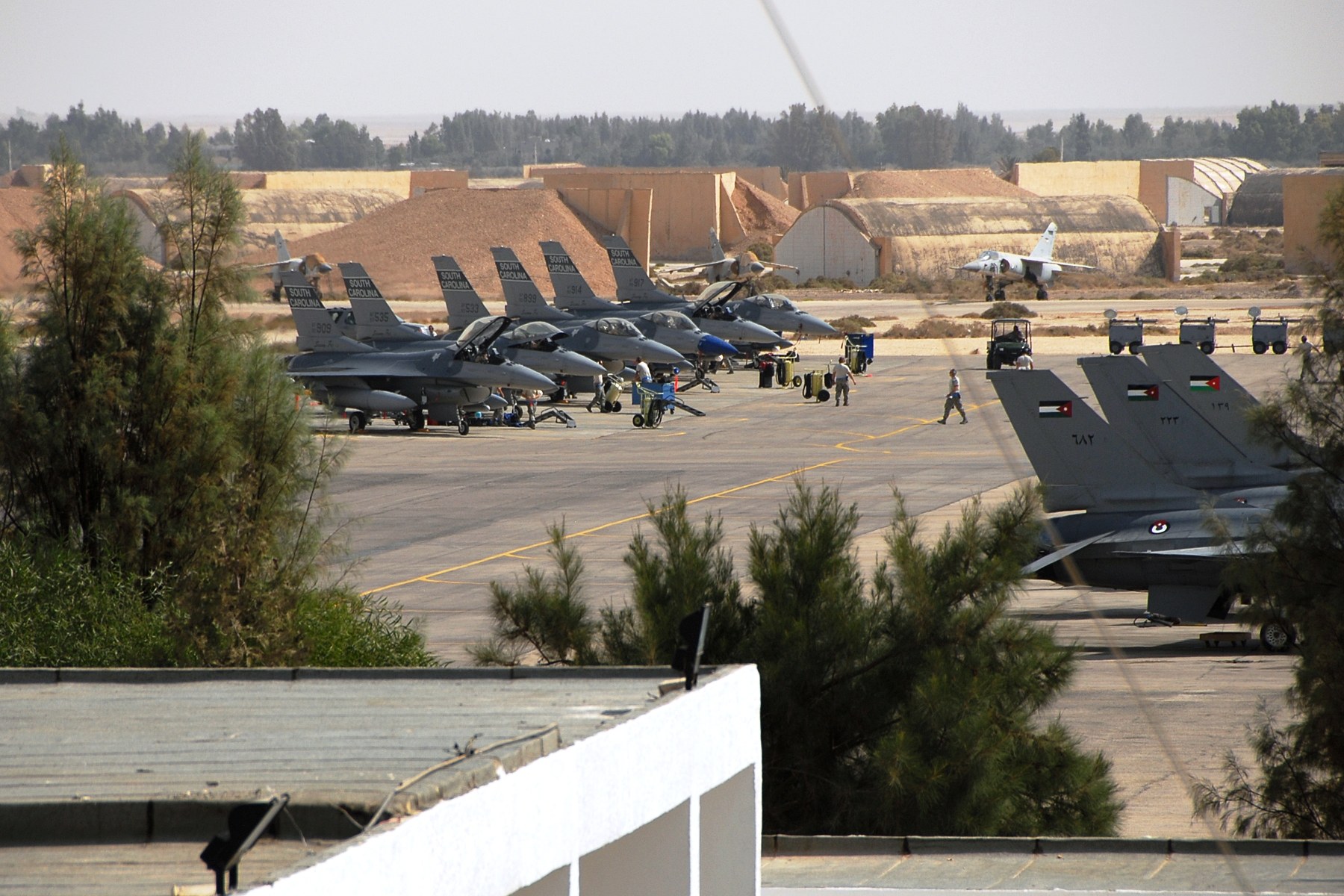
F-16 Fighting Falcons of the Jordanian and U.S. air forces at Muwaffaq Salti Air Base in Azraq, Jordan, Oct. 20, 2009. Iran's Revolutionary Guard named this base and King Hussein Air Base as its targets Monday. File photo by Caycee Cook, U.S. Air Force, public domain.
Azraq is not an abstraction to American families
The Revolutionary Guard named King Hussein Air Base and the Al Azraq base, better known as Muwaffaq Salti, and told Iran's state news agency its missiles hit maintenance infrastructure and areas "where enemy fighter jets were stationed," inflicting "heavy damage." Iran's army separately claimed drones hit Al Minhad Air Base outside Dubai, which the Emirati defense ministry denied.
Six weeks ago an Iranian attack on that same Jordanian base killed Pvt. Isabella Gonzales, 19, and Sgt. Angel Rampersad, 28, both assigned to the 10th Army Air and Missile Defense Command. 1st Lt. Tyler Feehan, 25, of the 32nd Army Air and Missile Defense Command died the following day of wounds from the same attack. The Pentagon's running count for the war stands at 18 killed and 759 wounded in action.
Families of the 82nd Airborne Division got their own news over the weekend. About 2,000 soldiers from the division deployed to the region in March, and families have now been told the deployments are expected to last up to 12 months, running into 2027. "We do not share that lightly, and we understand that a longer tour weighs heavily on every household, including our own," Maj. Gen. Brandon Tegtmeier and Command Sgt. Maj. James Bradshaw wrote in a letter to families obtained by CBS News.
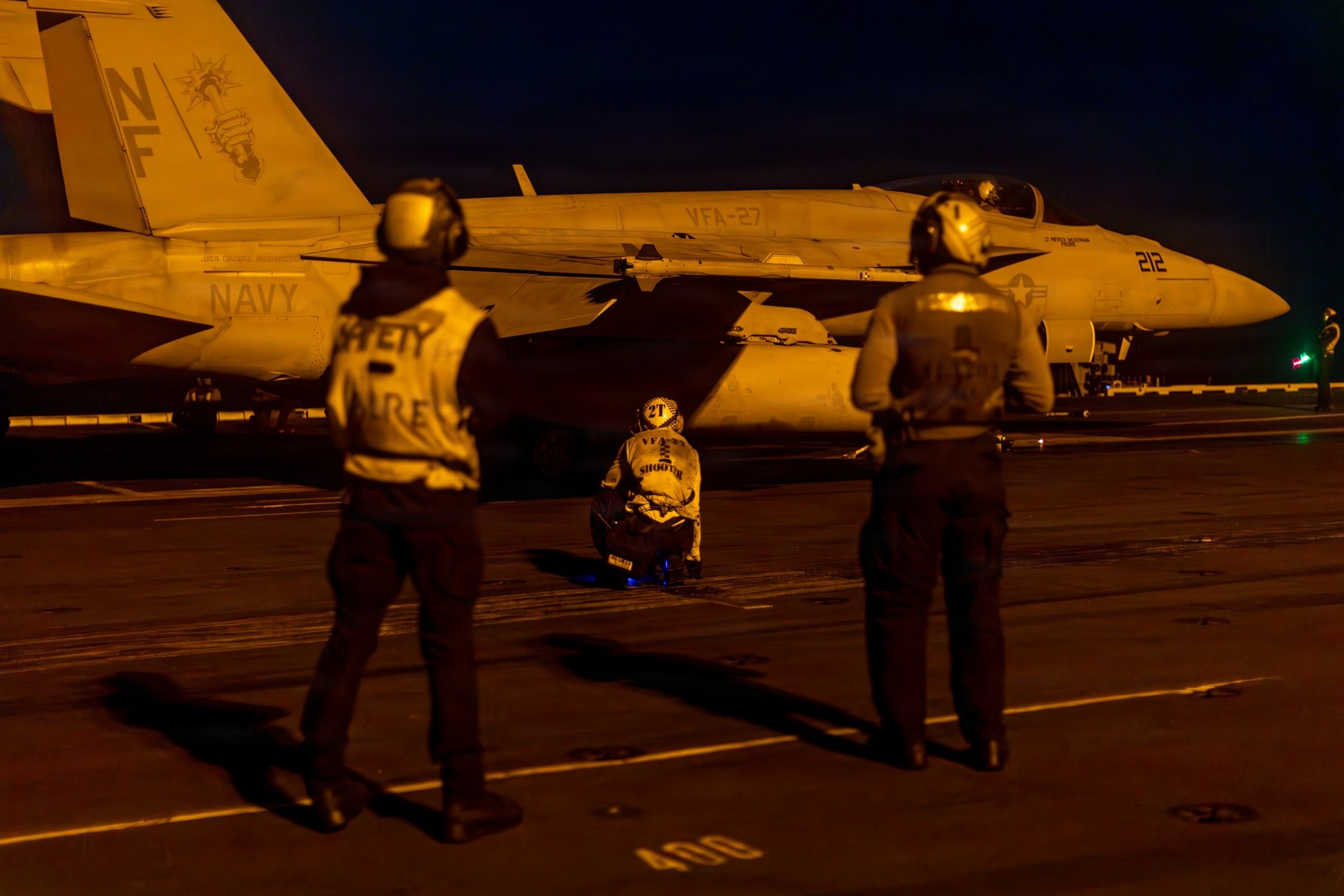
Sailors conduct pre-flight checks on an F/A-18 Super Hornet attached to Strike Fighter Squadron 27 aboard the carrier USS George Washington in the U.S. 5th Fleet area of operations, Aug. 28, 2026. U.S. Navy photo via DVIDS, public domain.
A limited war is still costing money at the pump
Two crude oil tankers were struck by projectiles minutes apart Monday evening while leaving the Persian Gulf, one Saudi-flagged and one South Korean-owned, according to the Greece-based maritime risk firm Marisks. The U.K. Maritime Trade Operations Center put the incident 17 nautical miles east of Khasab, Oman, inside the southern corridor the administration says is open and safe. Brent crude traded above $92 early Tuesday, up more than 2 percent for a second straight session.
Trump meets refiners and fuel distributors Tuesday afternoon over pump prices, with Interior Secretary Doug Burgum and Energy Secretary Chris Wright in the room. GasBuddy put the national average for regular at $4.01 on Monday, four cents below the prior week and still a midterm problem for Republicans.
"Hit them hard" and "very limited" describe one policy from two ends. The first is aimed at Tehran and at voters who want the missiles answered. The second is aimed at the officers who keep answering them with a force whose deployments now run into 2027. As of Tuesday morning the response is still a promise and the plan for delivering it is still sitting at the White House, while two more tankers have been hit in a corridor the administration calls safe.