Army Secretary Dan Driscoll resigned Monday effective Sept. 3, and the White House confirmed the departure without giving a reason. Driscoll ran the Army for 18 months. He leaves it with no confirmed civilian secretary and, since Pete Hegseth fired Gen. Randy George in April, no confirmed uniformed chief of staff either.
What the White House said, and what it left out
The confirmation came from White House spokeswoman Anna Kelly, who praised Driscoll's record and offered nothing about why he is going. Kelly said Driscoll "has been highly effective in advancing President Trump's agenda to Make America Strong Again at the Department of the Army," citing his role in the Russia and Ukraine negotiations, according to the Associated Press account carried by NPR. The Pentagon referred questions to the Army.
Two of the most-repeated details in Monday's coverage are not on the record. The Sept. 3 effective date comes from a source with knowledge of Driscoll's actions who spoke to Military Times, not an official announcement. The account that Driscoll spoke with President Trump about the state of the Army before resigning comes from an Army official not authorized to speak publicly. The resignation letter has not been released, and no outlet has published its text.
Which generals were actually fired, and when
On April 2, 2026, Hegseth removed Army Chief of Staff Gen. Randy George and asked him to retire immediately. The same shake-up took down Gen. David Hodne, who commanded the Army's Transformation and Training Command, and Maj. Gen. William Green, the Army chief of chaplains, as ABC News reported from Driscoll's April 16 budget testimony. No public explanation was given for any of the three.
Gen. Christopher Donahue, commander of U.S. Army Europe and Africa, left his post unexpectedly in June. Gen. James Mingus, the Army's vice chief of staff, is counted by Military Times among the firings and early departures under Hegseth. Defense One reports that Hegseth pushed out or removed all four of the uniformed leaders closest to Driscoll's reform push.
Driscoll's reaction to the George firing is on the record, and it is worth reading against Monday's anonymous sourcing. "We walked right in, and we all gave him a hug," he told the House Appropriations defense subcommittee, describing driving to George's house after hearing the news. "He was an amazing, transformational leader. That being said, the civilian leadership, the design of our system, is that they get to pick the leaders that they want, and we execute on those orders."
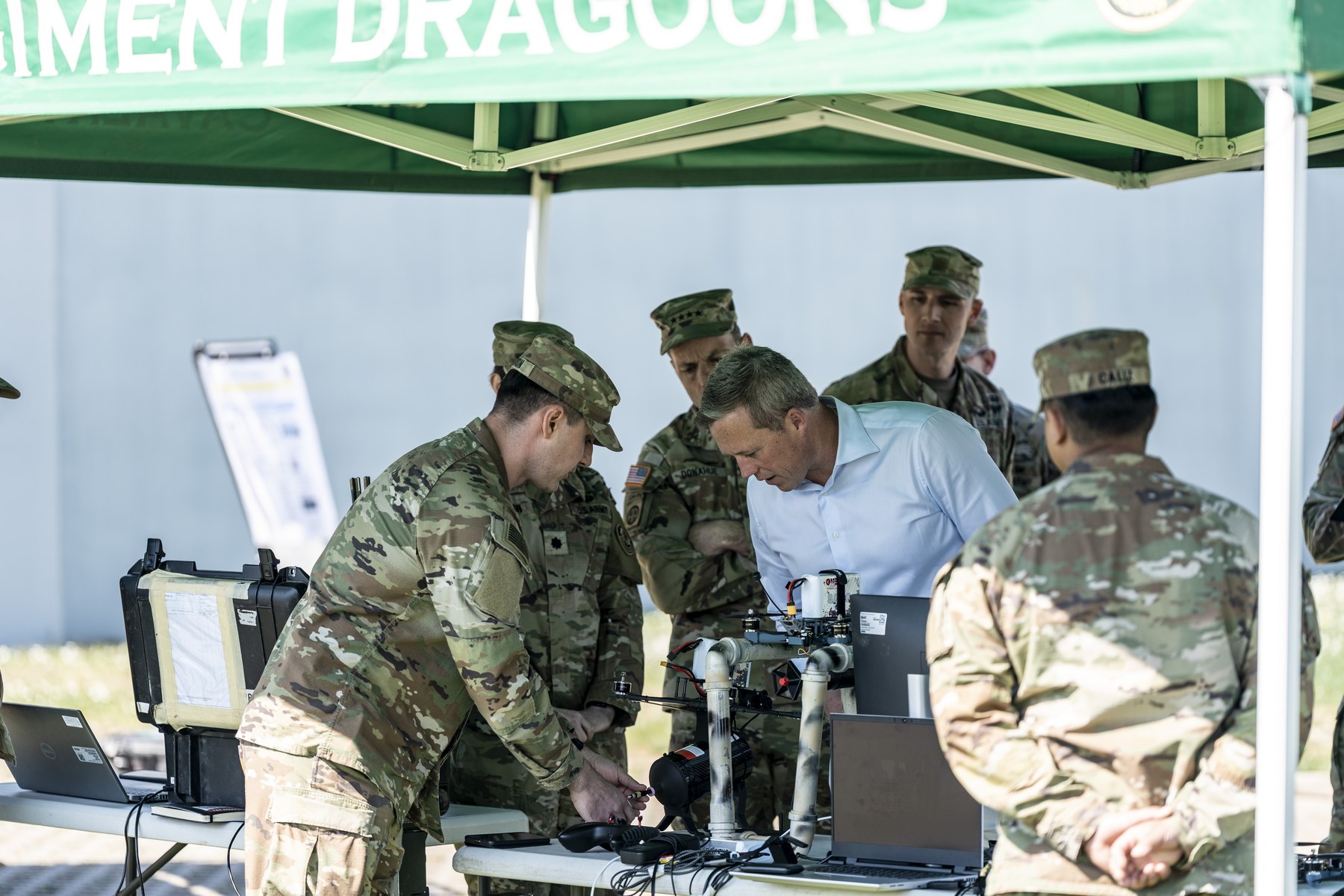
Driscoll, in the light shirt, inspects a 2nd Cavalry Regiment display of Transformation in Contact equipment during a meeting with Gen. Christopher T. Donahue, then commanding general of U.S. Army Europe and Africa, at Clay Kaserne, Germany, April 9, 2025. Donahue, visible at center with the four-star cap, relinquished command in June 2026. U.S. Army photo by Staff Sgt. Samuel Kim, public domain, via Wikimedia Commons.
What "Army transformation" actually refers to
The phrase is not vague. It names a specific program with a specific paper trail. On April 30, 2025, Hegseth signed a memorandum titled "Army Transformation and Acquisition Reform" ordering the Army secretary to restructure the force and shut down what it calls redundant headquarters and obsolete programs. Driscoll and George answered it the next day with a Letter to the Force published on army.mil that created the Army Transformation Initiative.
What followed was structural. Army Futures Command and Training and Doctrine Command merged into the Transformation and Training Command on Oct. 1, 2025, the four-star headquarters Hodne was running when Hegseth fired him. Forces Command was folded into the new Western Hemisphere Command that December. Fourteen infantry brigade combat teams are converting to mobile brigade combat teams, and procurement of the AH-64D and the Gray Eagle drone was cancelled.
Official record
Congressional Research Service Report R48606, "2025 Army Transformation Initiative (ATI) Force Structure and Organizational Proposals: Background and Issues for Congress," updated May 21, 2026, 20 pages.
"On May 1, 2025, in response to the Secretary of Defense's (War's) directive, Secretary of the Army Dan Driscoll and General Randy George, Chief of Staff of the Army published a 'Letter to the Force: Army Transformation Initiative' to implement 'a comprehensive transformation strategy,' referred to as the Army Transformation Initiative, or ATI." — CRS Report R48606, page 2
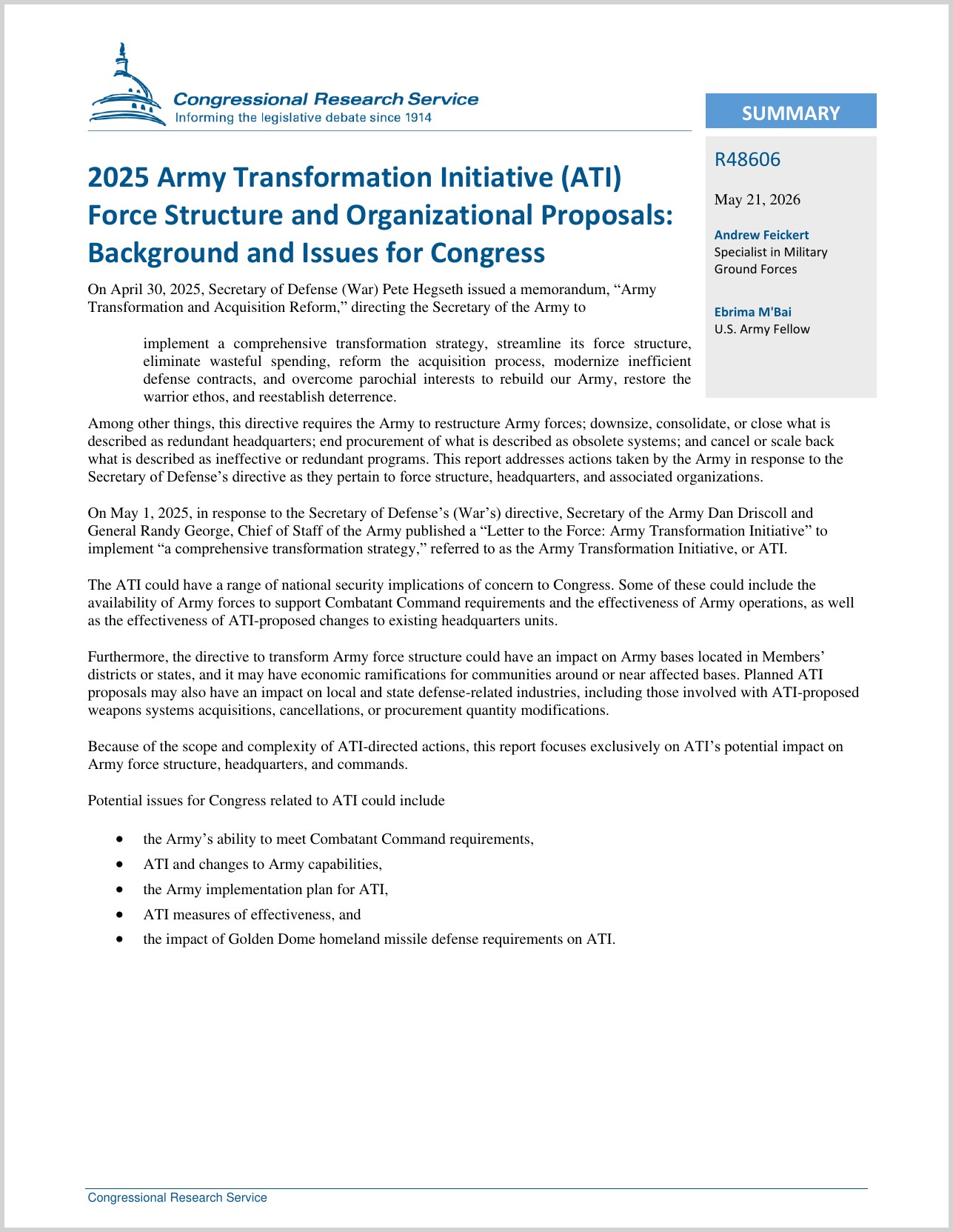
Read or download the full 20-page document (PDF) · official source at congress.gov
Hegseth said publicly in May that he wanted another look at it
The friction over transformation was visible on the record months before Monday. Asked about Army helicopter procurement at a May 12, 2026 House Appropriations subcommittee hearing, Hegseth said "there are some very good things in the Army Transformation Initiative, and there are some things that we needed to get another look at." The Congressional Research Service records that remark and Driscoll's response, citing Defense One's reporting from the hearings.
Driscoll's answer to the House Armed Services Committee three days later reads as a man absorbing a public correction. "I don't know all the depth of what was implied," he said, "but I absolutely agree that we will take a hard look with the Office of Secretary of War and make sure that we are synced with their strategy and their plans." CRS notes it is still not known whether any formal review was undertaken.
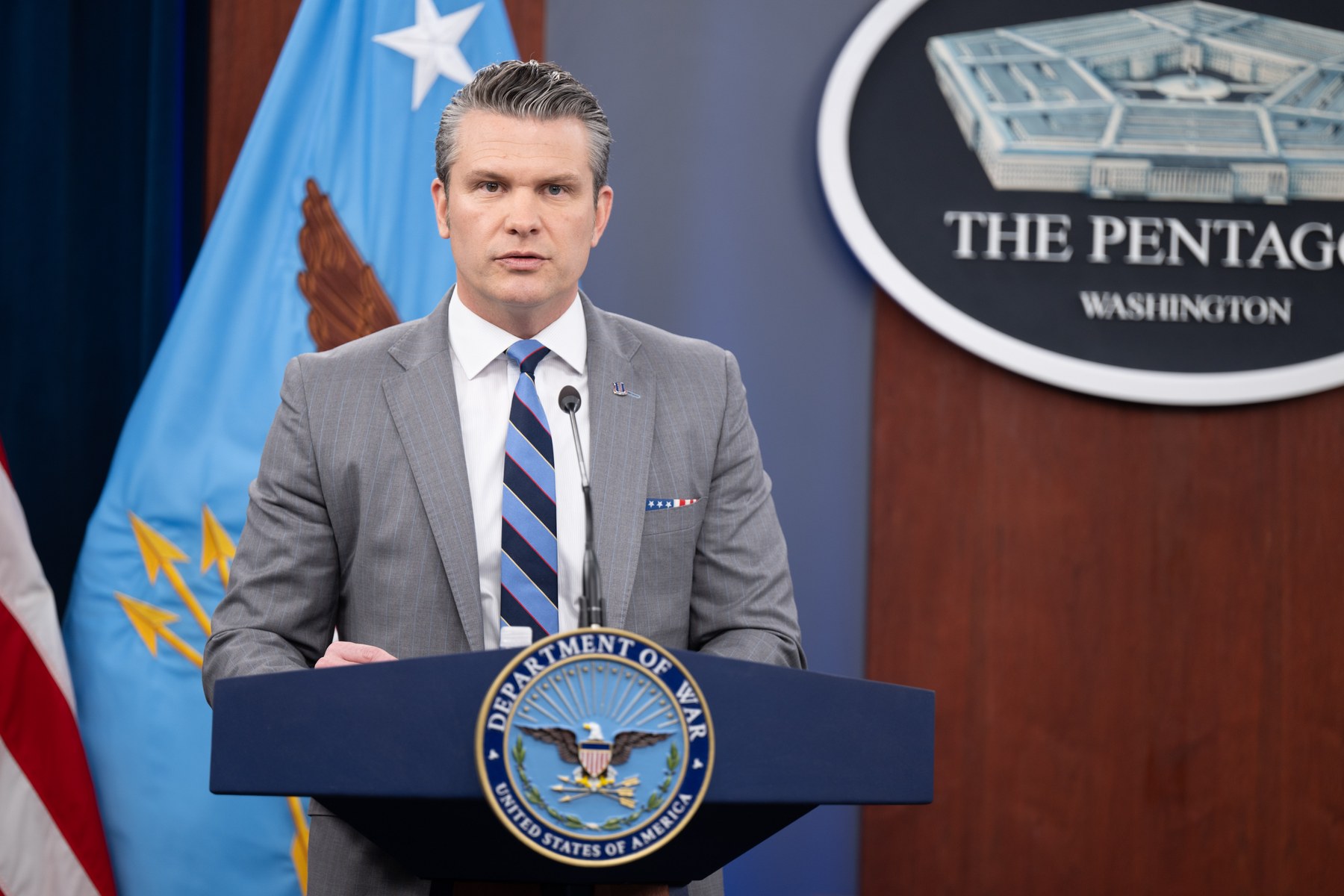
Defense Secretary Pete Hegseth, who uses "Secretary of War" as a secondary title under Executive Order 14347, at a Pentagon press briefing on April 24, 2026, three weeks after removing Army Chief of Staff Gen. Randy George. Department of Defense photo, public domain, via Wikimedia Commons.
The claim that Hegseth blocked transformation rests on one unnamed source
Here is where readers should slow down. Defense One reported that a source directly familiar with the matter said this: "Driscoll brought up concerns with the administration surrounding Army transformation and readiness, and Hegseth's blocking those efforts, specifically by firing the generals who were responsible." That single sentence is the origin of most of the framing now circulating.
It is one anonymous source, and Defense One presented it as such. Neither man has said any of it publicly. What is verifiable is narrower and still striking: after George was removed, acting chief Gen. Christopher LaNeve directed a Europe-based battalion that had been building its own drones on Ukrainian lessons to stop and revert to conventional infantry.
Sean Parnell is the name in circulation, and the Senate is the obstacle
Multiple outlets report that Hegseth favors Sean Parnell, the Assistant Secretary of Defense for Public Affairs, as the replacement. No nomination has been sent to the Senate. Parnell is the same official who told ABC News in April that reporting on colonels pulled from a general officer promotion list was "a distraction," which gives the Senate Armed Services Committee an obvious line of questioning if his name is ever submitted.
Driscoll was confirmed 66-28 in February 2025 after a hearing that drew little conflict. He served as an armor officer from August 2007 to March 2011 and deployed to Iraq from October 2009 to July 2010, according to the Army. Gun owners have a second reason to know his name: he took over as acting director of the ATF in April 2025, replacing FBI Director Kash Patel, as Stars and Stripes reported at the time, and Military Times says he held the dual role until April.
Two empty chairs at the top of the Army
Reaction crossed party lines, which is unusual for a Hegseth-era departure. Rep. Steve Womack, an Arkansas Republican and Army National Guard veteran, called Driscoll "a transformative leader who brought common sense and discipline to the Department of the Army." Rep. Jason Crow, a Colorado Democrat and former Army Ranger, said the Pentagon is "in some cases, rudderless" with so many senior leaders gone.
Sen. Jack Reed of Rhode Island, the ranking Democrat on the Senate Armed Services Committee, praised Driscoll's candor with Congress, then went after Hegseth directly, saying he "is cultivating a culture where dissent is punished and competence is secondary to personal allegiance." That is a partisan charge from the minority, and it should be read as one.
The arithmetic underneath the politics is not partisan. The Army's top uniformed job has been filled on an acting basis since April 2, with no nominee sent forward. Come Sept. 3, the civilian job is open too, and filling it permanently runs through a Senate floor vote that has not been scheduled because no name has been submitted.