President Trump's lawyers gave the Center for American Progress until 5 p.m. Friday to retract a July report on his National Guard deployments or face a $5 billion defamation suit. The think tank refused. The deadline came and went, and the report is still up.
What the letter actually demanded
The nine-page cease-and-desist letter went out Monday, August 17, under the signature of Alejandro Brito, the Miami lawyer who has handled most of Trump's defamation litigation against news organizations. It told the Center for American Progress to "immediately retract the false, malicious, and defamatory statements made about President Trump," according to the Associated Press, and warned that failure to do so would leave the president seeking remedies for "overwhelming financial and reputational harm that Defendants have caused him to suffer."
The demand was not just a retraction. Per NOTUS, which reviewed the letter, Brito wanted a retraction, an apology to the president, and compensation, by 5 p.m. Friday, or a suit for at least $5 billion. CBS News obtained both letters and confirmed the same terms.
Brito's core theory is worth quoting in full, because it is more careful than the headline number suggests. "Defendants did not merely draw a different academic conclusion; they defamed President Trump by distorting a contested empirical question into a sensational, false, malicious and defamatory accusation that President Trump knowingly lied to the American people," he wrote. The letter also accuses CAP of having "manufactured" data.
What the CAP report actually says
The report is "The Trump Administration's $1.7 Billion National Guard Deployments Fail To Reduce Urban Crime," published July 13 and written by Chandler Hall, CAP's associate director for public safety. It runs three separate interrupted time-series models against monthly violent crime rates, weekly homicide rates and weekly gun victimization rates in Los Angeles, Washington, Memphis and New Orleans, using the Real-Time Crime Index, the Gun Violence Archive and city-reported data from January 2023 through February 2026.
Its conclusion: the deployments "had no measurable effect on violent crime, homicides, or gun victimizations." The sentence Brito singled out is this one: "In an effort to falsely claim his policies have reduced crime, the president is exploiting the fact that violent crime and murder were already declining in the cities his administration targeted with these extreme interventions."
The factual backbone of that claim is a real number. Across the 11 cities where the Guard was deployed or threatened, CAP found a 14 percent drop in the 12-month rolling violent crime rate and a 22 percent drop in the murder rate between June 2024 and June 2025, before a single soldier arrived in Los Angeles.
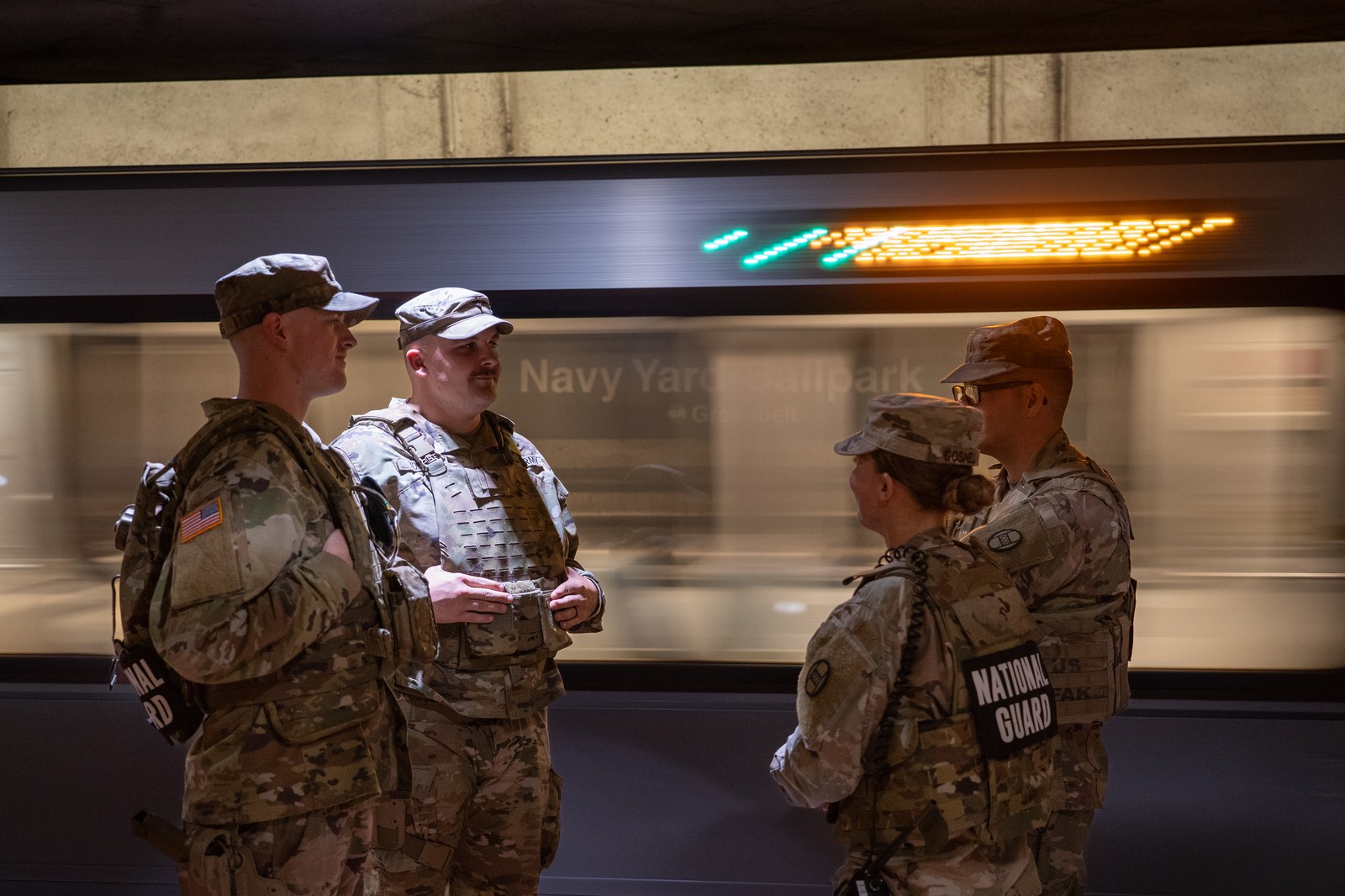
South Carolina Army National Guard soldiers patrol the Navy Yard Ballpark Metro station in Washington on Sept. 8, 2025, in support of Joint Task Force District of Columbia. About 2,300 Guard members were assigned to the mission at its peak. (Photo by Sgt. Ian Doyle, U.S. National Guard, public domain)
The numbers on the other side are real too
Here is the part CAP's defenders skip. In the first 19 days of the D.C. surge, a CBS News analysis of every incident reported to the Metropolitan Police Department from Aug. 7 through Aug. 25, 2025 found violent crime down by almost half against the same 19 days in 2024, with burglaries down 48 percent and car thefts down 36 percent. CBS also found that federal deployments were concentrated in higher-crime areas, not the safe tourist corridors some outlets claimed, with overall crime near deployment sites running nearly three times the citywide average.
And on August 14 of this year the FBI released its 2025 Uniform Crime Report showing an 18.1 percent drop in the murder rate, a 20-year low, along with robbery down 18.5 percent and motor vehicle theft down 22.7 percent. Trump called it "the single largest reduction in violent crime in American history." He is not making that up. The FBI's own release says it.
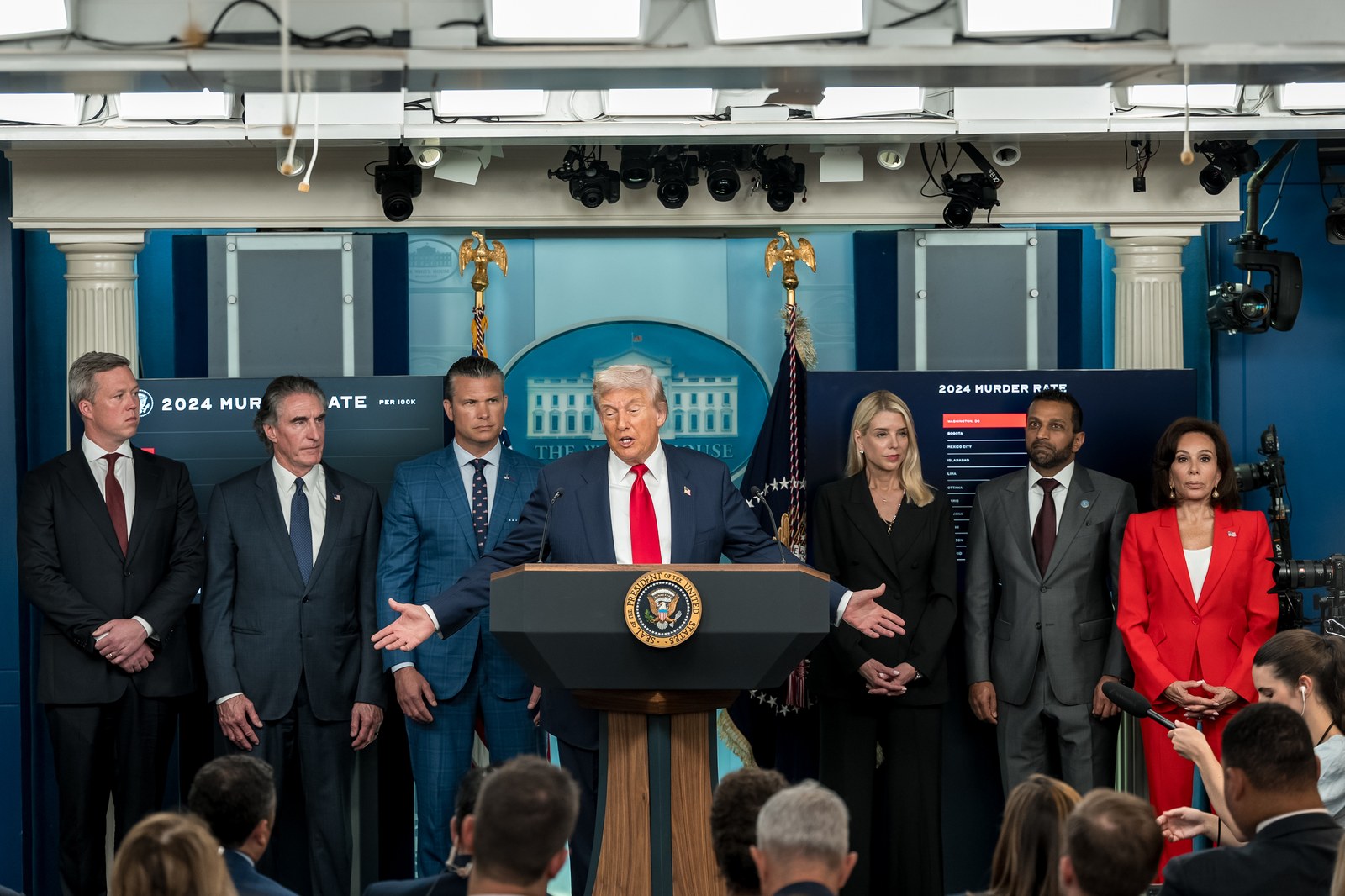
Trump at the Aug. 11, 2025 briefing where he declared a crime emergency in Washington and federalized the city's police force, flanked by "2024 Murder Rate" placards putting D.C. at the top. (Official White House photo by Abe McNatt, public domain)
Both sides are describing the same graph
The honest read is that the argument is about attribution, not arithmetic. Violent crime is down almost everywhere, including in cities that never saw a Guardsman. Adam Gelb, who runs the nonpartisan Council on Criminal Justice, put it about as plainly as anyone has: "The homicide drop is historic and crystal clear. But right now, what's driving it is about as clear as a glass of milk."
Jeff Asher of AH Datalytics, whose numbers both sides quote when convenient, called 2025 "the third straight year of a record drop in murder." That is a trend line that starts in 2023, under a different president, and it is the single strongest fact CAP has.
CAP's own report is more hedged than its title. It concedes that other federal surges ran alongside the Guard deployments and would be credited to the Guard by its models anyway, that its control cities are not a clean counterfactual, and that "across all stages of the analysis, only one city in one model produced a statistically significant result associated with a reduction in violent crime." That city was Memphis, and CAP says the drop there was erased within two months and that the case "lacks necessary external validity." A think tank that writes that about its own best result is not manufacturing data. It is showing its work.
But the D.C. crime data has a real credibility problem
Two of CAP's three models lean on Washington. One of them pulls weekly homicide counts straight from MPD's public crime data. That matters, because MPD's crime reporting has been under investigation by the Justice Department, the House Oversight Committee and the department's own internal affairs division for the better part of two years.
NOTUS reported that a 554-page internal affairs investigation led to proposed firings of 13 top police officials, several of them accused of pressuring officers to classify violent assaults, robberies and thefts as lesser offenses. House Oversight Chairman James Comer noted that MPD "recently entered into a settlement agreement related to allegations that senior MPD officials were engaged in falsifying crime statistics to artificially lower reported crime rates," a quote carried in Judicial Watch's announcement of its own FOIA lawsuit against the District, Judicial Watch Inc. v. District of Columbia, No. 2025-CAB-006701. Judicial Watch is a conservative group, and it is suing over exactly this.
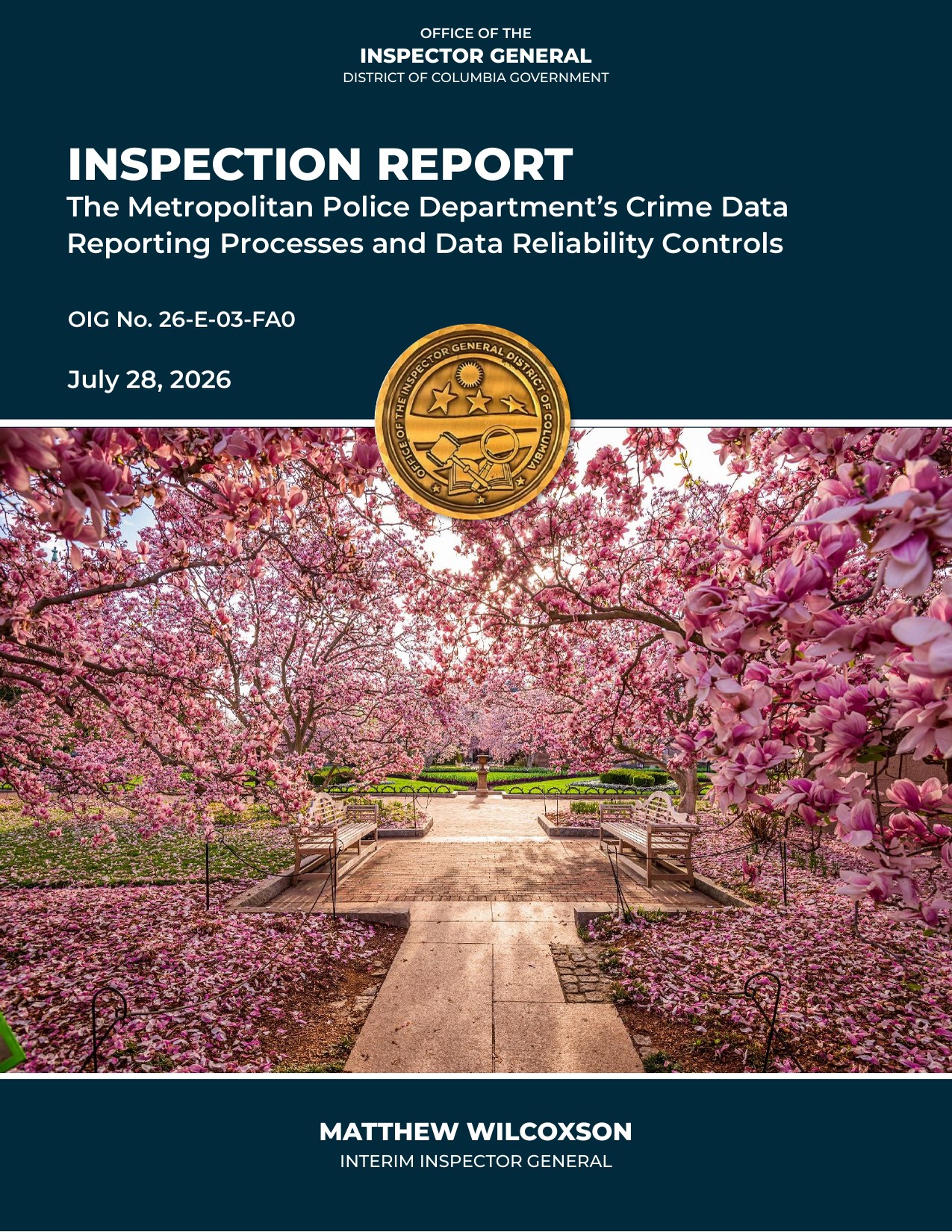
Cut both ways honestly and it lands here: the inspector general found the machinery that produces D.C.'s crime numbers was broken for a decade, which is a legitimate reason to distrust the inputs to anyone's model, CAP's included. It also found no fraud, and homicides, the metric CAP leaned on hardest in Washington, are the hardest category to quietly reclassify. A body is a body.
Is CAP a neutral referee? No, and it does not have to be
CAP calls itself "an independent, nonpartisan research organization." That description is doing some work. The organization was built as the progressive answer to the Heritage Foundation, it runs a 501(c)(4) sister group, the Center for American Progress Action Fund, and its president came back to the job in 2025 after serving as Joe Biden's staff secretary and then his domestic policy adviser running the White House Domestic Policy Council.
Readers are entitled to weigh that. A report from Biden's former policy chief concluding that Trump's signature public safety initiative accomplished nothing is not arriving from nowhere, and anyone who would apply that skepticism to a Heritage study should apply it here.

Neera Tanden speaking at the Center for American Progress Action Fund, the organization's 501(c)(4) political arm. She led CAP from 2011 to 2020, served as Biden's staff secretary and domestic policy adviser, and returned as president and CEO in 2025. (Photo by Shawn T. Moore, U.S. Department of Labor, public domain)
Tanden's answer is not that CAP has no politics. It is that the finding is either right or wrong on the numbers. "Based on analysis of crime data, our report demonstrated facts about the National Guard deployments that are inconvenient to the Trump administration," she said in CAP's public response. "A lawsuit is a transparent attempt to silence us. We will neither cower nor bend in the face of it."
The legal problem with the threat is enormous
Set the politics aside. As a lawsuit, this is very hard to win, and conservatives should want it that way. Trump is a public official suing over a statistical conclusion about his own policy. That means New York Times v. Sullivan, and it means proving actual malice.
"The official has to show that the defendant made the statement at issue with actual malice, which means they knew the statement was false, or they acted in reckless disregard of its falsity," Loyola Law School professor Jessica Levinson told CBS News. "It's very unlikely that a dispute about statistics would give rise to a defamation claim." She also flagged a second hurdle: Trump would have to show the statements are about him personally rather than general criticism of his administration.
CAP general counsel Kevin Metz made the same point in one line, and it is legally sound: the defamation allegation "is utterly absurd: truth is not and cannot be defamation. The legal standards here are clear, well-established, and speech-protective." A three-model regression analysis with a published methodology appendix and a stated limitations section is close to the hardest possible target for a falsity claim. Metz also noted that CAP would welcome discovery, which would put the administration's own deployment records in play.
Kevin Goldberg of the Freedom Forum told the AP that threats like this one are made "for the purpose of trying to push someone into submission rather than actually on the merits of compensating Donald Trump for any harm that might have been caused." Brito's record makes that a fair reading of the strategy: he won a $15 million settlement from ABC News and, per Florida Bulldog, has built a practice around suing media giants on the president's behalf. Settlements, not verdicts, are the business model.
This is not the New York Times case, and the difference matters
Two days before this letter became public, an Alabama jury handed The New York Times a $9.25 million defamation loss, which we covered on August 22. Kai Spears was an 18-year-old walk-on the paper placed in a car at a murder scene he was blocks away from, on a single anonymous source, and then defended for months. That is a false statement of verifiable fact about a private individual. It is what defamation law was built for.
This is a different animal. A think tank ran regressions on public crime data and concluded a policy did not work. Nobody is accusing anyone of being at a homicide. If the two cases collapse into one category in the public mind, the Spears verdict gets weaker, not stronger, because the standard that let an Alabama jury hold a newspaper accountable is the same standard that makes a $5 billion suit over a scatterplot go nowhere.
Where it stands
Trump had already gone after the report himself, calling it "just another Radical Left SCAM" in a Truth Social post earlier this month. The Friday deadline passed with no retraction, no apology and no payment. Brito could not be reached by the AP, and no complaint has been reported filed.
Meanwhile the underlying fight over whether the deployments are worth it continues on its own terms. Washington is now looking at a roughly $1.4 billion extension of the Guard mission through 2029. That is a debate about money and results, and it is a debate the administration can win on the numbers if the numbers are on its side. Threatening to bankrupt the people running the regressions is not how you demonstrate that they are.