Three of the largest gun rights groups in the country sued New York on August 13 over a law that turns selling a factory stock Glock into a felony carrying up to seven years in prison. Nothing has been struck down. Nothing has been blocked. What exists right now is a 17-page complaint and a docket number, and the ban itself does not bite until May 31, 2027.
The Second Amendment Foundation, the National Rifle Association and the Firearms Policy Coalition filed jointly, along with a licensed dealer and two private citizens. SAF announced the filing on August 14, FPC the day before, and NRA-ILA the same morning as SAF. Read past the press releases and the case is narrower, slower and more interesting than the headlines suggest.
New York did not ban a gun. It banned a part.
The law is Chapter 55 of the Laws of 2026, Part C, Subpart A, tucked into the public protection budget bill S9005C and signed by Gov. Kathy Hochul on May 27. It never says the word Glock. It defines a new category called a "convertible pistol" and then makes selling one a crime.
Under the amended Penal Law section 265.00(37), a convertible pistol is "any semi-automatic pistol with a cruciform trigger bar that can be readily altered by hand or with common household tools so that it can be converted into a machine-gun by the installation or attachment of a pistol converter." A cruciform trigger bar, in turn, is a linkage between the trigger and the firing pin "with its sear incorporated in a cross-shaped surface." The statute even lists what counts as a household tool: screwdrivers, pipe wrenches, pliers, hacksaws, crowbars, electric drills or rotary tools, hammers, chisels, files, crescent wrenches.
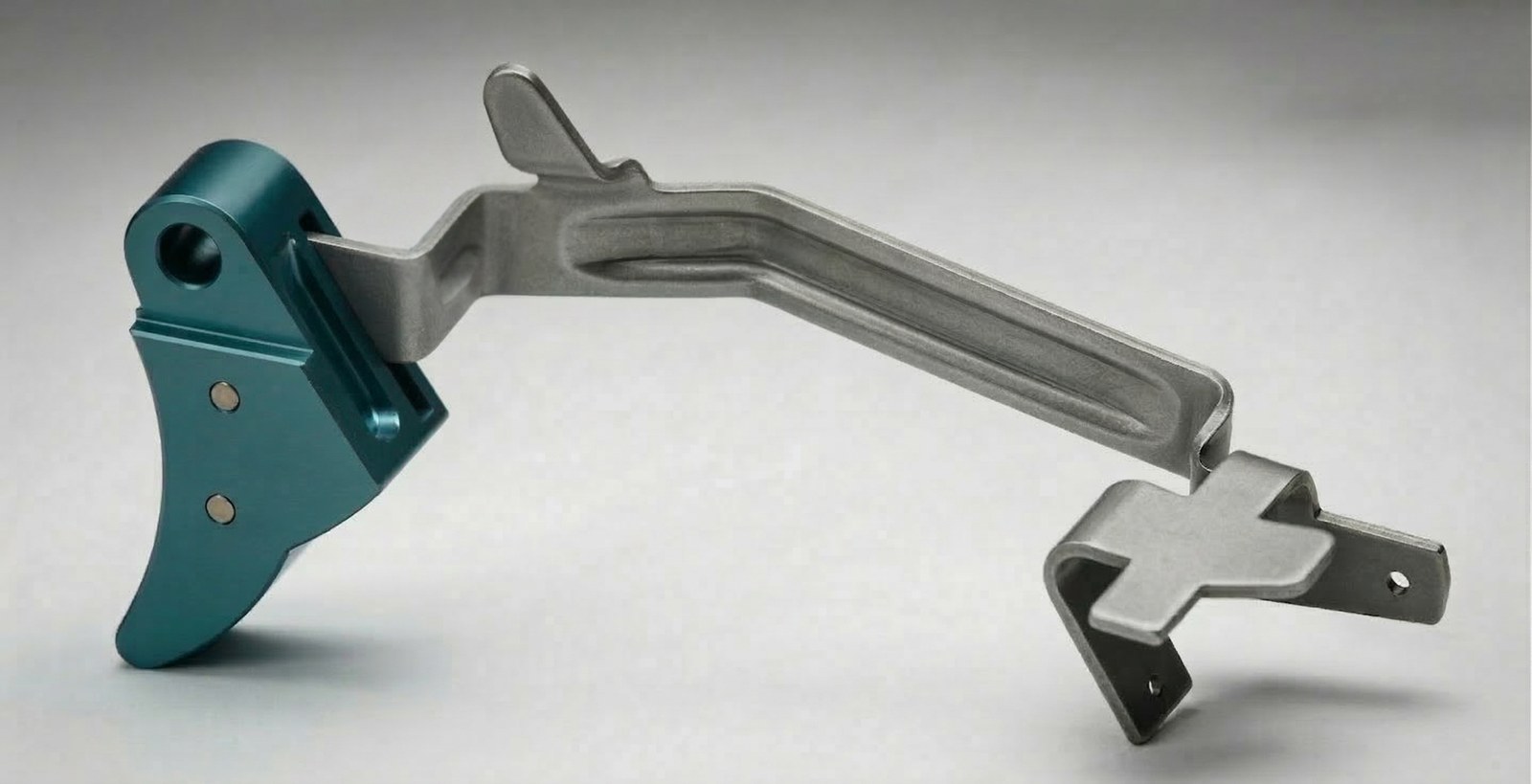
A Glock-pattern trigger bar. The cross-shaped sear at the right is the "cruciform" surface New York's statute keys on, and it has been factory standard on Glock pistols since the design was patented in 1982. Illustration rendered from the original US patent drawing. (Jorge A. Leon via Wikimedia Commons, public domain)
That cross-shaped piece of metal is not an aftermarket accessory. It is how a Glock works, and per the complaint it is part of why a dropped Glock does not fire. When the Gen 3 patent expired in 2020, other manufacturers copied the design. The Palmetto State Armory Dagger, the Ruger RXM and much of the Shadow Systems line all use it.
So the plaintiffs' math is simple. Every factory stock Glock has the part. Nearly every Glock-style pistol has the part. Define the part as contraband and you have defined the gun as contraband, without ever naming the manufacturer. Violating Penal Law section 265.10(10) is a class D felony, punishable by up to seven years and a fine of at least $5,000.
Your Glock does not become illegal on Monday
This part is getting garbled online, so here it is straight. The new definitions take effect August 25, 2026, two days from now. The dealer sales ban does not apply to anything until May 31, 2027, more than nine months out. Between now and then, nothing changes for a New Yorker who already owns one.
Existing owners keep their pistols. The New York State Association of Chiefs of Police bulletin on the law spells out that a convertible pistol without a converter attached is not a machine gun and that the law "does not criminalize a lawful owner's mere possession of such a pistol." Police and peace officers are categorically exempt, on duty and off. Private party resale and limited family transfers survive. Departments can still buy Glocks.
What dies is the retail counter. After May 31, 2027, a licensed dealer or gunsmith cannot sell, transfer, ship or transport one as merchandise. And because federal law bars buying a handgun out of state and bringing it home, a New Yorker cannot simply drive to Pennsylvania. That is the squeeze the complaint describes: not confiscation, but a market that only shrinks from here.
The whole case turns on two words: common use
The plaintiffs are not arguing that Glock switches should be legal. They go out of their way to say the opposite. Pistol converters are already machine guns under 26 U.S.C. 5845(b), already banned federally, and already a class A misdemeanor to possess under New York's own rapid-fire modification device statute. The complaint states flatly that those bans "are not at issue in this case."
The argument is Heller and Bruen. The Supreme Court held that arms in common use cannot be banned, and that handguns are the quintessential self-defense weapon. So the filing spends five pages proving Glocks are common: Forbes put Glock at nearly 65 percent of the U.S. handgun market as of 2020, ATF data shows Glock built 581,944 handguns in the U.S. in 2021 and exported only 67,106 of them, and the New York State Police have issued the Glock 17 to troopers since 1990. New York's own troopers carry the gun New York is about to stop selling.
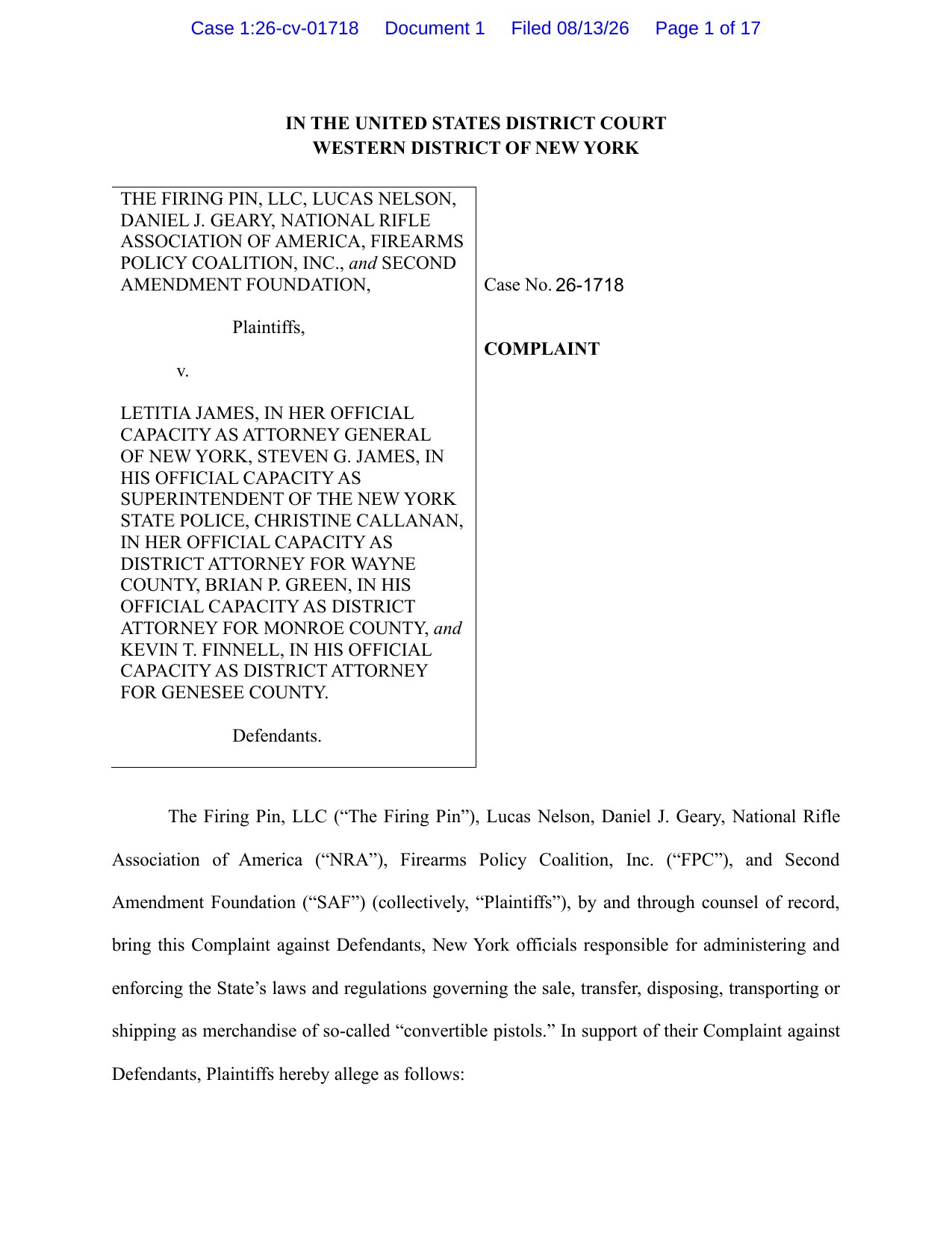
Note who is not a defendant. Hochul signed the bill, but the suit names Attorney General Letitia James, State Police Superintendent Steven G. James and the district attorneys of Wayne, Monroe and Genesee counties, the three counties where the dealer and the two individual plaintiffs actually do business and live. Plaintiffs are represented by Cooper and Kirk, PLLC and by Nicolas J. Rotsko of Fluet.
New York's answer is switches, and it is not a nothing argument
Hochul pushed the measure after a run of converted pistols turning up in New York cities. She says a converted pistol can fire up to 20 rounds a second and that modified pistols have been recovered by police in Albany, Buffalo and Syracuse. Sam Levy of Everytown for Gun Safety told Gothamist the point is design pressure on manufacturers: "We want to make those switches obsolete. Those switches only work on a very specific type of semiautomatic pistol that is uniquely vulnerable to this type of conversion."

Gov. Kathy Hochul at an October 2025 press conference in New York City. Hochul signed the convertible pistol ban into law as part of the state budget on May 27, 2026, and says she intends to fight the lawsuit. (Photo by Marc A. Hermann / Metropolitan Transportation Authority via Wikimedia Commons, CC BY 4.0)
SAF Executive Director Adam Kraut's response goes at the logic rather than the problem. "Not to be outdone by their West Coast gun-grabbing counterparts in California, New York lawmakers made providing some of the most common handguns in America to law-abiding New Yorkers punishable by seven years in prison," he said in SAF's release. SAF founder Alan Gottlieb was blunter: making someone a criminal for transferring a handgun "merely because someone can illegally convert those firearms into something they are not is absurd."
State Sen. Mark Walczyk, a Watertown Republican, made the enforcement point. "There's already laws on the books," he told Gothamist. "This is specifically targeting certain makes, especially the Glock pistol, which is the most popular across the country and here in New York."
The state is not blinking
Hochul answered the filing directly. "I strengthened our gun laws to protect New Yorkers from these deadly weapons," she said in a statement. "We'll defend our right to keep New Yorkers safe, and we'll win." A spokesperson referred the Daily Caller News Foundation to a post on X rather than issuing a fresh comment. Attorney General James, the lead defendant, has not filed a response.
New York is the fourth state to do this. FPC president Brandon Combs says the group is already litigating Glock bans in California and Maryland, and Connecticut passed one this year. In California, the challenge is not just from gun groups: the Justice Department's Civil Rights Division sued to block Gavin Newsom's version in July. Whatever happens in Buffalo will not happen in isolation.
This is not last week's federal suppressor case
Two very different things are moving at once, and gun owners are already blending them. On August 22 we covered the Texas NFA ruling, where a federal judge had already issued a decision, the injunction had already taken effect, and the Justice Department had already declined to seek an emergency stay. That case is over the finish line, at least for now, and only for the covered plaintiffs.
The New York case is at the opposite end. A complaint has been filed. That is the entire posture. The public docket shows the complaint, the summons and corporate disclosure statements, and nothing else. No temporary restraining order. No preliminary injunction motion. No hearing date. No ruling. New York's law is fully on the books and completely unaffected by this filing.

The Robert H. Jackson United States Courthouse in Buffalo, seat of the U.S. District Court for the Western District of New York, where The Firing Pin, LLC v. James was filed on August 13. (Photo by w_lemay via Wikimedia Commons, CC BY-SA 2.0)
What to actually watch
Two things, and neither is a court date. First, whether the plaintiffs move for a preliminary injunction. With the ban more than nine months out, a judge could reasonably find no emergency, and the NRA has publicly said only that it intends to stop the law "long before" June 1, 2027.
Second, the State Police list. The statute orders the Superintendent to publish, before the effective date and annually after, a roster of the pistols he has determined to be convertible. The chiefs of police bulletin calls that list "the practical key to enforcement and compliance." Until it exists, nobody outside Albany knows exactly how wide this net is. The complaint bets it will be very wide, alleging "a substantial likelihood that virtually all Glock and Glock-style pistols" will qualify.
New York lost Bruen at the Supreme Court in 2022 and rewrote its carry regime within weeks. It is now defending a rule that, by the plaintiffs' account, forbids selling the same pistol the state issues to its own troopers. That is the tension this case exists to resolve, and it is going to take a while.