Airline gate agents in Colorado, Texas and Arizona say ICE officers are now asking them to help find passengers, and to open jet bridges, without a warrant signed by a judge. That reporting, published this week, is the newest crack in a system that has been running quietly for more than a year: TSA hands ICE the passenger list, ICE runs it against its own records, and officers meet the match at the gate.
What broke this week
TIME reported on August 19 that gate agents at airports in three states describe ICE officers as a recurring presence in recent weeks, asking staff to identify or locate travelers, pull information out of internal airline systems, and grant access to restricted areas including jet bridges and aircraft. One agent, who would not give her full name, told TIME there has "never been an official written directive about ICE."
AsAmNews followed on August 21 with the same account, and with a DHS response that sidesteps the warrant question entirely. "When DHS components operate in the same transportation environment, they coordinate as appropriate to support public safety, security, and lawful operations while minimizing disruption to the traveling public," the department said.
Nothing here is a leak, a raid or a surprise policy launch. The infrastructure has been public since late July. What changed this month is that the people running the boarding process started talking.
TSA is handing ICE the manifest, and the numbers are not small
Every passenger on a US flight, domestic included, gets pushed to TSA before boarding under the Secure Flight program: full name, date of birth, gender, itinerary. TSA built it in 2007 to check names against terrorist watchlists. It is now also a lead generator for immigration enforcement.
Reuters reported in April that TSA passed ICE information on more than 31,000 travelers, producing more than 800 arrests between January 2025 and February 2026, figures matched by internal ICE data reviewed that month. The gap between those two numbers is the point: tens of thousands of travelers got screened against ICE records to produce a few hundred arrests.
The July surge is a separate, tighter count. ABC News reported at least 27 airport arrests using this tactic across at least nine states, from California to Virginia, citing an internal document. The New York Times, working from its own documents and from lawyers representing more than 25 people, counted arrests at check-in counters, arrival gates and jetways at no fewer than 15 airports. Travel writer Suzanne Rowan Kelleher tracked the same escalation for Forbes two days later.
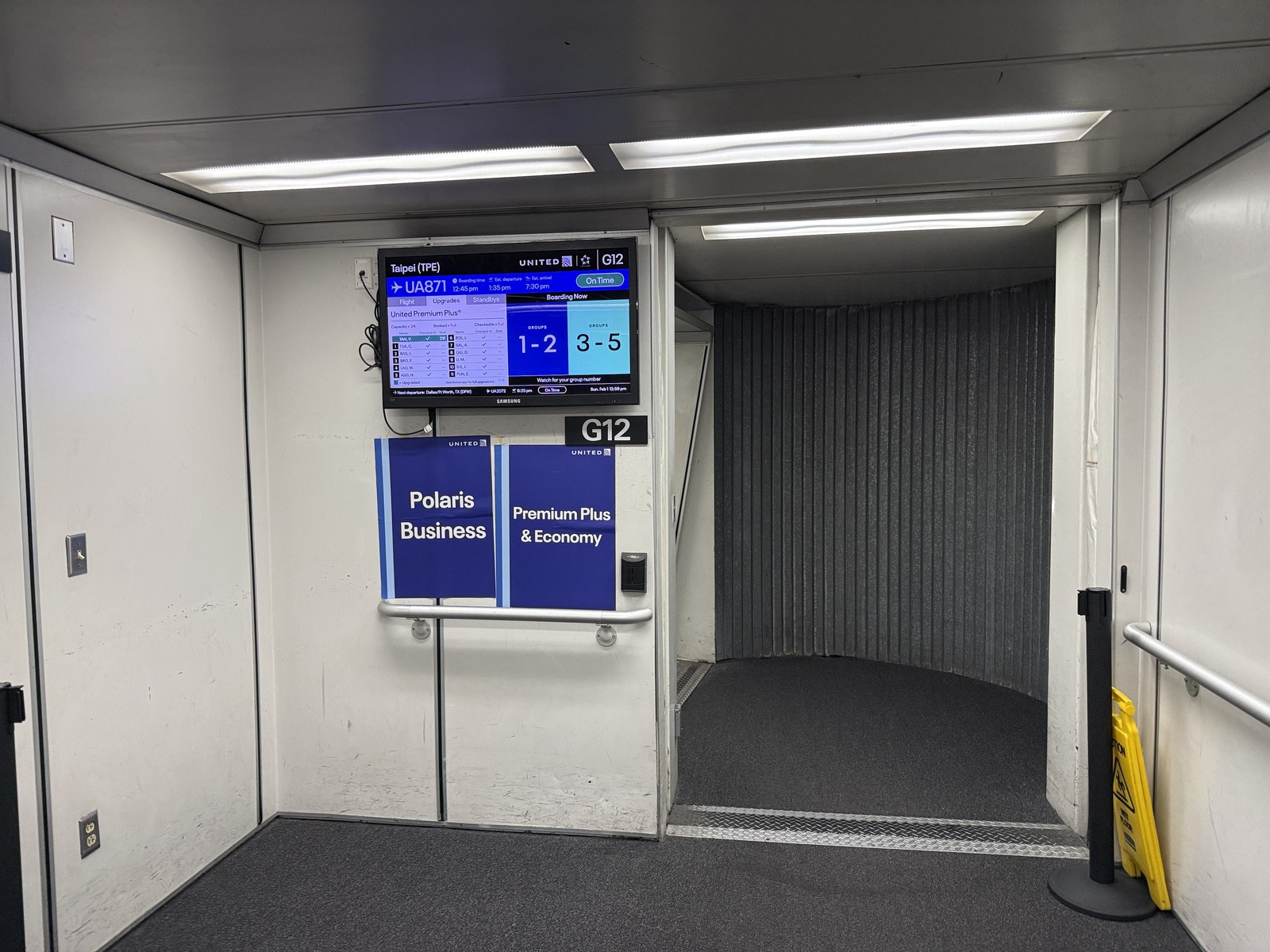
A jet bridge entrance at San Francisco International Airport. Jetways are one of the places ICE has made arrests, including a July 20 arrest on a Southwest jet bridge at Denver International. File photo, not connected to any specific enforcement action. (Photo by 4300streetcar via Wikimedia Commons, CC BY 4.0)
The legal authority is real, it is written down, and no court has ruled on it
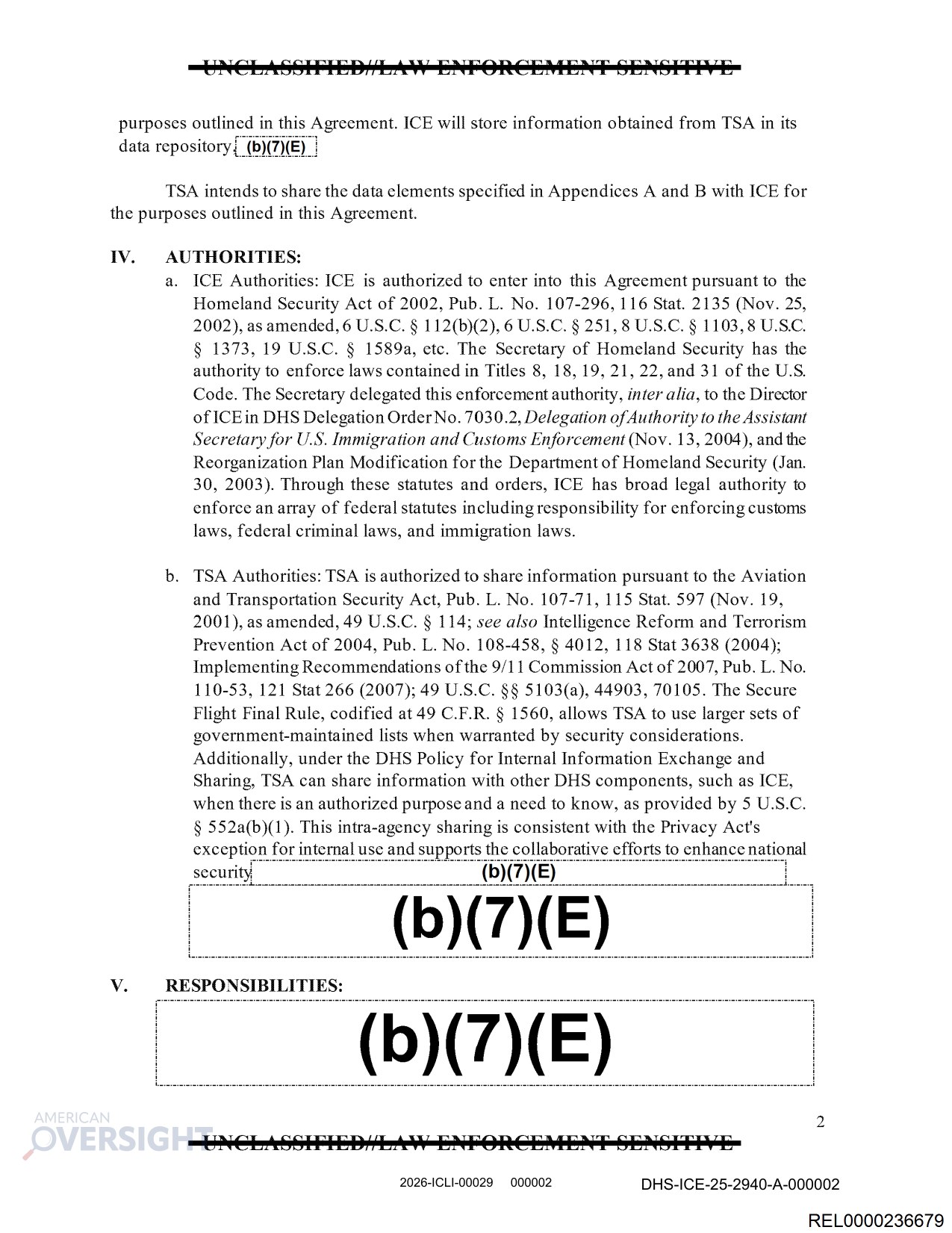
This is the part most coverage gets vague about, so here it is plainly. TSA and ICE signed a Memorandum of Agreement on May 29, 2025. The public did not learn it existed until the watchdog group American Oversight pried it loose through a FOIA lawsuit and posted it on July 28, 2026.
The agreement names its own authority. TSA cites the Secure Flight Final Rule at 49 C.F.R. Part 1560, plus the Privacy Act's internal-use exception at 5 U.S.C. 552a(b)(1), which lets one part of an agency hand records to another part of the same agency when there is an authorized purpose and a need to know. TSA and ICE are both inside DHS. That exception is why the Privacy Act's usual limits on cross-agency sharing do not bite here, a point the National Immigration Law Center makes bluntly in its own traveler guidance.
So the honest answer on legality: the government has a written, colorable statutory and regulatory basis, and no court has tested whether stretching a counterterrorism screening rule into routine civil immigration enforcement exceeds it. The only litigation to date, American Oversight v. TSA, was about disclosure, not legality. It won release of the document. It did not rule on the program.
A TSA administrator told Congress this was not happening
In January, acting TSA Administrator Ha Nguyen McNeill was asked at a House Homeland Security Committee hearing about an arrangement to share passenger data with ICE for deportation-order checks. "That is not what is occurring," she said. "We don't send the information to ICE, we help ICE check against information."
The agreement she was being asked about says ICE "will store information obtained from TSA in its data repository." Government Executive laid the two side by side. Asked about the program at his Senate confirmation hearing in July, TSA administrator nominee David Cummins told Sen. Gary Peters he would "try to provide as much as we can within our bounds" and declined to describe what is shared.
Whatever you think of the enforcement policy, an agency head telling a congressional committee something a signed agreement contradicts is a problem on its own terms. Congress cannot oversee a program it is being talked out of.
The enforcement case is strong. The collateral cases are real.
Start with what the government is right about. An airport terminal is the single most efficient place in America to take custody of someone. Nobody inside is armed, the government already knows exactly where the person will be and when, and it takes fewer officers to do it safely. "It makes for an easy immigration arrest for ICE," former acting ICE director John Sandweg told CNN. He is not wrong, and he served under Obama.
Compare that to the alternative. Two fatal shootings involving ICE officers happened in July, one in Houston and one in Maine, and both started with roadside traffic stops. Senior DHS officials changed enforcement operations on the heels of those killings. A gate arrest carries a fraction of that risk to everyone involved, and ICE is under real pressure to produce volume: CNN puts the administration's working target at around 2,000 arrests a day. Buffalo immigration attorney Rosanna Berardi put the mechanics plainly to ABC News: "There is no investigation or no home visit involved. It's simply a name match at a checkpoint."

ICE Enforcement and Removal Operations officers make an arrest during the enhanced enforcement operation ICE began in Chicago on January 26, 2025. File photo of a street arrest, not an airport arrest. (U.S. Immigration and Customs Enforcement, public domain)
Now the part the DHS press releases leave out. The people picked up at gates are not all final-order absconders. The New York Times documented an engineer waiting on a work visa extension, several people newly married to US citizens, a former au pair holding government-issued work authorization, and a Ugandan asylum seeker with sickle cell anemia who uses a wheelchair. ABC News reported that some of those detained have no criminal record and hold valid work authorization or parole documents.
The most-documented case is Chantal Alejandra Morales Rojas, pulled off a Southwest jet bridge at Denver International on July 20. She entered lawfully in January 2023 as an au pair, filed an application to stay, passed repeated background checks, and held DHS-issued work authorization while she waited. Her attorneys say she has no criminal history. A court later set her release on bond.
DHS's answer to that is legally accurate and worth quoting exactly, because it is the whole argument: "A pending application and work authorization does NOT confer any type of legal status in the United States." True. It is also why Berardi says "routine air travel has turned into a legal status audit for millions of foreign national visa holders and green card applicants," and why Jeff Joseph, president of the American Immigration Lawyers Association, told CNN that "if the new expectation is that if you have a pending application, you can't travel, that would be very, very new."
This is not a small category. The Deportation Data Project at UC Berkeley and UCLA, working from ICE's own internal records, found that arrests of people without criminal convictions rose more than eightfold in the administration's first nine months, with street and at-large arrests up roughly elevenfold. Airport arrests are the newest branch of that same tree.
What your rights actually are at a domestic airport checkpoint
This is the most useful thing in this article, so read it carefully. An ICE officer standing in an airport terminal has no more authority than an ICE officer standing on a public sidewalk. "They have no additional authority in an airport," Jonathan Blazer, the ACLU's director of border strategies, told KQED. "Nothing changes just because you're in an airport."
If you are a US citizen flying domestically, you must show TSA acceptable identification to be screened and board. That is a condition of flying, not an immigration inspection. You do not have to prove citizenship to fly inside the United States, and you have the same right to remain silent with an ICE officer that you have anywhere else. The question to ask is "Am I free to go?" Absent individualized reasonable suspicion of a crime, the answer is yes. Blazer's honest caveat is that walking away in an airport often means missing an expensive flight, which is exactly why people answer questions they do not have to answer.
Lawful permanent residents are in a different spot. Federal law requires adult noncitizens to carry proof of status, so carry the green card. You only have to answer questions establishing identity and permanent residency. A green card can be revoked only by an immigration judge, so per the ACLU's guidance, never sign anything surrendering it and never sign a document you have not had a lawyer read.
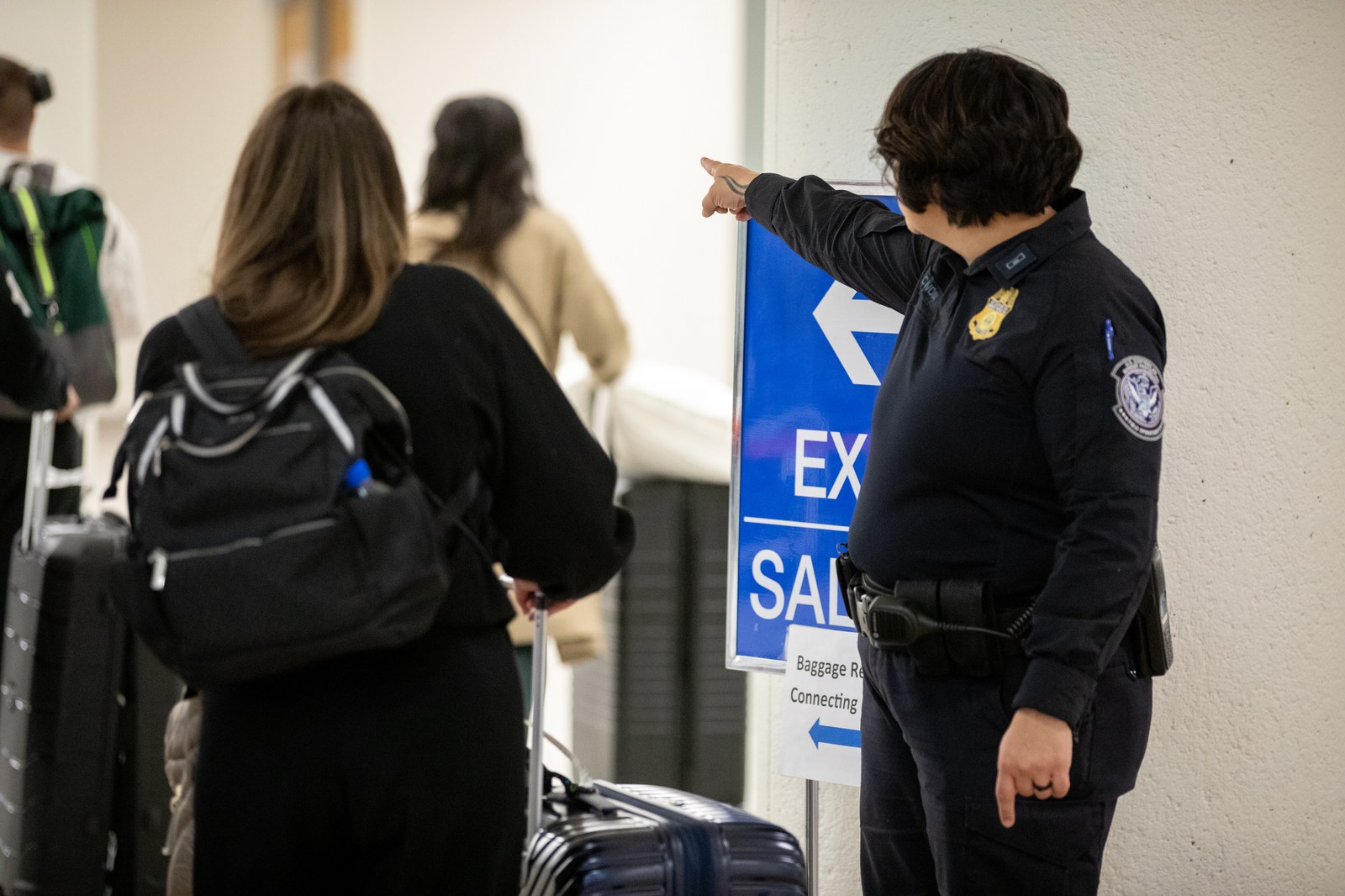
A Customs and Border Protection officer directs arriving international passengers in the baggage claim area at Phoenix Sky Harbor International Airport, December 11, 2024. CBP's broad border-search powers apply to international arrivals like this one, not to domestic flights. File photo. (CBP photo by Jerry Glaser, public domain)
Do not confuse ICE with CBP. Customs and Border Protection has sweeping search authority over people arriving on international flights. That authority does not follow you onto a domestic itinerary. Neither ICE nor CBP should be searching your phone without a warrant on a domestic flight, and University of Chicago law professor Nicole Hallett, quoted by the Washington Post and carried by KQED, says ICE cannot search a passenger's belongings without a warrant unless it is acting on behalf of an agency that can.
One more distinction that matters at the gate. Most ICE arrest paperwork is an administrative warrant signed by an ICE officer, not a judicial warrant signed by a judge, and an administrative warrant does not compel an airline employee to open a jet bridge or hand over passenger records. That is exactly the line the gate agents are drawing: one told AsAmNews that when federal authorities used to ask for help, she was given advance notice and shown a judge-signed warrant, and that has stopped. Southwest told CNN it "has provided guidance to employees to help ensure appropriate legal documentation is presented by law enforcement agencies prior to interactions in the gate areas." That guidance is precisely what the gate agents in the TIME story are trying to apply without a written policy to point at.
How ICE ended up inside airports in the first place
The deployment was not a border policy. It was a budget fight. DHS funding lapsed on February 14, 2026, and TSA screeners went unpaid while ICE personnel kept drawing checks under the One Big Beautiful Bill Act. As callouts stacked up and security lines stretched for hours, the administration sent ICE officers into 14 major airports starting Monday, March 23, to backfill TSA.
Border czar Tom Homan made no secret of the second purpose. Asked whether officers would make arrests, he said: "We're going to arrest criminals going through the airport. We're going to look for human trafficking, sex trafficking, money smuggling. We're going to be at the airports, working with our brothers and sisters from TSA." He later told CBS News that ICE would keep assisting TSA "until the airports feel like they are 100%."
The staffing emergency ended. The officers stayed. That is the whole arc of this story in two sentences.
What happens next
Rep. Rashida Tlaib introduced the No TSA Data For ICE Act on August 3 to bar TSA from passing personally identifiable passenger data to ICE and CBP. In a Republican Congress it is not going anywhere, and Tlaib knows it. Its real function is to force members to take a recorded position on whether a counterterrorism screening system should double as an immigration database.
The more likely pressure points are the airlines, who do not want their gate agents deputized, and the confirmation of a TSA administrator who will eventually have to answer Sen. Peters in writing. American Oversight is still litigating for the implementation records, including the redacted appendices that would show exactly which data elements move.
Here is the thing conservatives should sit with rather than skip. The mechanism at issue is not deportation. It is a federal agency taking information Americans are legally required to hand over for one stated purpose and repurposing it for another, with no new statute, no public rulemaking, no court review, and an agency head telling Congress it was not happening. Today it is aimed at visa overstays, and at the roughly one million people whose Temporary Protected Status just ended. The precedent does not carry a note on it saying who it can be used against next.
Enforce the immigration laws. Deport people with final removal orders. But the paperwork should be public before the arrests start, not fourteen months after, and it should take a judge's signature to open a jet bridge.