The Supreme Court on Tuesday let the Trump administration restart deportations to third countries and agreed to decide in December whether the policy is legal. The sworn ICE numbers behind the government's emergency request tell you who has been waiting on this ruling: about 8,179 people with final removal orders, including almost 1,432 convicted criminals, whom ICE says it could otherwise be forced to release.
The Court Stayed Judge Murphy and Took the Whole Case
The one-page order in Department of Homeland Security v. D.V.D., No. 26-426, freezes the February 25 final judgment of U.S. District Judge Brian Murphy in Boston. That judgment struck down DHS's third-country removal guidance and required new notice and hearing steps before anyone could be flown to a country not named in their removal order.
The justices did more than pause it. They treated the government's stay application as a petition for certiorari, granted it, and told the Clerk to set a schedule for argument in the December 2026 session. The stay lasts until the Court issues its final judgment, so third-country flights can run for the rest of the case.
Justices Sonia Sotomayor, Elena Kagan and Ketanji Brown Jackson "would deny the application for stay," the order says. None of the three wrote an opinion. That makes the count 6-3, and it is the third time the full Court has sided with the administration in this same case, after rulings in June and July of 2025.
Official record
Department of Homeland Security, et al. v. D.V.D., et al., No. 26-426 (Application No. 26A406), Supreme Court of the United States, Order List of Tuesday, September 29, 2026. Official docket at supremecourt.gov.
"The application is also treated as a petition for a writ of certiorari, and the petition is granted. The parties are directed to brief and argue the following questions: (1) Whether the district court had jurisdiction over Respondents' claims. (2) Whether the district court had authority to enter classwide declaratory relief and APA vacatur under 8 U. S. C. §1252(f)(1). (3) Whether the Government's Guidance on third-country removals is unlawful under 8 U. S. C. §1231(b), the Due Process Clause, or FARRA/CAT and its implementing regulations. (4) Such other questions that the Government determines are appropriate for the proper disposition of the case."
Supreme Court order, September 29, 2026
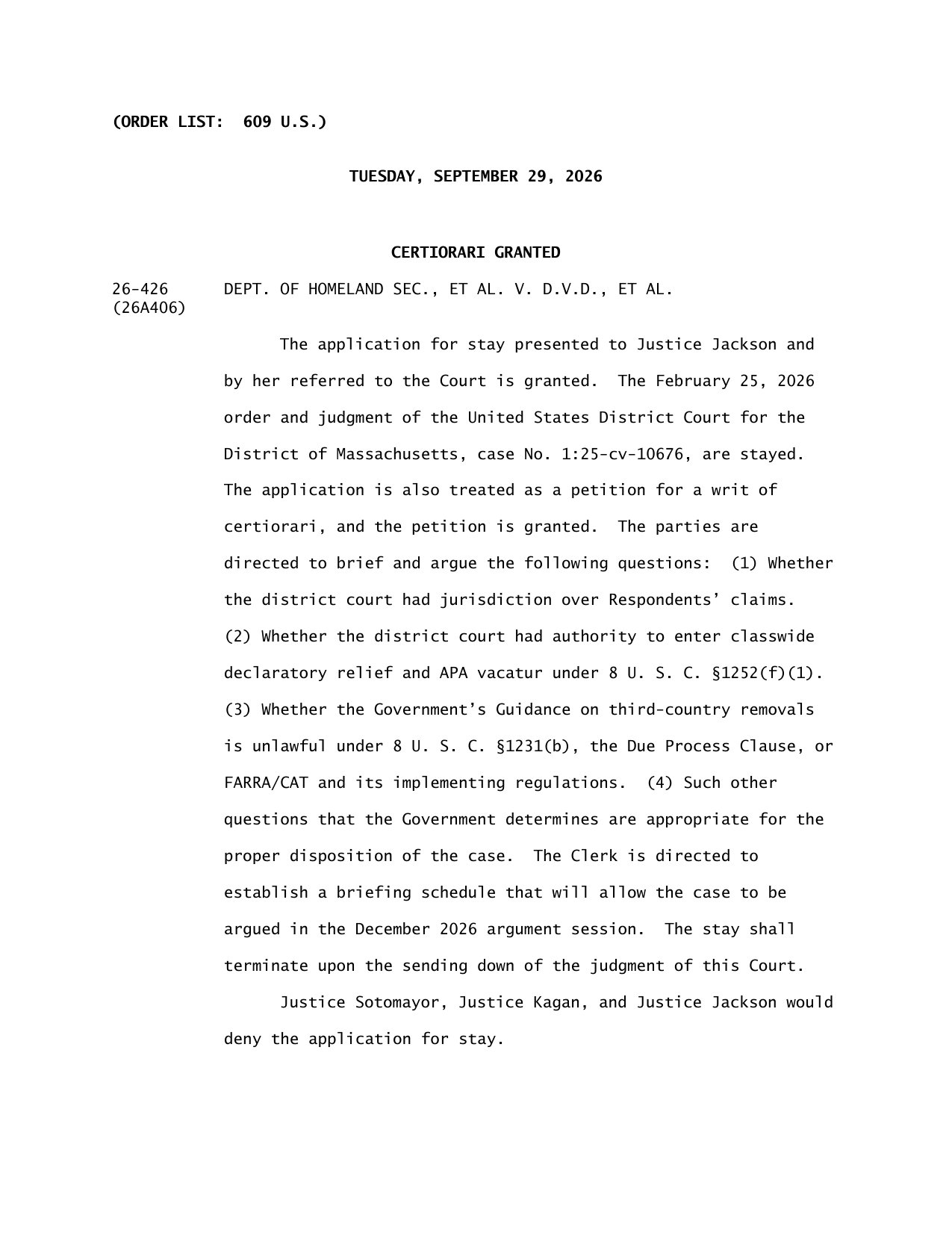
Read or download the full one-page order (PDF) · official copy at supremecourt.gov
Read that fourth question again. The Court did not only write its own list of issues. It left room for the Justice Department to add others it considers "appropriate for the proper disposition of the case." The first two questions are about whether Murphy had the power to rule at all, before the Court ever gets to whether the policy itself is lawful.
Six Days From Filing to Order
The speed matters here. The docket shows Solicitor General D. John Sauer filed the application on September 24 with Justice Jackson, who handles emergency matters from the First Circuit. She called for a response by 4 p.m. on September 28. The immigrants' lawyers filed on time, and so did two friend-of-the-court briefs, from the Federation for American Immigration Reform and America's Future. The Court ruled the next day.
Jackson referred the application to the full Court, according to the order, and then voted to deny it.

D. John Sauer at his February 2025 Senate Judiciary Committee confirmation hearing. As solicitor general, he signed the government's stay application. (U.S. Senate Committee on the Judiciary, public domain, via Wikimedia Commons)
The First Circuit Flipped a Switch at 11:36 P.M.
Last week's crisis started in the First Circuit, not the Supreme Court. On September 18 a panel of that court upheld most of Murphy's judgment. DHS General Counsel James Percival said the same day that removals would go on because the ruling was "not currently in effect," as we reported then. He was right, for five days.
On September 23 the same panel of Judges Montecalvo, Howard and Aframe entered a short order declaring that its March 16 stay "is dissolved." The government's application says the order came at 11:36 p.m., "just three hours after" the immigrants filed their motion, with no chance for the government to respond. "The court did not provide any reasoning," the brief adds. It also notes the formal mandate was not due until at least November 9, so the judgment snapped back into force weeks early.
The fallout, according to what DHS told the Solicitor General, came fast. The application says DHS canceled "a flight to three separate countries carrying 70 aliens with criminal convictions (including aggravated assault and serious drug offenses)." It says DHS also pulled "nearly 150 aliens from removal flights to at least four different countries," with another flight to four countries carrying 58 people scheduled for later that week. Each cancellation, the brief says, meant another round of diplomacy with the receiving countries.
What ICE Swore to About the People Waiting
The numbers most coverage skipped are in the 155-page appendix, in a declaration by John A. Schultz, a deputy assistant director in ICE's Enforcement and Removal Operations who has worked at ICE since 2003. He signed it under penalty of perjury.
Schultz swore that about 559 people were in ICE custody awaiting removal to a third country, including about 139 "convicted of serious offenses such as murder, rape, child sexual abuse, armed robbery, and aggravated assault." Another 7,620 people with final removal orders were living outside detention after winning withholding of removal or Convention Against Torture protection, which bars sending them back to their home countries. About 1,293 of those were convicted criminals.
Add those groups together and you reach his bottom line. If third-country removals become "operationally burdensome," he wrote, "approximately 8,179 aliens" including "almost 1,432 convicted criminals" would likely remain in the United States. Because the law limits how long ICE can hold someone with no realistic prospect of removal, Schultz said ICE would be "legally compelled to release these individuals."
Official record
Declaration of John A. Schultz, Deputy Assistant Director, ICE Enforcement and Removal Operations, signed March 5, 2026, filed in the First Circuit in No. 26-1212 and reproduced at pages 91a-98a of the government's Supreme Court appendix.
"Among those removed through these third-country missions were individuals whose criminal records included convictions for first-degree murder, the rape of minors, repeated violent sexual assaults, and other violent felonies."
Schultz Declaration, paragraph 12
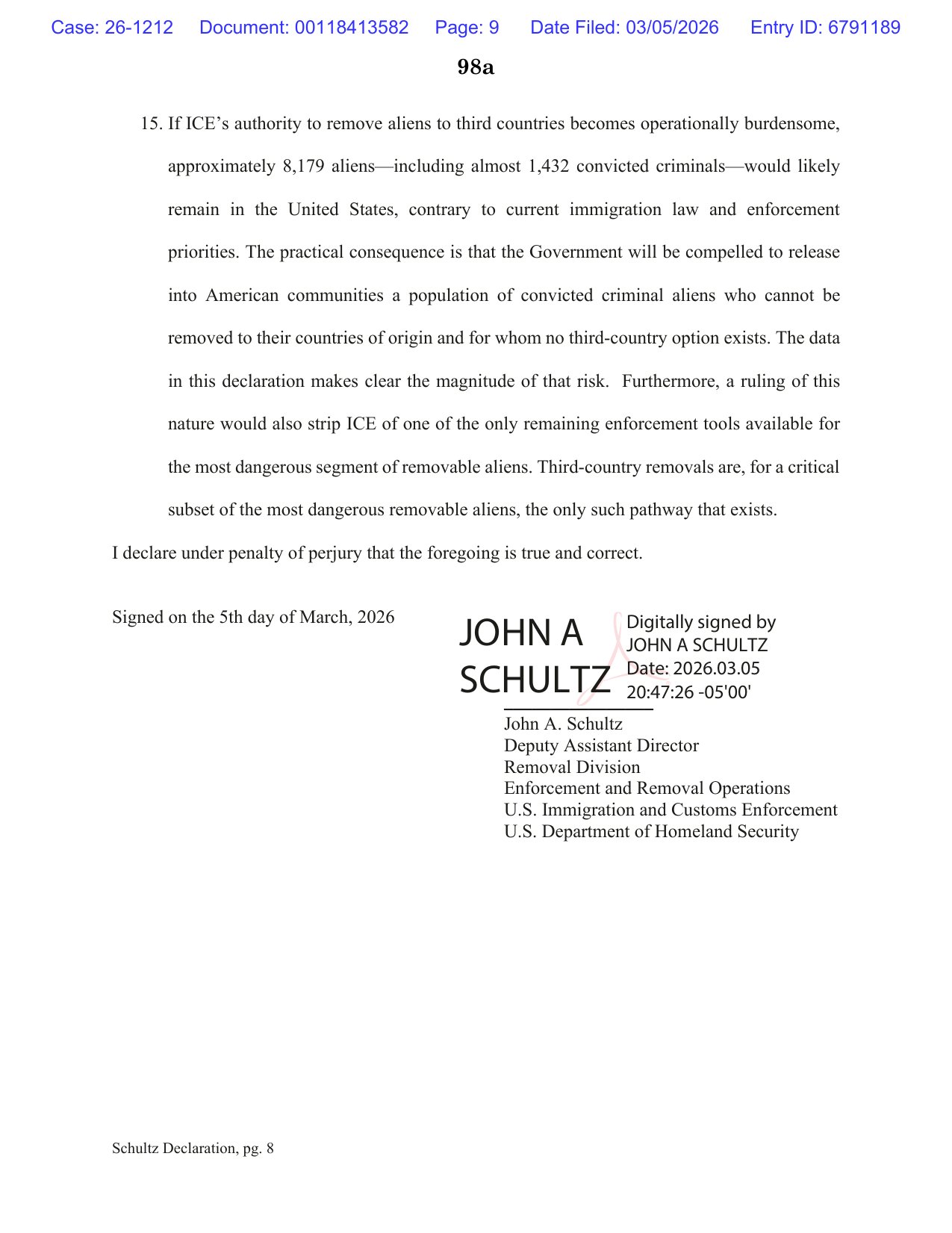
Read or download the full eight-page Schultz declaration (PDF) · official docket
The Declaration Is Nearly Seven Months Old
Here is what the headlines missed. The figures the Solicitor General put before the justices last week, including the 1,432 convicted criminals and the 139 detained serious offenders, come from a declaration dated March 5, 2026. It was written to win the First Circuit's March 16 stay. The appendix index lists only two sworn declarations, from Schultz and Secretary of State Marco Rubio, and both are dated March 5. The September figures on canceled flights appear only in the brief itself, as things "DHS informs us."
That does not make the numbers wrong. It does mean nobody in this case has told the Court how many of those 559 detainees are still sitting in ICE custody today. After the stay was lifted and flights were canceled last week, that is the number that matters most, and it is not in the record.
The Supreme Court Building in Washington, where the justices will hear the third-country removal case in December. (Photo: Tony Webster, CC BY 2.0, via Wikimedia Commons)
Mexico Takes Almost All of Them
The same declaration explains what "third-country removal" means in practice. Since January 21, 2025, Schultz swore, ICE has removed 7,257 people to Mexico as third-country removals. Field offices along the southwest border send "a varying number of aliens each week" through ports of entry. Mexico is "the country that has accepted the most third-country removals."
The long-haul flights that draw the coverage are a much smaller group. Schultz counted about 103 removals to countries such as South Sudan, Eswatini, Rwanda, Ghana, Cameroon and Equatorial Guinea, where home countries refused to take people back or "extraordinary public safety considerations" required it. Of those 103, he said, 23 were convicted of murder, attempted murder or manslaughter, six of rape or sexual assault, and three of lewd acts with children under 16.
Run the math and more than one in five of those African-flight deportees had a homicide-related conviction. These are exactly the cases the administration says no other country would take.
What the Other Side Says, and What Comes in December
The immigrants' lawyers, from the National Immigration Litigation Alliance, Northwest Immigrant Rights Project and Human Rights First, argued in their opposition that "Denying a stay does not prevent third-country removals; rather, it simply requires them to do so lawfully." Citing a Washington Post analysis, they said DHS has deported more than 25,000 people to at least 28 third countries in 2025 and 2026, many with no criminal record.
Attorney General Todd Blanche called the policy "an entirely lawful and critical tool for immigration enforcement," the Associated Press reported. Roll Call noted the case now puts the justices at the center of one of President Trump's signature priorities.
For now, the flights resume. In December the Court will decide whether a single district judge in Boston could rewrite national removal procedures for an entire class of people who already have final orders. ICE's own sworn count says 1,432 convicted criminals are riding on the answer.
Top photo: ICE Enforcement and Removal Operations officers escort a high-profile removal to an ICE Air charter flight, February 2017 file photo. (U.S. Immigration and Customs Enforcement, public domain, via Wikimedia Commons)