Defense Secretary Pete Hegseth has ordered the Pentagon's cyber and spy agencies to hunt down foreign meddling in the 2026 midterms, according to a one-page memo made public Monday. Read the memo itself and the "military at the polls" panic falls flat: it goes to four intelligence and cyber chiefs, it never uses the words troops, National Guard or polling place, and its core language is borrowed almost word for word from the Biden-era Pentagon.
What Hegseth Actually Signed on September 22
The memo is titled "Countering Foreign Threats to 2026 Elections." It is dated September 22, 2026, carries Hegseth's signature under the Secretary of War letterhead, and was first reported Monday by Axios, which posted the full text on DocumentCloud. The Washington Times and The Hill followed within hours.
It gives three orders. U.S. Cyber Command and the directors of the combat support agencies "will prioritize the use of DoW intelligence and cyber capabilities to ensure foreign actors do not meddle in our democratic systems." The Defense Intelligence Enterprise is told to "execute collection and production on foreign threats to our elections." Cyber Command is told to work with the Department of Homeland Security "to counter potential cyber threats from foreign actors targeting our elections."
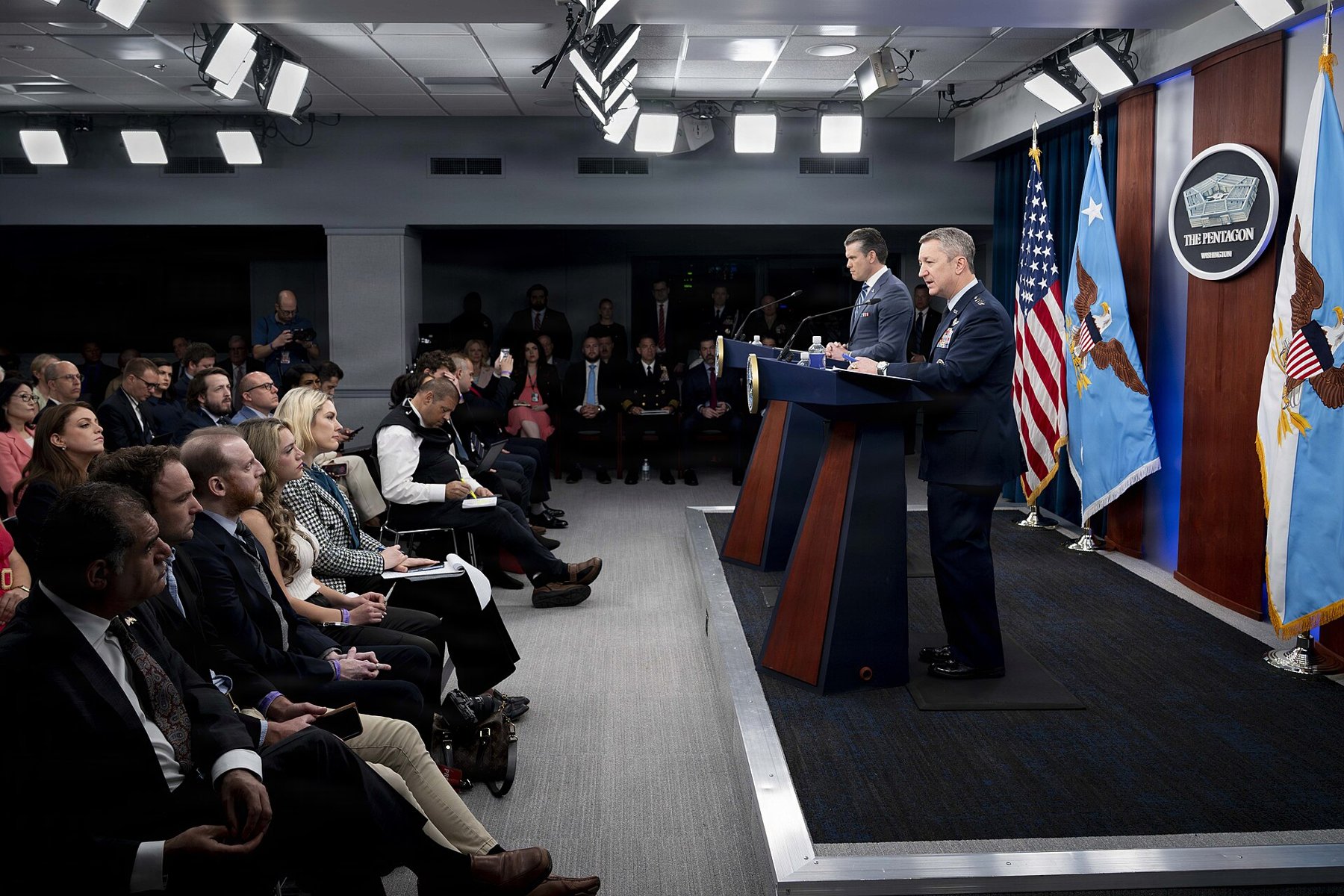
Secretary of War Pete Hegseth (left) and Chairman of the Joint Chiefs Gen. Dan Caine brief reporters at the Pentagon on April 16, 2026. (DOW photo by Chief Mass Communication Specialist James Mullen, public domain, via Wikimedia Commons)
Look at Who the Memo Is Addressed To
The address block is where the story is. The memo goes to exactly four officials: the Commander of U.S. Cyber Command, the Director of the National Security Agency, the Director of the Defense Intelligence Agency and the Director of the National Geospatial-Intelligence Agency. Those are the officials who run America's signals intelligence and cyber operations.
It does not go to any of the military services, U.S. Northern Command or the National Guard Bureau. We searched the text for "troops," "Guard" and "poll," and none of them appear. The only voter-facing line promises that "every lawful voter can cast their ballot free from foreign intimidation, coercion, or fear." The word doing the work in that sentence is foreign.
Every tasking in the memo points outward. The word "foreign" appears in the subject line and in each of the three directives. Cyber Command is told to use "its existing authorities," which means the memo creates no new power at all. Intelligence collection must follow "the law, regulation, Executive direction, and DoW policies and directives."
Official record
Secretary of War Pete Hegseth, Memorandum for Commander, U.S. Cyber Command; Director, NSA/Chief, CSS; Director, DIA; Director, NGA. Subject: "Countering Foreign Threats to 2026 Elections," dated September 22, 2026. Full text on DocumentCloud, as published by Axios.
"I also direct U.S. Cyber Command to use its existing authorities, capabilities, and competencies in coordination with the Department of Homeland Security, to counter potential cyber threats from foreign actors targeting our elections."
Hegseth memo, paragraph 4
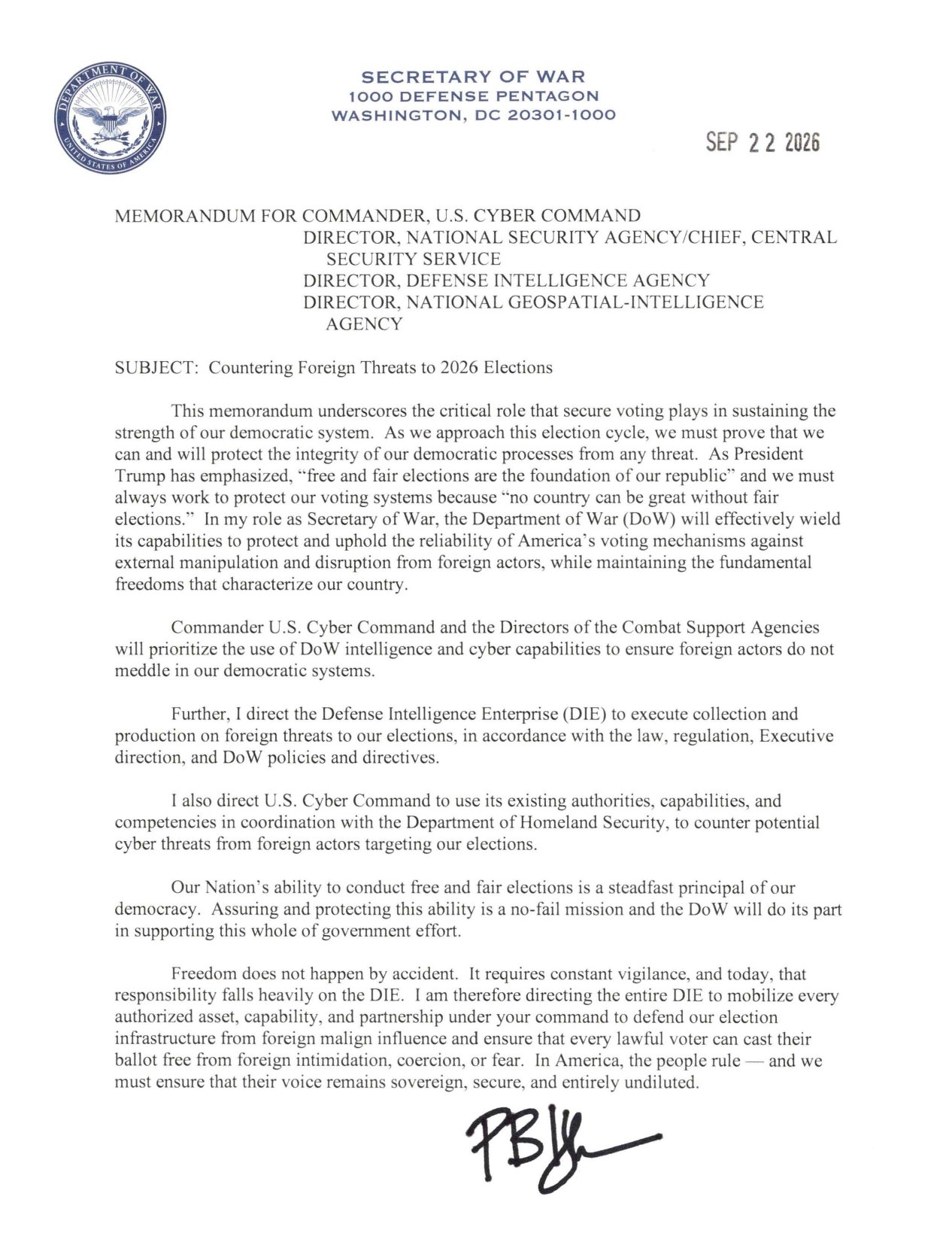
Read or download the full one-page memo (PDF) · view it on DocumentCloud
The "No-Fail Mission" Line Came From the Biden Pentagon
Here is the detail the Monday coverage missed. Hegseth's memo calls protecting elections "a no-fail mission" and says the department "will do its part in supporting this whole of government effort." Both phrases appear in the Pentagon's own August 25, 2022 midterm announcement, published jointly by Cyber Command and the NSA under President Biden.
In that 2022 release, then-Cyber Command chief Gen. Paul Nakasone called election defense "an enduring, no-fail mission" for his two organizations, "who bring unique insights and actions to the whole-of-government effort." The same article said the joint Election Security Group had been "stood up again in early 2022" to "disrupt, deter and degrade" foreign interference.
That release also credited "the last two election cycles," which were 2018 and 2020, both on Trump's watch. So the mission Hegseth is ordering started on Trump's first-term watch and continued under Biden, and Hegseth is describing it in Nakasone's own words. Critics will have a hard time calling the same job a threat to democracy now that a Trump appointee signed the order.
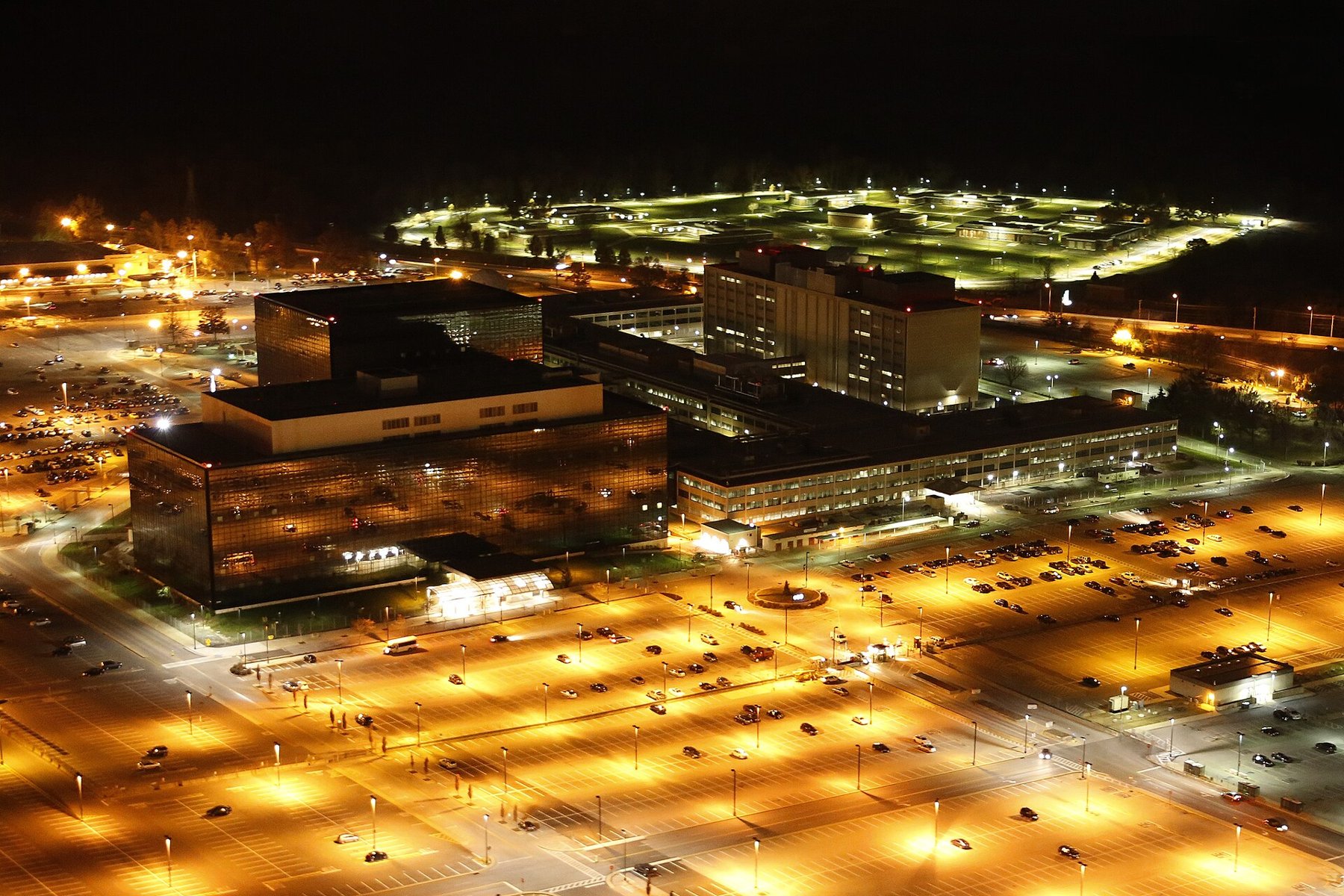
National Security Agency headquarters at Fort Meade, Maryland, which shares its director with U.S. Cyber Command. Both are addressees on the Hegseth memo. (Photo: Trevor Paglen, 2013, CC0, via Wikimedia Commons)
Why Democrats Were Asking About Soldiers at Polling Places
The memo lands after a month of pressure from Sen. Elissa Slotkin, a Michigan Democrat on the Armed Services Committee. In August she wrote to Hegseth and Gen. Dan Caine, the chairman of the Joint Chiefs, asking them to confirm the military "will not send Federal troops to the polls or to seize election materials of any kind," as PBS reported. Axios notes that Trump has declined to rule out sending ICE or the Guard to the polls.
Caine answered in writing on August 28. "The Joint Force has no plans to send Federal military personnel or Federalized members of the National Guard to polling places during the 2026 elections," he wrote, according to Slotkin's office, which posted the letter. He added that he had "neither received nor anticipate receiving any unlawful order" about the midterms. Slotkin's office said on August 31 that Hegseth had not replied.
The new memo is not a reply to Slotkin, and it doesn't make her requested promise in so many words. But it puts Hegseth's own signature on the department's election role, and it aims that role at foreign hackers and spies, full stop.
Federal Law Already Bars Troops at the Polls
There is a reason the memo doesn't need to say it. Under 18 U.S.C. 592, any military officer who brings or keeps "troops or armed men at any place where a general or special election is held" faces up to five years in prison and is disqualified from holding federal office. The only exception is force needed "to repel armed enemies of the United States."
The statute took its current form in 1948. It applies to every uniformed officer who might receive such an order, which is why Caine's letter could state flatly that he expects no unlawful order. A memo to four cyber and intelligence directors doesn't touch it.
The Threats Are Real, and Iran Has Already Tried
Anyone who thinks foreign meddling is a talking point should remember 2024. The Justice Department indicted three IRGC hackers on September 27, 2024 for breaking into a Trump campaign official's email and trying to leak stolen material to the press and to people tied to the Biden-Harris campaign. The target was Trump.
Iran now has far more reason to try again. The United States is more than seven months into open conflict with Tehran, with Day 213 logged on September 28 by GlobalSecurity.org's running war log, and Trump rejected Iran's latest Strait of Hormuz offer over the weekend, CBS News reported. A regime at war with Washington has every motive to sow chaos around a U.S. election five weeks out.
China is the other name in the file. Axios says the memo was drafted partly in response to Trump's July 16 address, in which he released documents alleging Beijing obtained "220 million U.S. voter files" and that intelligence about it was kept out of his briefings. Beijing denied it, Axios reported, and a 2021 intelligence assessment had concluded China did not try to sway the 2020 outcome. The memo quotes that July address, citing Trump's line that "no country can be great without fair elections." The White House's own clip has him saying "fair and honest elections."
What the Memo Leaves Out
The memo is short on specifics. It sets no deadline and orders no report back to the secretary. It tells Cyber Command to coordinate with DHS, at a time when Axios reported the administration cut roughly 1,100 employees from DHS's cyber agency, CISA, and ordered it to stop its election security programs for states and counties.
That leaves the Pentagon's cyber warriors carrying more of the load. Chief Pentagon spokesman Sean Parnell told Axios that federal, state and local officials are working "in lockstep" with Cyber Command and defense intelligence teams. An unnamed official put it more simply: "This is what CYBERCOM does every day."
For voters, the bottom line is on the page. The Pentagon's election order is about foreign powers like China and Iran reaching into American networks, and it rides on authorities the last two administrations used for the same job. If Democrats want to argue the military is coming for the ballot box, they will have to find it somewhere other than this memo.