The Justice Department's new $25 million ANGEL grant is named for Americans killed by illegal aliens, and two of the families who spoke at its launch come from Illinois. Read the 16-page funding notice and you find why Illinois police can't touch the money: every applicant needs a 287(g) partnership with ICE, and Illinois law bans them.
DOJ Launched the Grant at Its First Summit for Crime Victims
Attorney General Todd Blanche unveiled the program on September 24 at the department's first Summit on Victims of Violent Crime, held the day before the National Day of Remembrance for Murder Victims. ANGEL stands for "Assisting Neighborhoods and Governments with Enforcement of Laws." Local agencies can win up to $500,000 each.
"Our prosecutors are spending every day focused on violent crime and illegal immigration and for the first time in history, DEA, FBI, and Marshals are doing Title 8 work," Blanche said. Border czar Tom Homan promised ICE would "surge resources and flood the zone" in sanctuary cities.
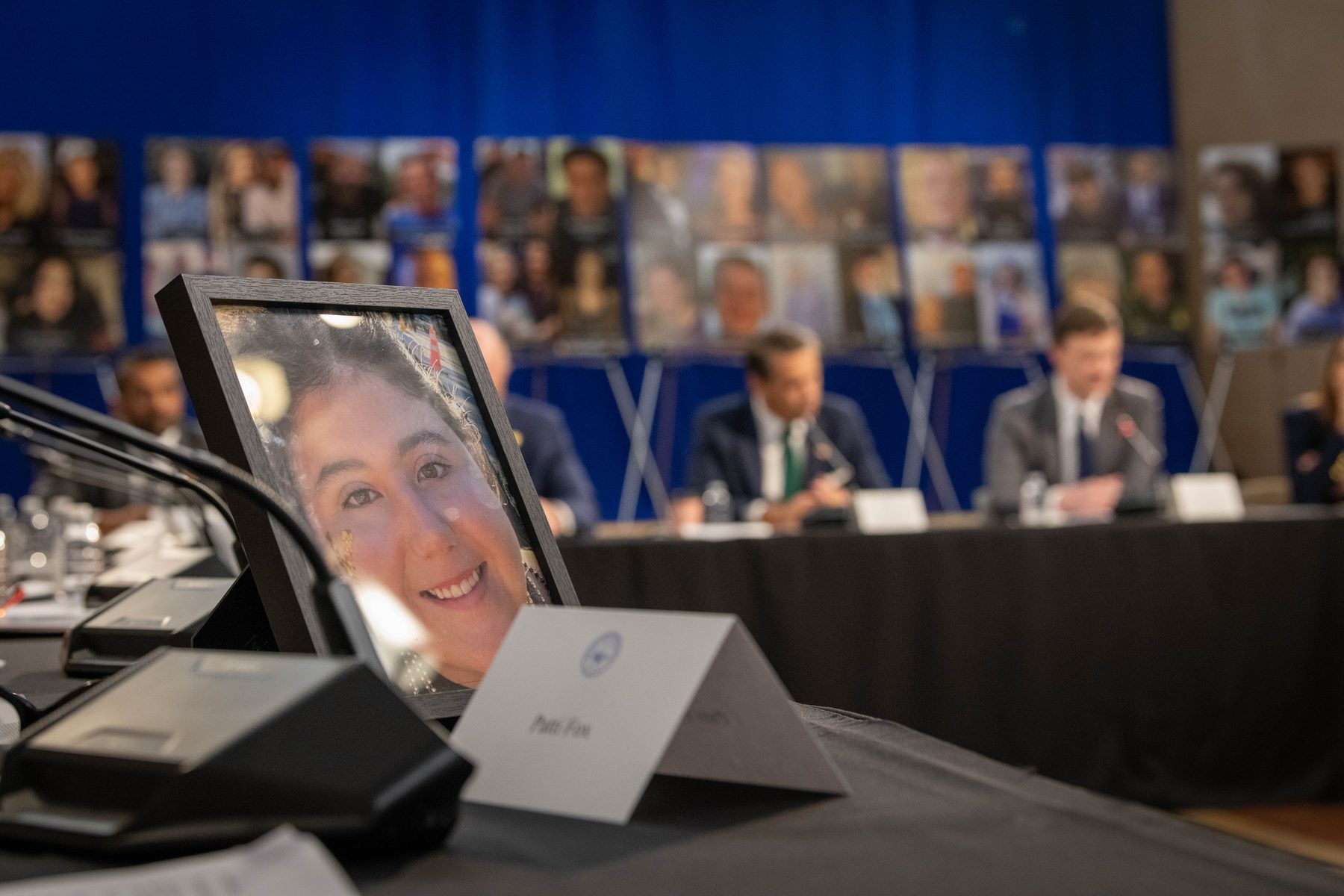
A framed photo at Patti Fox's seat during the September 24 summit. The Colorado mother's daughter, Carissa, was critically injured in a hit-and-run by an illegal alien, according to DOJ's speaker biography. (U.S. Department of Justice photo, public domain)
The families at the table carried the day. Joe Abraham, a lifelong Illinois resident, lost his daughter Katie to a drunk-driving illegal alien in January 2025, per DOJ's speaker list. Jennifer Bos of Illinois lost her daughter Megan. Jessica Gorman's daughter Sheridan, an 18-year-old Loyola University Chicago freshman, was shot dead near Chicago's lakefront on March 19.
The 287(g) Gate Is in the Fine Print
The DOJ press release never uses the term 287(g). The notice of funding opportunity puts it on page 5. Applicants "must also have established and fully participate in a 287(g) partnership, or commit to entering into and fully participating in one."
A 287(g) agreement lets ICE train and deputize local officers to handle certain immigration duties. The notice also demands full participation in Homeland Security Task Force operations or another major DOJ enforcement effort. Applicants have to prove it with a letter from the Lead HSTF Attorney in their U.S. Attorney's Office.
Nationwide, the door is wide open. ICE's 287(g) program page lists signed agreements with agencies in dozens of states, most of them under the Task Force Model.
Illinois Law Slams That Door Shut
Illinois is not on the map. The state Attorney General's own June 2025 guidance on the TRUST Act says it plainly: "Illinois law, however, prohibits any law enforcement agency or official in Illinois from entering into a Section 287(g) agreement." It cites 5 ILCS 835/5(b).
The ban dates to 2019, when Gov. J.B. Pritzker signed House Bill 1637, The Appeal reported at the time. The same report noted that McHenry County's sheriff had applied to join the program, and the law cut that application off. California passed its own ban in 2017.
Official record
DOJ FY 2026 Assisting Neighborhoods and Governments with Enforcement of Laws (ANGEL) Grant Program, Notice of Funding Opportunity O-BJA-2026-172778, Bureau of Justice Assistance, released September 24, 2026. Official copy at ojp.gov.
"Awards under this funding opportunity will include a condition (the specific terms of which will govern the award) related to the future reimbursement of the costs associated with federal law enforcement intervention or assistance provided to reduce crime or public disorder."
Notice of Funding Opportunity, page 6
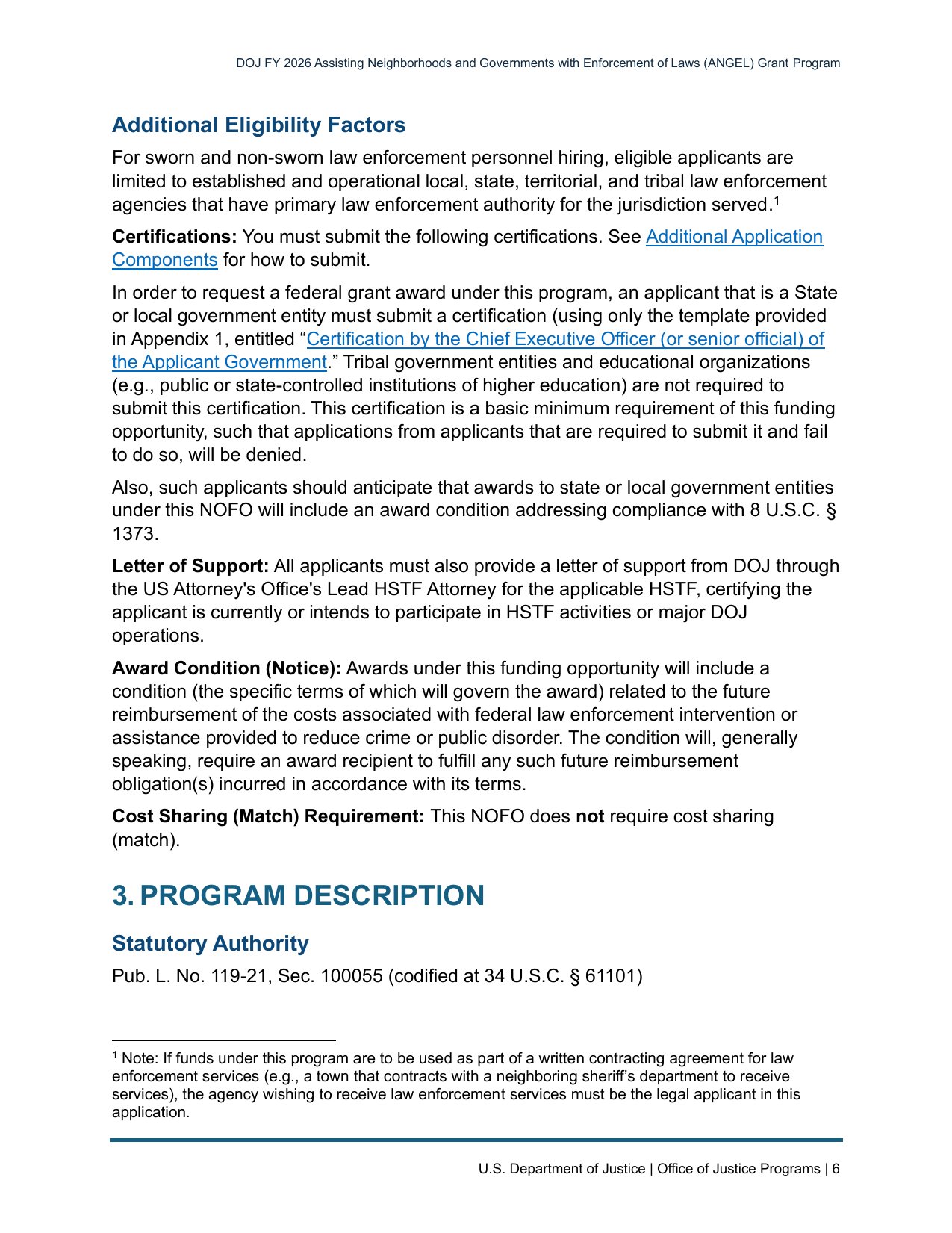
Read or download the full 16-page funding notice (PDF) · Bureau of Justice Assistance listing
So the math is simple. Associate Attorney General Stanley Woodward told departments "whose states have failed to provide you with the support you need" that "this program is for you." In Illinois, a police chief who wanted in would have to break state law first.
A Mayor Signs Under Penalty of Perjury
The 287(g) rule is not the only string. Every state or local applicant has to file a certification signed by its chief executive, usually a mayor or county executive. Appendix 1 has the signer swear "under penalty of perjury" that the jurisdiction will comply with 8 U.S.C. 1373 and 1644, the federal laws that bar governments from restricting the sharing of immigration status information with federal authorities.
The form spells out the exposure. A false statement "may be the subject of criminal prosecution," including under 18 U.S.C. 1001 and 1621, and can bring False Claims Act penalties. Skip the certification and the application "will be denied."
The out-of-scope list goes further. Nothing funded may impede immigration enforcement, "including by failing to comply with 8 U.S.C. § 1373, give access to DHS agents, or honor DHS requests." Money for legal services to removable aliens is barred, and hiring funds "may not be used for co-responders, interpreters, or translators."
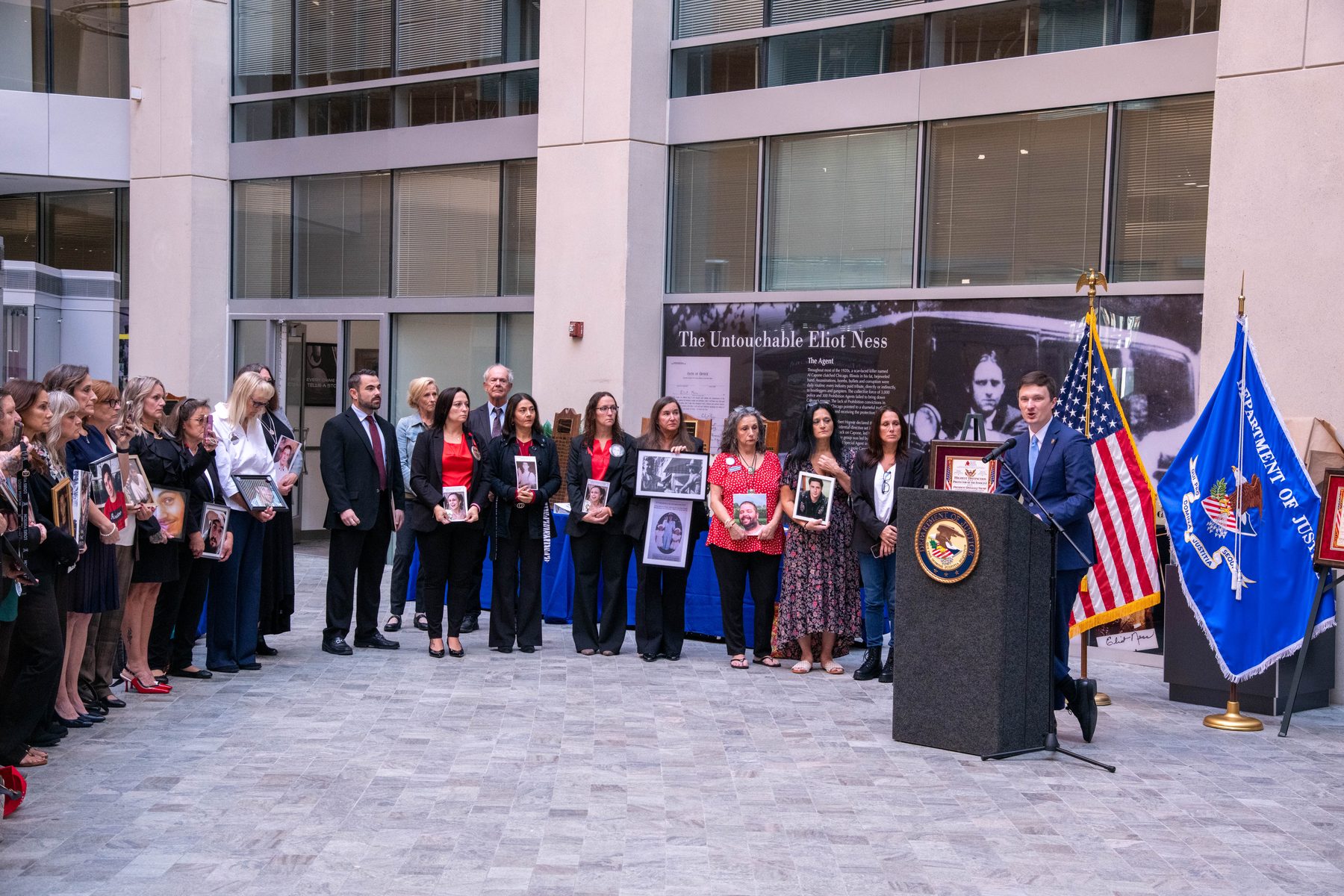
Families hold photos of loved ones as Acting Deputy Attorney General Trent McCotter speaks at the Justice Department memorial for the National Day of Remembrance for Murder Victims. (U.S. Department of Justice photo, public domain)
The Clause Nobody Is Talking About
Page 6 carries a condition that neither the DOJ press release nor the early coverage we reviewed mentions. Every award will require the recipient to "fulfill any such future reimbursement obligation(s)" tied to "federal law enforcement intervention or assistance provided to reduce crime or public disorder."
Read that twice. A city that takes ANGEL money agrees, in advance, to cover costs if federal officers later step in to restore order there. The notice never defines "intervention" or puts a cap on the bill. It says the exact terms will come in the award itself. Expect city attorneys to read that sentence very slowly.
$25 Million Is a Sliver of a $3.5 Billion Fund
ANGEL is funded by a pot with a name built to sting. The One Big Beautiful Bill Act created the "Bridging Immigration-related Deficits Experienced Nationwide (BIDEN) Reimbursement Fund," now codified at 34 U.S.C. 61101. Congress appropriated up to $3.5 billion, available until September 30, 2028.
The statute lets DOJ pay back state and local spending on qualifying work "that occurred on or after January 20, 2021," the day Joe Biden took office. ANGEL's $25 million is about 0.7 percent of that ceiling, spread across an expected 50 awards. Hoodline reports a separate, much larger BIDEN program launched in June under the same authority.
The scoring tells you what DOJ wants. "Description of the Need" counts for 5 percent of an application's score. Project design counts for 35 percent, and one required question asks how the applicant will advance "its established 287(g) partnership, HSTF operations, or other DOJ activities."
What Happens Before the October Deadlines
Applicants must file the SF-424 on Grants.gov by 11:59 p.m. Eastern on October 20 and finish in JustGrants by October 27. Awards run 36 to 60 months starting December 1. Hiring money can pay salaries for up to three years, including officers laid off in local budget cuts.
The accused in Sheridan Gorman's killing, Jose Medina, is a Venezuelan national the Department of Homeland Security says entered the country illegally in 2023, FOX 32 Chicago reported. He has pleaded not guilty to first-degree murder. His case will be tried in Chicago.
Her mother sat at the Justice Department's table last week. Under the grant announced in her daughter's honor, sheriffs in Texas, Florida and dozens of other states can line up for the money. In the state where Sheridan died, the law keeps every police department out of the line.
Top photo: Attorney General Todd Blanche's panel at the September 24 Summit on Victims of Violent Crime, with FBI Director Kash Patel and White House border czar Tom Homan seated at left, in front of photos of crime victims. (U.S. Department of Justice photo, public domain)