Two Christian student groups sued Virginia State University last week over a new campus ministry policy that stripped them of club status and put a university-employed pastor in charge of their Bible studies, prayer nights and guest speakers. Read the six-page policy the university actually wrote and you find something the coverage has not mentioned: the word "Christian" never appears in it. The only place the policy becomes Christians-only is in what its enforcer told students out loud.
Two Christian Clubs Just Sued a Public University in Virginia
The case is Women of Victory at Virginia State University v. Branch, Case No. 3:26-cv-01009, filed September 24 in the U.S. District Court for the Eastern District of Virginia, Richmond Division. Alliance Defending Freedom represents the VSU chapters of Women of Victory and Bethel Campus Fellowship, two national ministries that run Bible studies, worship nights and leadership trainings on college campuses.
The 36-page complaint names the university's entire Board of Visitors, President Makola M. Abdullah, Campus Minister Thomas Wynn and the eight staff members on a new Campus Ministries Faculty Advisory Board. Its opening line sets the tone: "The government cannot prefer Muslim and secular groups over Christian groups, cannot dictate to Christian groups how to worship, and cannot strip Christian groups of benefits for what they believe and for what they say."
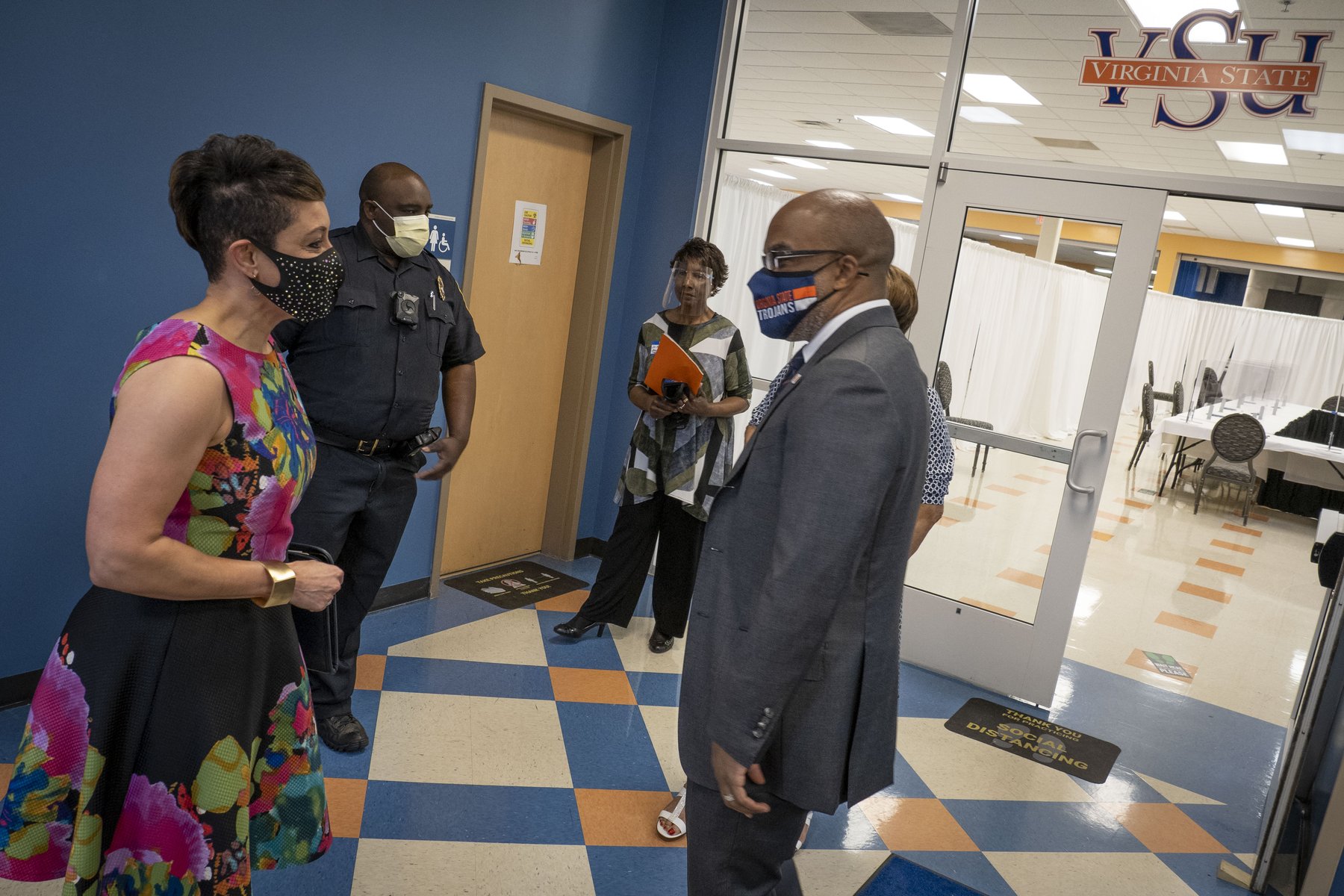
Virginia State University President Dr. Makola M. Abdullah (right, in VSU mask) greets USDA Deputy Secretary Jewel Bronaugh on campus in May 2021. Abdullah is a named defendant in the lawsuit. (USDA photo by Preston Keres, public domain, via Wikimedia Commons)
What the University Took Away on August 6
According to the complaint, both groups had been registered student organizations for years. Bethel Campus Fellowship registered in 2018, and Women of Victory started in 2019 under the name "Pinky Promise." Registered status came with meeting rooms, event promotion, leadership training, a spot at the October Org Bazaar during Homecoming, and access to money from student fees.
Those fees are not small. The complaint cites the state's 2026-27 tuition and fees report showing every VSU student pays a $473 "student activity" fee and a $91 "student union" fee. The members of these two clubs still pay both. Their clubs can no longer draw on the fund.
On August 6, the Campus Ministries office circulated the new policy. Student-led ministries could no longer hold registered status or affiliate with their national organizations. In an email quoted in the complaint, Wynn wrote that "there will be no 'campus chapter' of an external faith-based ministry or organization at Virginia State University."
The Six-Page Policy Never Names Christians
The policy itself is Exhibit 3 to the complaint, titled "VSU Campus Ministries Policy and Procedures Manual 2026-2027." We read all six pages. It talks about "faith-based community," "student-led ministries" and students growing "in their respective faith traditions." Section 4.3 says "Students from all faith traditions are welcomed and respected." Section 8 says Campus Ministries "is committed to serving students from all faith traditions."
The word "Christian" does not appear once. Neither does "Jesus," "Christ," "church" or "Bible." On paper, this is a neutral rule for every faith group on campus.
Then comes Section 9, titled "Muslim Student Association Relationship." It says the MSA "maintains its status as a separate officially registered student organization" and that "MSA governance and funding remain independent from VSU Campus Ministries." Section 10 sets up a "Community Faith Alliance" for local faith leaders, with no oversight rules at all. Every rule in Sections 4 through 7 about room requests, fundraising approval and two-week guest-speaker reviews lands on whatever groups are left.
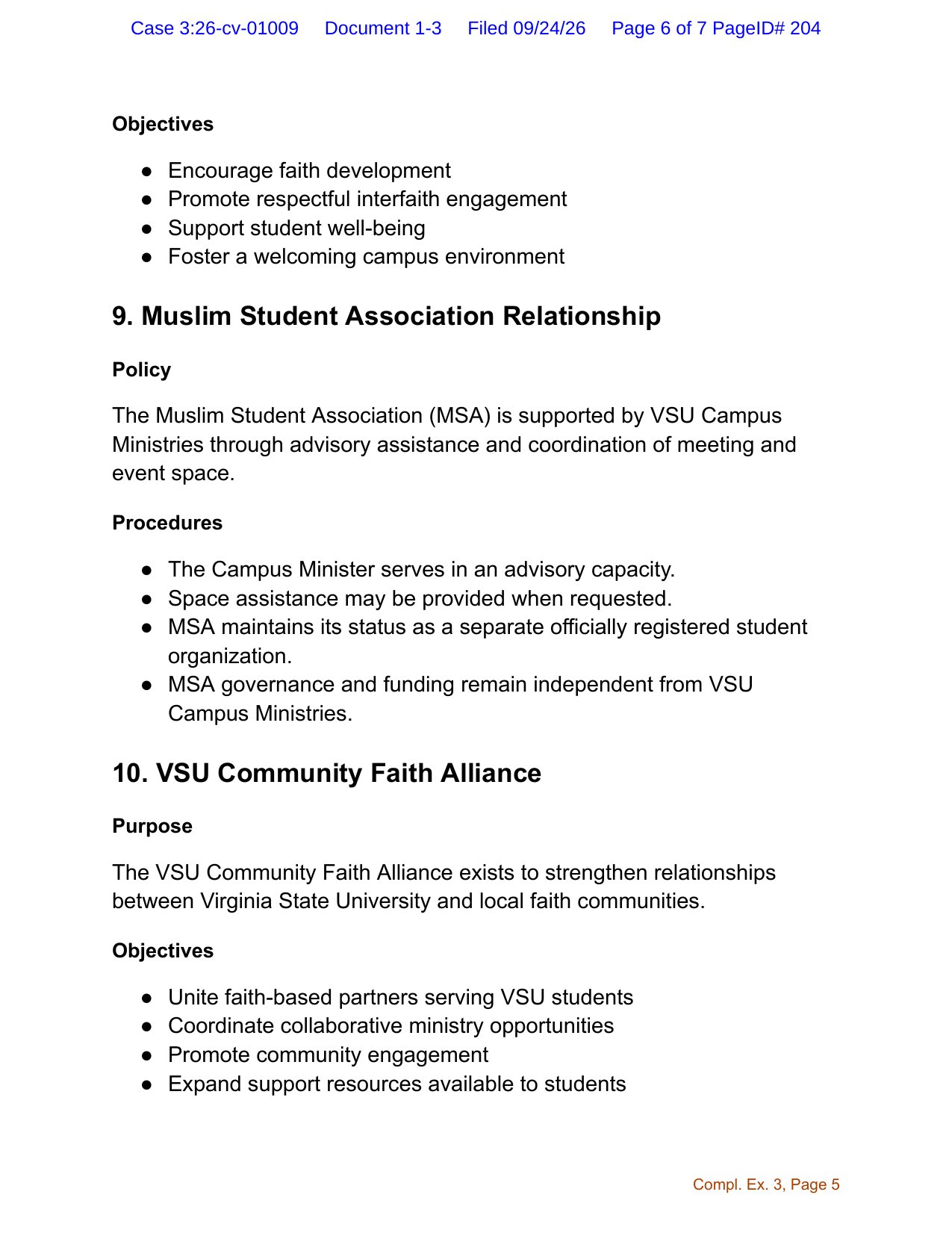
Section 9 of VSU's Campus Ministries manual lets the Muslim Student Association keep its registered status and independent funding. The Christian groups get no such section. (Complaint Exhibit 3, page 5, Women of Victory at VSU v. Branch, E.D. Va.)
One more detail at the bottom of the manual. The approval line reads "Approved By: VSU Campus Minister and Faculty Advisory Board." In other words, the document lists as its approvers the same nine people it hands power to. The complaint separately points out that under Virginia law and the Board's own bylaws, the Board of Visitors holds final authority over university policy. The manual lists no Board vote.
Official record
Women of Victory at Virginia State University and Bethel Campus Fellowship at Virginia State University v. Victor K. Branch, et al., Case No. 3:26-cv-01009 (E.D. Va., Richmond Division), Complaint, filed September 24, 2026. Full filing with all eight exhibits (PDF, via ADF).
"Although the Policy begins with a commitment to help students 'grow in their respective faith traditions,' Defendant Wynn clarified that the Policy applies only to Christian religious groups."
Complaint, paragraph 13
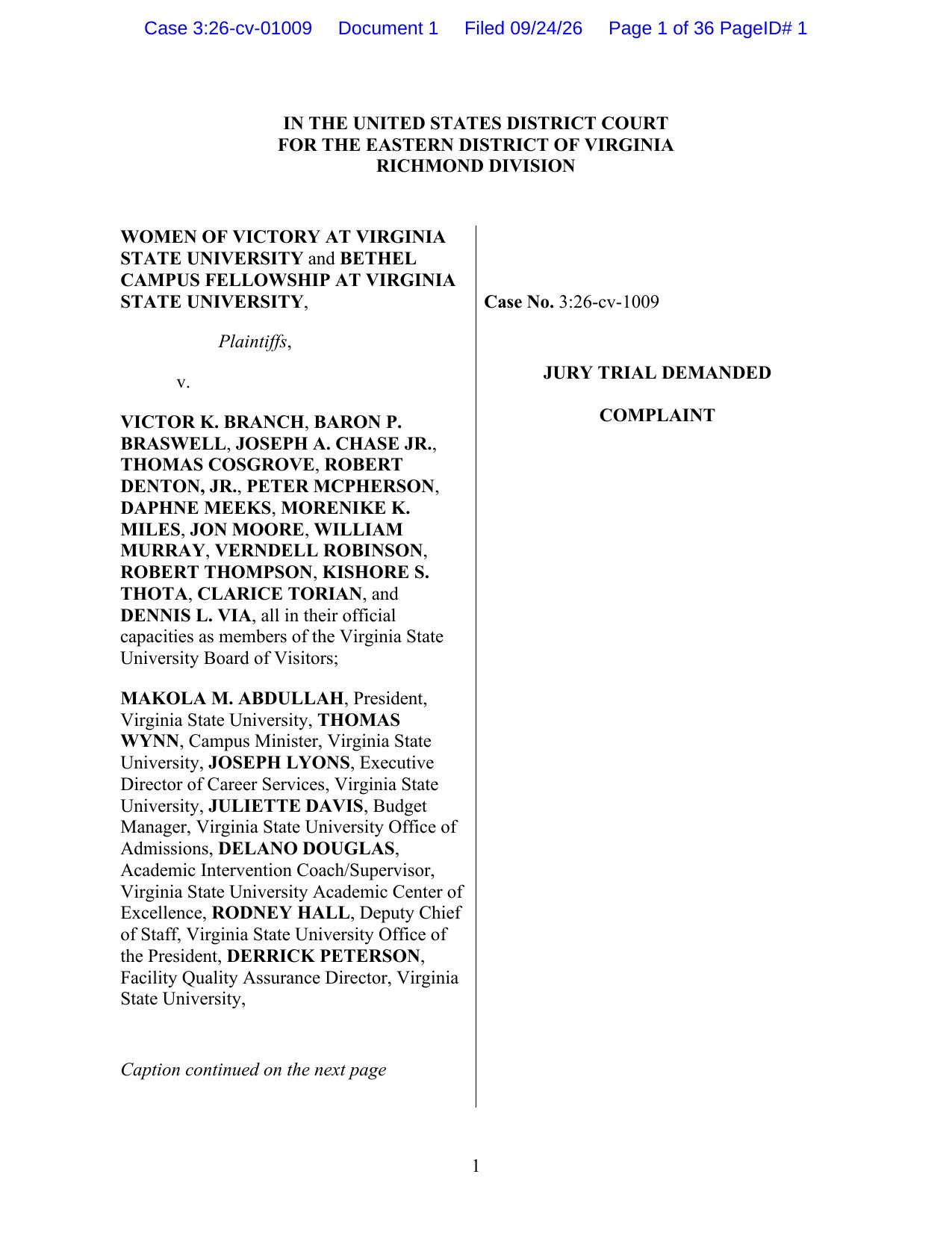
Read or download the 36-page complaint (PDF) · Read the six-page VSU Campus Ministries manual (Exhibit 3, PDF)
So Who Said It Was Only for Christians?
The campus minister did. On August 19, VSU held a roughly two-hour meeting for Christian student leaders, and the plaintiffs filed a 106-page transcript of it as Exhibit 2. When a student asked why fraternities and sororities kept their registered status and national ties, Wynn answered, according to the complaint, "Because you all are faith-based .... Because, because you purport Jesus Christ and faith."
Asked whether students could keep talking to their national ministries, he said, "It's just a chop. Is it gonna be pain? Is it gonna be uncomfortable? Probably." Groups could keep the national name, he added, "but know it'll be name only."
The transcript also shows how far the rules reach past the written text. Wynn described a student who called to ask permission for a Friday prayer meeting and said the old habit of just getting friends together to pray in Foster Hall "is not what the university want." The complaint says Wynn told students a faculty advisor must be physically present at every Christian gathering, from Bible studies to pajama parties.
Wynn's Own Explanation for the Muslim Exemption
To be fair to Wynn, the transcript contains more than the lawsuit's headline quote. When pressed on the MSA carve-out, he said the group has "money outside of Campus Ministries" and is "part of a grant," and that it was treated differently "because they were a underserved demographic." He also said, "Because we are a state university, I cannot only deal with people who believe in Christ. I have to deal with everybody."
Then he kept going. The MSA is different, he said, "'cause they, they're higher up. They're with the, with... I think he works in the president's office or very close to the president's office." He added, "it's not discrimination. It's actually to give them a more equal footing and a voice on campus."
That answer is the lawsuit's problem for VSU. A grant might explain separate bookkeeping. It does not explain why only Christian students need a minister's sign-off to hold a prayer meeting. The complaint adds that Wynn said any future Hindu or Buddhist group would be judged "case-by-case" for the same kind of exemption.
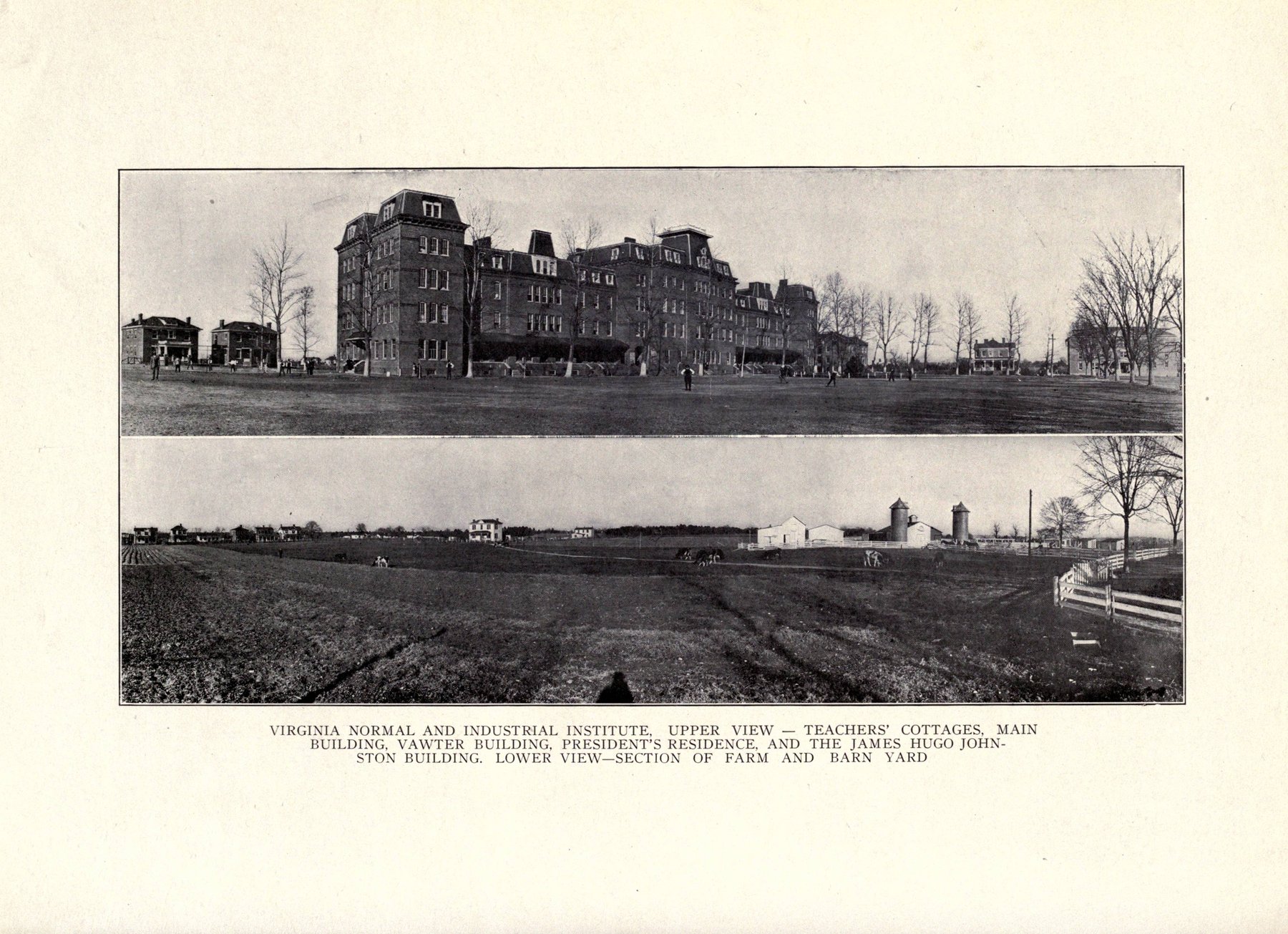
The campus of Virginia Normal and Industrial Institute, now Virginia State University, as published by 1919. The school dates to 1882. (From The National Cyclopedia of the Colored Race, 1919, public domain, via Wikimedia Commons)
A Labor Day Pajama Party Drew a Reprimand
The complaint's most concrete example came after the policy took effect. On Labor Day, September 7, Women of Victory members met in a campus common area for an informal "pajama party" to close out the long weekend. When Wynn learned about it, the complaint says, he texted a student leader to reprimand her for gathering without his permission, even though the written policy says nothing about informal hangouts.
The suit also says the policy ended Sunday shuttles that used to take students to a local church. The transcript quotes Wynn directly: "The school wants to crack down on transportation to out- outside churches." Bethel Campus Fellowship has stopped its on-campus activities entirely, according to the filing. Women of Victory still meets weekly, with Wynn attending, despite the women's request for a female advisor.
Why This Case Looks Like an Uphill Fight for VSU
The suit brings free exercise, church autonomy, Establishment Clause, free speech, association and equal protection claims. It leans on Trinity Lutheran v. Comer for the rule that government may not impose "special disabilities on the basis of ... religious status," and on Our Lady of Guadalupe School v. Morrissey-Berru for the rule that government cannot "dictate or even to influence" matters of faith and doctrine. Putting one state-paid pastor over every Christian ministry on campus is close to a textbook example of what those cases forbid.
Virginia's own law points the same direction. Section 23.1-400 of the Virginia Code, on the books since 2013, lets a religious student group choose its own leaders and define its own doctrines, and bars public colleges from discriminating against groups that do. The complaint cites it in a footnote.
The clubs want a preliminary and permanent injunction, restored registered status, a halt on charging members activity fees while the policy stands, and damages from the officials sued individually. VSU had not posted a public response as of Friday, The Legacy Newspaper reported, and no ruling has been issued.
The Real Test Is What a University Says Out Loud
VSU wrote a policy that reads as neutral and then, according to its own campus minister on tape, enforced it against one faith. The paper version will not save the university if the court believes the transcript. And that transcript runs 106 pages, recorded in a room full of Christian student leaders who were told, in Wynn's words from the complaint, that "you're not being suppressed, you're being released."
Women of Victory's founder, Jneva Norfleet, started the ministry as a VSU sophomore nearly nine years ago. Her students are not asking for special treatment. They are asking for the same rules the Greek organizations and the Muslim Student Association already get.
Top photo: Vawter Hall on the Virginia State University campus. (Photo: Jweaver28, CC BY-SA 4.0, via Wikimedia Commons)