ATF is sitting on 1,414,088,513 pages of gun sale paperwork from closed dealers, and eight Republican senators and Rep. Michael Cloud now want the Trump administration to destroy it. To defend the archive, ATF told Congress it cracked the Butler assassination attempt in 30 minutes with those records. Read the letter, and ATF's own paragraph shows that the Butler rifle was sold 11 years before the shooting, well inside the 20-year cutoff ATF has already proposed.
Congress Just Put the "Gun Registry" in Writing
On September 24, Sen. Jim Risch of Idaho and seven colleagues wrote to Attorney General Todd Blanche about what they call "an illegal national gun registry now containing 1,414,088,513 records of guns and gun owners." The records sit at ATF's Out-of-Business Records Center in Martinsburg, West Virginia. The senators say they "include names, addresses, Social Security numbers, and the specific firearms purchased."
The signers are Risch, Mike Crapo, Marsha Blackburn, Ted Budd, Tom Cotton, Steve Daines, Cindy Hyde-Smith and Pete Ricketts, according to AmmoLand. They want an independent investigation and the "prompt and verifiable destruction" of any records kept in violation of the 1986 Firearm Owners' Protection Act, which bans "any system of registration of firearms, firearms owners, or firearms transactions."

Sen. Jim Risch (R-Idaho), who led the September 24 letter to Attorney General Todd Blanche. (U.S. Senate official portrait, public domain, via Wikimedia Commons)
On Tuesday, Cloud took the same demand to the top. Just the News reported that the Texas Republican sent a letter asking President Trump and Vice President JD Vance to dismantle the database. Vance has called it "a back door to a gun registry in this country," a line the senators quote in full.
Where the 1.4 Billion Number Comes From
The figure traces to a five-page ATF letter to Cloud, dated June 10, 2026, and signed by Assistant Director Justin Ward. It answers questions Cloud sent in February 2025 and February 2026. Gun Owners of America publicized it Tuesday as ATF "confirming to Congress," though the letter itself is more than three months old and its count runs "as of 05/19/2026."
ATF's own chart breaks the total into 912,184,571 images in its Enterprise Content Management system, 397,009,542 images converted from microfilm and microfiche, and 104,894,400 paper pages still waiting to be scanned. Those add up exactly to 1,414,088,513. A footnote under the chart says "an image is the equivalent of a single one-sided page of a document."
So the famous number counts pages, not people or guns. That cuts both ways. A multi-page Form 4473 takes up several images for one sale, while a single page of a dealer's bound acquisition and disposition book can list many guns. Nobody outside ATF knows how many Americans are in there, and ATF's letter doesn't say.
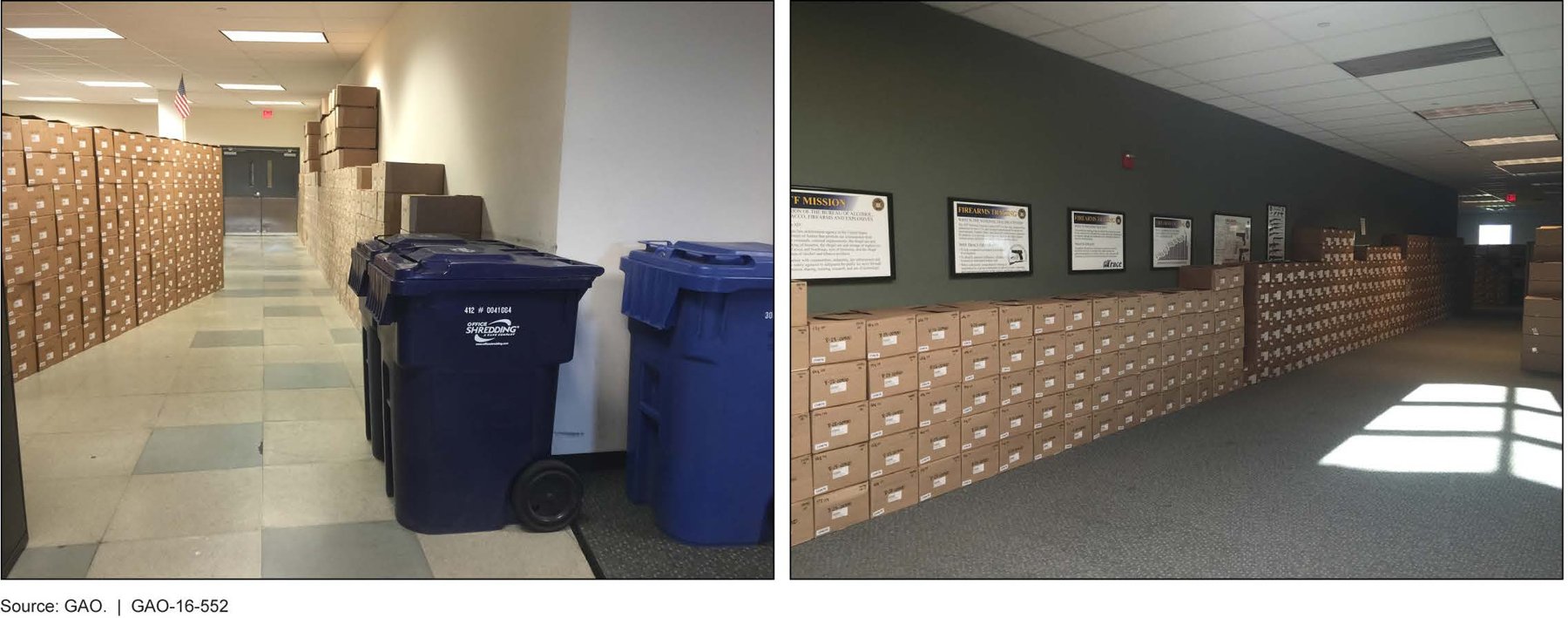
Boxes of out-of-business dealer records lining the halls of ATF's National Tracing Center in Martinsburg, West Virginia, photographed for a 2016 federal audit. (U.S. Government Accountability Office, GAO-16-552, public domain, via Wikimedia Commons)
ATF's Star Witness Is the Butler Trace
Before it answers a single question, the letter makes its case with the worst day of the 2024 campaign. "The importance of OBRs was vividly demonstrated on July 13, 2024," ATF wrote, when the National Tracing Center traced the would-be assassin's rifle "within 30 minutes of the request and did so using OBRs."
That trace mattered. CNN reported at the time that the shooter carried no ID, and that the AR-style rifle led agents to a 2013 purchase by his father from a now-closed dealer. ATF's statement then said results "helped identify the shooter."
Official record
Letter from ATF Assistant Director Justin Ward, Public and Governmental Affairs, to Rep. Michael Cloud, June 10, 2026 (5 pages), as published by AmmoLand.
"The firearm was purchased 11 years prior to that event and from a business that is no longer in existence. Absent the ability to review OBRs, the trace would not have been able to be completed."
ATF letter to Rep. Cloud, page 1
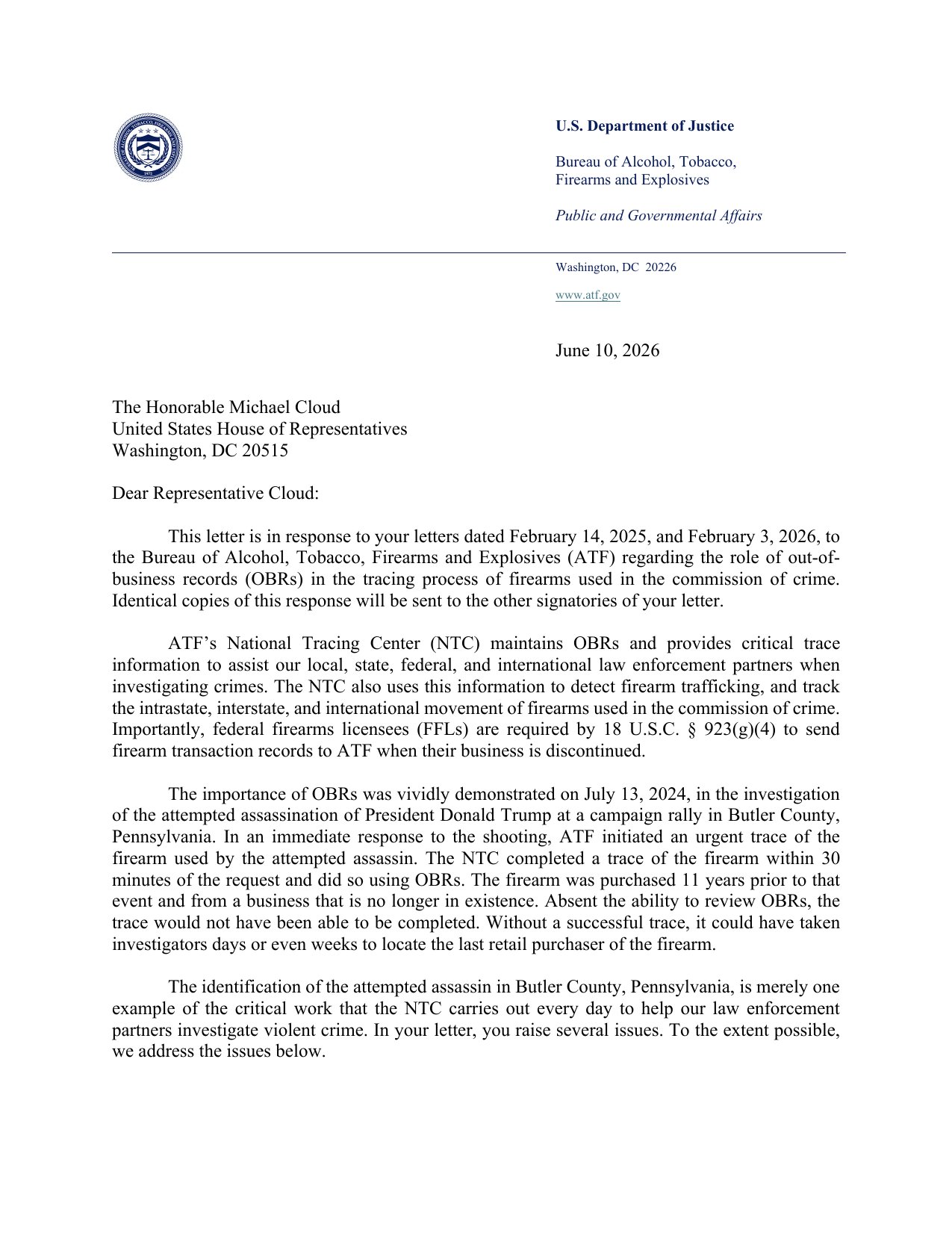
Read or download the full 5-page ATF letter (PDF) · ATF's proposed retention rule, 91 FR 24413
Eleven Years Is Inside ATF's Own Proposed Cutoff
This is where the argument falls apart. ATF's own proposed rule, published May 6 under President Trump's February 2025 Second Amendment executive order, would let ATF keep out-of-business records "for no longer than 20 [or 30] years from the date they receive the records." Neither option touches an 11-year-old sale.
Look at the clock in that sentence. It starts when the box arrives in Martinsburg, not when the gun was sold. A rifle sold in 2013 by a shop that closed later would be safe under either option until the 2030s at the earliest. The Butler trace would have gone exactly the same way under the rule ATF itself wrote.
The 20-year line is not new either. The rule's own history section says a 1985 ATF rule let dealers stop keeping records after 20 years, citing "the diminished frequency in utilizing records over 20 years of age in tracing." That stood until the Biden ATF's 2022 rulemaking required dealers to keep records until they close the business. ATF's letter to Cloud offers Butler as proof that old records matter. It is really proof that records under 20 years old do the work.
The 12.86 Percent Figure Shrinks When You Check the Table
Cloud asked ATF for "concrete evidence" that records older than 20 years are needed. ATF answered that "law enforcement would be denied investigative leads 12.86% of the time" without them. The table printed right above that sentence tells a different story.
The share of traces using records 20 or more years old fell from 17.80 percent in fiscal 2017 to 10.30 percent in fiscal 2025. The 12.86 figure is simply the average of those nine yearly percentages, propped up by the older, higher years. The letter also describes that same number as a share of "all traces" in one sentence and of "successful crime gun traces" in the next. The table measures total traces. We added up the table's own yearly counts, too, and they average 67,601 traces a year, not the 66,642 the letter reports.
ATF's proposed rule is more precise. It says about 89 percent of successful traces in fiscal 2024, or 414,405 of 464,325, found a purchaser using records less than 20 years old. It also concedes that keeping records to 30 years would have added "almost 10,000" successful traces that year. So the real choice between a 20-year and a 30-year limit comes down to roughly 10,000 extra leads a year, weighed against another decade of gun buyers' names in a federal archive.
Even the Trump Rule Leaves Most of the Archive Standing
The proposed rule says that as of June 2025, ATF held "approximately 1.3 billion images" and estimated that "500 million images in the OOB records are older than 20 years." By ATF's May count, the archive had grown by about 114 million images in less than a year. The rule says the tracing center was taking in about 6.8 million out-of-business records a month.
By ATF's own estimate, then, a 20-year limit would still leave about 800 million of those 1.3 billion images in place, and a 30-year limit even more. It may keep more than that, because the 500 million estimate appears to measure how old the records are, while the rule's clock runs from the day ATF received them. The dealer side of the rule sets a floor, not a ceiling. Dealers must keep each Form 4473 "for no less than 20 [or 30] years" from the sale, and anything still on hand when a shop closes goes to Martinsburg. That is the pairing Risch calls "effectively creating lifetime registration of every legal purchase." Comments on the rule closed August 4, and no final rule has been published.
ATF Says It Can't Search by Name. Congress Wants More Than a Promise.
ATF's defense is technical. Records go into its system as "non-searchable, static images," indexed by dealer license number and sometimes serial number. ATF says it "does not utilize optical character recognition" to capture buyer names. It "does not have the capability to conduct a search" by name, the letter says. Gun Owners of America argues name search is only switched off, and Bearing Arms pointed out that ATF disclosed a breach of one of its systems in August, which Justice Department officials classified as a "major incident". ATF says its digitized records were not accessed.
ATF's letter shows the bureau already knows how to purge buyer names. On page 5 it says that under longstanding policy it "purges individual purchaser names from multiple sale transaction reports after 24 months," unless a report matches a crime gun trace. ATF clears names from one database after two years while defending decades of names in another.
Some coverage is garbling ATF's own words, too. Just the News wrote that investigators traced the Butler rifle "using records from a dealer that had closed 11 years earlier." The letter says the gun was purchased 11 years earlier. That detail is the whole ballgame, because it puts ATF's best example inside the line ATF has already drawn.
Blanche has not publicly answered the senators. The Trump ATF has already admitted in the Federal Register that indefinite retention raises registry concerns. The open question is whether it finalizes a cutoff that keeps most of the archive, or listens to the members of Congress who say federal law never allowed it in the first place.
Top photo: Rep. Michael Cloud (R-Texas) speaking at The People's Convention in Detroit, Michigan, June 15, 2024. (Photo: Gage Skidmore, CC BY-SA 2.0, via Wikimedia Commons)