Hackers breached a Bureau of Alcohol, Tobacco, Firearms and Explosives computer system, and senior Justice Department officials declared it a "major incident." That phrase is a legal designation with a deadline attached, not an adjective. ATF confirmed the intrusion on Wednesday, August 26, hours after the ransomware group Qilin added the agency to its dark-web leak site.
What ATF actually said
The ATF statement runs five short paragraphs. It says the incident hit "a standalone system" that "operates separately from the ATF enterprise network," with "no indication" the breach reached that network, the eForms platform, or anything else the agency runs. ATF cut connections and began forensic work. Justice is investigating.
An ATF spokesperson went further with one outlet. Jonathan Greig of Recorded Future News reported that the compromised machine was "a standalone computer system containing information about targets of ATF investigations." That is the only description of the contents on the record.
Now the other half. David DiMolfetta of Nextgov/FCW reported that ATF would not identify the system, say when the intrusion was found, or say whether anything was stolen. Qilin has posted no data samples. ATF has not blamed Qilin and has not used the word ransomware.
"Major incident" has a legal definition and a seven-day clock
Agencies do not decide what "major incident" means. Congress told the Office of Management and Budget to define it, and OMB's most recent published guidance is Memorandum M-25-04, issued January 15, 2025. Page 18 sets the test: an incident is major if it "is likely to result in demonstrable harm to the national security interests, foreign relations, or the economy of the United States, or to the public confidence, civil liberties, or public health and safety of the American people," or if it is a breach of personal information likely to do the same.
The memo forces that determination for any unauthorized access to the personal information of 100,000 or more people. Once the label attaches, the agency has seven days to notify the relevant congressional committees and its inspector general under 44 U.S.C. 3554(b)(7)(C)(iii)(III), and 30 days for a supplemental report if it was a breach.
Read ATF's sentence again. The bureau did not make this call. "Senior Department officials" did, and ATF says the notifications are done. ATF never named the authority, saying only "applicable federal guidelines." DiMolfetta wrote it is likely the FISMA classification, the reasonable reading and still an inference, because nobody at Justice has said what tipped the scale.
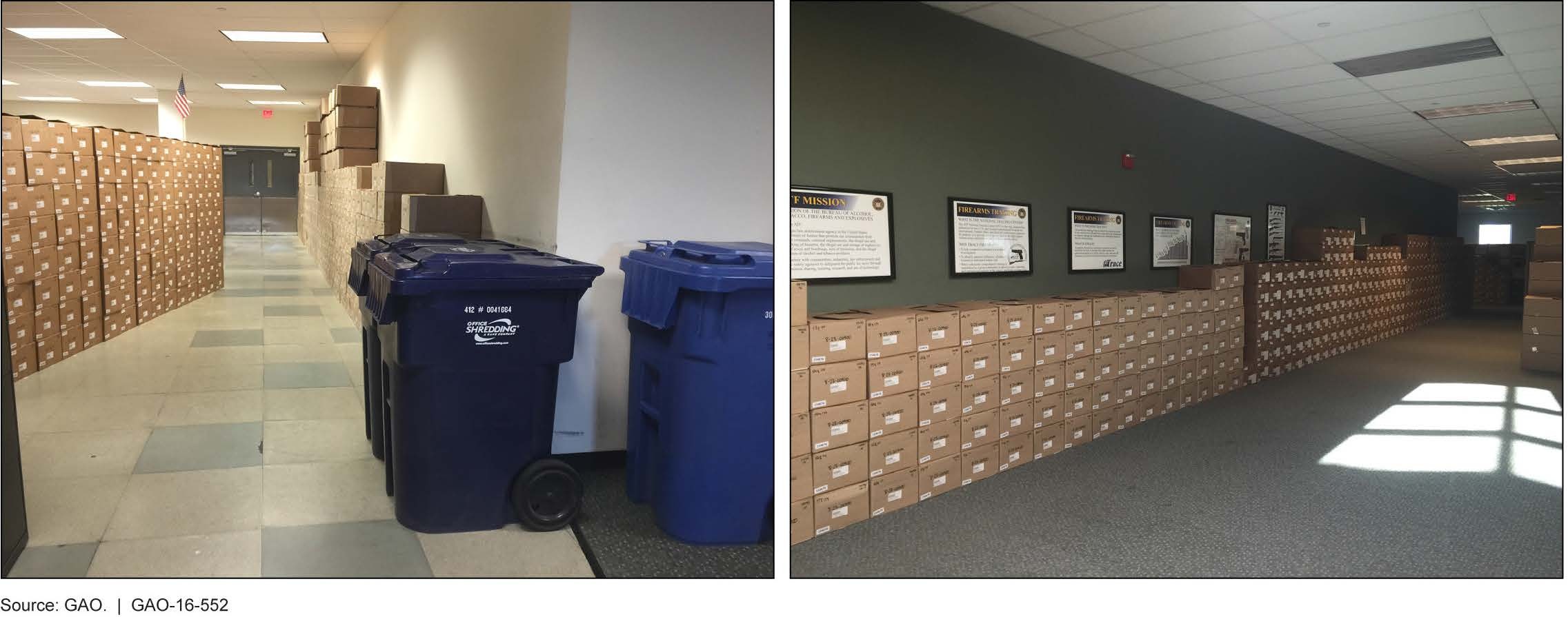
Out-of-business records boxes lining the halls at ATF's National Tracing Center in Martinsburg, West Virginia. These are the paper Form 4473s surrendered by dealers who closed their doors, and they feed the agency's digital records system. (U.S. Government Accountability Office, report GAO-16-552, public domain)
Why gun owners hear this differently
A breach at the Department of Agriculture stays a Department of Agriculture story. A breach at ATF lands on a database Congress has been fighting the agency over for five years. When a licensed dealer closes, federal law makes it hand its transaction records to ATF, which images them into the Out-of-Business Records Imaging System.
The scale is not in dispute. In a written response to Rep. Michael Cloud of Texas, ATF conceded it managed 920,664,765 out-of-business records as of November 2021, roughly 865.8 million already digitized. ATF says that is not a registry because the system cannot be searched by name, and a 2016 GAO audit found the same: searchable by dealer number, serial number and firearm descriptors, not by the buyer's name. Twenty-seven members of Congress do not find that reassuring, and said so in writing three weeks before this breach.
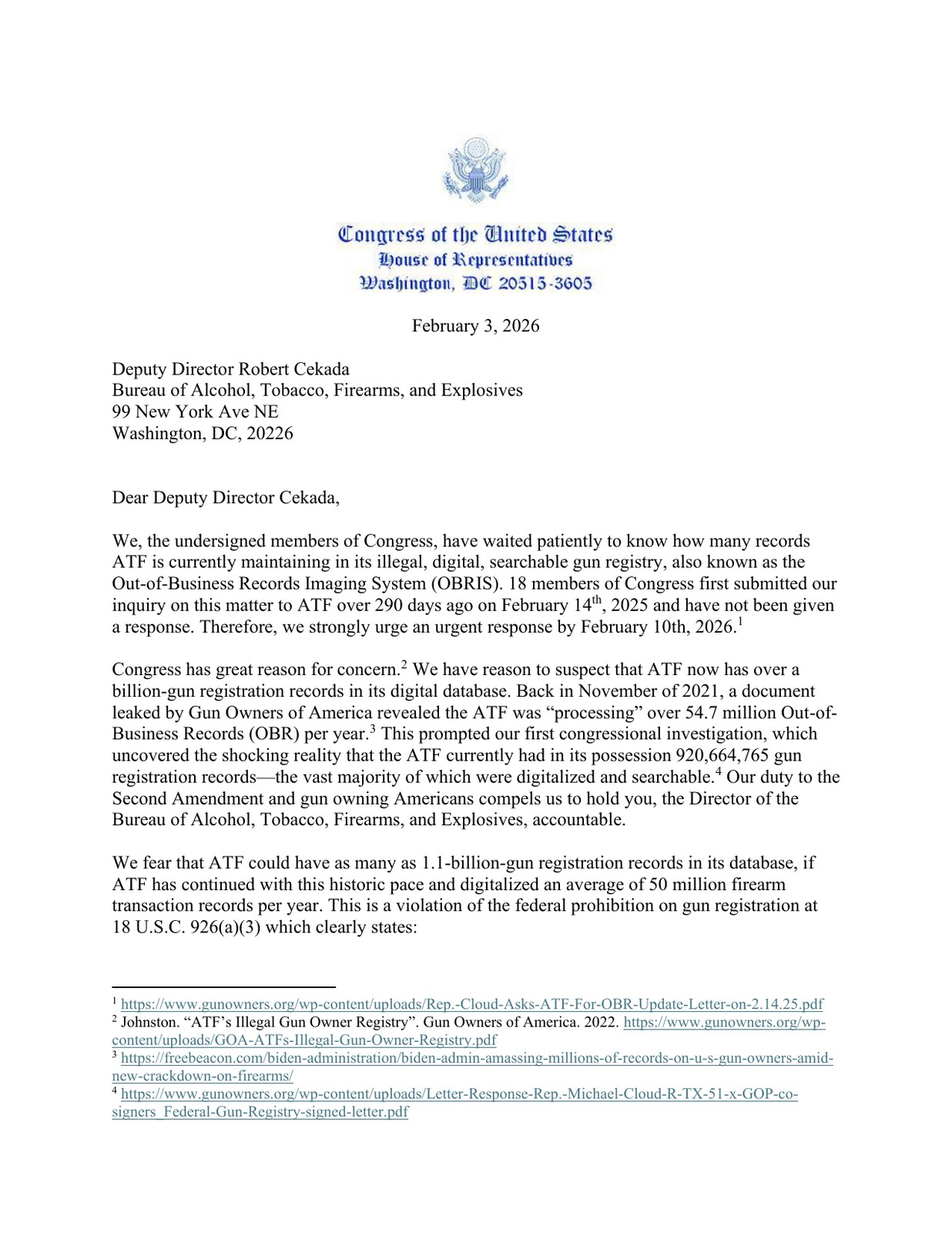
That was a follow-up. The original inquiry went to ATF on February 14, 2025 and sat unanswered for more than 290 days. The new one set a February 10 deadline. ATF has said nothing publicly.
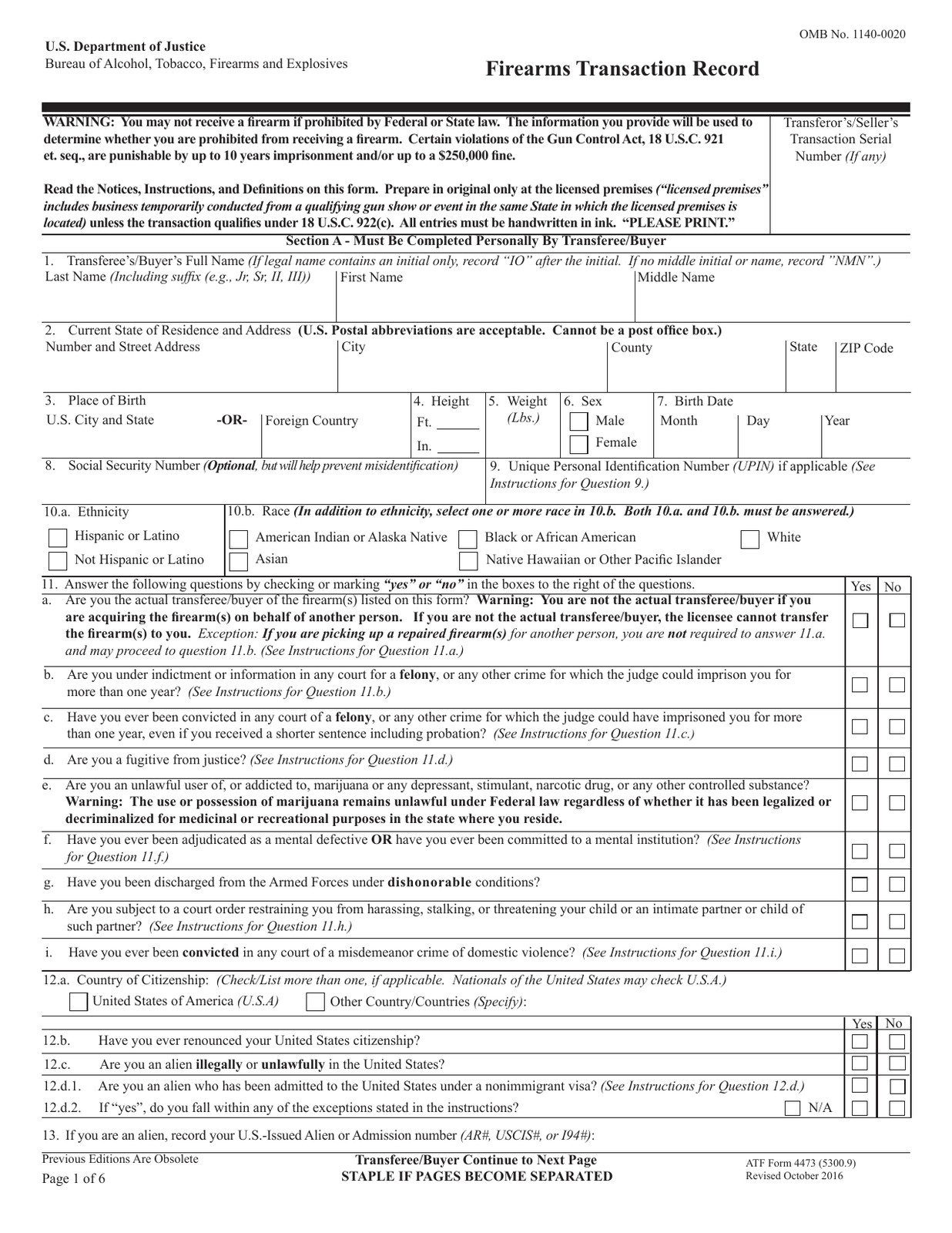
Page one of ATF Form 4473, the Firearms Transaction Record every buyer fills out at a licensed dealer, shown here in the October 2016 revision. Name, home address, place of birth, height, weight, sex, date of birth, race and an optional Social Security number all sit on the first page. (ATF via Wikimedia Commons, public domain)
What the gun groups are saying
Gun Owners of America got out ahead of the agency, posting on August 26: "Ransomware gang Qilin claims to have hacked ATF. It's unclear what data, if any, was stolen. But @ATFHQ maintains a registry of more than 1 BILLION guns and gun owners." The Daily Caller News Foundation took it to Justice, which is how the confirmation surfaced.
An NRA spokesperson told the DCNF: "The NRA is deeply concerned about how data leaks can expose the privacy of gun owners." Second Amendment Foundation litigation director William Sack put it harder in the same story. "Not only should our government not have that information," he said, "but they've shown over and over again that it's not even secure in their possession."
What has not been established
No one has shown that a single Form 4473 left ATF's custody. Qilin listed the agency and posted nothing to back it up. Every line connecting this breach to gun-owner records is an inference from what ATF holds, not from anything ATF or the hackers have produced. The bureau says it does not yet know what was taken, normal enough four days in. It has not committed to saying later.
What to watch next
The congressional notification is reportedly done, so members of the Judiciary, Oversight and Homeland Security committees are sitting on a briefing the public has not seen. If Justice concluded this was a breach of personal information rather than only an intrusion, the supplemental report falls due around the last week of September. Cam Edwards of Bearing Arms argued the episode should force a real fight on Capitol Hill over how much data ATF has compiled on lawful firearm transactions.
That fight was already scheduled. House appropriators wrote two sections into the FY 2026 Justice Department funding bill aimed at defunding the records system, and Cloud says ATF's silence is blocking Congress from evaluating them. An agency that will not tell Congress how many gun-owner records it holds has now told Congress, and not the public, what happened when someone came looking for them.