A second mediator landed in Tehran on Thursday. Qatar's prime minister and foreign minister, Sheikh Mohammed bin Abdulrahman Al Thani, spent the day working through the Strait of Hormuz file with Iran's foreign minister, its president, its parliament speaker and its security chief, and put Doha's name on the same interim framework Oman has been drafting for weeks. Qatar's official readout added one clause Oman's never did.
The next morning Iranian Foreign Minister Abbas Araghchi posted his own verdict on the visit. "Putting diplomacy back on track isn't impossible," he wrote on X. "It hinges on U.S. understanding of one simple fact: pressure doesn't work." Today is six months to the day since the war began.
What Qatar actually put its name to
Qatar's foreign ministry published a short readout of the Araghchi meeting, carried in full by The Peninsula in Doha. It says the two men addressed "ongoing discussions regarding the proposed interim framework, which includes the establishment of a temporary joint shipping corridor through the Strait of Hormuz and an agreement to implement a joint project to clear the strait of mines."
Then comes the clause that is not in anything Oman has released. Sheikh Mohammed, the readout says, "stressed the necessity of respecting the sovereignty of neighboring countries and freedom of navigation." He repeated it on X, calling for "respecting freedom of navigation in the Strait of Hormuz in accordance with international law," per Al Jazeera. Reuters, working from the same ministry statement, called it a "temporary joint Iranian-Omani shipping corridor," a wording Al Arabiya carried. Qatar's own English text leaves the two national adjectives out.
That is a small difference in wording and a large one in meaning. Doha is endorsing the process without endorsing the premise that two countries own the waterway.
Qatar and Oman are not carrying the same document
The Oman track has details. Iranian Deputy Foreign Minister Kazem Gharibabadi announced on state television Tuesday that the lane will be seven miles wide, that entry begins in Iranian territorial waters, and that "part of the exit route would also be through our territorial waters," according to Al Jazeera's account. He also called it what it is: "The agreed-upon transit route with Oman is a temporary route." We covered that framework in full when it broke, including why the inbound leg running through Iranian water is the whole story.
An IRGC spokesman went further the next day. "Agreements have been reached on the share of each country in the waters of the strait and the share of Iran and Oman in its revenues," he said. Iranian army spokesman Mohammad Akraminia said vessels will be watched before they enter and will pass only if Iran grants permission. Al Jazeera's rundown lists what nobody has published: the coordinates, when ships can start using the lane, how the revenue gets generated, and whether any flag or vessel type will be barred from it.
Read Qatar's sovereignty line against that and it stops sounding like boilerplate. Muscat has never publicly claimed a share of anything. Tehran has claimed a revenue split, a permission regime and a lane that starts in its own water, and the government that helped secure both the April ceasefire and the June memorandum flew in and said out loud that neighbors have sovereignty too.
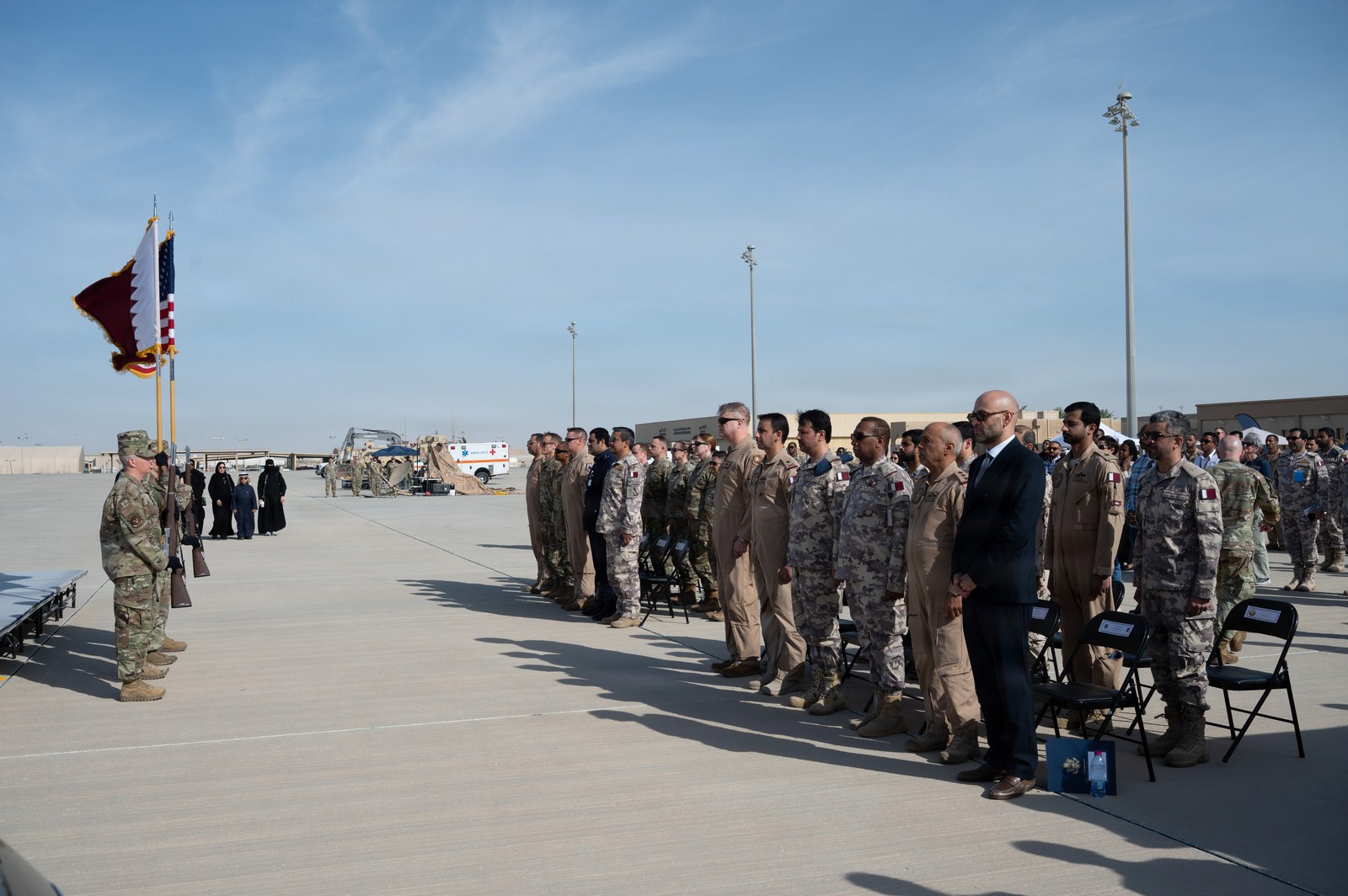
Qatar Emiri Air Force and U.S. Air Force leaders at a Partnership Day ceremony at Al Udeid Air Base, Qatar, on Feb. 11, 2026, seventeen days before the war started. Al Udeid is the main U.S. air hub in the region, and it sits in the country now carrying the Hormuz file into Tehran. (U.S. Air Force photo, public domain, via Wikimedia Commons)
Who clears the mines, and who signs off that they are gone
This is where the joint project gets expensive. Adm. Brad Cooper, the CENTCOM commander, announced Thursday in a video posted to X that American forces have cleared the internationally recognized shipping lanes. "Over the past few months, our forces have meticulously and quietly cleared them of sea mines using a combination of Navy divers, Navy SEALs, and U.S. air power from the Army, Navy, Air Force, and Marine Corps," he said. "We got the job done." His claim covers the traffic separation scheme, not the whole strait, as gCaptain noted the same day. The president's version was bigger. Trump wrote on Truth Social earlier in the week that the Navy had informed him "all mines have been removed and/or detonated from within the International Waters of the Strait of Hormuz."
The body that actually advises merchant shipping agrees with neither. The Joint Maritime Information Center holds the Strait of Hormuz at SEVERE and reports a "continued risk of drifting or uncharted mines in and near the TSS, with mine danger areas still active," with "clearance and mine-surveying operations continue throughout the Strait of Hormuz." That language is in Update 087 to the JMIC advisory note, dated Aug. 20, and JMIC repeated the substance of it Thursday, the same day Cooper declared the lanes clear.
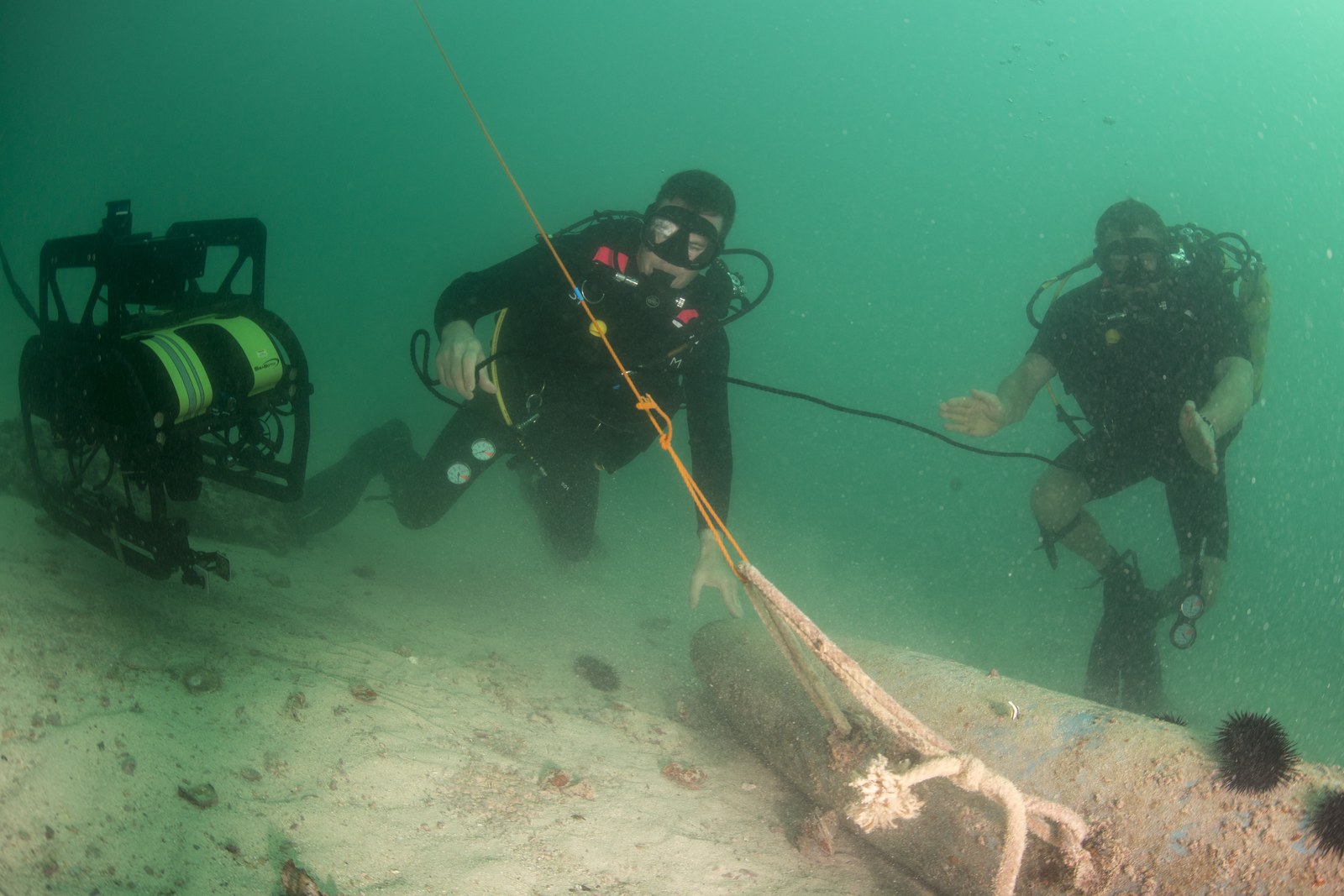
File photo: divers of the Royal Navy's Fleet Diving Unit 3 work with a remotely operated underwater vehicle alongside U.S. explosive ordnance disposal technicians in the Arabian Gulf, Nov. 17, 2015. Adm. Brad Cooper said Thursday that divers, SEALs and aircraft, rather than minesweepers, cleared the Hormuz shipping lanes. (U.S. Navy photo by Chief Petty Officer Brett Cote, public domain, via Wikimedia Commons)
Gharibabadi dismissed the American mine claims as "only aimed at calming the markets," and warned that U.S. mine-detection vessels entering the area would make "very good targets," per Al Jazeera. Nobody in the U.S. government has published a count of mines found or destroyed. Under the framework Qatar is now backing, the country that laid them helps run the operation that certifies they are gone.
Washington's answer is a two-page alert, not a proposal
The administration has not responded to the Iran-Oman framework on the record. Three days before Sheikh Mohammed flew to Tehran, it did something narrower. Treasury reissued its warning on paying Iran for passage, and one line in it lands directly on the corridor being drafted.
Official record
U.S. Department of the Treasury, Office of Foreign Assets Control, "OFAC Alert: Sanctions Risks of Iranian Demands for Strait of Hormuz Passage," dated August 24, 2026, an update to OFAC's May 1, 2026 alert. It was issued alongside the Aug. 24 designations Treasury branded Operation Economic Outcast, which added 24 individuals, 48 entities and 6 vessels to the sanctions list that day, per OFAC's own action page.
"OFAC strongly encourages all maritime service providers to conduct enhanced due diligence on any vessels attempting to transit the Strait of Hormuz to ensure that such vessels have not engaged in any sanctionable conduct involving Iran, which could expose the service provider to sanctions risk. Service providers should carefully review all available information for red flags, including voyage planning or actual transits through Iranian territorial waters." — OFAC Alert, August 2026, page 2
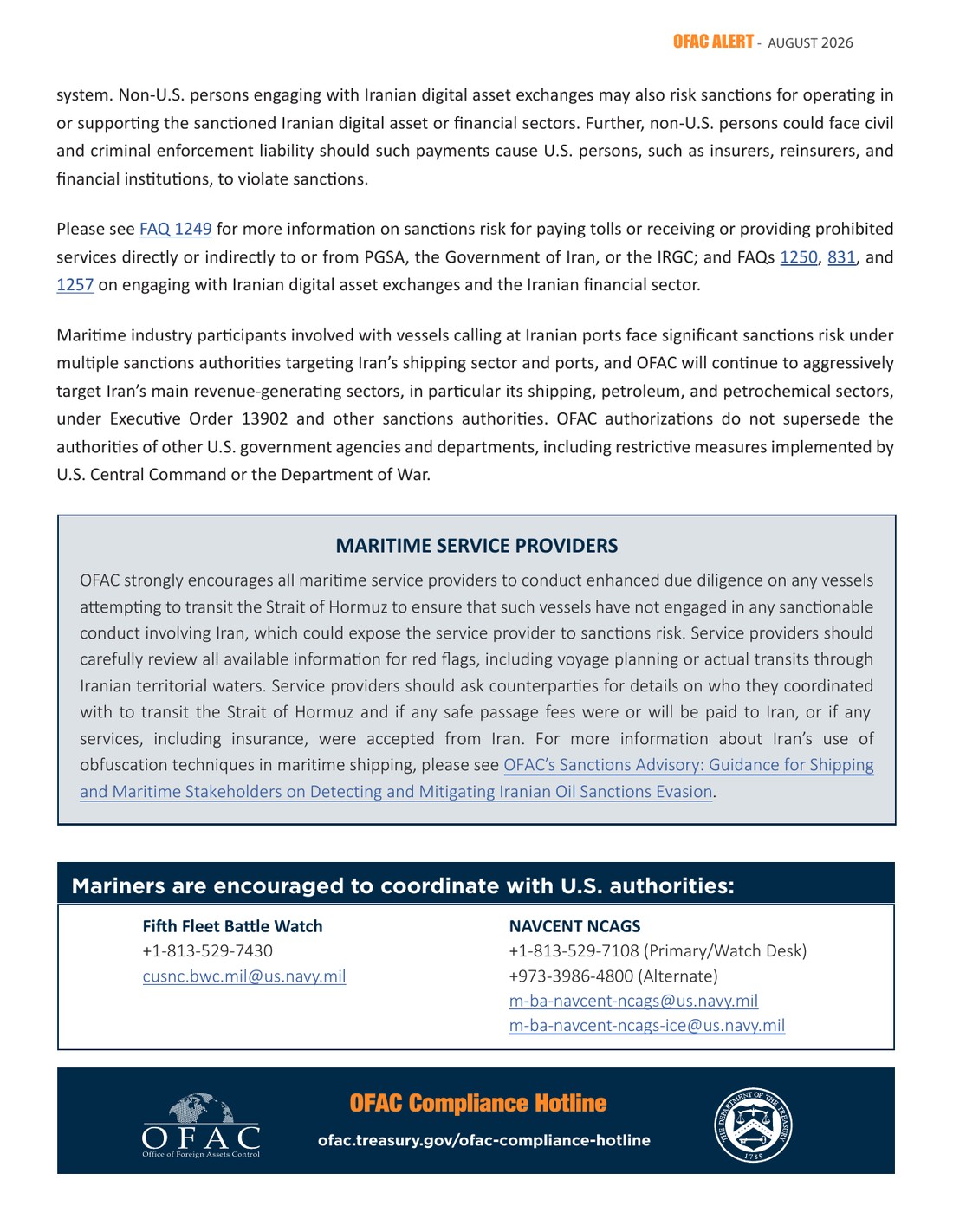
Read or download the full two-page alert (PDF) · page 2 shown, where the maritime guidance sits · view the same document on treasury.gov
The alert also states that a toll can be "fiat currency, digital assets, offsets, government-to-government deals, informal swaps, or other in-kind payments," and that the sanctions risk attaches "even if there is no associated payment or other exchange of value."
Treasury has told every insurer, broker and shipowner on earth that planning a voyage through Iranian territorial water is a red flag. The lane Iran and Oman drew begins in Iranian territorial water. Those two documents cannot both govern the same tanker.
The White House, meanwhile, says there is nothing to negotiate. Press Secretary Karoline Leavitt told Fox News on Thursday that "no negotiations are happening right now, and this will continue until the president feels that maybe they come to the table in a meaningful way," remarks Al Arabiya reported. Trump told Al Jazeera on Wednesday: "I have no time schedule, none. I'm not in a hurry."
Six months of no time schedule, priced in dollars
The Energy Information Administration put the U.S. average for regular gasoline at $4.218 a gallon for the week of Aug. 24, against $3.072 the last full week before the war. That is a dollar and fifteen cents, or 37 percent, and it is 95 cents above the same week last year. The weekly series is public.
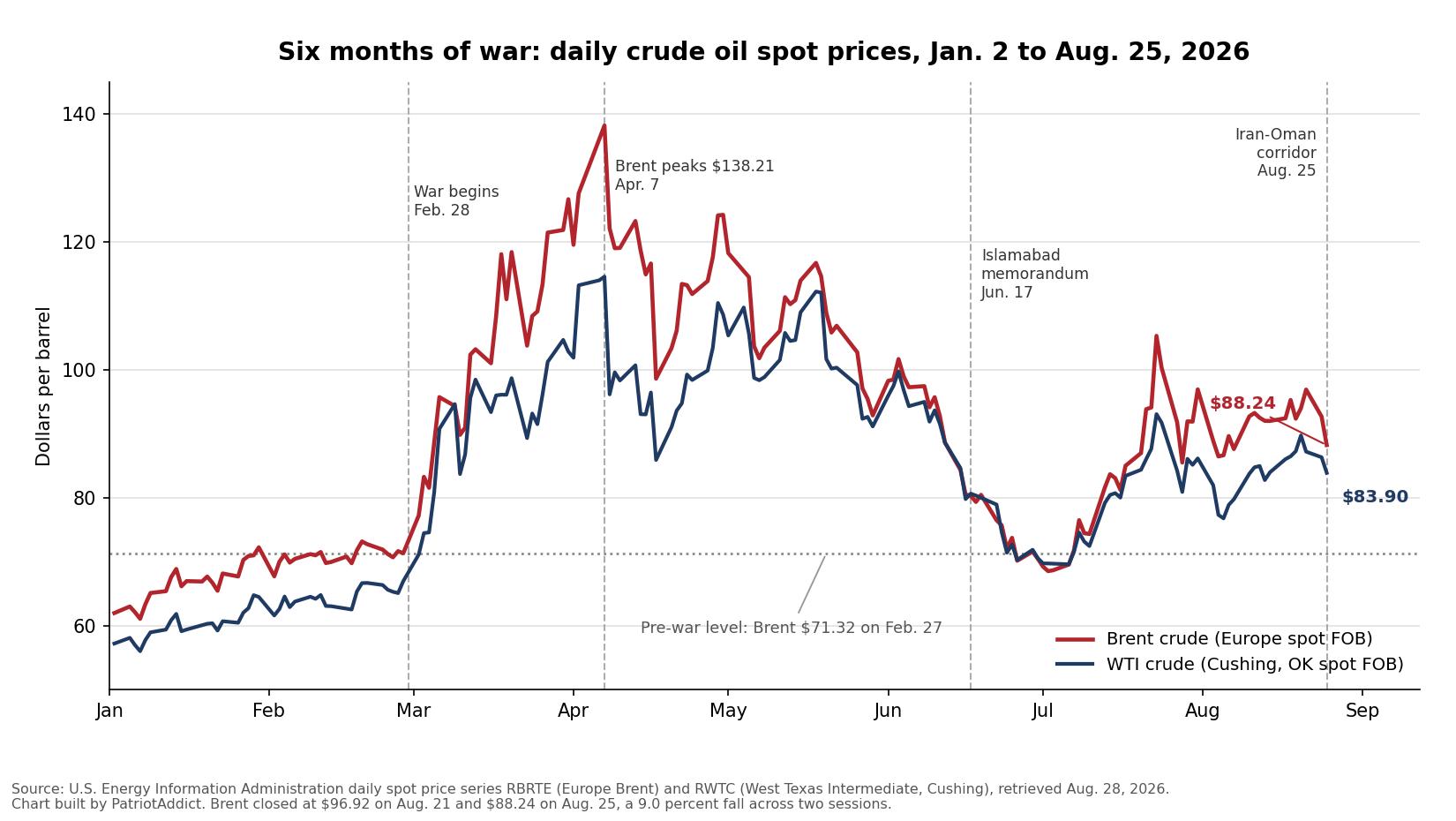
Chart built by PatriotAddict from the Energy Information Administration's daily spot price series for Europe Brent and West Texas Intermediate, data through Aug. 25, 2026.
Crude tells the same story with a twist at the end. Brent closed at $88.24 on Aug. 25 against $71.32 the day before the war and a wartime peak of $138.21 on April 7. West Texas Intermediate closed at $83.90. The twist is the last four sessions: Brent fell 9 percent, from $96.92 on Aug. 21, across Treasury's sanctions blitz and the Oman corridor announcement. Traders are pricing the corridor as real. They are not pricing the strait as open.
It is not open. Mohsen Rezai, secretary of Iran's Supreme National Security Council, told Sheikh Mohammed that the "US must first take practical steps to fulfil Iran's conditions and then Iran will proceed to open the Strait of Hormuz," according to IRNA. Those conditions have not moved since June. Before the war the strait carried 20.9 million barrels a day of petroleum liquids, about a fifth of world consumption, by EIA's count.
Why Doha wants this badly enough to fly
Qatar is not a disinterested referee, and its interest happens to run our way. It hosts Al Udeid Air Base and shares the world's largest gas field with Iran. Its LNG exports have collapsed to 18 cargoes over the past six months against 509 in the same period a year earlier, and Qatari officials say strikes on Ras Laffan cut production 17 percent with full recovery taking up to five years, Euronews reported. Doha cannot afford a settlement that hands Tehran a permanent tollbooth on its own export route.
That makes Qatar the closest thing to an American position currently in the room, and a reminder of how empty the room is on our side. Six months in, the president has a sanctions campaign, an admiral's video and no corridor of his own on the table.
Araghchi is wrong that pressure does not work. The rial has fallen past two million to the dollar and ordinary Iranians are paying for it. But pressure is a lever, not a plan, and a lever with nothing attached to it just keeps the strait shut while Americans pay $4.22 a gallon. Qatar showed up in Tehran with a sentence about sovereignty and freedom of navigation. That sentence should have come from Washington, attached to a chart with coordinates on it.
Hero image: President Donald Trump meets with Qatar's Emir Sheikh Tamim bin Hamad Al Thani, left, and Prime Minister and Foreign Minister Sheikh Mohammed bin Abdulrahman bin Jassim Al Thani, right, aboard Air Force One, Oct. 25, 2025. Official White House photo, public domain, via Wikimedia Commons.