Iran and Oman announced a framework Tuesday for a temporary shipping corridor through the Strait of Hormuz, six months into a war that has kept most of the world's tankers out of it. The United States was not in the room. And according to Iran's own deputy foreign minister, ships heading into the Persian Gulf would run entirely through Iranian water.
That last detail is the whole story. Everything else is process.
What the two foreign ministers actually put in writing
Omani Foreign Minister Badr al-Busaidi flew to Tehran on Tuesday and met Iranian Foreign Minister Abbas Araghchi. The two governments issued a joint statement afterward saying they had discussed "a phased framework that could provide a practical and implementable basis for moving forward," built around the "establishment of a temporary joint navigation corridor through the Strait of Hormuz" and "an agreement to implement a joint project to clear the Strait of mines," according to the text shared by Oman.
The temporary lane is the smaller half. The larger half is what comes after it. Technical negotiations will continue, the statement said, toward a permanent navigation corridor, "future arrangements for managing the Strait," and "a mechanism for exchanging information, managing navigation traffic, and providing related navigational and security services." The maritime trade press read that language the way any shipowner would. gCaptain called it a framework for the future management of the strait, and noted the statement gives no coordinates and no reporting or security procedures.
Al-Busaidi posted his own summary on X. "Constructive dialogue in Tehran with my colleague Dr @Araghchi," he wrote. "I am hopeful we will soon announce a temporary corridor for the Strait of Hormuz and practical arrangements to restore safe navigation." Then the part that matters: "Future management of the Strait and a permanent solution will follow in due course, as per Article 5 of the Islamabad Memorandum."

Sayyid Badr bin Hamad Al Busaidi, Oman's foreign minister, who flew to Tehran on Aug. 25 and announced the corridor framework afterward on X. File photo taken in London on July 1, 2026. (Photo: UK Foreign, Commonwealth and Development Office, CC BY 4.0, via Wikimedia Commons)
Iranian Deputy Foreign Minister Kazem Gharibabadi filled in the geography on Iranian state television. The inbound route from the Gulf of Oman into the Persian Gulf would pass entirely through Iranian waters, he said, while the outbound route would run through both Iranian and Omani waters, with another 30 to 60 days of talks to come. That account comes from Iranian state broadcasting, relayed by Euronews, and has not been independently confirmed. Oman's statement says nothing about which side of the strait the lane sits on.
The memorandum they are citing expired nine days ago
Article 5 of the Islamabad Memorandum is a real clause in a real document. It is also part of an agreement that ran out on Aug. 17.
The memorandum was a 14-point ceasefire signed June 17 by President Trump and Iranian President Masoud Pezeshkian after talks mediated by Pakistan. The full text is published by the American Presidency Project at UC Santa Barbara.
Article 5 reads: "Upon the signing of this MoU, the Islamic Republic of Iran will make arrangements using its best efforts for the safe passage of commercial vessels, with no charge for 60 days only, from the Persian Gulf to the Sea of Oman, and vice versa." It then says Iran "will conduct dialogue with the Sultanate of Oman, to define the future administration and maritime services in the Strait of Hormuz." Article 4 committed the United States to ending its naval blockade within 30 days, with vessel traffic returning "in proportion to the numbers of pre-war traffic being restored by the Islamic Republic of Iran." Read the full 14 points here.
One caveat worth knowing. The publicly circulating text carries a draft notation and blanks where the date and place of signing should be, so what is public is the negotiated language read to reporters rather than an executed instrument.
None of it held. Trump declared the agreement "over" on July 7. Iranian Foreign Ministry spokesman Esmaeil Baghaei later said that "due to the gross and widespread violation of the memorandum by the United States just a few weeks after it was signed, no talks were initiated," and that "the issue of a 60-day deadline became entirely moot," per Al Jazeera's account of the collapse. So Oman is invoking, as authority for a permanent settlement, an article of a document both parties treat as dead.
Ships were shot over this exact question two months ago
Here is why the routing detail is not a technicality. After the memorandum was signed, Oman issued a route through the strait that hugged its own coast, backed by Washington. Iran had already issued a map requiring vessels to pass closer to the Iranian shore and declaring the Omani side restricted.
Several ships that followed the Omani route were attacked at the end of June. The Singapore-flagged Ever Lovely was struck by a projectile on June 25 while transiting near Oman's coast. Iran neither claimed nor denied it. Trump called it "a foolish violation." Two days later CENTCOM said its aircraft had hit missile and drone storage sites and radar along Iran's southern coastline "as a powerful response to yesterday's attack on a commercial ship that was transiting the Strait of Hormuz."
Joey Hood, formerly the acting director of the State Department's Office of Iranian Affairs, told Al Jazeera the memorandum "was doomed to fail" because "it was very poorly written and it gave Iran the chance to interpret the MoU as giving it sovereignty over the Strait of Hormuz." Two months after that fight, the framework on the table routes inbound traffic through Iranian water. Tehran shot at ships over which line on the chart counted, and the line it wanted is now the one being drafted.
Washington is not at this table, and Tehran wants it that way
Iranian officials have been explicit that the Hormuz channel runs through Muscat alone, without what they call foreign interference. American officials have pushed back in generalities. Washington rejects any arrangement requiring Iranian permits, approvals or fees, and one U.S. official told the Associated Press the goal remains a system in which no party controls the lanes or the ability to transit them, as Al Jazeera laid out both sides' positions this month. That official was not named, and the administration has said nothing on the record about Tuesday's framework.
What the State Department has said on the record is narrower and harder. On July 29 it designated two IRGC-backed Iranian entities, the Persian Gulf Marine Insurance Company and the Hormuz Safe Marine Services Authority, for what it called coercive insurance schemes.
"These entities manufacture risk, including the threat of vessel seizures, and then charge commercial vessels for coverage against dangers created by the regime itself," the department said, adding that the United States "will act, alongside partners, to ensure Iran cannot hold international commerce hostage." That statement is reproduced in full here. Trump's own version, to reporters on Aug. 3, was shorter: "I'm not going to let them charge. Anybody's going to charge, we'll charge."
The administration's other move has been to threaten the mediator. As we reported on Aug. 22, Trump told Fox News that "if Oman gets in the way, we'll bomb the s--- out of them," the second such threat this year. Muscat kept talking to Tehran anyway. There is no American proposal on the table for Oman to carry.
The international maritime body already told Iran to stop
The legal position on the strait is not a matter of interpretation, and it is not something the United States asserted on its own. The International Maritime Organization's governing Council took it up in an emergency session in March and put it in a formal decision.
Official record
International Maritime Organization, Council, 36th extraordinary session, document C/ES.36/D, "Summary of Decisions," dated 19 March 2026. The session was convened over the impacts on shipping and seafarers of the situation in and around the Strait of Hormuz. The Council's declaration "strongly condemned the threats and attacks against vessels and purported closure of the Strait of Hormuz by the Islamic Republic of Iran," and recalled United Nations Security Council resolution 2817 (2026).
".9 demanded that the Islamic Republic of Iran immediately refrain, in accordance with international law, from any actions or threats aimed at closing, obstructing or otherwise interfering with international navigation through the Strait of Hormuz or against merchant or commercial vessels in and around the Strait of Hormuz, to ensure the safety and welfare of seafarers and the security of international shipping and the marine environment, and to respect its obligations under international law; and .10 reaffirmed that the exercise of navigational rights and freedoms by merchant and commercial vessels, in accordance with international law, must be respected." — IMO Council, C/ES.36/D, page 4
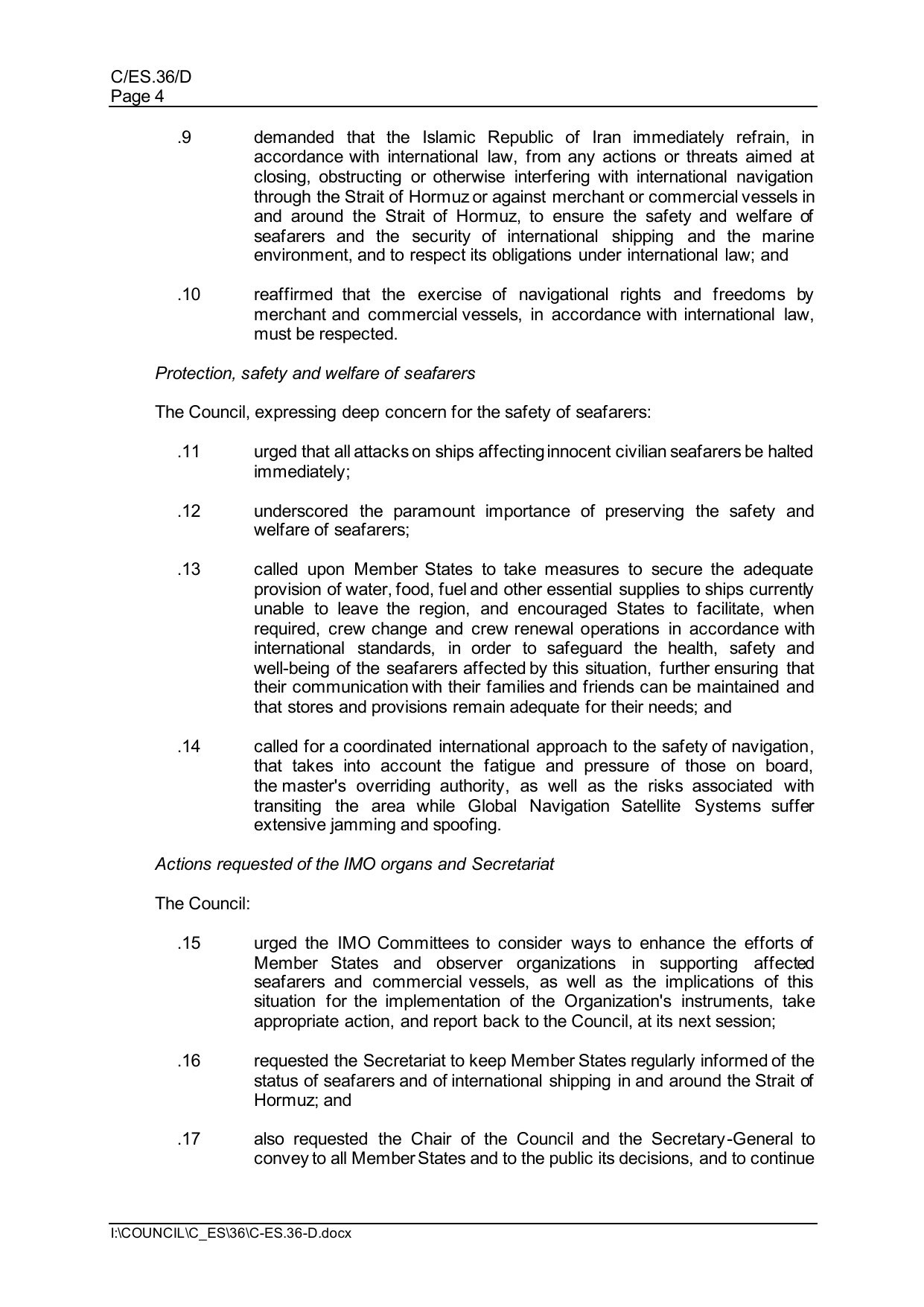
Read or download the full 5-page summary of decisions (PDF) · page 4 shown, where the demand sits · view the session page on imo.org
The same document records that Iran and Russia filed their own papers to the session, and that the Council "noted concerns expressed by some delegations about the wording of some elements of the declaration, which in its present form was deemed not balanced, inclusive nor constructive." It was not unanimous.
IMO Secretary-General Arsenio Dominguez went further at the U.N. Security Council on April 27, telling members there is "no legal basis to introduce payments or tolls or discriminatory conditions on international straits," and that any deviation "would set a negative precedent and undermine the integrity and stability of shipping operations worldwide," per the U.N.'s own record of the meeting. Eight global shipping bodies, including INTERTANKO, BIMCO, the International Chamber of Shipping and the World Shipping Council, wrote to Dominguez and Secretary-General Guterres on Aug. 3 warning against "service fees that are a toll in all but name," because "once such a precedent is established, it becomes increasingly difficult to resist similar measures elsewhere." Their joint letter is public.
Mine clearance is the bill that lands on the U.S. Navy
Trump declared Tuesday on Truth Social that "all mines have been removed and/or detonated from within the International Waters of the Strait of Hormuz," citing the Navy, and warned that "any ship or boat placing new mines will be immediately and systematically destroyed." It was the second time in a week he had said the mine threat was finished.
The Joint Maritime Information Center, the multinational body that actually advises merchant shipping, published its assessment the same day and did not agree. Its advisory holds the strait at SEVERE and states there is a "continued risk of drifting or uncharted mines in and near the TSS, with mine danger areas still active," with "clearance and mine-surveying operations continue throughout the Strait of Hormuz." Iran and Oman announcing a joint de-mining project one hour after the president said the mines were gone is its own answer.
Note what the joint project does to responsibility. The June memorandum put de-mining on Iran, saying full restoration of traffic depended on "removing the technical and military obstacles, and de-mining by the Islamic Republic of Iran." Tuesday's framework makes it a joint Iranian and Omani undertaking. The party that laid the mines now co-owns the verification.
Clearing them is slow, physical work, and the hard part is not finding mines. It is proving there are none left. The traffic separation scheme runs roughly 100 nautical miles, and supporting inbound and outbound tanker traffic means clearing two channels covering something on the order of 200 square miles, retired Navy Capt. Kevin Eyer wrote in the U.S. Naval Institute's Proceedings in April.
Scott Savitz of RAND put the timeline honestly. "It is extraordinarily difficult and slow to try to clear mines under fire," he said, so "if Iran is still firing projectiles or sending out small attack boats, that could protract the timeline for months. On the other hand, if it's quiet, it might be a matter of days." His other line is the one to remember: "the number of mines you need to create an effective minefield is zero. You just need people to perceive that there's a threat there." Read the full exchange.
Nobody in the U.S. government has published a count of mines found or destroyed. Estimates of how many Iran laid range from 20-plus, per a senior defense official briefing the House Armed Services Committee in April, to roughly 80, the figure Dominguez cited in July. Iran is believed to hold thousands.
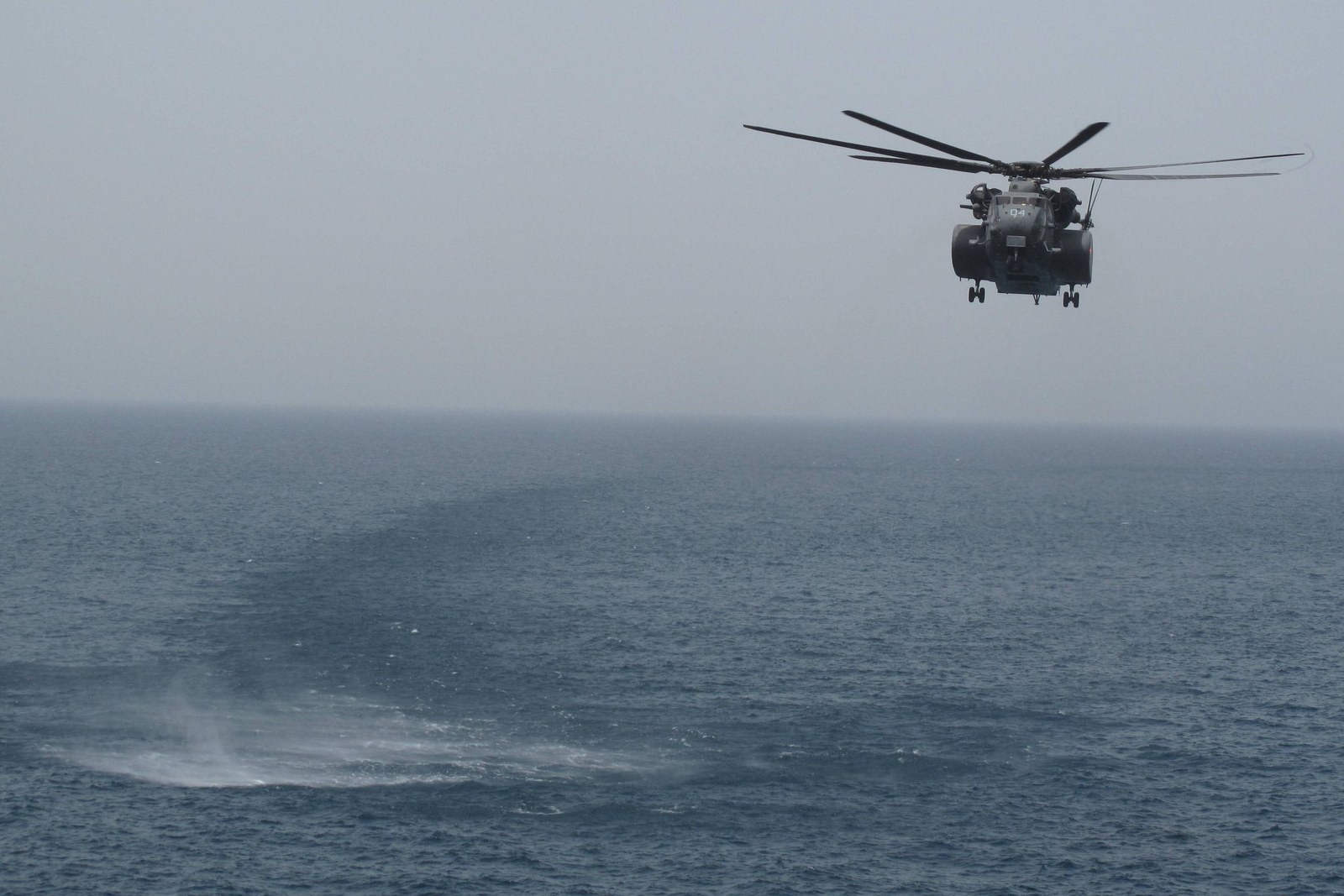
File photo: an MH-53E Sea Dragon of Helicopter Mine Countermeasures Squadron 15 returns from a mine countermeasures run during the International Mine Countermeasures Exercise, May 17, 2013. The Navy's Sea Dragon detachment in the Arabian Gulf closed in August 2025, and the service now has no dedicated airborne mine countermeasures capability. (U.S. Navy photo by Lt. Cmdr. T. Scot Cregan, public domain, via Wikimedia Commons)
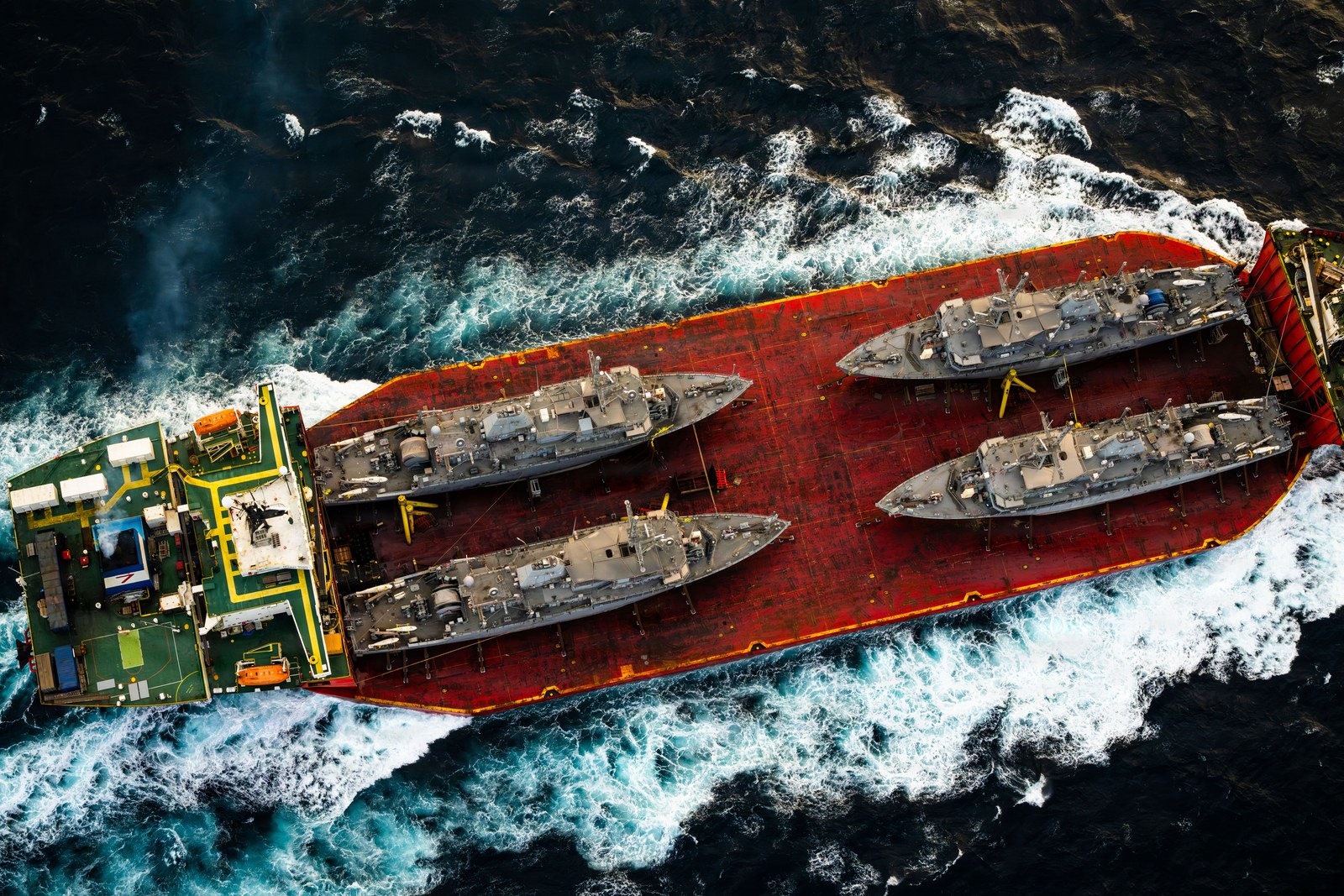
The merchant vessel Seaway Hawk in the Arabian Gulf on Jan. 21, 2026, carrying the decommissioned Avenger-class mine countermeasures ships USS Devastator, USS Dextrous, USS Gladiator and USS Sentry home, escorted by the littoral combat ship USS Canberra. The war began five and a half weeks later. (U.S. Navy photo by Mass Communication Specialist 2nd Class Iain Page, public domain, via Wikimedia Commons)
The force that would do the clearing is thinner than it was a year ago. The Navy ended its Avenger-class minesweeper presence in Bahrain on Sept. 25, 2025, decommissioning USS Devastator, USS Sentry, USS Dextrous and USS Gladiator in a single ceremony, per Naval Forces Central Command. Four Avengers remain in the fleet, all homeported in Japan, USNI News reported. The MH-53E Sea Dragon detachment in the Arabian Gulf shut down in August 2025, leaving the Navy without a dedicated airborne mine countermeasures capability.
The replacement is a mine countermeasures mission package aboard Independence-variant littoral combat ships. Only three of those ships carry it in theater, and two of the three were in Southeast Asia for maintenance as of April. The Pentagon's own director of operational test and evaluation reported on March 13 that the Navy "has not provided sufficient data from operational employment" to determine whether the package is operationally effective, as Navy Times reported.
The Avenger hulls were wood, with low magnetic signatures, and could work inside a minefield. The LCS is aluminum and has to stay outside one.
CENTCOM began clearance on April 11, sending the destroyers USS Frank E. Peterson and USS Michael Murphy through the strait. "Today, we began the process of establishing a new passage and we will share this safe pathway with the maritime industry soon to encourage the free flow of commerce," said Adm. Brad Cooper, the CENTCOM commander, in the command's release. That was four and a half months ago. Neither destroyer is fitted for mine clearance.
What the closure costs at the pump
The Energy Information Administration published its weekly retail price series on Tuesday. The U.S. average for regular gasoline was $4.218 a gallon for the week of Aug. 24. The last full week before the war it was $3.072. That is a dollar and fifteen cents a gallon, or 37 percent, and it is 95 cents above the same week in 2025. The 2026 peak was $4.628 on May 11. The full series is public.
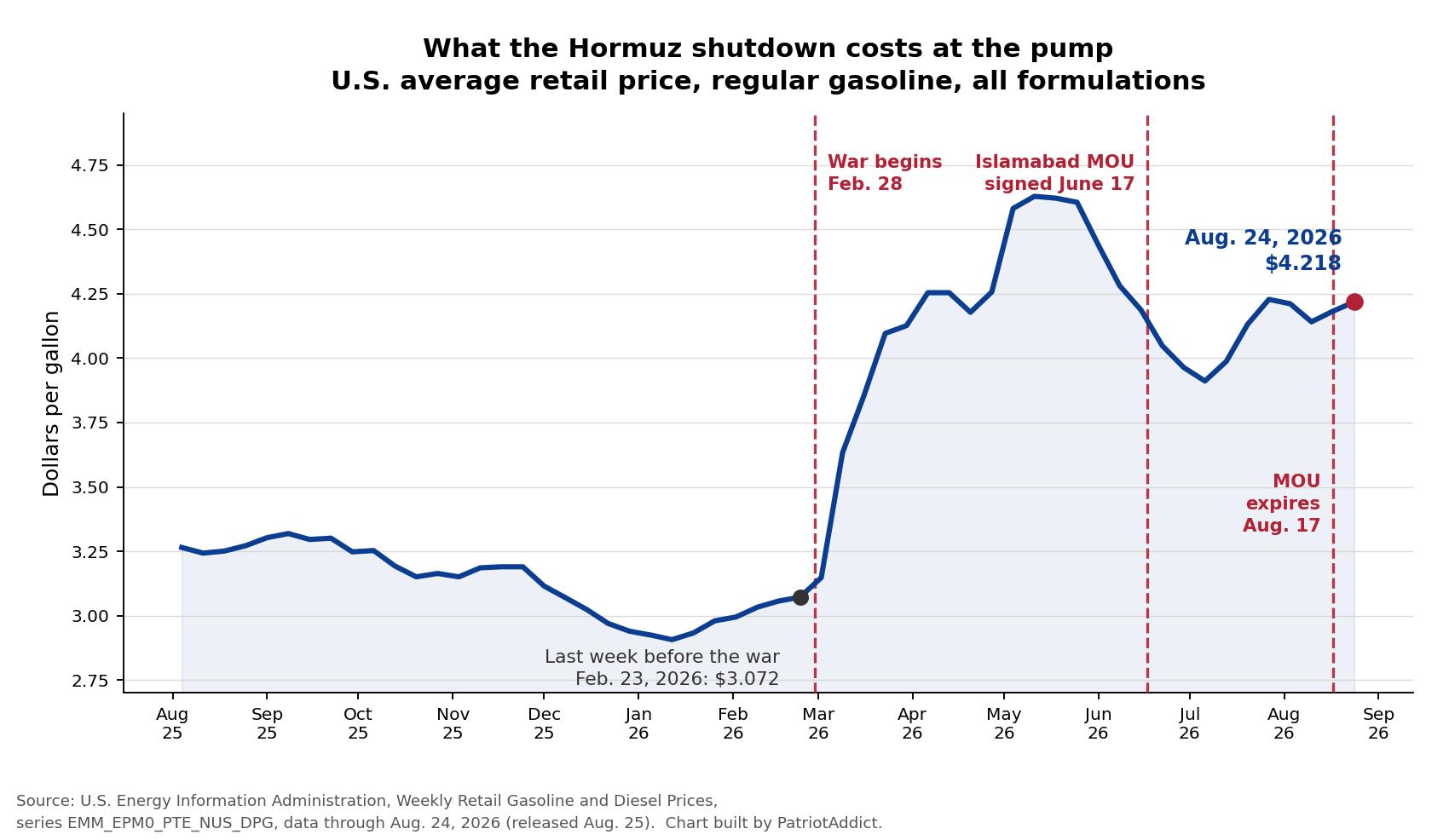
Chart built by PatriotAddict from the Energy Information Administration's weekly retail gasoline series (EMM_EPM0_PTE_NUS_DPG), data through Aug. 24, 2026, released Aug. 25. Markers show the start of the war on Feb. 28, the signing of the Islamabad memorandum on June 17, and its expiration on Aug. 17.
The physical numbers behind that price are worse than the price suggests. Before the war the strait carried 20.9 million barrels a day of petroleum liquids, about a fifth of global consumption, by EIA's count. Vortexa put oil transits on Monday at 5 million barrels a day. Lloyd's List Intelligence counted 73 transits by cargo vessels over 10,000 deadweight tonnes in the week of Aug. 10 to 16, down from 91 the week before. Reuters, citing Kpler, reported just two tankers transiting on Monday, against a 10-day average of 14. JMIC's own baseline for a normal year is about 138 vessels a day. Those counts measure different things and should not be added together, but they point the same direction.
Insurance tells the same story in dollars. War-risk cover for a Hormuz transit ran about 0.25 percent of hull value before the war. Marcus Baker, global head of marine at Marsh, said in July that rates "can be anywhere between 3 per cent and 10 per cent on hull value," with "the range reflecting the concerns," he told The National. On a $100 million tanker that is three to ten million dollars for one passage. DP World has been spending roughly $100 million a month keeping Jebel Ali ready while container throughput sits near a tenth of normal, per Lloyd's List Intelligence.
Is Tehran negotiating in good faith, or buying time
The honest answer is that Iran is doing both, because it has one lever left and it is using it. The rial hit a record low of roughly two million to the dollar as markets opened Monday, per the Associated Press. Iran's own Statistical Center reported year-on-year inflation of 88 percent in July, with food prices up 128 percent, figures Al Jazeera compiled last week. Treasury spent Monday adding 78 names to the blacklist under Operation Economic Outcast, which we covered Tuesday. Tehran called the sanctions campaign an act of "gross lawlessness" and said it expects its trading partners not to comply, Reuters reported.
And Iranian officials have been clear about what the strait is for. They have said repeatedly that it will not fully reopen until the United States lifts the naval blockade, drops oil sanctions and unfreezes Iranian assets abroad, a position Tehran restated Tuesday. That is not a shipping-safety negotiation. It is a sanctions-relief negotiation conducted in sea lanes, with the world's tanker fleet as the collateral. Iran has also blacklisted 45 tankers for violating its passage rules, and JMIC counts 94 confirmed vessel incidents in the region since March 1.
One of them happened as al-Busaidi was arriving. The United Kingdom Maritime Trade Operations logged Warning 120-26 at 2025 UTC on Aug. 24: "The Master of an oil tanker reports the vessel has been struck by an unknown projectile causing damage to the engine room and disabling the vessel," nine nautical miles northeast of Ash Shishah, Oman, at the mouth of the strait. Crew were reported safe. The warning is public. No vessel name, no flag, and nobody claimed the attack.
The part worth getting right
Reopening the Strait of Hormuz is worth having. It is the fastest way to take a dollar off the price of a gallon of gas in this country, and every week it stays shut is money out of the pocket of every American who drives to work.
Trump has said a deal is close so many times that CNBC ran a piece on why markets keep believing him, writing that he "has claimed dozens of times that the U.S. is close to an agreement that will end the war." Treasury Secretary Scott Bessent told CNBC on Aug. 4 there was "a chance we may have a deal today or tomorrow to open the Strait and move towards a more normalized position in this conflict." Brent slid 5.3 percent that day. Asked that evening whether an announcement was coming, Trump told reporters: "It could happen. Tomorrow or the next day." That was three weeks ago. He has been right that the strait needs to open. He has not made it happen.
But the terms decide whether reopening is a win or a mortgage. A corridor Iran administers, with the inbound lane in Iranian water, a fee schedule left for a later round, and Tehran co-signing the certification that its own mines are gone, converts a right of transit passage that has held for decades into a permission Iran grants. That is precisely what the IMO Council demanded Iran stop asserting in March, what its secretary-general told the Security Council has no legal basis in April, and what eight shipping associations warned against in August.
The administration's answer to the Muscat channel so far has been more sanctions and a threat to bomb Oman. Neither is a proposal. If Washington does not put a workable American corridor on the table, the one being drafted in Tehran is the only one there is, and the country that mined the strait gets to write the rules for reopening it.