The Pentagon handed separation notices to three people at Stars and Stripes on Friday, and the stated cause was insubordination. Editor-in-chief Erik Slavin, publisher Max D. Lederer Jr. and Middle East reporter Lara Korte each got five days to appeal. The paper reported its own firings. And on that same day, August 21, a new Department of War instruction governing Stars and Stripes took effect, replacing a directive that had stood since 1993.
What Slavin actually said
The alleged insubordination is an interview. In July, Slavin and Korte appeared in a "CBS Sunday Morning" segment about the Pentagon's plans for the paper. Asked whether he had a red line he would not cross, Slavin answered, per CBS News: "'Don't run a perfectly accurate story, run this instead. Here it is, written by the Pentagon.' That would be a red line."
That is the sentence in the notice. "According to the notice, I am being fired for stating in a CBS interview that censorship of news for service members would constitute a red line. The Pentagon's public affairs office has charged me with insubordination," Slavin said in a statement. "I stand by the principle that Stars and Stripes must remain editorially independent, as required by law and by the department's own policies." He joined the paper in 2005 as a reporter in Japan, embedded with U.S. forces in Iraq, reported from South Korea, and was named editor-in-chief in September 2025.
Korte's line in the same segment was shorter: "I'm working for Stars and Stripes. Not for the Pentagon, not for any administration, not for any policymaker. I'm here to cover the military community." She posted on X, per the Associated Press, that she had been told the Defense Department was firing her for insubordination after telling a CBS reporter she works for Stars and Stripes. She has covered the Middle East for the paper since December 2024 from its European headquarters in Kaiserslautern, Germany.
Lederer was already leaving. Three days before the notices went out, on Tuesday, August 18, he told staff he would retire on September 30. "It has become clear that my philosophy of leadership, and my understanding of the value and mission of Stars and Stripes, differ in fundamental ways from the direction the leadership of the Department of Defense has for the organization," he wrote in a memo obtained by CBS News. He added that he would "do everything I can to make sure the transition is smooth for each of you." The Pentagon fired him anyway, with six weeks left on the clock.
The Pentagon has not said a word on the record
This matters, so it goes here plainly: as of Wednesday, no Defense Department official has put a name to a statement about these three firings. A Pentagon official confirmed the separation notices to Stars and Stripes on condition of anonymity and pointed reporters to an open letter published that afternoon by Navy Capt. William Urban, the paper's newly installed military deputy to the publisher. A Defense Department spokesman declined to comment to CBS News. Fox News Digital got the same referral to Urban's letter. Everything known about the grounds comes from the people who received the notices, plus unnamed officials.
The closest thing to an administration comment came from outside the building. Asked about the reports by CBS chief White House correspondent Nancy Cordes, White House adviser Stephen Miller said he was confident that "if anybody was fired, it was for just cause."
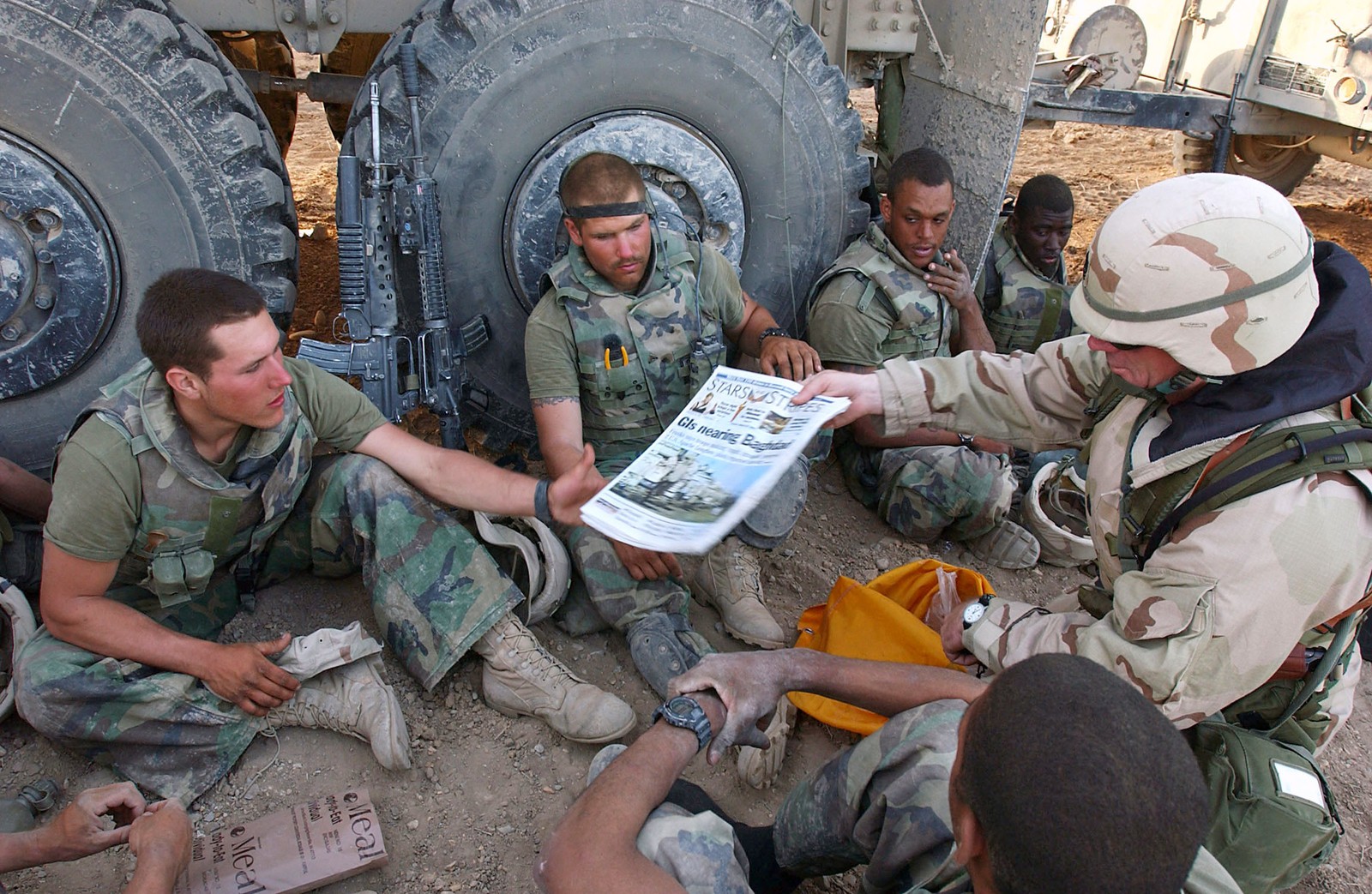
Command Sgt. Maj. John Sparks delivers copies of Stars and Stripes to Marines of Weapons Platoon, 3-2 India Company, in Iraq on April 4, 2003. File photo. (U.S. Marine Corps photo by 1st Sgt. David K. Dismukes, public domain, via Wikimedia Commons)
The rule that protected the paper left the federal code in January
Slavin says editorial independence is "required by law." The honest version is narrower than that, and it is the most important fact in this story. Until this January, the independence guarantee lived in the Code of Federal Regulations at 32 CFR part 246, on the books since April 22, 1994. It said the Defense Department's policy was that "there shall be a free flow of news and information to its readership without news management or censorship," and then added a sentence with teeth: "The calculated withholding of unfavorable news is prohibited." Only a unified command commander could order news withheld, and only for classified information, harm to national security, or clear danger to American lives.
On January 15, 2026, the Office of the Assistant to the Secretary of Defense for Public Affairs deleted the whole part, effective the day it published. The stated reason was that the rule "is unnecessary" and "does not have an impact or burden to the public." Of 88 on-point public comments, the notice acknowledges that some "advocated for not changing the existing rule because of perceived concerns that changes would restrict Stripes in continuing its mission of providing editorially independent news and information." The department's answer was that the rule was outdated because it treated Stripes as a print-only product.
Official record
32 CFR part 246, the Defense Department regulation on Stars and Stripes newspaper and business operations, as it read in the final annual Code of Federal Regulations edition (revised as of July 1, 2025) before its removal. Source: govinfo, U.S. Government Publishing Office.
"Except as provided in paragraph (e) of this section, the DoD policy for the Stars and Stripes is that there shall be a free flow of news and information to its readership without news management or censorship. The calculated withholding of unfavorable news is prohibited." — 32 CFR 246.4(b)
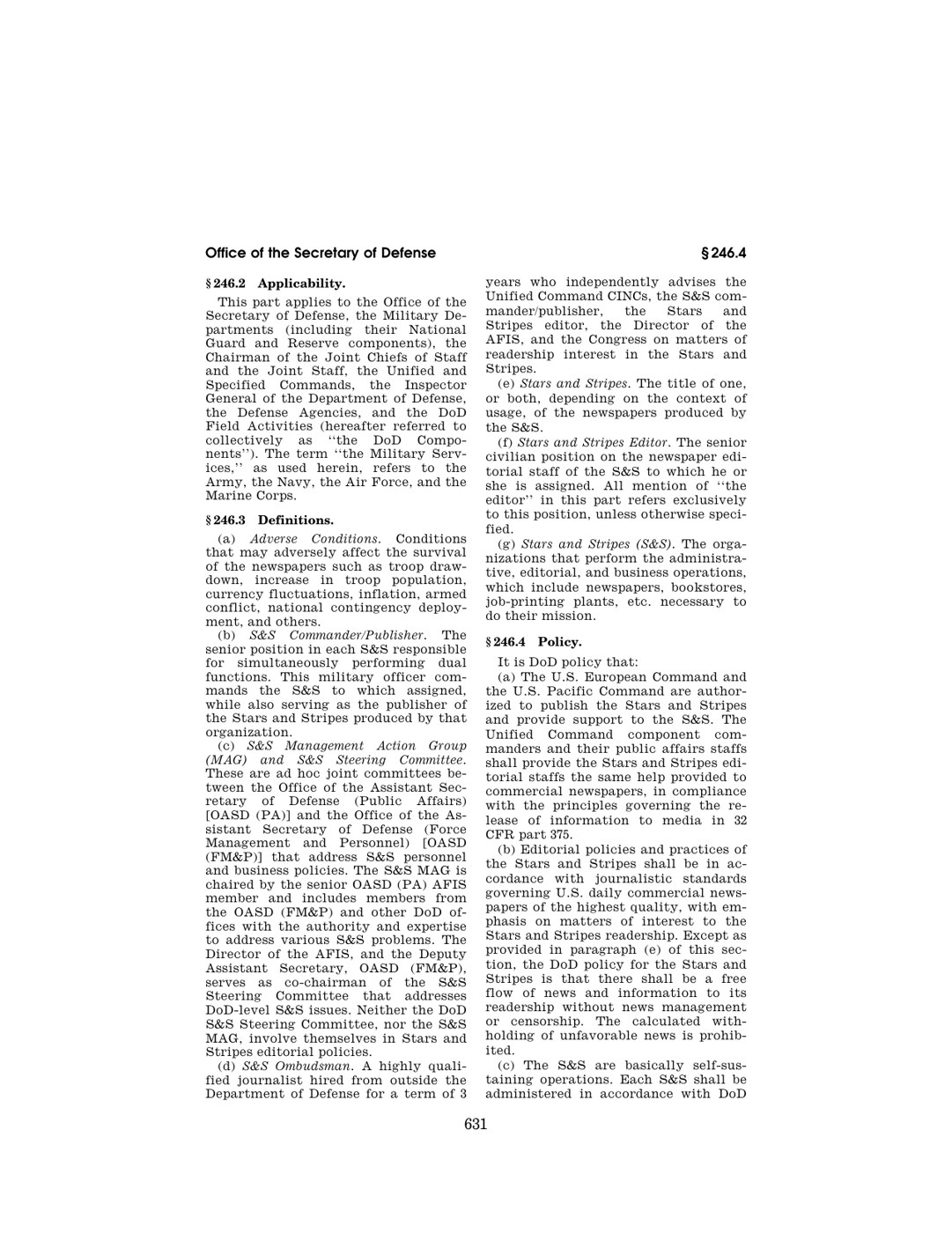
Read or download the full 14-page CFR extract (PDF) · read the January 15 final rule that removed it
Two members of the paper's publisher advisory board sued over that deletion. Retired Minnesota Star Tribune editor Suki Dardarian and Santa Fe New Mexican executive editor Bill Church, represented by Democracy Forward, filed in Washington on June 3, arguing the removal skipped the notice-and-comment process the Administrative Procedure Act requires. Stars and Stripes is not a party. Pentagon chief spokesman Sean Parnell answered on X the day it was filed: "The lawsuit is without merit, and the Department expects to prevail. The Department remains committed to a Stars and Stripes that is modern, mission-focused, and worthy of the servicemembers it serves."
What the new instruction says, and what it left out
The replacement is now public. DoW Instruction 5122.11, approved August 14 by Parnell and effective August 21, cancels the 1993 directive and folds in the March 9, 2026 modernization memo that imposed the content restrictions. Paragraph 1.2.c keeps the core promise: Stripes "will maintain editorial operations independent of the military chain of command, military public affairs activities, or other external influences, free from censorship or propaganda." Paragraph 3.4.e tells commanders they "will not block the release of, or access to, otherwise releasable news."
Read what changed, though. The sentence banning "the calculated withholding of unfavorable news" is gone, and no equivalent replaces it. Paragraph 3.1.a.(2)(e) is new: "In support of good order and discipline of the military, Stripes content must not have a direct, material, and immediate negative impact on military readiness and safety." The same paragraph then narrows itself, saying that standard "is not intended to prevent coverage of matters such as critical analysis of policy, reporting on command climate issues, or other information that may not be aligned with the official position of the DoW." Whether that carve-out holds depends entirely on who is applying it.
Paragraph 1.2.e is the one Congress should read twice. Stripes must now "coordinate all of its congressional briefings, reports, and non-newsgathering engagements" with the Office of the Assistant Secretary of War for Legislative Affairs, before the engagement. The old regulation defined the ombudsman as a journalist hired from outside the department who "independently advises" the commanders, the publisher, the editor and "the Congress." The new instruction routes the ombudsman's reports to legislative affairs "for transmittal to Congress," while promising the document "will not be changed without the Ombudsman's concurrence."
The outside oversight changes too. The publisher advisory board that Dardarian and Church sit on is a group of working civilian journalism professionals. The instruction replaces the old board structure with a "Stars and Stripes Advisory Group" whose members the publisher appoints, with Parnell's office concurring, from among "full-time or permanent part-time Federal officers or employees, or active-duty members of the Armed Forces." Outside industry figures can be brought in only as non-member subject matter experts. The group "will not involve itself in Stripes' editorial decisions."
Official record
DoW Instruction 5122.11, "Stars and Stripes Media Organization," Office of the Assistant to the Secretary of War for Public Affairs, effective August 21, 2026, cleared for public release. Hosted at the Pentagon's own Directives Division site and reproduced here in full.
"In support of good order and discipline of the military, Stripes content must not have a direct, material, and immediate negative impact on military readiness and safety, such as content that incites or produces imminent lawless action, or provides non-public operational details that could be foreseeably exploited by an adversary to compromise a mission's success or endanger personnel." — Paragraph 3.1.a.(2)(e)
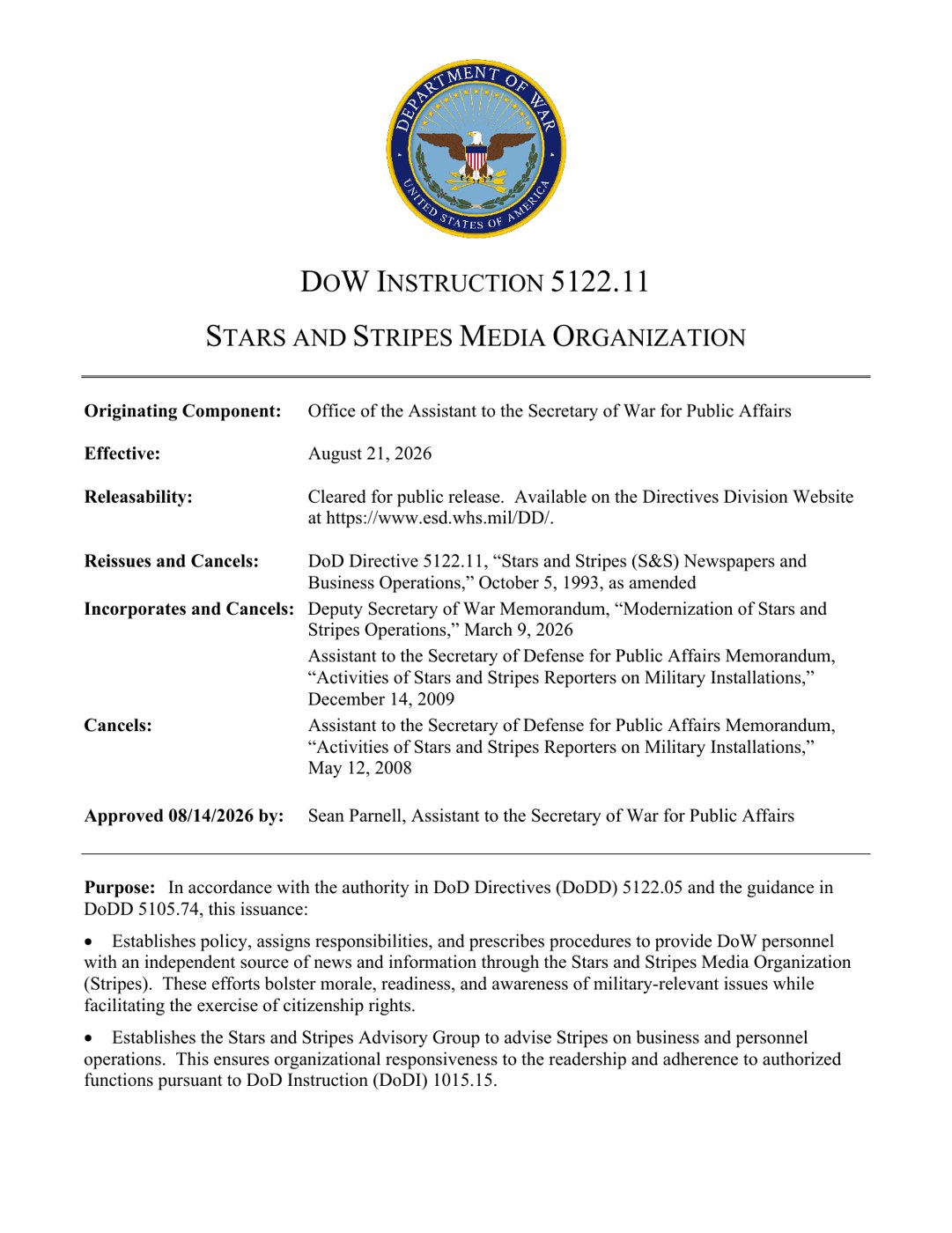
Read or download the full 17-page instruction (PDF) · the cover page records what it cancels, including the March 9, 2026 modernization memo
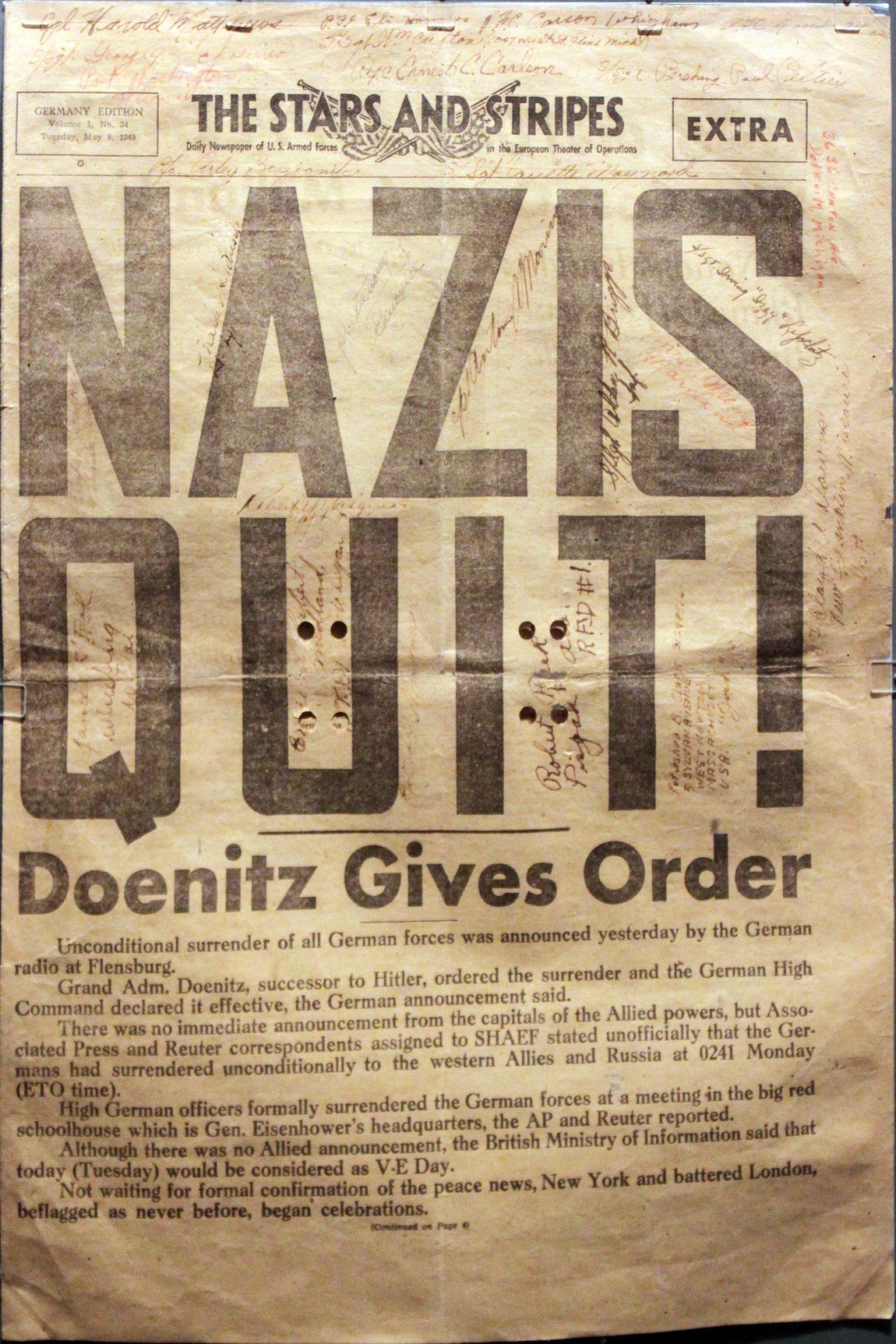
The Stars and Stripes, Germany Edition "Extra," Tuesday, May 8, 1945. This surviving copy is covered in the signatures of the American soldiers who read it. (Photograph by Wikimedia Commons user Anagoria, released CC0)
The Pentagon's case, at full strength
There is a real argument on the other side of this, and it deserves to be put properly rather than waved at.
Stars and Stripes is a government organization. Its staff are Defense Department personnel. Even 32 CFR part 246, the regulation whose deletion Dardarian and Church are now litigating, said in its appendix on editorial operations that "as a Government organization, the Stars and Stripes news staff may not take an independent editorial position." The paper is a nonappropriated fund instrumentality that is supposed to pay for itself "to the maximum extent possible," with taxpayer money "kept to a minimum." It is not paying for itself. CBS News reported, citing a person familiar with operations, that roughly half of a $29 million annual budget comes from taxpayers. Breitbart News reported, citing its own sources, that the fiscal 2026 budget was $27.4 million with 65 percent of it appropriated. Those two figures do not match, and neither side has published the ledger.
On Lederer, the specific charge is not that he gave an interview. Fox News Digital reported, citing a source familiar with the matter, that his insubordination was refusing to fire Slavin and Korte when Pentagon leadership directed him to. Breitbart's sources went further, saying he stopped showing up for work and refused to implement the modernization directives. One told the outlet: "Lederer is likely going to paint himself as some kind of a First Amendment martyr, but in reality, it's much simpler: he's just bad at his job." Lederer has not responded to requests for comment from Stars and Stripes, the AP, Fox or Breitbart. He is an Army veteran who joined the paper in 1992 and had been publisher since 2007.
The numbers in Urban's own open letter are the strongest thing the Pentagon has going. He writes that it is "difficult to credibly claim that we are the media of choice for a military community that numbers in the millions while only having a paid digital subscriber base of less than 30,000 people and a daily paper distribution of less than 10,000 copies." Service members currently get five free articles a month before hitting a $50-a-year paywall. Urban wants to sell a sponsorship that would make the paper free to every service member. He also says the department is putting roughly $8 million into modernization over two fiscal years and offering 25 additional military public affairs billets. That is not the behavior of an office trying to kill a newspaper.
The case for the paper, at full strength
National Press Club President Mark Schoeff Jr. called the firing of Slavin "another brazen attempt by the Pentagon to dictate coverage of the military" and said it should be reversed immediately. "Firing a newspaper editor after he publicly defended his newsroom's editorial independence is deeply troubling, and it should concern every journalist and every member of the U.S. military who depends on independent reporting," he said. "Our service members deserve news and information they can trust, not narratives that are shaped solely by their own employer."
The pattern he is pointing at is documented, not inferred. Parnell announced in January that the department would "modernize its operations, refocus its content away from woke distractions that syphon morale, and adapt it to serve a new generation of service members," and that the paper would carry "no more repurposed DC gossip columns; no more Associated Press reprints." The same day, the regulation came out of the code. In March an eight-page memo signed by Deputy Defense Secretary Steve Feinberg cut paid wire services and syndicated features, barred Stripes reporters from filing Freedom of Information Act requests in an official capacity, and said content must be consistent with "good order and discipline," a phrase lifted from the Uniform Code of Military Justice. In April the department fired ombudsman Jacqueline Smith, ten days after she wrote a column asking for the comics back. She wrote that the ombudsman position was created by Congress in 1991 because military officials had repeatedly tried to suppress unfavorable news, and that she had reported her concerns to both armed services committees. She sued the Pentagon in federal district court in Washington on June 25, alleging retaliation. Her three-year term ran through December 2026.
Then there is the story Urban himself names as the trigger. In August, Stripes reporter Alison Bath reported on a town hall where families of sailors aboard the USS Abraham Lincoln described mental health strain and risk of self-harm during a nine-month deployment. Defense Secretary Pete Hegseth, Acting Navy Secretary Hung Cao and President Trump downplayed or denied the reports. The carrier left the Middle East for home this month. In his open letter, Urban calls Bath's reporting "the straw that stirred the drink," notes that outside analysts rated it the least biased coverage of the episode, and tells the newsroom: "There are no external editorial curbs on our journalists searching out and reporting significant stories. Carry on and ignore the noise." The Pentagon's own installed deputy is defending the story his bosses denied.

Pvt. Troy Patrick of Salyersville, Kentucky, shows liberated Russian prisoners the "Soviets in Berlin" headline in a copy of Stars and Stripes at Ulm, Germany, April 25, 1945. File photo. (U.S. Army Signal Corps, SC 405036, public domain, via Wikimedia Commons)
Who exactly do they appeal to
The notices gave five days, so that window closes this week. Nothing filed by any of the three has surfaced in public reporting as of Wednesday morning, at the Merit Systems Protection Board or in any court. Smith's suit is the only Stars and Stripes retaliation case now on a docket, and she was the ombudsman, not a staff journalist.
Look at where the new instruction sends an appeal. Stripes staff are nonappropriated fund employees, and paragraph 3.2.f makes the Stripes publisher "the final authority for resolution of NAF administrative grievances within Stripes." The publisher was fired the same day the instruction took effect. The senior official standing in his place is an active-duty Navy public affairs officer whom the Pentagon installed two weeks earlier without telling Lederer, and who told the AP, asked whether he would become publisher, "I can't comment on what my role will be in the future." Urban is by his own account a career spokesman with no formal journalism experience and more than 20 years in Navy public affairs. He may well mean every word of his letter. The structure still routes a complaint about a Pentagon firing back to a Pentagon appointee.
Congress wrote the protection once and has not finished the job
Senators Richard Blumenthal, Elizabeth Warren and Jeanne Shaheen wrote to Hegseth on August 20, the day before the firings, demanding to know who directed Urban's assignment, whether he will touch editorial or personnel decisions, and whether he will become publisher. They asked for answers by August 28, which is Friday. Shaheen and Blumenthal also introduced the Stars and Stripes Editorial Independence Act on May 20; it sits in the Senate Armed Services Committee, and the senators say their language was adopted into the committee-approved fiscal 2027 defense authorization bill. That bill is not law yet.
Which leaves the thing worth sitting with, whichever way your instincts run. A paper written for American troops since 1861 was protected for three decades by a rule the department could delete on its own authority, and did, publishing the removal as a final rule it declared did not need to go out for comment. The replacement is more carefully drafted than the reaction to it suggests, and thinner than what its defenders were promised. Every safeguard in it now depends on the good faith of the officials the paper exists to cover. Congress can fix that with statutory text and has a bill sitting in committee to do it. Until it does, the answer to "who protects Stars and Stripes" is the Pentagon, and the Pentagon just fired the three people who said so out loud.
Hero photo: the Pentagon in Arlington, Virginia, November 23, 2005, by Chief Photographer's Mate Johnny Bivera, U.S. Navy photo 051128-N-2383B-014, public domain via Wikimedia Commons.