The House returns Monday to vote on a stopgap that leaves federal spending exactly where it is through December 11, and Speaker Mike Johnson is bringing it up under a procedure that cannot pass without Democratic votes. The vote has not happened yet. The procedure already tells you how it ends.
What is actually on the floor calendar
Majority Leader Steve Scalise's published schedule for the week of August 31 has the House in at noon Monday, votes postponed until 6:30 p.m. The stopgap is not on Monday's list. It sits on the Tuesday-and-balance-of-the-week list under "Legislation Considered Under Suspension of the Rules," with last votes expected by 3:00 p.m. Thursday.
The bill number matters. The vehicle is H.R. 6500, added to the Clerk's Bills This Week page on August 26. It started as the AGOA Extension Act, a trade bill from Rep. Jason Smith of Missouri. The Senate struck everything after the enacting clause and inserted a continuing resolution, and it is now the Continuing Appropriations and Extensions Act, 2027. The House's own December 4 stopgap, H.R. 9770, is nowhere on the schedule. Johnson took the Senate's date.
Suspension of the rules settles this before anyone votes
Suspension takes two-thirds of the members voting. By the Clerk's party division, the House has 218 Republicans, 212 Democrats, one independent and four vacancies. If all 431 sitting members vote, passage takes 288. Every Republican in the building gets you 218.
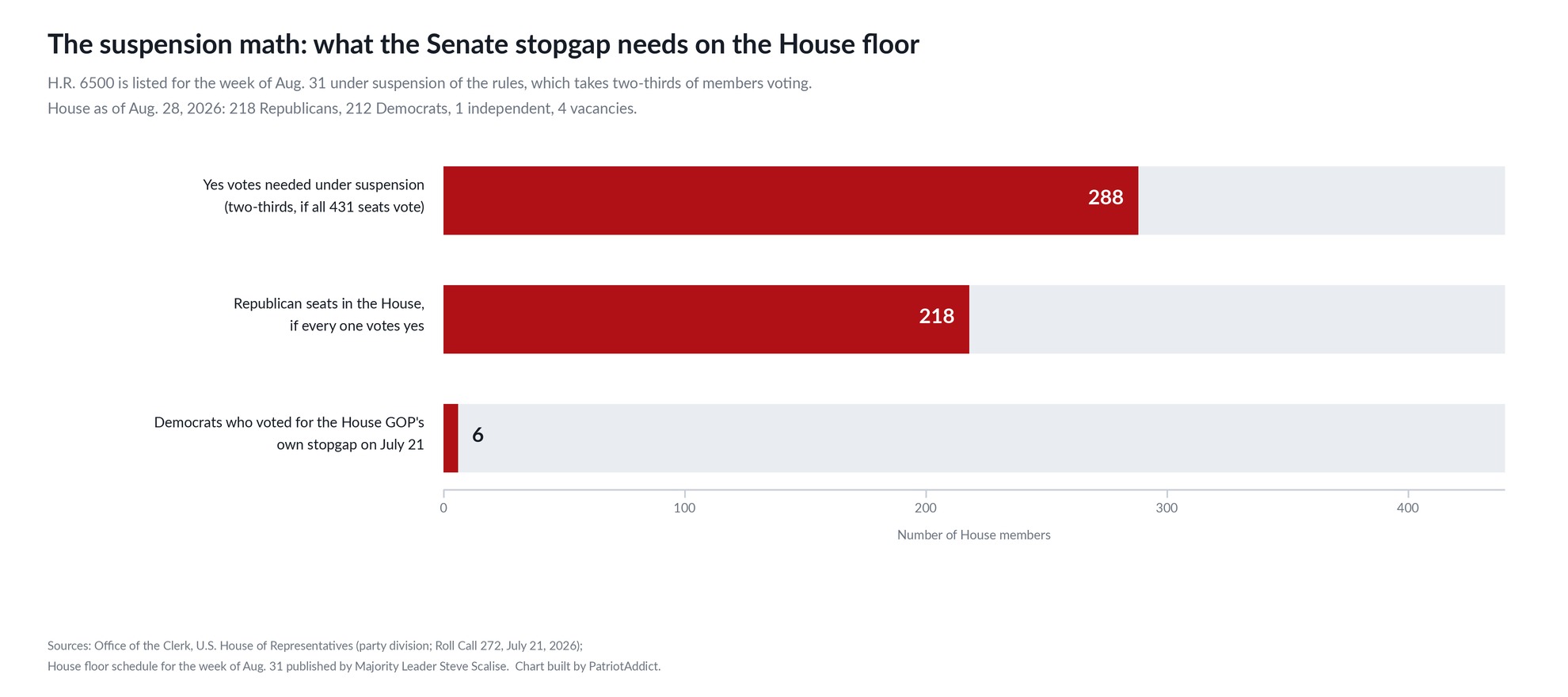
The arithmetic Speaker Johnson is working with this week. Chart built by PatriotAddict from the Office of the Clerk's party division and Roll Call 272 of July 21, 2026.
The remaining 70 must come from Hakeem Jeffries. Six weeks ago they were not there. On July 21 the House passed its own December 4 stopgap 220 to 205, and the Clerk's roll call has Democrats at 6 yes and 204 no. Roll Call identified the six: Kathy Castor, Henry Cuellar, Don Davis, Jared Golden, Vicente Gonzalez and Gabe Vasquez. Republicans went 213 to 1, with Thomas Massie of Kentucky the only no.
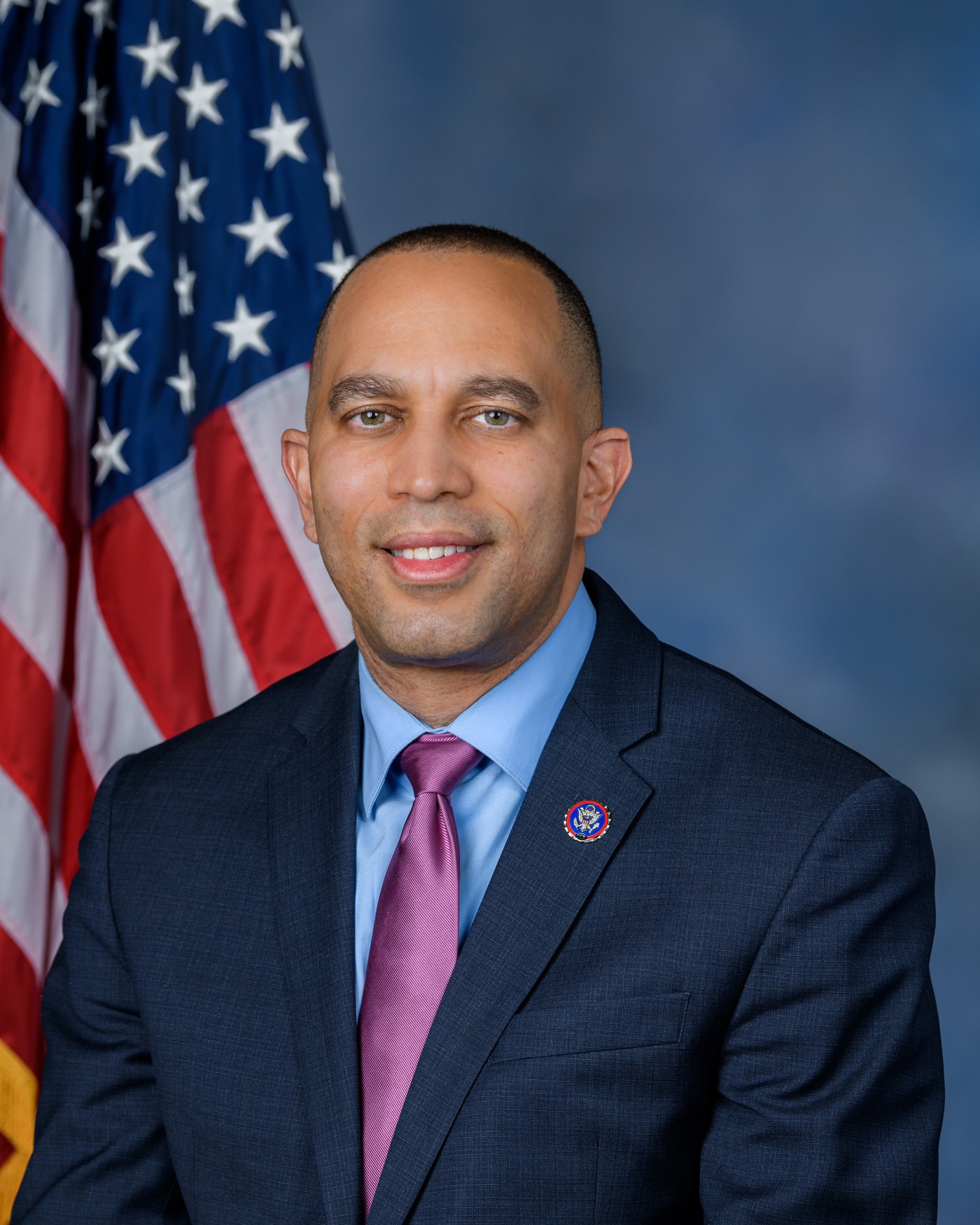
House Minority Leader Hakeem Jeffries, D-N.Y., whose caucus supplied six votes for the House GOP stopgap in July and would need to supply roughly 70 for the Senate version. Official House portrait, file photo (Office of Rep. Hakeem Jeffries, public domain, via Wikimedia Commons).
Jeffries called that bill "a premature and desperate attempt by Republicans to abdicate their responsibility to govern," in a joint statement with Katherine Clark and Pete Aguilar, and added, "We will be voting No." The Senate text carries provisions Democrats bargained for, which is the only reason it can reach 288 when the House version could not.
The White House put its position in writing
The Office of Management and Budget issued a Statement of Administration Policy on August 3, five days before the Senate passed the bill 90 to 6 and sent it to the House. One page, no hedging.
Official record
Statement of Administration Policy, Senate Amendment to H.R. 6500. Executive Office of the President, Office of Management and Budget, August 3, 2026.
"President Trump strongly opposes another futile Government shutdown. Every Member of Congress should support passage of this CR to keep the Government open as discussions on full-year appropriations continue." (Statement of Administration Policy, Aug. 3, 2026)
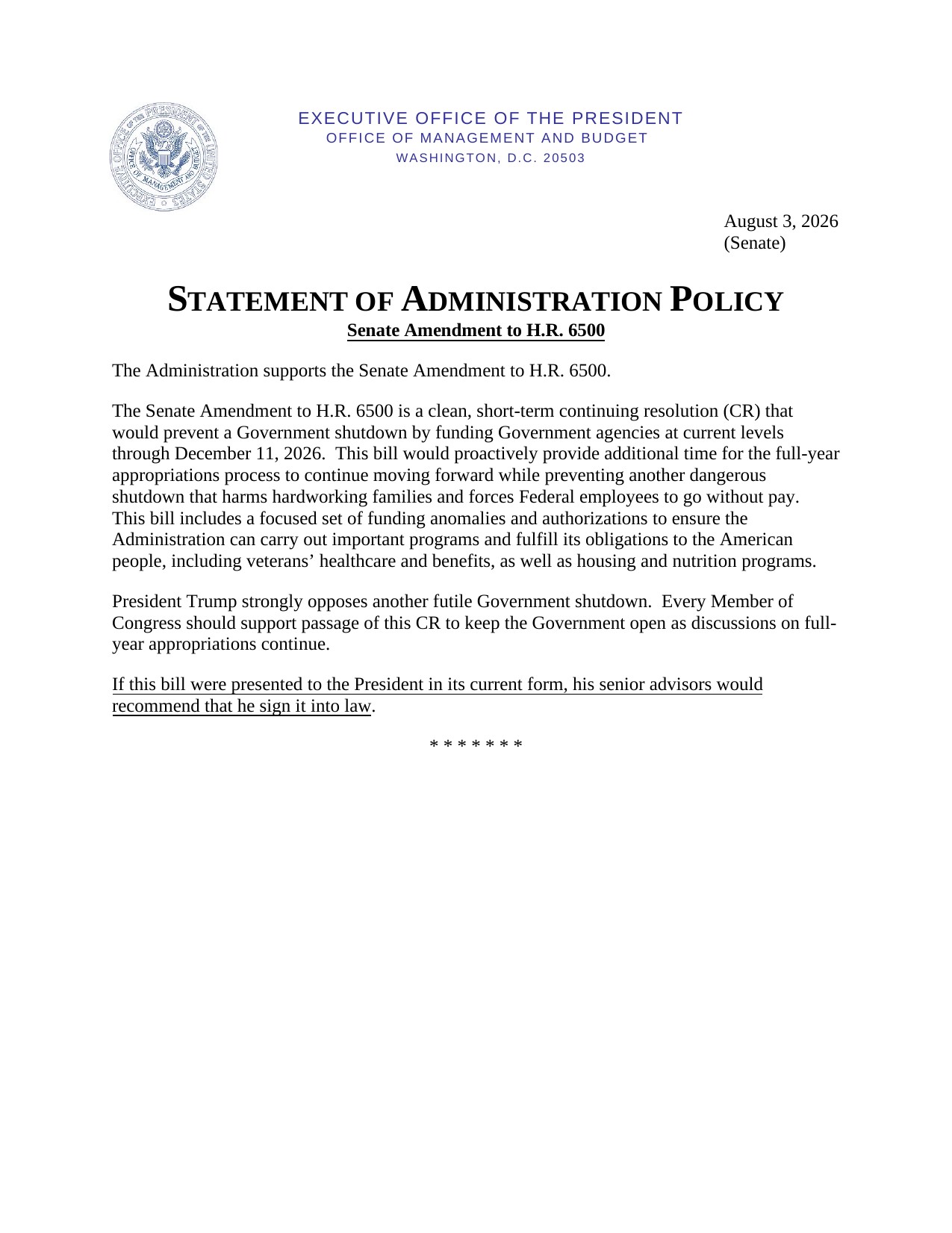
Read or download the full one-page statement (PDF) · view the same document on whitehouse.gov
The same page calls it "a clean, short-term continuing resolution" funding agencies "at current levels." That is the administration telling House Republicans to vote for flat spending.
Be honest about the fiscal math
Current levels means fiscal 2026 levels. The Committee for a Responsible Federal Budget puts enacted fiscal 2026 base discretionary funding at $1.622 trillion, and a CR carries that forward without anyone voting on it.
Here is what should sting. Take the seven fiscal 2027 bills for which House appropriators have published allocations and compare them with the same accounts in fiscal 2026. The Republican numbers come in about $600 million lower, on a base near $399.6 billion. That is fifteen hundredths of one percent, and the stopgap gives up even that. The Fiscal Responsibility Act's discretionary caps expired after fiscal 2025, so nothing enforceable sits on fiscal 2027 either.
Twelve of twelve House bills cleared committee and three passed the floor. The Senate, as of CRFB's August 12 update, has reported none and passed none.
Who is objecting, and over what
Not spending. The loudest House Republican complaint is Section 2019, which delays a ban on intoxicating THC-infused hemp products from November 12 to December 11. Freedom Caucus Chairman Andy Harris of Maryland wrote that ban into law last year. "Let's be clear: these are not harmless hemp products. They're intoxicating, unregulated, and widely available resulting in devastating numbers of children being hospitalized," Harris wrote on X in a post quoted by Roll Call on August 24. He has not said he will vote the bill down.
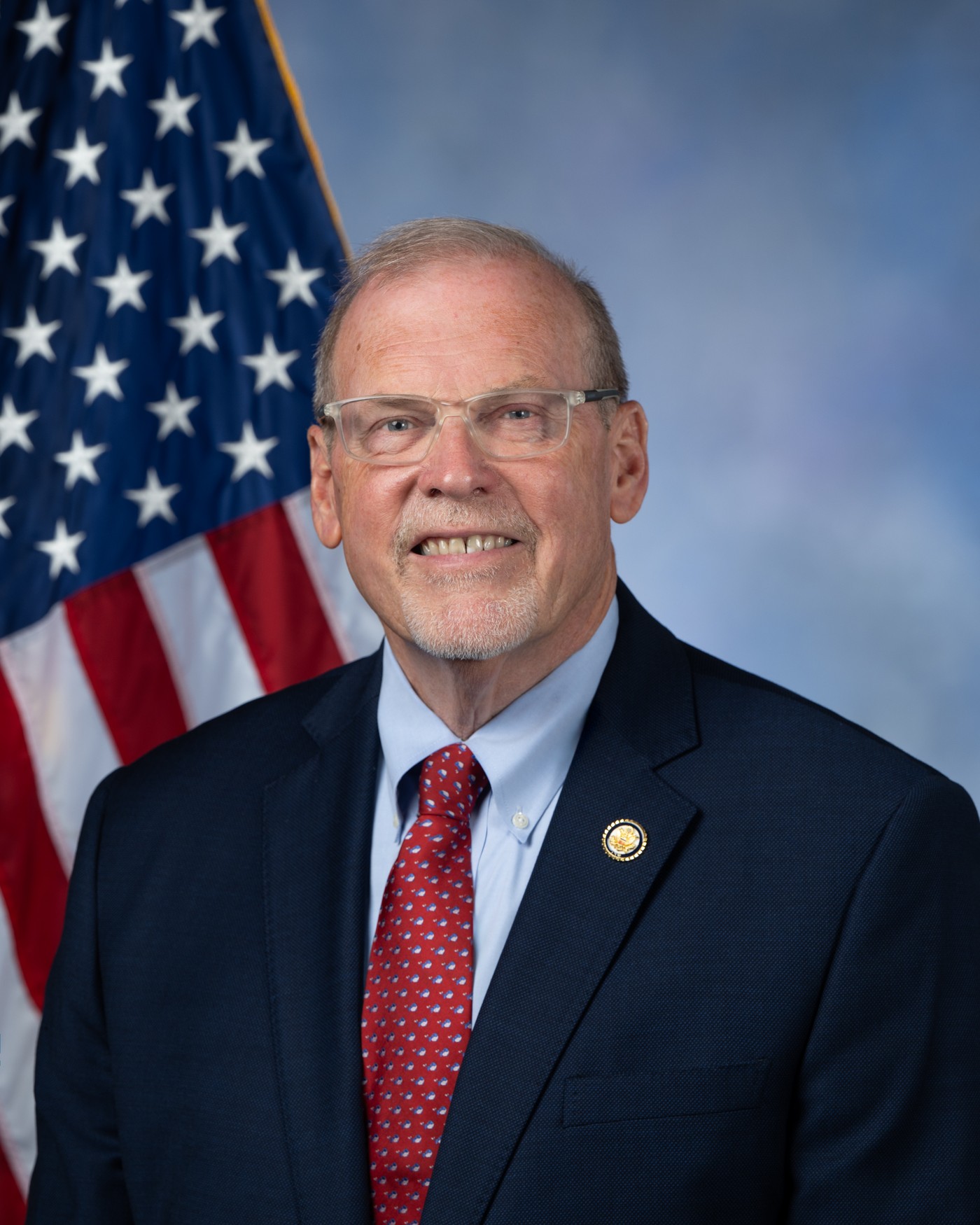
Rep. Morgan Griffith, R-Va., who wants the hemp ban delayed and replaced with a regulatory framework, and who laid out the whip math for Roll Call. Official portrait, 119th Congress, July 1, 2025 (Brendan O'Hara, U.S. House of Representatives Creative Services, public domain, via Wikimedia Commons).
Morgan Griffith of Virginia, who wants the ban replaced with a real regulatory framework, gave Roll Call the whip math. "The question is, if the Democrats decide to oppose the stopgap spending measure across the board, then there are probably enough 'no' votes to take that out," Griffith said. "I hope they don't." Roll Call notes conservatives have criticized leadership before for exactly this maneuver.
The date was always the point
Election Day is November 3. December 11 falls after it, and so did December 4. Neither chamber proposed a funding deadline that puts the spending argument in front of voters first, and the Washington Times reported Friday that the House is moving four weeks ahead of the September 30 deadline. This site covered the Senate half three days ago, when Susan Collins and Patty Murray killed the October shutdown and left the House to pick a December date. The House picked.
State it plainly: as of Saturday the House has not voted on H.R. 6500. No roll call and no vote count. The Clerk's last recorded House vote is still Roll Call 283, from July 23. When the number posts, watch the Democratic column.