Homeland Security Investigations began a coordinated voter fraud enforcement push across nine states on Tuesday, September 1, covering California, Connecticut, Georgia, Missouri, Nevada, New York, Pennsylvania, Washington and Wisconsin. The operation is scheduled to run into mid-October, and it is being carried out by an arm of ICE rather than by the Justice Department lawyers who normally handle election crimes. That is not a technicality. It is why the surge can happen at all.
CNN reported Monday, citing internal federal guidance it reviewed, that HSI is standing up a "coordinated criminal voter fraud surge initiative to pursue investigative leads, conduct field interviews, and support timely prosecutorial review." No public document describes the operation. DHS would not discuss it, telling both CNN and the Washington State Standard that it cannot comment on active investigations but that HSI "is actively rooting out and investigating election fraud wherever it can be found."
Why is ICE running this instead of the Justice Department?
Because the rule that would slow this down lives at DOJ, and DHS does not answer to DOJ. The Justice Manual's section on ballot fraud, JM 9-85.300, says the Department "should not engage in overt criminal investigative measures in matters involving alleged ballot fraud until the election in question has been concluded, its results certified, and all recounts and election contests concluded." Field interviews of voters are exactly the kind of overt step that language is aimed at.
There is a second wrinkle most of the coverage skipped. JM 9-85.300 allows exceptions, but only with the approval of the Criminal Division's Public Integrity Section. The section immediately above it, JM 9-85.210, now carries this notice: "Department leadership is currently revising this section. The Consultation Requirement is suspended while revisions are ongoing. [June 2025]" The gatekeeper for exceptions is the office whose gate has been propped open for more than a year.
Official record
Justice Department, Federal Prosecution of Election Offenses, Seventh Edition (May 2007, revised August 2007), page 91, section 4, "Noninterference with Elections." This is the Department's own handbook for the district election officers who run federal election-crime cases, and it is the source of the language CNN quoted. The Eighth Edition, published in December 2017, no longer resolves at its former justice.gov address.
"Starting a public criminal investigation of alleged election fraud before the election to which the allegations pertain has been concluded runs the obvious risk of chilling legitimate voting and campaign activities. It also runs the significant risk of interjecting the investigation itself as an issue, both in the campaign and in the adjudication of any ensuing election contest." — U.S. Department of Justice, Criminal Division, Public Integrity Section
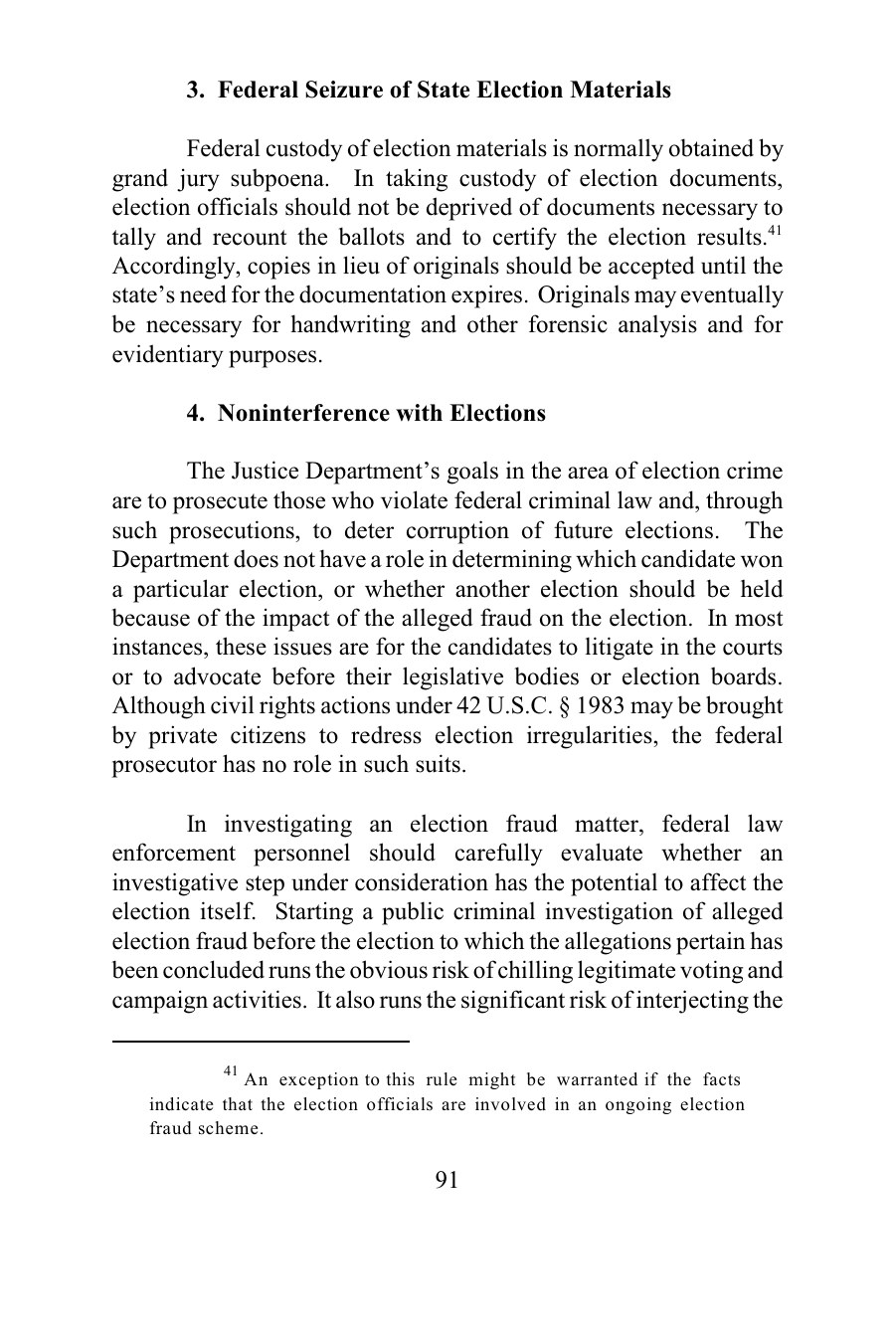
Read or download the full 345-page handbook (PDF) · view the original file on justice.gov
Mullin promised numbers that would not lie. The numbers keep shrinking.
Homeland Security Secretary Markwayne Mullin has made himself the face of this effort. His department pressed states to hand over their voter rolls for audit and threatened to withhold grant money from those that refused a broader package of election changes. Earlier this summer DHS said an audit of public rolls had found more than 250,000 registered noncitizens in California, Pennsylvania, New Jersey and Nevada. "One thing that I love about numbers, and I love about facts, is they don't lie," Mullin told reporters at the time.
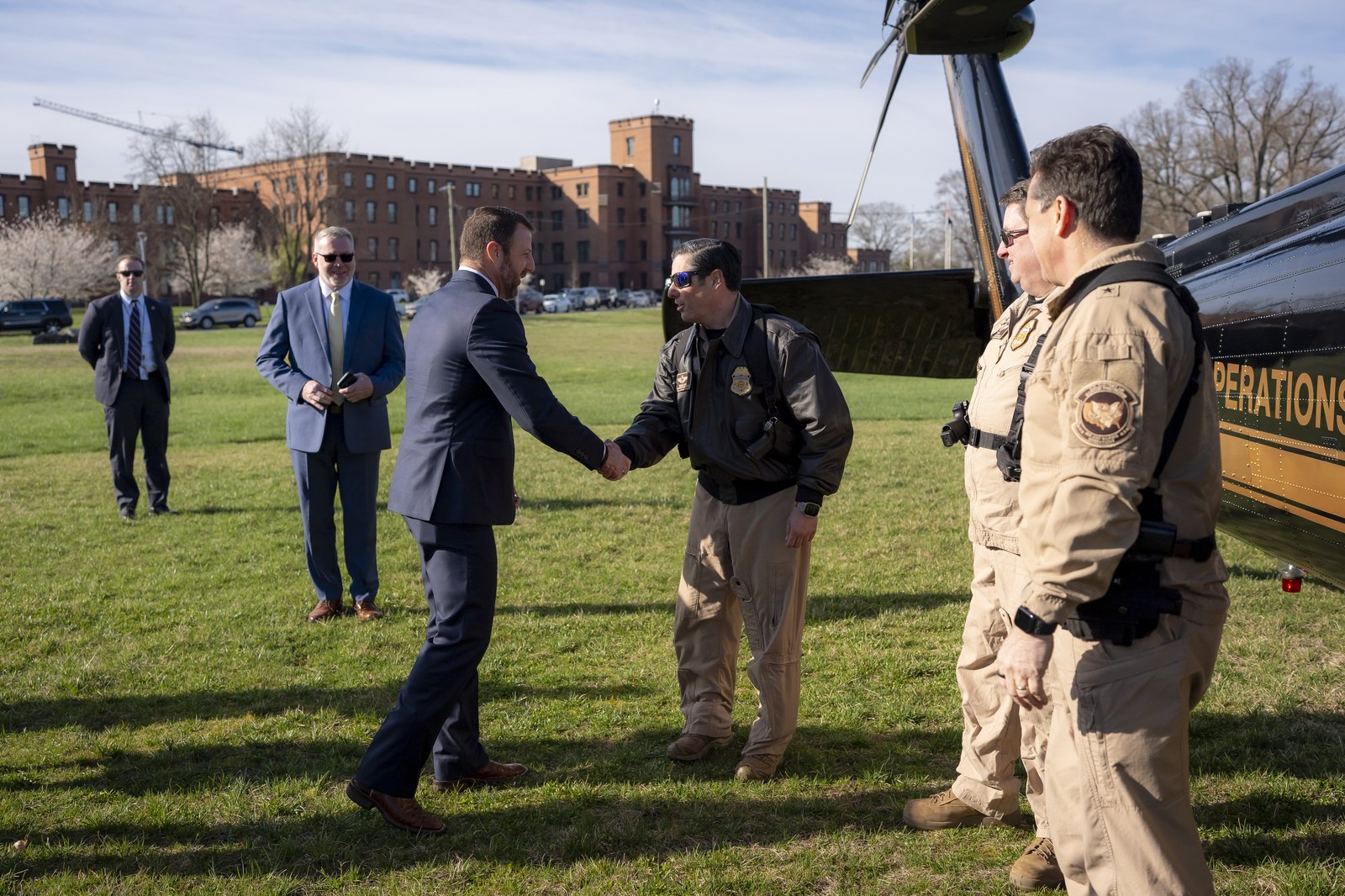
Homeland Security Secretary Markwayne Mullin greets federal law enforcement officers during a March 24, 2026 visit to the St. Elizabeths campus and DHS headquarters in Washington. (Department of Homeland Security photo via Wikimedia Commons, public domain)
Nevada is where that claim has been tested hardest. DHS said publicly it had found close to 16,000 noncitizens on the state's rolls. Behind closed doors, according to internal records CNN reviewed, the department told Nevada's election officials it had confirmed 185.
Another 6,200 were tagged as higher confidence matches that still needed vetting. That is not nothing, and it is also not 16,000. The same gap ran through the Census Bureau's own 2020 estimate.
What has 20 months of this produced?
ProPublica pulled Justice Department data covering January 2025 through May 2026 and found fewer than 150 alleged noncitizen voters referred for prosecution in that stretch. Forty-one people were charged with voting illegally or other election crimes. Through May, prosecutors had won convictions or guilty pleas in 14 cases, with the largest cluster in the Southern District of Florida. In Ohio, where the secretary of state referred more than 1,000 possible noncitizens in October, two cases had been referred for prosecution by May and nobody had been charged.
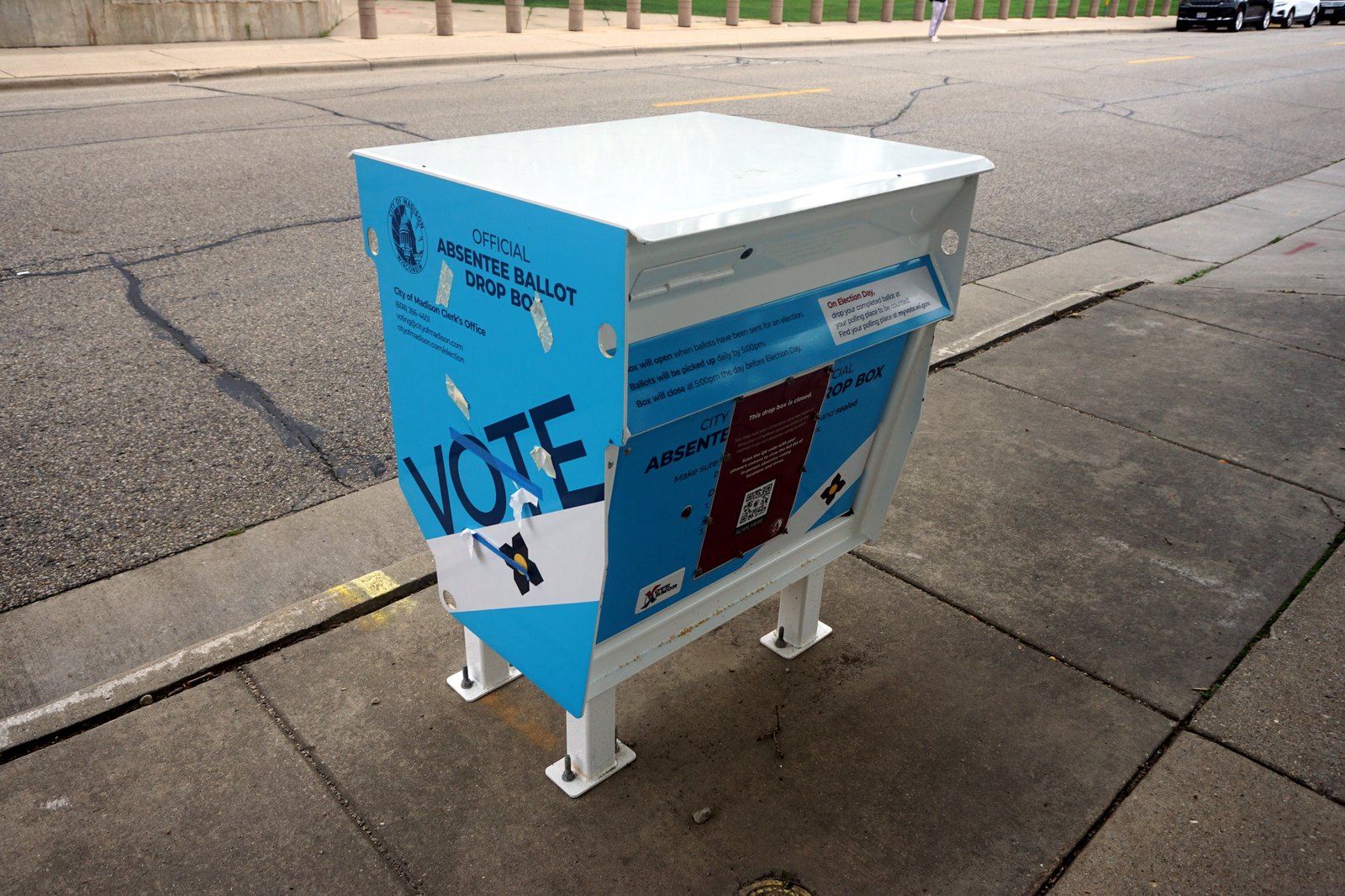
An official City of Madison absentee ballot drop box, photographed in August 2022 with its ballot slot taped shut. Wisconsin is one of the nine states where HSI offices are expected to take investigative action through mid-October. (Photo by Michael Barera, CC BY-SA 4.0, via Wikimedia Commons)
The case the White House is holding up
Four days before the surge began, prosecutors in Los Angeles charged Darwin Jonathan Rivera-Flores, a 30-year-old Honduran national and green card holder, with fraudulent voter registration and falsely claiming U.S. citizenship. Fox News reported that the affidavit describes an online registration checking the citizenship box, that DOJ says he never actually voted, and that he had texted an HSI agent that he could not wait until the midterms. "Today's arrest is the first of many to come," First Assistant U.S. Attorney Bill Essayli said. White House spokeswoman Lauren Bis told Fox that "the evidence of non-citizens registering to vote in our elections continues to pile up."
The states in the crosshairs are not cooperating
Washington Secretary of State Steve Hobbs called the surge "another attempt by the federal government to cause chaos and confusion ahead of the midterms," and said his state has documented five cases of voter fraud out of 90 million ballots cast between 2008 and 2025. Attorney General Nick Brown said he has "no reason to believe this is a legitimate inquiry by DHS." Neither said he had been told anything beyond what he read in the press, which is its own problem: state officials cannot correct a bad match on a list they have not seen.
Mid-October is the part that matters
The operation's window closes right as mail ballots land in mailboxes, the same stretch in which the courts are still fighting over how those ballots get delivered. If agents knock on doors in Nevada or Pennsylvania in early October and the cases hold up, the administration will have the proof it has been promising for two years. If they interview voters in nine states and the charges never come, DOJ's own handbook already wrote the counterargument. Either way, routing this through ICE instead of the Public Integrity Section is the choice that made the timing possible.