The House cleared the stopgap spending bill 370 to 48 on Tuesday afternoon and sent President Trump a measure funding the federal government through December 11, taking a pre-election shutdown off the table. The 48 no votes were 29 Democrats and 19 Republicans, and the Clerk's roll call shows the two groups voted no for opposite reasons.
Who the 48 actually were
Roll call 286 was taken at 2:03 p.m., on a motion by House Appropriations Chairman Tom Cole to suspend the rules and agree to the Senate amendments to H.R. 6500. Republicans voted 193 to 19 for it, Democrats 176 to 29. The chamber's one independent voted yes and 14 members did not vote.
The Republican no list reads like a House Freedom Caucus roster. It includes Harris of Maryland, who chairs the caucus, Roy and Sessions and Cloud and Self of Texas, Massie of Kentucky, Crane and Schweikert of Arizona, Clyde of Georgia, Higgins of Louisiana, Burlison of Missouri, Davidson of Ohio, Brecheen of Oklahoma, Perry of Pennsylvania, Norman of South Carolina, Rose of Tennessee, Steube of Florida, and both members named Biggs, one from Arizona and one from South Carolina.
The Democratic no list runs the other direction. Ocasio-Cortez of New York, Omar of Minnesota, Tlaib of Michigan, Pressley of Massachusetts, Jayapal of Washington, Casar of Texas and Ramirez of Illinois voted against it, alongside long-serving members like McGovern of Massachusetts and Matsui of California. Nobody in that group objected that the bill spends too much.
What the Senate put in the bill that moved 167 Democrats
Six weeks earlier the House passed its own stopgap, H.R. 9770, running only to December 4. It cleared 220 to 205 on roll call 272 on July 21, with Democrats voting 6 to 204 against. Comparing the two roll calls member by member shows what moved: 167 Democrats who voted no in July voted yes on Tuesday, and 16 Republicans who voted yes in July voted no.
The reason is in the text. The House version ran 18 pages and stopped at section 128. The Senate version the House swallowed whole on Tuesday runs 58 pages and goes to section 157, which appears nowhere in the House bill.
Official record
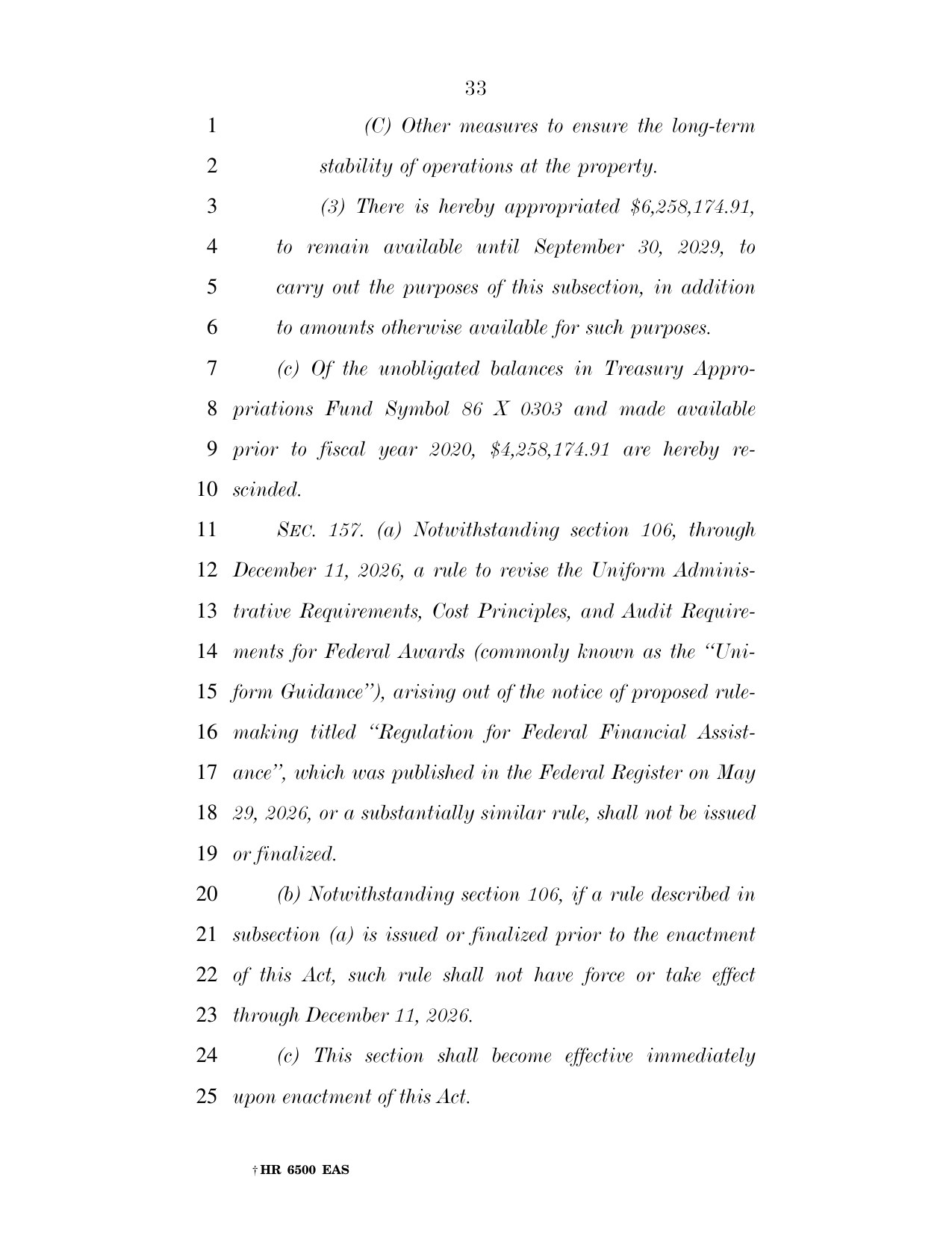
H.R. 6500, Continuing Appropriations and Extensions Act, 2027, as engrossed with the Senate amendment (BILLS-119hr6500eas), division A, section 157, page 33 of 58.
"Notwithstanding section 106, through December 11, 2026, a rule to revise the Uniform Administrative Requirements, Cost Principles, and Audit Requirements for Federal Awards (commonly known as the 'Uniform Guidance'), arising out of the notice of proposed rulemaking titled 'Regulation for Federal Financial Assistance', which was published in the Federal Register on May 29, 2026, or a substantially similar rule, shall not be issued or finalized." — H.R. 6500 EAS, Sec. 157(a)
Read or download the full 58-page Senate-passed text (PDF) · view the original on govinfo.gov
Subsection (b) goes further: if the rule is finalized before enactment, it has no force through December 11 anyway. Rep. Debbie Wasserman Schultz described it to Roll Call as halting an "outrageous OMB rule that would let political appointees make decisions about grants." Ranking member Rosa DeLauro called the Senate text a "marked improvement," per Government Executive.
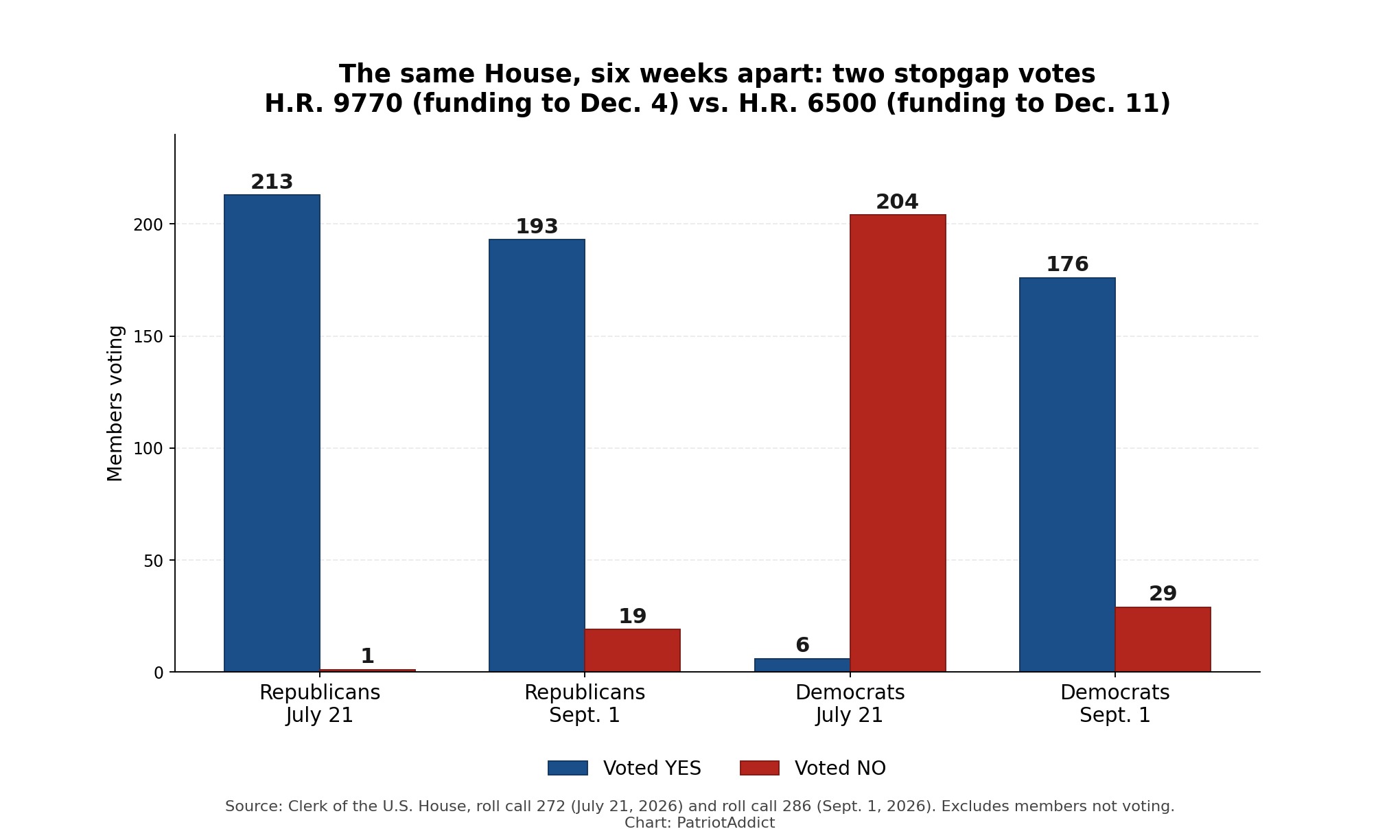
The same House on two stopgap bills six weeks apart. Chart built by PatriotAddict from the Clerk of the House roll calls 272 and 286.
Republicans could not have passed this on their own
Leadership brought the bill up under suspension of the rules, which blocks amendments but requires two thirds of those present and voting. With 418 members voting, the bar was 279. Republicans produced 193 yes votes, so at least 86 Democrats had to vote yes or the bill died on the floor. In the end 176 did. When we ran that math last week, the figure came out near 70, assuming near-unanimous Republicans. The 19 defections moved it.
The vote that nearly failed came 17 minutes later
The stopgap was never the hard vote. Seventeen minutes later the House adopted H. Res. 1499, the rule setting up debate on four unrelated bills, by 210 to 208. Five Republicans voted against their own leadership's rule: Roy and Sessions of Texas, Harris of Maryland, Higgins of Louisiana and Norman of South Carolina. Two Democrats voted for it: Jared Golden of Maine and Marie Gluesenkamp Perez of Washington. Without those two it failed.

Rep. Jared Golden, D-Maine, one of two Democrats whose votes carried the Republican-drafted rule 210 to 208. Official portrait, House Creative Services, public domain.
That was the whole point. Suspension bars amendments, so the rule was the only leverage the holdouts had left. "NO ON CR. NO ON RULE THAT DOES NOT ALLOW US TO AMEND AND FIX THE CR," Roy posted on X beforehand. Harris told reporters Monday night, "If the rule comes out without the CR in it, with a hemp amendment to undo what the Senate did, I'm voting against the rule." Cole said the push to run the CR through a rule was an attempt "to blackmail the rest of us."
Golden, who is retiring, framed his vote in his office's release as removing "the incentive for either party to hold the government hostage in an attempt to score political points." Speaker Mike Johnson, after the rule survived, told reporters: "The rule has passed. Many of you thought that would not happen today."
December 11 is 100 days out, and the bills are not written
The fiscal year ends September 30, and per the National Association of Counties, Congress has not passed one of the 12 regular fiscal 2027 appropriations bills through both chambers. Government Executive counts three House-passed bills and none in the Senate. The Committee for a Responsible Federal Budget's Appropriations Watch, last updated August 12, still lists every Senate entry as undetermined. Cole put it to Government Executive plainly: "the fiscal year deadline is outpacing the work that remains."
He was equally blunt about the calendar. "This will allow Congress time to get past the November elections," he said, "and allow us time to assess and move forward with further appropriations measures in November and December." December 11 falls 38 days after the November 3 midterms, so the next funding fight belongs to a lame-duck House elected in 2024, not the one voters pick this fall.
Section 157 expires that day. So does the National Flood Insurance Program extension, per NACo, and the surface transportation extension, per Roll Call. Everything Democrats won in August and everything the Freedom Caucus lost lands back on the floor in the same week, with the election already settled.
Header photo: Rep. Chip Roy, R-Texas, speaking at the 2024 Young Americans for Liberty National Convention in Kissimmee, Florida. Photo by Gage Skidmore, via Wikimedia Commons, CC BY-SA 2.0.