A Georgia long-haul truck driver has asked the Supreme Court to rule that Minnesota cannot ignore the carry permits Florida and Georgia issued him. Minnesota's response, filed Monday, was that it does not intend to respond at all. The petition in Johnson v. Jacobson hit the docket August 27 as No. 26-255.
Minnesota's list is a roster of the states it rejects
The law at issue is one paragraph long. Minn. Stat. 624.714, subd. 16(a) orders the public safety commissioner to publish a list each year of states whose carry-permit laws "are not similar to this section." Anyone holding a permit from a state not on that list can carry in Minnesota. Landing on the list is what costs you the right.
Fifteen states are on it right now, per the Bureau of Criminal Apprehension's live page: Alabama, Arizona, Florida, Georgia, Indiana, Iowa, Maine, New Hampshire, Oregon, Pennsylvania, Utah, Virginia, Washington, Wisconsin and Wyoming. The 33 states Minnesota does honor include California, New York, New Jersey, Hawaii, Maryland, Massachusetts and Illinois.
That pattern is not a clean partisan split, and it is worth being straight about why. Oregon, Washington and Maine are rejected too. The statutory test is whether another state's paperwork resembles Minnesota's, not whether its politics do. Six of the honored states count only for the upgraded permit tier the state labels "enhanced."
Official record
Jeffrey M. Johnson, Sr. v. Bob Jacobson, Commissioner, Minnesota Department of Public Safety, No. 26-255, Petition for a Writ of Certiorari, filed August 24, 2026 by Ryan Morrison of the Liberty Justice Center. Live on the Court's own public docket.
"In the Eighth Circuit's view, an individual's Second Amendment rights are confined to the borders of the state of where he holds a firearm permit. No matter how many times an ordinary law-abiding citizen proves his worth through a state's firearm licensing process, another state can force him to do it again." (Petition, p. 1)
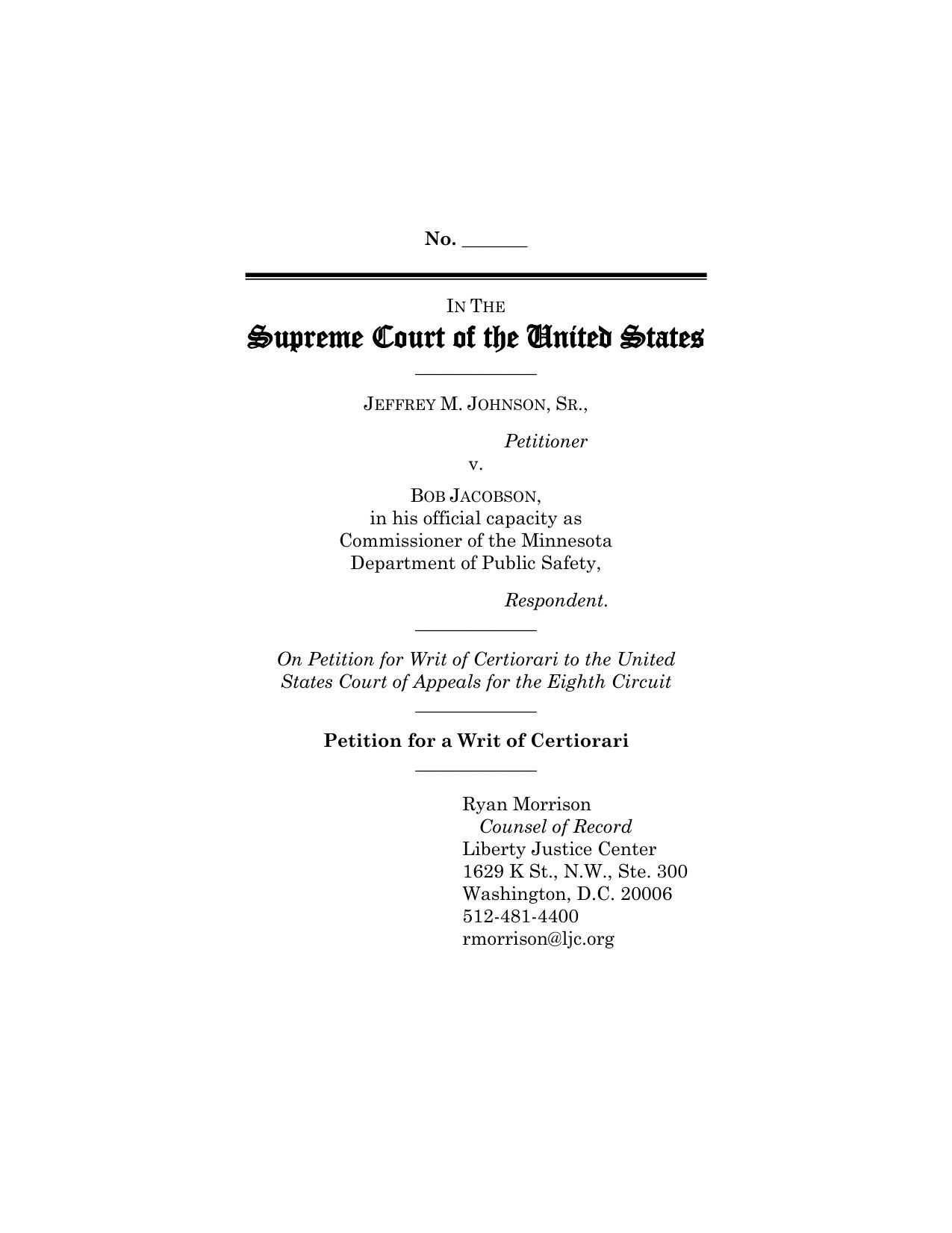
Read or download the full 65-page petition and appendix (PDF)
The concession that sank him
Jeffrey M. Johnson Sr. lives in Georgia, drives freight through the lower 48, and holds a Florida concealed weapons license and a Georgia weapons carry license. He keeps a handgun in the cab, which the petition attributes to "the prevalence of violent crimes" against truck drivers. His dispatcher hands him each route only after he finishes the last delivery, so he does not know in advance when he is being sent through Minnesota.
Judge John Tunheim dismissed his suit on September 11, 2025, but sided with Johnson on the threshold question: carrying in public in Minnesota "falls squarely within the scope of activity that the Second Amendment protects" at step one of the Bruen test. Tunheim then upheld the provision as a modern echo of historic surety laws.
The Eighth Circuit affirmed on May 26 and threw out the district court's reasoning to do it. Judge L. Steven Grasz, writing for a unanimous panel, held that the reciprocity statute "standing alone, does not regulate arms-bearing conduct" and that it "merely creates an exemption from the permitting process." The hinge is a sentence Johnson's own lawyers wrote: he "repeatedly concedes that Minnesota's shall-issue permitting requirement does not violate the Second Amendment." If the permit rule is lawful, the panel reasoned, reciprocity is a courtesy being withheld rather than a right being taken. Its analogy was Hawkins v. Moss, a 1974 case about states declining to honor each other's professional licenses.
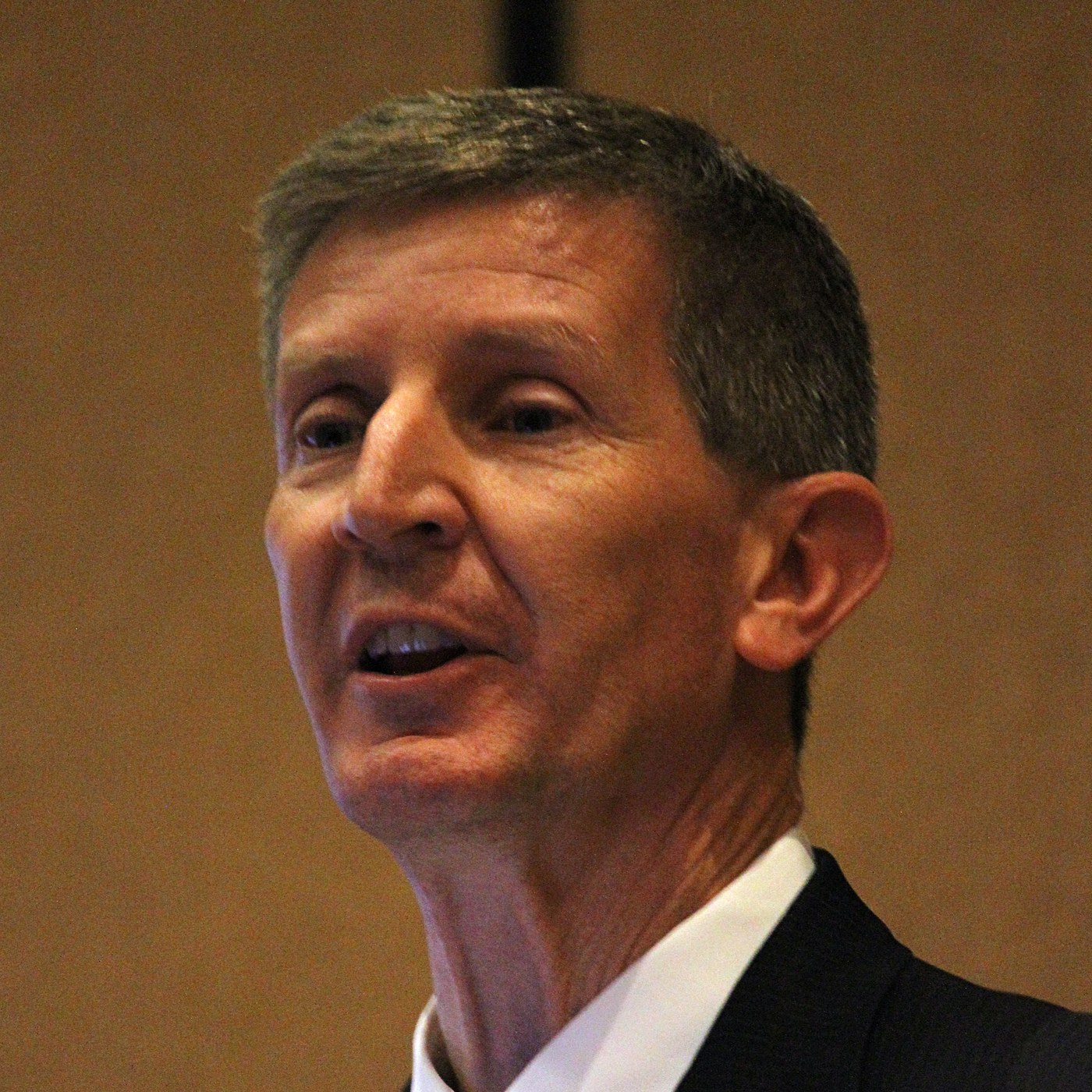
Judge L. Steven Grasz of the Eighth Circuit, who wrote the opinion against Johnson, speaking at a Federalist Society event in 2018. Grasz was appointed by President Trump. The two judges who joined him, Ralph Erickson and Bobby Shepherd, were appointed by President George W. Bush, per The Reload. Photo by Wikimedia Commons contributor Cornstalker, CC BY-SA 4.0.
Minnesota is not going to defend the ruling it won
The docket had Minnesota's brief in opposition due September 28. On August 31, assistant attorney general Michael Goodwin filed a one-page form instead: "I DO NOT INTEND TO FILE A RESPONSE to the petition unless one is requested by the Court." Commissioner Bob Jacobson was named to the job by Gov. Tim Walz in December 2022.
Waiving cuts both ways, and gun owners cheering it should read it carefully. It clears the deadline out of the petition's path, and the Court's own case distribution schedule shows paid-list distributions on September 2, 9 and 18 all feeding the term's first conference on September 28. But a state that believed it was in real danger of losing would have written something. Waiving is what a respondent does when it expects a denial without help.
Official record
Waiver of the right of respondent Bob Jacobson to respond, No. 26-255, filed August 31, 2026 by Michael Goodwin of the Minnesota Attorney General's Office. One page, on the public docket.
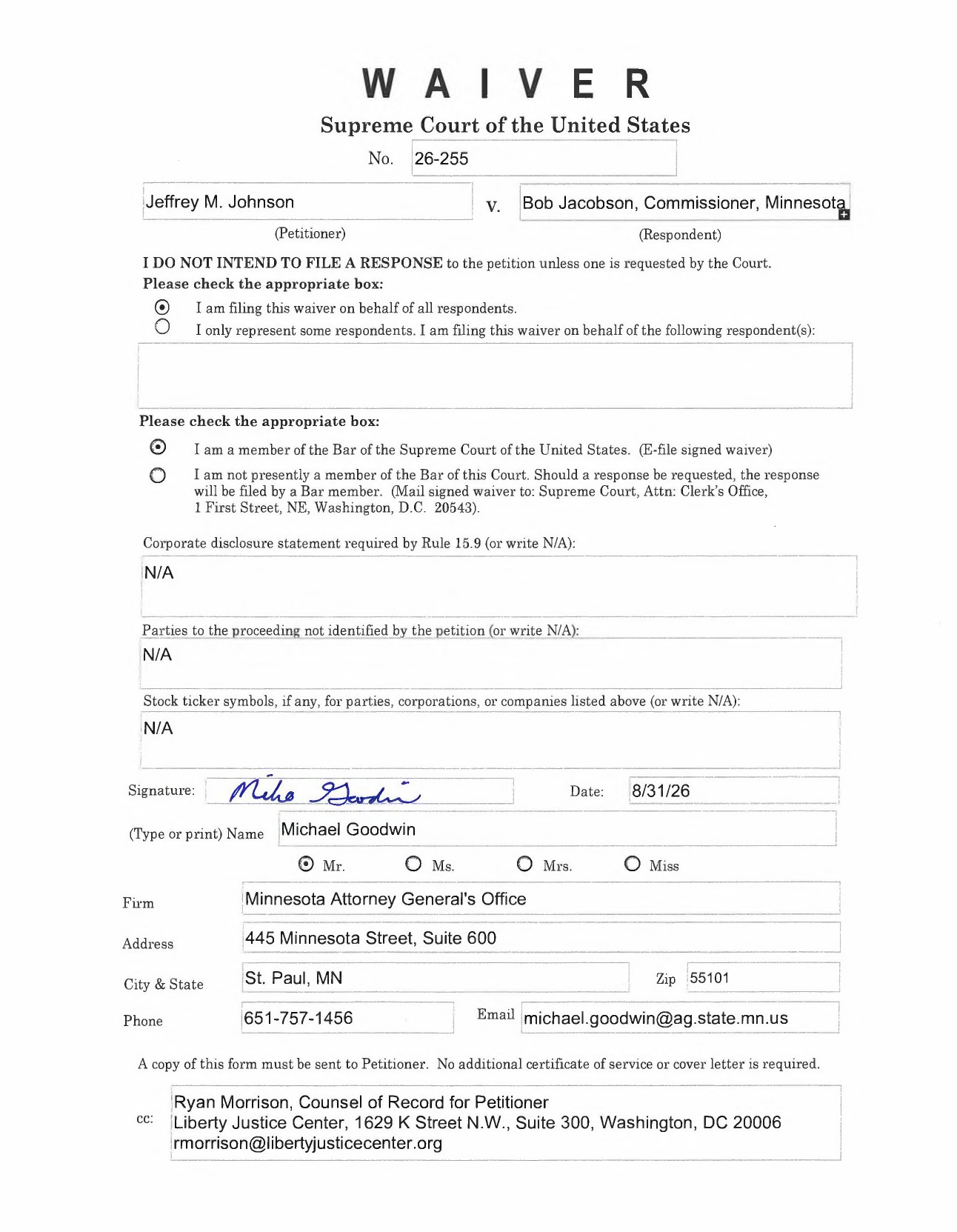
Read or download Minnesota's waiver (PDF)
The petition's real weapon is ten weeks old
Johnson's brief leans hardest on Wolford v. Lopez, which the Court decided 6-3 in June, striking down Hawaii's rule barring permit holders from private property open to the public. Justice Alito wrote for the majority that Hawaii's "particular customs and laws" could not save the rule "because the Second Amendment has the same meaning in all parts of the United States." Of the Hawaii scheme itself he wrote that it "hobbles what the Second Amendment protects: the right of Americans to carry arms for self-defense as they go about their daily lives."
The petition's argument is that those words and the Eighth Circuit's opinion cannot both be right. Its sharpest line: the ruling below "forces Americans to carry a rolodex of firearm licenses so that they can exercise their constitutional rights across the country."
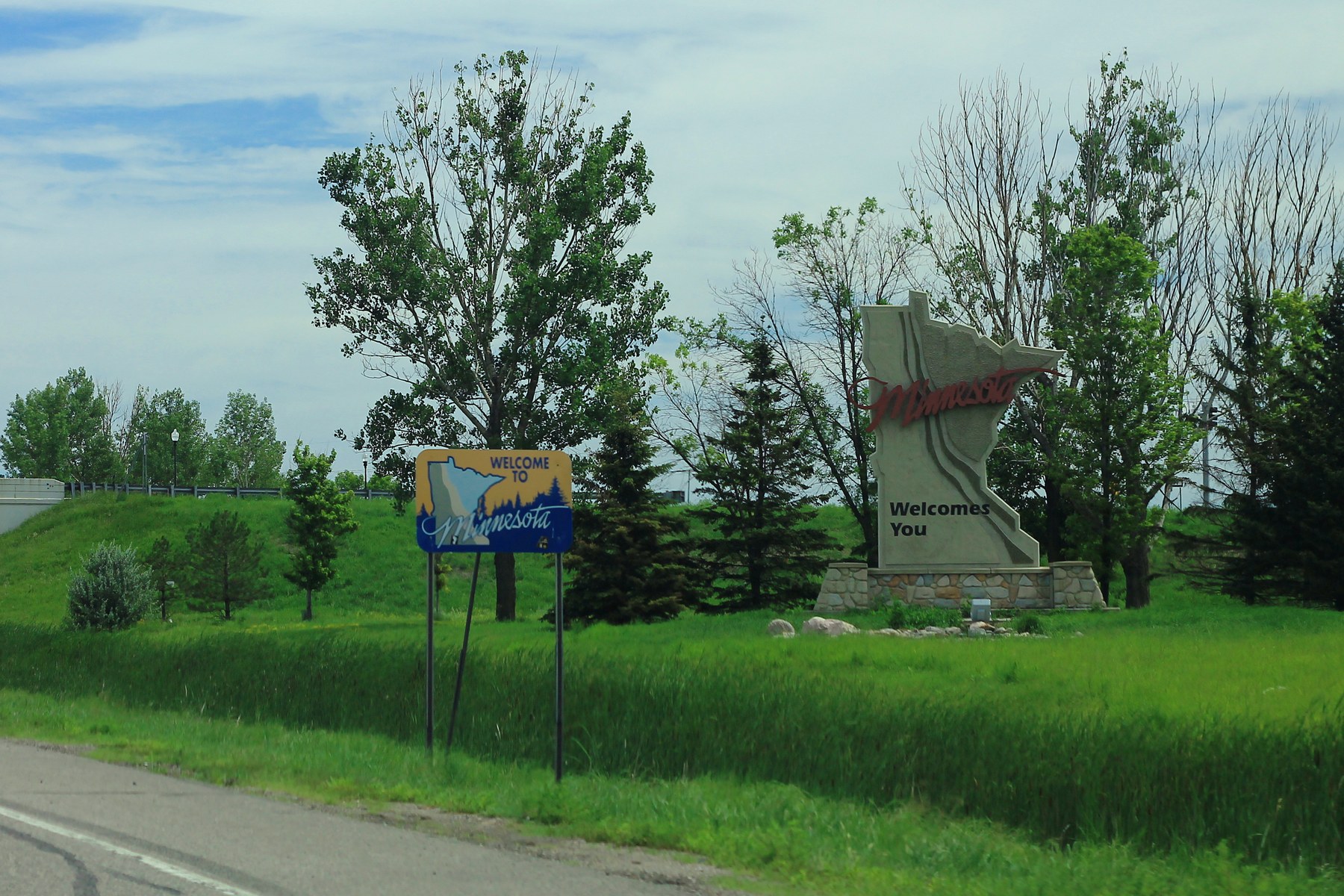
The Minnesota state line on eastbound Interstate 94. Under current law this is the point where a Florida or Georgia permit stops working and the pistol has to come out of reach. Photo by Wikimedia Commons contributor formulanone, CC BY-SA 2.0.
The case has been shrinking the whole time it moved
Johnson started out with a co-plaintiff. David A. McCoy II, a trucker with a Texas license, filed alongside him in January 2025 and then dropped his claim after Minnesota granted reciprocity to Texas permits, per a footnote on page 5 of the petition. The Liberty Justice Center's own case page still describes Minnesota as excluding 29 states, the figure that was right when the suit was filed. The rejected list is down to 15.
That is Minnesota's best argument, and it made it without filing a word: the problem is shrinking on its own as legislatures rewrite their permit statutes. Johnson's answer is that a right which depends on 50 legislatures agreeing with each other is not much of a right.
What is actually settled and what is not
A cert petition is a request. The overwhelming majority are denied, and four justices have to want this one for anything to happen. The Court can also ask Minnesota for a brief it just declined to write, which would push everything past the fall. By the Daily Caller's count, this is the fifth major Second Amendment case the justices have been asked to take up for the new term.
What has not changed is the only thing Johnson can feel. He crosses into Minnesota, the handgun goes into a locked case, and it stays there until he crosses back out. That is the rule today, it was the rule when he sued 20 months ago, and it will be the rule on September 28 no matter which way the conference goes.