ICE arrested 49,571 people in July, the biggest single month of Trump's second term and almost certainly the biggest in the agency's history. The number came out Tuesday, three weeks after Fox News reported a higher one from federal sources, and it lands with a second set of figures attached: in ICE's most recent published detention snapshot, taken July 11, 70.6 percent of the people the agency was holding had no criminal conviction of any kind. Both facts come from the government's own records. Neither cancels the other.
Three numbers for the same month, and where each one comes from
Start with the sourcing, because it decides how much weight each figure can carry. The Deportation Data Project at UC Berkeley and UCLA received a new ICE dataset on August 21 and released it on August 24, covering every ICE encounter, detainer, arrest, book-in and removal from October 1, 2022 through August 6, 2026. That is the release everyone is now working from.
The Associated Press analyzed it and put July at 49,571 arrests, up 15 percent from 43,021 in June and up 70 percent from 29,241 in February. Texas and Florida alone accounted for close to 20,000 of the July total, which is what happens when two large states go all in on 287(g) agreements that let their own police act as federal immigration officers.
Immigration data analyst Austin Kocher, who publishes his own tabulations of these releases, ran the same file and got 49,138 for July and 42,637 for June, which works out to 1,585 arrests a day in July against 1,421 in June. His count and the AP's differ by less than 1 percent. That is a filtering disagreement, not a dispute about what happened.
The third number is the one that ran first. On August 3, Fox News reported roughly 51,000 July arrests, about 1,645 a day, citing multiple federal sources. Nobody outside the agency could check it at the time. Kocher, who has no reason to talk down an unflattering figure, called 51,000 "within the realm of plausibility" while noting that numbers a reporter is told by agency staff "are not able to be independently and publicly validated." Twenty-two days later the released data came in about 3 percent below the leak. Treat 49,571 as the checkable floor and 51,000 as an unverified ceiling.
What the data counts, and what it does not
These are administrative immigration arrests recorded in ICE's own arrest tables, obtained under the Freedom of Information Act. They are not criminal arrests, and they are not the same thing as book-ins to detention, which is the number ICE publishes on its own schedule.
ICE's detention management file, the one the agency is required to put out roughly every two weeks, tells the flow story in a different unit. In June, 43,138 people were booked into ICE detention: 39,563 of them after an ICE arrest and 3,575 after a CBP arrest. Through July 11, fiscal 2026 had produced 353,948 total book-ins, 319,982 of them off ICE arrests. Anyone comparing a book-in figure to an arrest figure and calling it a discrepancy is comparing two different measurements.
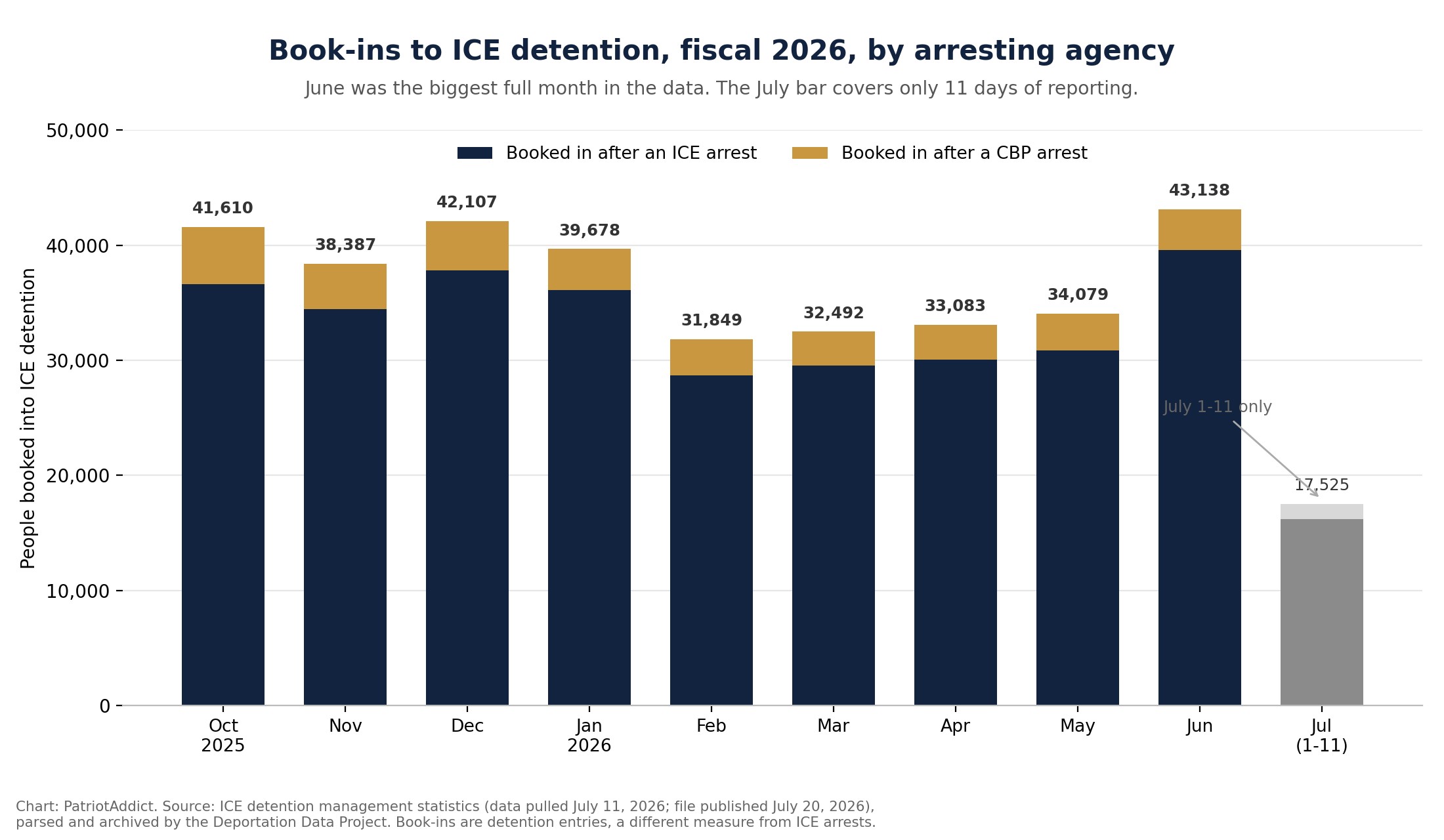
Monthly book-ins to ICE detention in fiscal 2026, split by which agency made the arrest. PatriotAddict built this chart from ICE's own detention management statistics, the file the agency published July 20, 2026 with data pulled July 11, as parsed and archived by the Deportation Data Project. Book-ins are detention entries, a different measure from arrests.
Notice where that chart stops. ICE has not published a detention statistics file since July 20. The most recent data pull in it is July 11. The agency publishes these figures under an obligation set by the Homeland Security Act, and there is now a five-week hole in the public record on detention while the arrest record hits an all-time high.
The prior peak was December, and February was the floor
This is not a straight line up. The month before Trump took office again, ICE arrests ran a little over 8,000, most of them people handed over from city and state jails. The fall of 2025 brought the first real surge, averaging 36,348 arrests a month from September through January by Kocher's count, and December 2025 set what was then the record at 40,177.
Then it broke. Two fatal shootings in Minnesota in January produced protests, an uproar from Democratic lawmakers and a visible pullback. Arrests fell to 29,241 in February and sat between roughly 30,000 and 32,000 for four months. Kristi Noem was fired in March. Book-ins into detention dropped in lockstep, from 42,107 in December to 31,849 in February.
What changed in June was method, not appetite. Mark Krikorian of the Center for Immigration Studies, who wants this enforcement to work, told the AP the agency "changed the tactics and are, if anything, being more effective," and said the earlier showy approach had been "provoking a lot of ordinary people, turning them off even if they liked the idea of the immigration law being enforced." That is a fair read. The raids that generated the most footage generated the most backlash, and the quieter model is producing more arrests with fewer cameras pointed at it.
Congress paid for the capacity. The reconciliation package sent ICE roughly $75 billion, broken out by the American Immigration Council as $45 billion for detention capacity and $29.9 billion for enforcement and removals, the latter including money to hire 10,000 more ICE officers over five years. The AP reports the agency has already hired 12,000 deportation officers and investigative agents. Give a law enforcement agency that much money and that many people and it will produce record numbers. It did.
The "worst of the worst" claim, run against DHS's own table
DHS has a house style for this. Nearly every day it posts a release headlined WORST OF THE WORST listing individual arrests of convicted criminals, and the one dated August 25 is titled "ICE Arrests Murderers, Robbers, Violent Assailants, and Drug Traffickers." Secretary Markwayne Mullin's framing in the August 10 release, as quoted by Kocher, was this: "While Americans enjoyed their weekend, the patriots of ICE worked around the clock to remove murderers, drunk drivers, pedophiles, sexual predators, drug traffickers, and other public safety threats from our communities." The department's line to KSL in Utah was that it "has remained singularly focused on removing the worst of the worst criminal illegal aliens from the United States." On X, as Fox News reported, DHS described officers "arresting and DEPORTING dangerous criminal illegal aliens, including gang members," and said that "under @POTUS Trump and @SecMullinDHS, the safety of the American people will always come first."
Those individual cases are real. The question is whether they describe the population.
ICE sorts everyone it detains into three buckets of its own devising: convicted criminal, pending criminal charges, and "other immigration violator," meaning no criminal record beyond the immigration violation. On July 11, with 65,765 people in custody, the split was 19,329 convicted, 20,247 with charges pending, and 26,189 with nothing on record but immigration. Add the first two and you get 39,576, or 60.2 percent, which is exactly the "60 percent have a criminal record" figure ICE gave ABC News in July. Take convictions alone and 46,436 people, 70.6 percent, have none, which is the figure TRAC publishes.
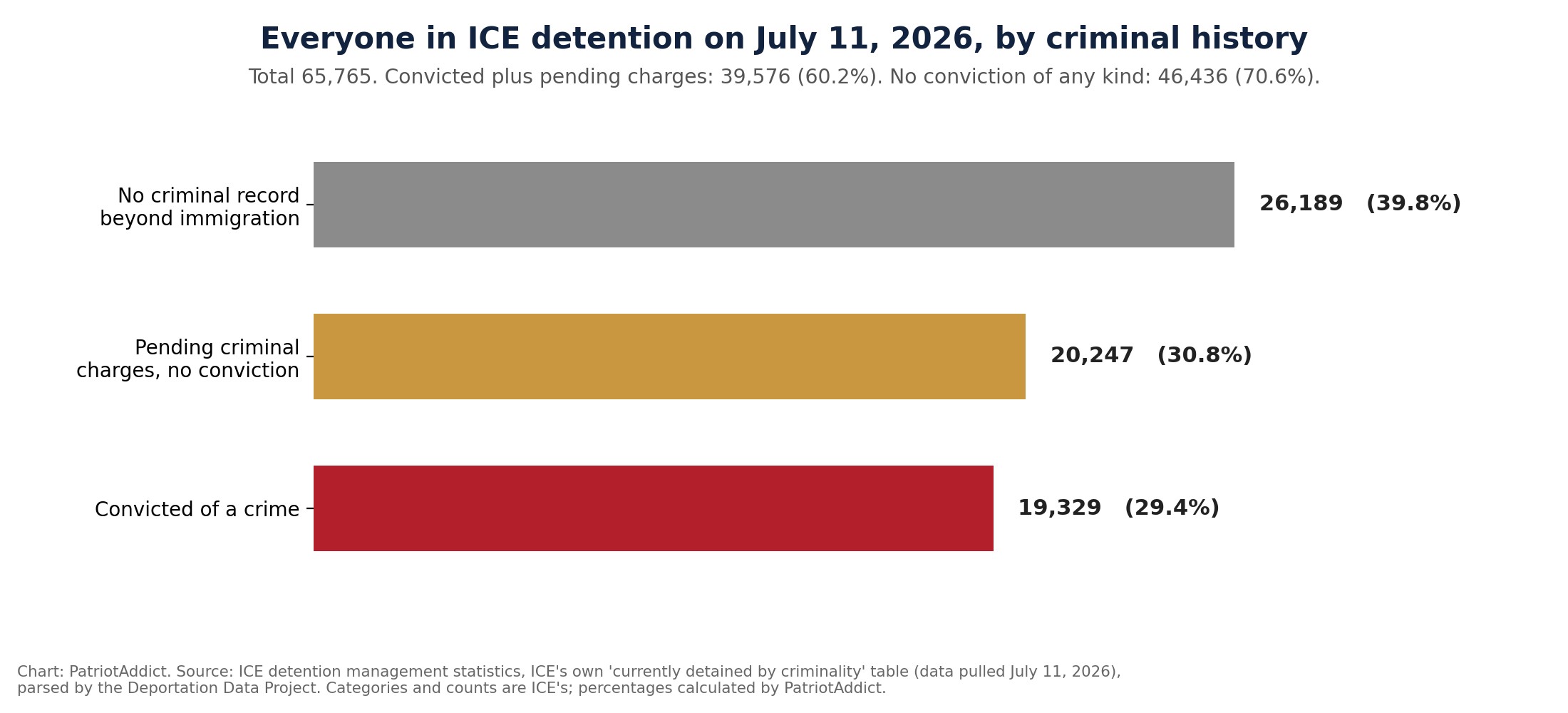
Every person ICE held in detention on July 11, 2026, sorted into ICE's own three criminal-history categories. PatriotAddict built this chart from ICE's "currently detained by criminality" table, parsed by the Deportation Data Project. The counts and the category labels are ICE's. The percentages are ours.
Both government numbers are true and they are measuring different things. DHS is counting anyone with an open charge as having a criminal record, which is defensible, because a pending charge is a real charge. Critics are counting convictions, which is also defensible, because a charge is not a finding of guilt and some share of that column will never be convicted of anything. Whoever picks the definition wins the argument, which is why both sides pick.
The harder number is the trend. Kocher's read of the arrest data is that people with no criminal history made up about 47 percent of June arrests and more than half of July's, and that while arrests of people with charges or convictions rose by a little under 20 percent over the surge, arrests of people with no criminal history more than doubled. In the partial August data, one arrest in five involved a conviction, the lowest share in the dataset. Kocher also points to a Cato Institute analysis of early fiscal 2026 detention data that found 73 percent of detainees with no conviction at all and 5 percent with a violent conviction.
Here is the honest version. The surge to a record was driven mostly by arresting people whose only offense on record is being here illegally. DHS's answer is that being here illegally is the offense, that Congress wrote it into law, and that an agency enforcing immigration law is not required to wait for a felony first. That answer is legally sound. What it is not is the same claim as "worst of the worst." An administration can defend removing people with no criminal record on the straightforward ground that the law says so. Dressing the same policy up as a manhunt for murderers invites exactly the fact-check it is now getting, and it hands critics a free win they did not have to earn.
Mullin said he would keep ICE out of the headlines
At his confirmation hearing, Markwayne Mullin pledged to keep ICE out of the headlines. On the narrow question of press attention he has mostly succeeded, in the sense that the arrest numbers went up while the coverage went down. The rest of it has not held. Two more men were killed in ICE operations this summer, one in Maine and one in Texas, and ICE acknowledged neither was the target of the operation he died in.

Markwayne Mullin is sworn in as Secretary of Homeland Security by Attorney General Pam Bondi, with President Trump in the foreground. Mullin replaced Kristi Noem, who was fired in March 2026. (Official White House photo, public domain, via Wikimedia Commons)
The quieter method has its own signature, and it is not raids. It is traffic stops. Patricia Quinonez, who covers Utah's Venezuelan community for Utahzolanos, described the pattern to the AP: "They stop you for whatever reason, for example, you don't have a driver's license, your vehicle tags are expired, your windows are more tinted than what is allowed. From there, they take advantage of the situation and ask about immigration." That is a lawful pretext stop used as an immigration checkpoint, and it scales without a single press release.
What Monday looked like in Connecticut
Numbers this large are made out of ordinary days. On Monday, Connecticut Public reported at least 20 arrests across three cities, based on an internal tally from the group CT Students for a Dream: 16 in Danbury, four in Stamford, one in Bridgeport. About half the Danbury arrests happened at a day laborer site. The four in Stamford all worked for tree removal companies. One man taken in Danbury needs dialysis. Another is the father of a high school student.

Wooster Square in downtown Danbury, Connecticut. Advocates counted at least 16 ICE arrests in Danbury on Monday, August 24, 2026, roughly half of them at a day laborer site. File photo from 2022, not connected to any enforcement action. (Photo by CityLimitsJunction via Wikimedia Commons, CC0)
Tabitha Sookdeo, who runs CT Students for a Dream, called the activity "indiscriminate" and said "the scale of enforcement activity in our beloved state of Connecticut is at an all-time high. I have never seen anything like this." Her group's own document says "many detained community members have no criminal or immigration history" and that "the detention patterns in Danbury deviate from the more common trend of targeted arrests." Danbury Mayor Roberto Alves said agents appeared to be "just pulling random people."
Those are advocates and Democratic officials describing enforcement they oppose, and their count is a community tally rather than an official one. Read it as such. What makes it worth reading anyway is that the pattern they describe, day laborers and tree crews rather than convicted felons, is the same pattern that shows up in ICE's own dataset. When the advocates and the agency's spreadsheet agree on the composition and disagree only on whether it is good, the composition is probably right.
Arrests are not removals, and the removal math is harder
Coverage runs these together constantly. They are separate pipelines with separate bottlenecks. Arrests are the front end and ICE controls them. Removals require travel documents, a receiving country and, usually, an immigration judge.
ICE's own posted statistics had fiscal 2026 removals at 356,389 as of late July, with two months left in the year. That is well ahead of fiscal 2025's 319,980 and fiscal 2024's 248,739, and it puts the agency within range of the modern single-year record, the 438,421 the Obama administration removed in fiscal 2013. It is nowhere near the 1 million a year that ICE wrote into its own fiscal 2026 congressional budget justification.
Two caveats belong on that figure and both cut against taking it at face value. ICE's removal count, by the agency's own footnotes, folds in voluntary returns, voluntary departures, withdrawals and Alien Enemies Act expulsions, so it is broader than formal deportation orders. And the Deportation Data Project says flatly, in the release notes for this very dataset, that it continues "to have questions about the reliability of the removals data." DHS's separate December claim of 2.5 million total departures counting self-deportations is a different measurement again, built from estimates rather than case files. If you want one number you can actually defend in an argument, use arrests. They are the cleanest thing in the file.
What this actually means
For anyone who voted for immigration enforcement, July is the month it started working at scale. Six times the arrest volume of the last month before this administration took office, back-to-back monthly records, and a delivery model that no longer depends on made-for-television operations. That is a real policy result, produced by real money Congress appropriated, and the people who said it could not be done were wrong.
The part worth holding onto is the part DHS keeps stepping on. This enforcement does not need a false advertisement. The legal case for removing people who are here unlawfully stands on its own, and it is a case conservatives have made honestly for thirty years. Every time the department captions a 49,571-arrest month as a sweep of murderers and pedophiles, it puts a claim into the record that its own detention table refutes, and it teaches the public to discount the next number too. We made the same point about the airport arrests three days ago: the policy can be defended on the merits, and the shortcut around the merits is what creates the vulnerability.
There is a practical version of this too. ICE has not published a detention file in five weeks, and the arrest data for the biggest month in its history reached the public only because the Deportation Data Project's own co-director filed suit in the Northern District of California. Enforcement this large should not be harder to audit than it is to run. A Republican Congress that funded the surge could require the numbers to be posted monthly and take the entire argument away from the litigators. It has not, and until it does, every claim about who is being arrested will be settled by whoever gets the spreadsheet first.
Header photo: an ICE vehicle in Minneapolis, January 8, 2026. Photo by Chad Davis, licensed CC BY 4.0. File photo, not connected to any July or August 2026 enforcement action.