Darline Graham beat Rep. Ralph Norman 193,396 to 175,327 in South Carolina's Republican Senate runoff Tuesday, an 18,069-vote margin that makes her the GOP nominee for the seat her brother held for 23 years. She was appointed to that seat six weeks ago and had never run for anything before. President Trump asked her to run, endorsed her, flew to Myrtle Beach for her, and his super PAC put $827,711 into the race in the final 48 hours. It worked, and the county he rallied in produced almost the entire statewide margin.
The official numbers, and the one county that decided it
The percentages from the South Carolina Election Commission's own reporting system are 52.45 percent for Graham and 47.55 percent for Norman out of 368,723 votes cast in the contest. Statewide, 369,014 ballots were cast, which the commission's detail report puts at 12.23 percent turnout. That is higher raw participation than the Aug. 11 first round, which drew 335,555 votes across a ten-candidate field. Runoffs almost always shrink. This one grew by more than 33,000 votes.
Pull the county-by-county detail report off the commission's results page and the race stops looking like a statewide win. Graham took Horry County, home of Myrtle Beach, by 26,459 to 9,618. That is 73.3 percent in her single biggest county, and a raw margin of 16,841 votes. Her statewide margin was 18,069. Horry alone accounts for 93 percent of it.
Trump held his rally in Myrtle Beach on Aug. 21, four days before the vote. Horry County is also the base of Rep. Russell Fry, who finished third on Aug. 11 with 19.66 percent and whose voters had to go somewhere.

President Trump boards Air Force One at Myrtle Beach International Airport on Friday, Aug. 21, 2026, after a rally for Sen. Darline Graham. Graham went on to win Horry County, which contains Myrtle Beach, with 73.3 percent of the vote. (Official White House Photo by Molly Riley, public domain, via Wikimedia Commons)
Trump asked her to run, then paid for the last two days
The endorsement came on July 17, three days after she was sworn in and right after she visited the Oval Office. "During her visit, I asked Darline, for the Good of our Nation, to run for the U.S. Senate in the Special Republican Primary on Tuesday, August 11, 2026," Trump wrote in a Truth Social post quoted by both Breitbart and TIME. He gave her his "complete and total endorsement" in the same post. At the Myrtle Beach rally five weeks later he put it plainly: "I'm doing this to honor Lindsey. That's why I'm here. So, Darline, we got to win that race."
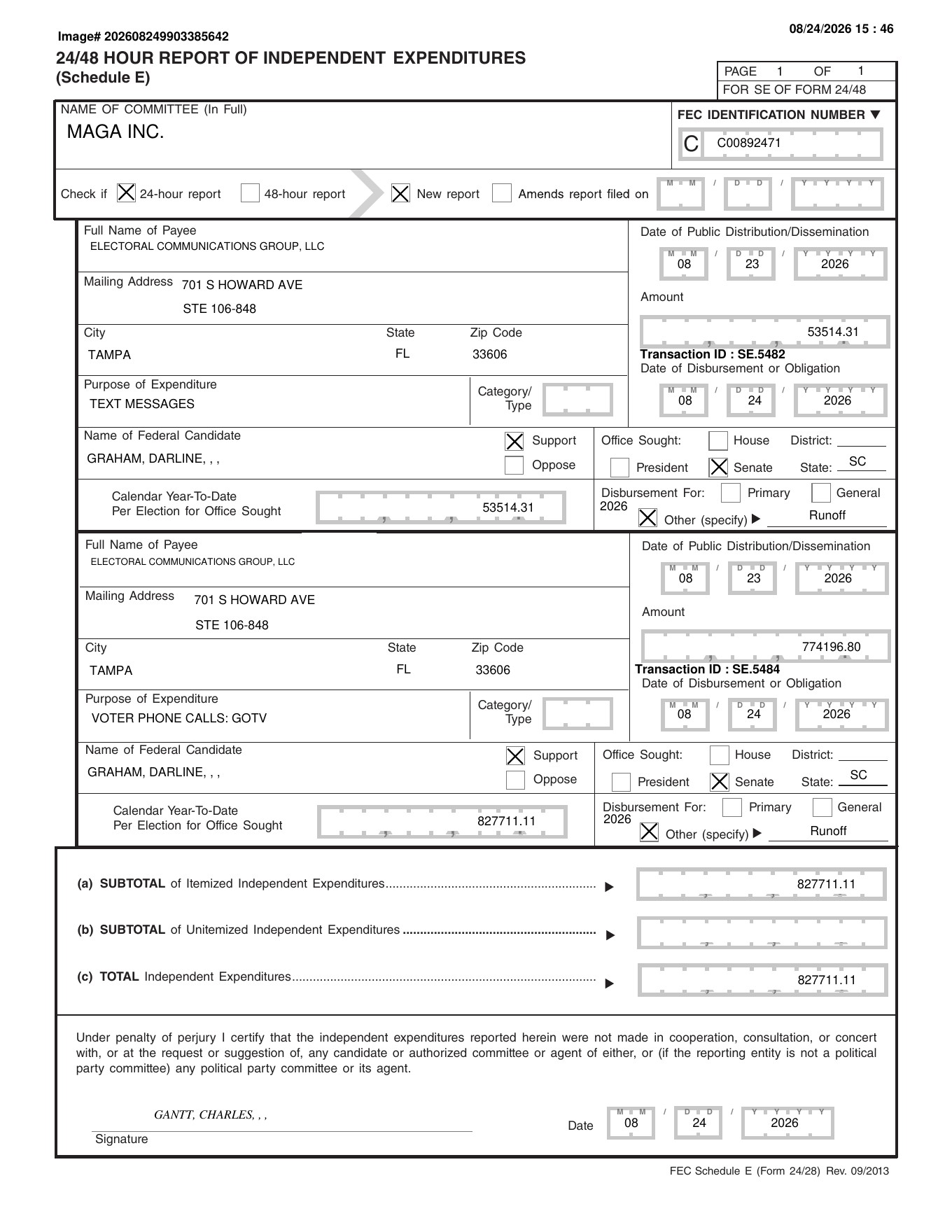
Then came the money. MAGA Inc. reported spending exactly $827,711.11 on Graham's behalf this cycle, and every dollar of it shows up in a single filing. The committee's 24-hour independent expenditure report, filed Aug. 24, lists two line items disseminated Aug. 23: $53,514.31 in text messages and $774,196.80 in get-out-the-vote phone calls. Both are checked "Support," "Senate," "SC," and "Runoff." The year-to-date total on the form matches the total for the cycle, which means Trump's outside operation sat out the entire campaign and then dropped its whole budget into the final weekend.
NPR noted that Trump's PAC wallet has stayed mostly shut through close Republican primaries this year. This was the exception, and the timing was surgical.
The outside money ran roughly 11 to 1 against Norman
MAGA Inc. was a small piece of it. Add up the independent expenditures reported to the FEC in this race and the pro-Graham side, counting money spent for her and money spent against him, comes to about $9.3 million. Palmetto Action spent $3.19 million attacking Norman and $701,730 backing Graham. Security Is Strength PAC spent $2.6 million for Graham and another $1.14 million against Norman. American Mission added $690,820 for her.
Norman's side totals roughly $842,000. Palmetto First PAC put up $390,762 for him and $297,501 against her. The Freedom Caucus Fund, the outside arm of the caucus he belongs to, managed $60,230 for Norman and $40,006 against Graham. Gun Rights America spent $21,448. The Senate Conservatives Fund spent $11,502. That is the whole conservative-movement effort for a five-term House Freedom Caucus member in a Republican Senate primary, and it was outgunned about eleven to one. One group, Hold the Line PAC, spent $37,500 against each candidate and is left out of both totals. You can check both ledgers yourself on the FEC's Graham and Norman candidate pages.
Norman won the Upstate and nothing else that mattered
Norman's map was real, it just was not big enough. He carried Greenville County 32,887 to 15,844, a margin of 17,043 votes that nearly cancelled out Graham's Horry advantage on its own. He took Spartanburg with 65.6 percent, Anderson with 57.3 percent, Union with 63.1 percent, and his home base of York County, where Rock Hill is, with 63.8 percent.
He also won Pickens County 7,959 to 5,720. Pickens contains Central, the small town that Gov. Henry McMaster's office named as Darline Graham's hometown. Norman beat a Graham in Graham country.
Everywhere else the pattern held against him. Graham won Charleston 56.2 percent, Richland 55.5 percent, Lexington 59.7 percent, Berkeley 63.9 percent, Dorchester 65.8 percent, Beaufort 65.8 percent, Florence 68.2 percent, and Aiken 61.8 percent. The Lowcountry, the Midlands, and the coast went to the appointed senator with the famous last name. The Upstate went to the conservative with the voting record.
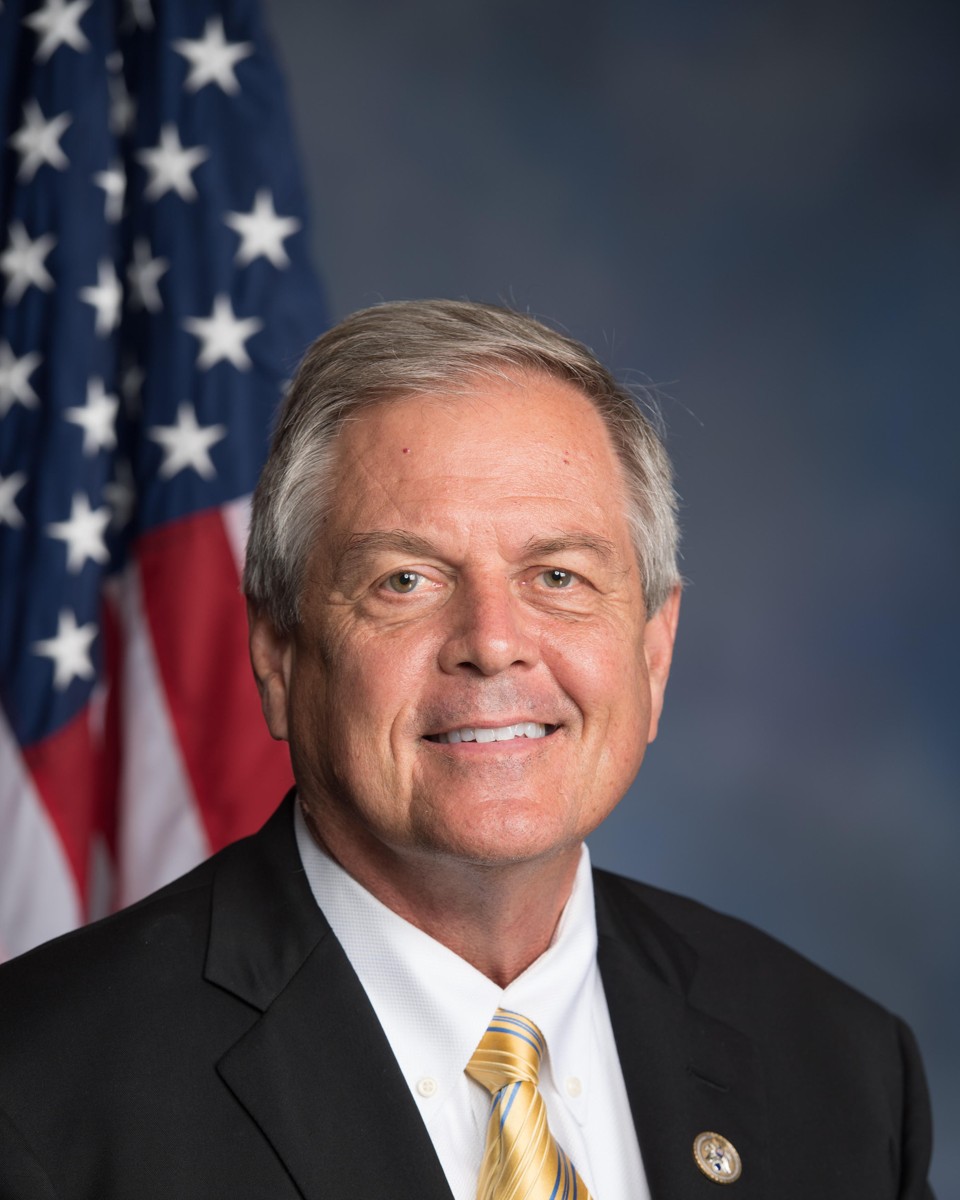
Rep. Ralph Norman of Rock Hill, a House Freedom Caucus member who gave up his 5th District seat to run for governor, lost that primary in June, then lost the Senate runoff on Tuesday. Official congressional portrait, 2017 file photo. (US House Office of Photography, public domain, via Wikimedia Commons)
Here is the part that should worry the Freedom Caucus lane. Norman appeared on a statewide ballot three times in a single year, per Live 5 News in Charleston, which reported he spent millions of dollars of his own money along the way. He gave up a safe House seat to run for governor, finished third in June, pivoted to the Senate in July, survived Aug. 11, and lost Tuesday. Two statewide defeats in under three months. He came onstage in Rock Hill on Tuesday without a concession speech written. He got close to criticizing Trump and pulled back, and his own supporters booed. His summary of the night was six words: "I don't like it, but I accept it."
Norman had Sen. Rick Scott of Florida and Sen. Mike Lee of Utah behind him, according to TIME, which noted at the time that Trump's own Senate allies were splitting on this race. Graham had Trump, McMaster, and NRSC chairman Tim Scott. Movement endorsements lost to institutional endorsements, and it was not close.
Why there was a runoff at all
None of this schedule was improvised. Lindsey Graham had already won the June primary for a fifth term when he died on July 11, which left the Republican Party holding a nomination and no nominee. Section 7-11-55 of the South Carolina Code handles exactly that case: filing opens the second Tuesday after the death for one week, the special primary runs the second Tuesday after filing closes, and a runoff, if needed, comes two weeks later. That math produced July 21 to 28 for filing, Aug. 11 for the primary, and Aug. 25 for the runoff. The general election was never moved. It is still Nov. 3.
The seat itself was handled separately. Under Section 7-19-20, the governor fills a Senate vacancy by appointment through Jan. 3 following the next general election. McMaster announced Darline Graham on July 13 and she was sworn in on July 14. Whoever wins in November takes the seat when the new Congress convenes.
So there was no special election for the seat and there is no separate special general. Tuesday was a party primary runoff to fill a ballot line, and the winner runs for a full six-year term on the regular November ballot.
She is not the blank slate the coverage keeps calling her
NPR wrote about her "lack of political experience" and TIME said she "has never held an elected office." Both are accurate about elected office and both undersell the rest. McMaster's announcement lays out the actual record: she has been Commissioner of the South Carolina Commission for the Blind since 2019, she previously worked for Clemson University, the state Department of Employment and Workforce, and the Department of Vocational Rehabilitation, and she has worked for the state of South Carolina for nearly 30 years. She sits on the State Workforce Development Board. She is a Certified Public Manager. Her full name is Darline Graham Nordone, though she appears on the ballot and in Senate records as Darline Graham.
She ran on the label anyway. "The critics say I shouldn't run for the Senate. They say I'm not a politician. You know what I say? Guilty as charged," she told the Myrtle Beach crowd, per NPR. "By the way, President Trump has never served in elected office before and I think he's done a damn good job." In a cycle where voters in both parties have been throwing out career politicians, running as the one person on the ballot who never wanted the job was the strongest card she had.
She is also the first woman ever to represent South Carolina in the United States Senate, a fact the governor's office put in its second sentence and most national coverage buried. TIME reported in July that if she wins in November she would be the first person in American history to succeed a sibling in the Senate.
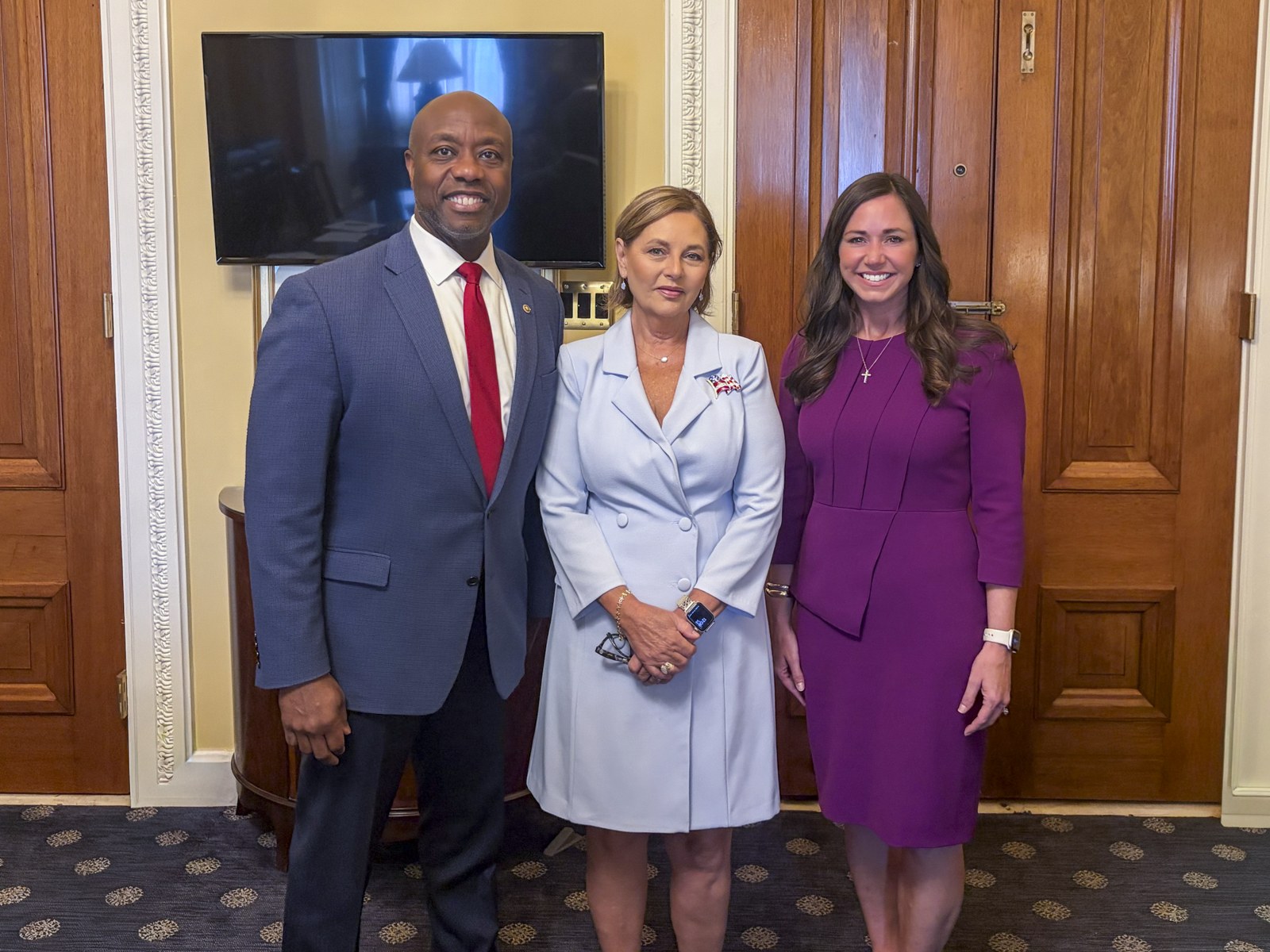
Sen. Tim Scott, Sen. Darline Graham, and Sen. Katie Britt at the Capitol on July 14, 2026, before Graham's swearing-in. Scott, who chairs the National Republican Senatorial Committee, endorsed Graham in the runoff. (Office of Sen. Tim Scott, public domain, via Wikimedia Commons)
Her weak spot is the one the debate exposed. Asked about Taiwan and the South China Sea at the Newsmax-hosted runoff debate, she answered, "I'm just going to be honest here. I'm not that informed on national security." The room booed. Her brother built a 23-year Senate career almost entirely on foreign policy and defense. Breitbart reported that some voters read the answer as authenticity from someone who had not spent years rehearsing for a Senate run. Judging by Tuesday, enough of them did.
What this does to Trump's endorsement record
The timing matters more than the margin. Six days before the runoff, the Washington Examiner counted 313 Trump endorsements in Senate, House, and state primaries this cycle, a 96 percent win rate, and 12 losses, with nine of those 12 coming in the previous three weeks. One of the twelve was South Carolina Lt. Gov. Pamela Evette, who lost the state's Republican gubernatorial primary in June. Trump had already lost a statewide South Carolina primary this year.
He also started this one from a long way back. An Emerson College Polling survey released July 16, cited by TIME, had Graham at 6 percent, Norman at 16, Mace at 10, and 18 percent undecided. Six weeks later she took 32.75 percent of a ten-way primary and then 52.45 percent head to head. Those are three different denominators and they are not strictly comparable, but the direction is not ambiguous. Whatever you want to say about a 96 percent success rate that includes uncontested races, a first-time candidate polling in single digits in July does not become the nominee in August by accident.
The honest counterweight is the Horry County number. When one county produces 93 percent of a statewide margin, and the president rallied in that county four days before the vote, the win is real but the mechanism looks narrow. Trump did not lift Graham everywhere. He lifted her hardest in the place he physically showed up, with a $774,196 phone bank running behind him.
November is the easy part, on paper
Graham faces Dr. Annie Andrews, a Charleston pediatrician who ran against Nancy Mace in the 1st District in 2022 and lost. Fox Carolina's candidate profile lists her platform: expanding Medicaid and Medicare access, raising wages, cutting tax breaks for billionaires, restoring Roe v. Wade, term limits, banning corporate PAC money, and requiring congressional approval for the use of military force. NPR called the seat a safe Republican hold, and the Charleston City Paper put the obstacle in one line: the South Carolina GOP has "stomped every Democrat running statewide for the past 20 years."
Andrews posted on X after the call: "The field is set and I'm ready to bring this election home." The South Carolina Republican Party's statement said it is "time for Republicans to come together, unite and work to expose the Democrats' candidate for the radical liberal that she truly is."
Republicans should know what she will say when they run that ad. Andrews has already gone on the record with the City Paper calling some Democratic Socialists of America positions, prison abolition among them, "unAmerican and unhinged," and adding, "I don't support the DSA or its platform. And that's not the last time you'll hear me say that." She is not running as a socialist. She is running on grocery prices, gas prices, and Medicaid cuts, and she is running as a doctor rather than a politician. "I'm not a career politician," she told the paper, which is the same sentence Darline Graham used at the Myrtle Beach rally.
So the November race is two women who both campaign as outsiders in a state that has not elected a Democrat statewide in two decades. Andrews would need something close to a collapse. But two things in Tuesday's numbers are worth watching for ten weeks. Norman's 175,327 voters live mostly in the Upstate, the most reliably Republican part of the state and the part Graham lost worst. And her one televised answer on national security is already a finished, clippable ad, aimed at exactly the seat her brother used to run defense policy from.
The nomination fight is over and it was decided by a rally, a phone bank, and a last name. The general election gets ten weeks, a full electorate, and an opponent who has been campaigning since before Lindsey Graham died. Graham's first real test is whether the coalition Trump assembled for her in Horry County shows up again when he is not on the ballot and not in the state.
Vote totals are the South Carolina Election Commission's unofficial election-night returns as of Wednesday morning. County boards certify results on the Friday after the election, and provisional ballots can still move the totals slightly. Independent expenditure figures are FEC-processed filings as of Wednesday morning and will rise as post-election reports come in.