A federal grand jury in Los Angeles says a San Gabriel Valley businessman funneled almost $300 million in Nvidia-powered servers to China through Malaysia and Singapore. The Justice Department's press releases call it a 2023-to-2024 scheme. The indictment itself says the conspiracy kept running until at least August 12, 2026, less than two months ago.
Who is Greg Lui, and what is he charged with?
Greg Lui, 38, also known as Yiu Kong Lui, owns Earthmade Computer Inc., a small company in City of Industry, California. Federal agents arrested him on Thursday, Oct. 1, on a three-count indictment returned Sept. 29, according to the Justice Department's national announcement.
The charges are conspiracy to violate the Export Control Reform Act, outbound smuggling, and conspiracy to commit money laundering. The U.S. Attorney's Office in Los Angeles puts the maximum at 20 years on the export conspiracy, 20 on the laundering count and 10 on smuggling. Prosecutors asked the court to hold him without bail as a flight risk, Bloomberg reported. An indictment is only an accusation, and Lui is presumed innocent.

The First Street U.S. Courthouse in downtown Los Angeles, a federal courthouse of the Central District of California, the court where the case against Greg Lui (No. 2:26-cr-00618) was filed. Photo: Levi Clancy via Wikimedia Commons (CC0).
The dates in the indictment don't match the press release
Both DOJ releases say that "from 2023 to 2024, Lui and his co-conspirators used Earthmade" to send controlled hardware to China. Bloomberg's write-up repeated that window. A reader would come away thinking this is an old case about something that stopped two years ago.
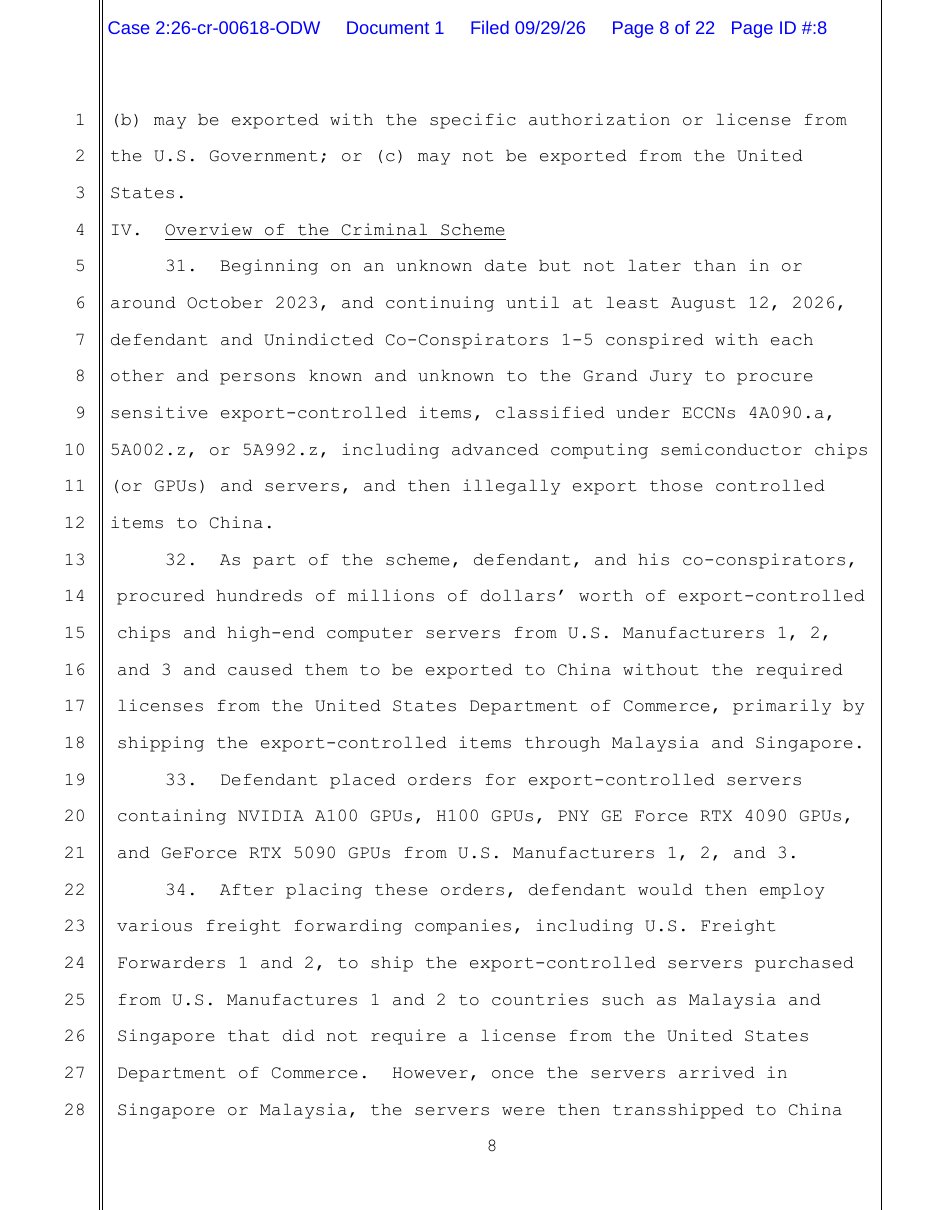
The grand jury says otherwise. Paragraph 31 of the 22-page indictment alleges the conspiracy began "not later than in or around October 2023, and continuing until at least August 12, 2026." The export count and the smuggling count both use the same end date. Only the money-laundering count is limited to 2024 (Feb. 28 through about Dec. 13).
The specific shipments the indictment describes all happened in 2024. But the government is telling the court the pipeline was still operating this summer, under this administration's export rules, which is a very different story from a 2024 cleanup case. The Register was one of the few outlets to print the August date.
Official record
United States v. Greg Lui, No. 2:26-cr-00618, U.S. District Court for the Central District of California, Indictment filed Sept. 29, 2026 (via the CourtListener RECAP archive).
"Beginning on an unknown date but not later than in or around October 2023, and continuing until at least August 12, 2026, defendant and Unindicted Co-Conspirators 1-5 conspired with each other and persons known and unknown to the Grand Jury to procure sensitive export-controlled items..."
Indictment, paragraph 31, page 8
Read or download the full 22-page indictment (PDF)
A quote about "dummy servers" that came from a different case
The Los Angeles office's release quotes Assistant Attorney General John Eisenberg saying the indictment "details alleged efforts to evade U.S. export laws through false documents, staged dummy servers to mislead inspectors, and convoluted transshipment schemes." That is a vivid detail. It is also nowhere in the Lui indictment. We searched all 22 pages: the words "dummy," "inspector" and "inspection" do not appear.
The sentence is word for word what Eisenberg said on March 19, 2026, about a separate case, the indictment of Supermicro co-founder Wally Liaw and two others in Manhattan. That case did involve thousands of fake servers staged for an audit, and surveillance video of a broker using a hair dryer to move serial-number stickers. The only changes in the October version are "AI" swapped for "SI" and "NSD" spelled out.
The Justice Department's own national release on Lui carries a different, new Eisenberg quote with no mention of dummy servers. The recycled one still went out under the Los Angeles office's name, and it spread. AI Frontier Post told readers the Lui indictment "reads like a playbook" that includes "dummy hardware staged to throw inspectors off the scent." The charging document says no such thing.
The company was set up a week before the new rules hit
The indictment says Earthmade was established on or about Nov. 10, 2023. The Commerce Department's expanded chip controls, released Oct. 25, 2023, took effect on Nov. 17, 2023, seven days later. The grand jury also says the conspiracy started no later than October 2023, which means before the company existed.
A second California shell, Topmost Corp, was set up Feb. 24, 2024, by the man prosecutors call Unindicted Co-Conspirator 4. On paper he was the chief technology officer of a Malaysian buyer. The indictment says he was really "an international broker of export-controlled servers." Lui allegedly used Topmost paperwork naming a "Jackie Lui" as CEO, built on identity documents he bought back in 2021.
A plywood company paid $80 million for American chips
Here is a detail most coverage skipped. "Malaysian Transshipment Company 1," which the indictment says wired Earthmade more than $80 million in 2024, was founded in 1999 and "primarily focused on the lumber, plywood, millwork, and wood panel industries." A second Malaysian firm, described flatly as "a front company," sent $96 million.
The end buyer named in the paperwork is "a Chinese industrial company based in Hangzhou." One shipment shows how the route worked. On June 15, 2024, 92 servers left San Francisco International on Singapore Airlines flight SQ33 to Kuala Lumpur, then went on to Hong Kong on Cathay Pacific flight CX722, with the Hangzhou company listed as consignee.
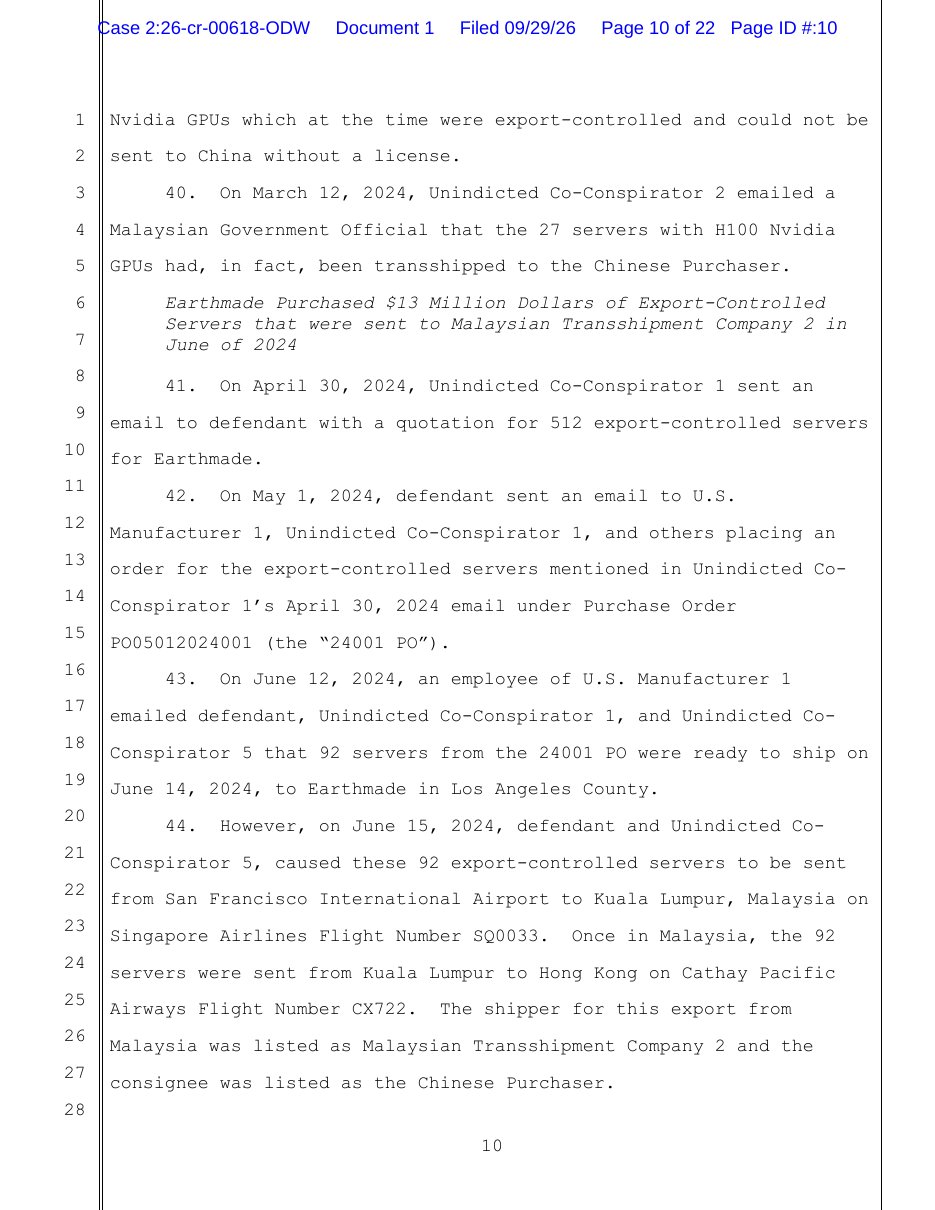
Page 10 of the Lui indictment, describing the 92-server shipment from San Francisco to Kuala Lumpur and on to Hong Kong. U.S. District Court for the Central District of California (public court record).
An earlier shipment shows what this hardware costs. On Jan. 30, 2024, Lui ordered 27 servers with Nvidia H100 chips for about $7,614,000. By our math that is roughly $282,000 per server. On March 12, 2024, the Malaysian company's CEO allegedly emailed a Malaysian government official confirming those 27 servers had gone to the Chinese buyer.
Gaming cards are on the list too
The hardware is not limited to data-center chips. Paragraph 24 says Nvidia A100 and H100 GPUs, PNY GeForce RTX 4090 cards and GeForce RTX 5090 cards all fall under export classification 4A090.a, which requires a license to ship to China. The RTX 4090 and 5090 are graphics cards sold to American gamers. The 2023 rules were written broadly enough to sweep in top-end gaming cards like these.
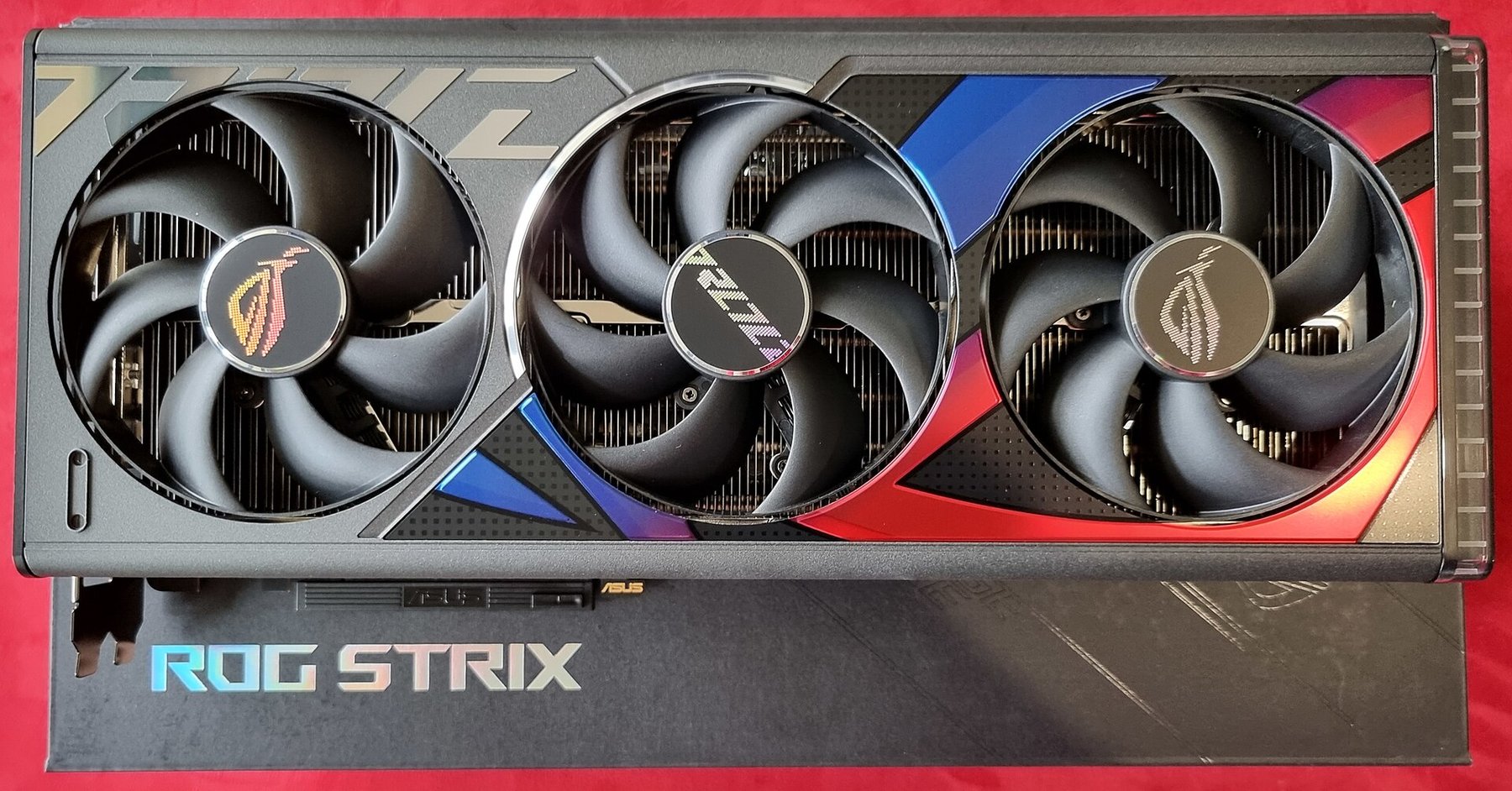
An Asus ROG Strix GeForce RTX 4090, the consumer gaming card the indictment lists alongside Nvidia's A100 and H100 data-center chips. Photo: Benlisquare via Wikimedia Commons (CC BY-SA 4.0).
One wrinkle worth noting: the smuggling count names only "servers containing NVIDIA A100 GPUs and H100 GPUs." The gaming cards appear in the background allegations and the broader export conspiracy, but not in Count Two.
Americans inside U.S. companies helped, the grand jury says
Five unindicted co-conspirators are described, and two of them sit inside American businesses. Co-Conspirator 1 was a sales manager at "U.S. Manufacturer 1" who "approved the sale of high-end technology to Earthmade." Co-Conspirator 5 was an executive at a U.S. freight forwarder that moved the servers. Neither is charged, and neither company is named.
Nvidia told Bloomberg that "smuggling is a losing proposition." Maybe so for Lui. But this indictment and the Supermicro case both describe insiders at American server makers helping the hardware out the door. The government also chose to say "Super Intelligence" in its press releases, following the White House's new name for AI, while the indictment itself uses "artificial intelligence" throughout.
What happens next
The case is assigned in the Central District of California under No. 2:26-cr-00618. Prosecutors are also seeking forfeiture of property tied to the scheme. The open questions are the ones the indictment leaves unanswered. Who are the three U.S. manufacturers? What was still moving between the last 2024 shipment and Aug. 12, 2026? And will the American insiders the grand jury described ever be charged?
China wants these chips badly enough to route them through a plywood company. Keeping them out depends on the people selling and shipping them here at home, and on the government telling the public the facts of its own case accurately.
Top photo: Nvidia H100 accelerator cards. Still from a video by 极客湾Geekerwan via Wikimedia Commons (CC BY 3.0), cropped.