The Federal Reserve raised interest rates Wednesday for the first time since July 2023, and the man President Trump put in charge of the Fed cast the vote himself. Chairman Kevin Warsh and the rest of the Federal Open Market Committee voted 12 to 0 to push the federal funds rate up a quarter point, to a range of 3.75 to 4 percent. Hours later, Trump told reporters interest rates in this country should be "1%, or less." The gap between what the president wanted and what his own pick just did is now on the record, in both men's own words.
What the Fed actually voted to do
The FOMC's official statement, released at 2:00 p.m. Eastern, says the Committee "decided to raise the target range for the federal funds rate by 1/4 percentage point to 3-3/4 to 4 percent, in support of the Federal Reserve's dual mandate." The vote was unanimous, 12 to 0. That single line ends a stretch that started in December 2025, when the Fed cut rates to 3.50 to 3.75 percent and then held there through five straight meetings in 2026, January through July.
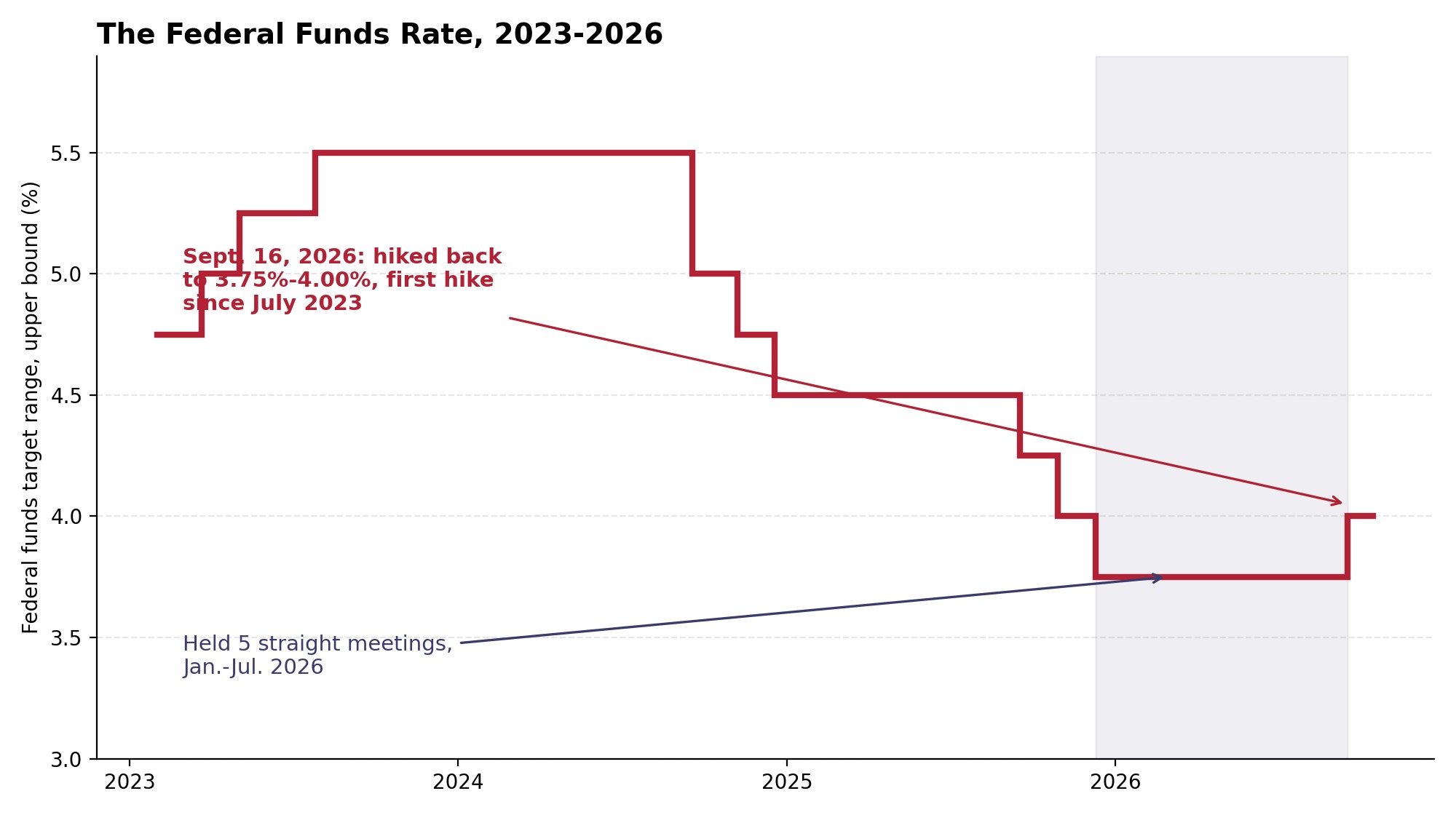
Chart built by PatriotAddict from Federal Reserve press releases dated 2023-2026. The rate held at 3.50-3.75 percent for five consecutive meetings before Wednesday's hike, the first increase since July 2023.
The statement's language on the economy reads almost upbeat: "economic activity is expanding at a solid pace," domestic spending "has been resilient," and "job gains have kept pace with the workforce." Then it turns. "Inflation remains elevated. Today's policy action will support a timelier return to the Committee's 2 percent goal. The Committee will deliver price stability." A Fed that describes the economy as strong and then raises rates anyway is telling you which half of its job it thinks is failing.
The inflation number Warsh cited that the headlines missed
PatriotAddict reported Tuesday that the Bureau of Labor Statistics' August CPI showed core inflation reaccelerating on a monthly basis even as the annual core rate ticked down. That CPI number, 2.4 percent annual core, is the one most coverage of this week's meeting has led with. It is not the number Warsh actually watches.
In his press conference, Warsh laid out the real gauge himself: "Based on the most recent CPI and PPI data, the 12-month change in total PCE prices likely was around 3.6 percent in August. Core PCE and CPI prices are running at about 3.2 percent and 2.4 percent respectively." Read that again. The Fed's own preferred inflation measure, the personal consumption expenditures price index, is running at roughly one and a half times the CPI figure that made the rounds this week. "Too many categories are still posting increases above 3 percent, on both a 6- and 12-month basis," Warsh said. That is the real reason the Fed hiked into an economy it just called strong.
Official record
Federal Reserve, Federal Reserve issues FOMC statement, released 2:00 p.m. EDT, September 16, 2026, approved by a 12-0 vote. Full statement on federalreserve.gov.
"The Committee decided to raise the target range for the federal funds rate by 1/4 percentage point to 3-3/4 to 4 percent, in support of the Federal Reserve's dual mandate." — FOMC statement, September 16, 2026
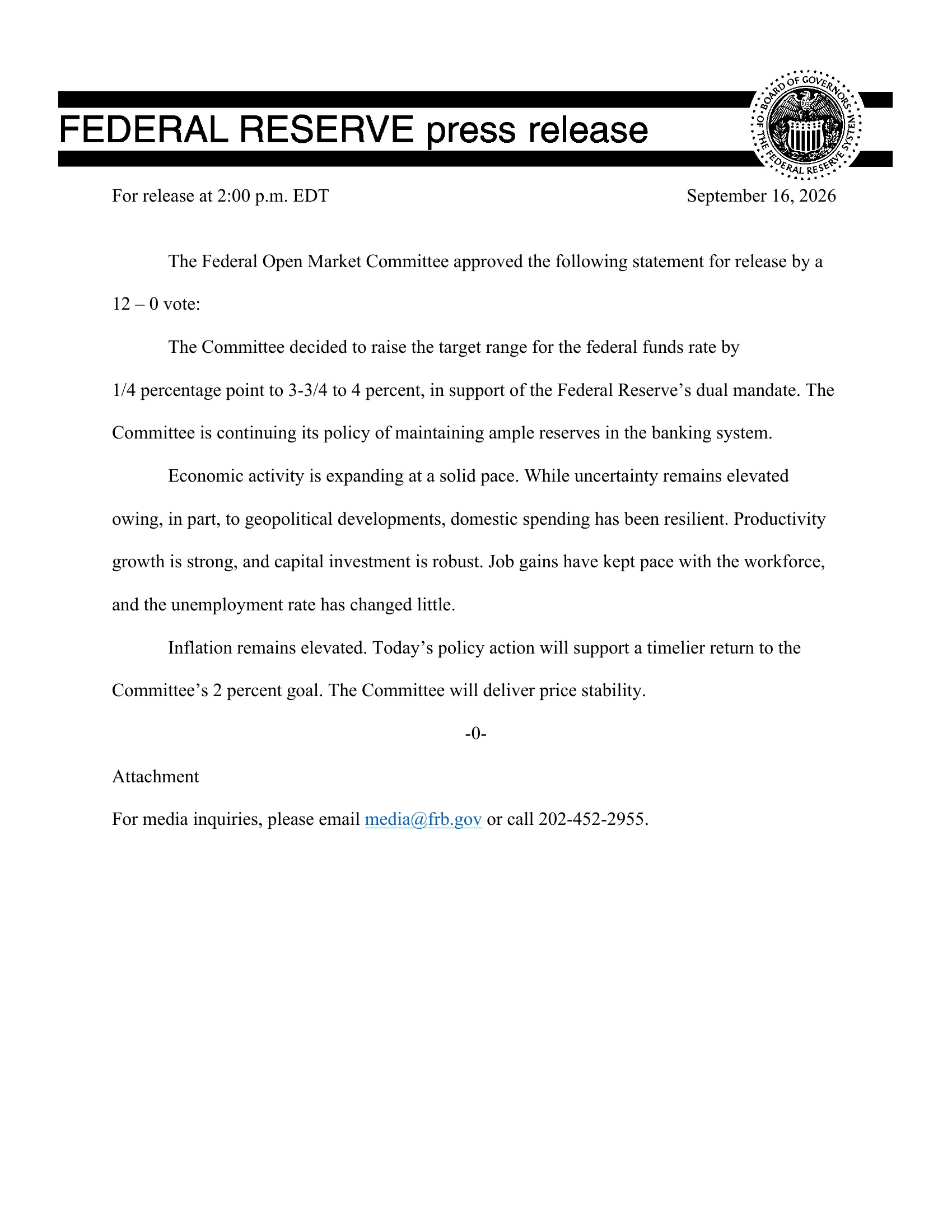
Read or download the full statement (PDF) · About the FOMC
The Fed's own Summary of Economic Projections, released the same afternoon, backs up Warsh's math. The median projection has total PCE inflation at 3.7 percent for all of 2026, core PCE at 3.4 percent, and both only falling to roughly 2.3 percent next year. Warsh told reporters he does not submit his own projection to that summary, "but like in June, I said I would faithfully discharge the summary of their projections, so here goes." He then read out figures matching his colleagues' median almost line for line, including GDP growth of 2.3 percent this year and unemployment holding near 4.1 percent.
"You might as well vote with the board": Trump's version of events
Trump did not wait for market reaction. He posted on Truth Social that the trade deficit was reason to "LOWER THE INTEREST RATES FOR THE UNITED STATES OF AMERICA, AND FAST!" Speaking to reporters Wednesday evening, he went further, according to Yahoo Finance's Washington desk: "Interest Rates in the United States should be 1%, or less." He also described a private conversation with the man he chose to run the Fed. "I talked to Kevin and I said, 'you might as well vote with the board because it's not going to matter,'" Trump said.
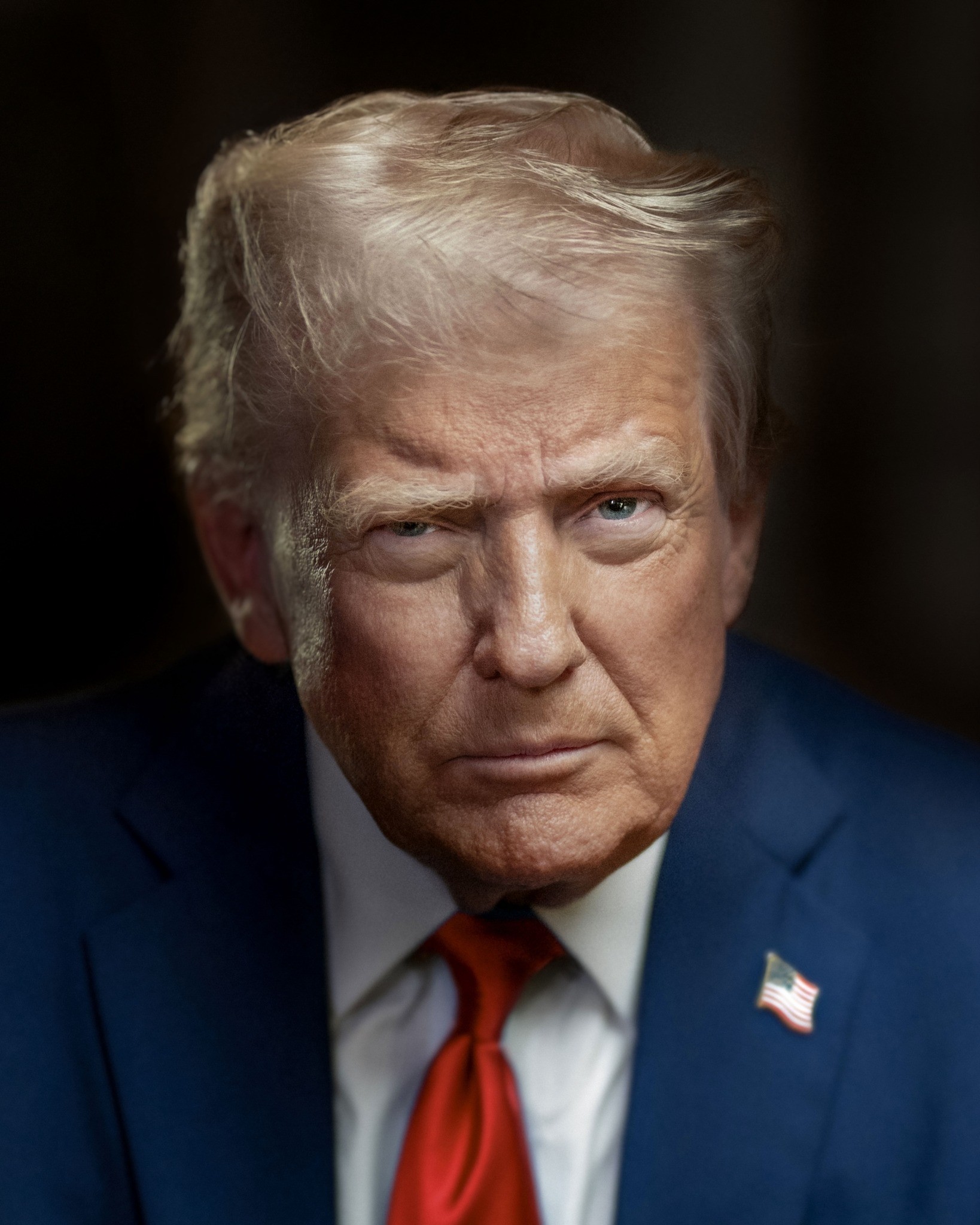
Official White House portrait of President Donald J. Trump, photographed by Daniel Torok, 2025. Public domain, courtesy of the White House.
Asked directly whether he still has confidence in Warsh, Trump said he did, then added a caveat: "he's got a very tough board." He called the FOMC "a bunch of politicians." Warsh, for his part, declined to confirm the president's account of their conversation when reporters raised it at his own press conference. "I've got nothing for you on a discussion with the president," he said, before adding that Fed independence is "a two-way street": "Part of the independence of the Federal Reserve is we stay in our lane... we'll let people that do trade policy and fiscal policy stay in their lane too."
A White House caught flat-footed by its own pick
The administration had spent recent weeks trying to look hands-off about the Fed's decision, only to hit back hard once it landed. Senior deputy press secretary Kush Desai told Fox News the hike was a "rather unfortunate decision by the Federal Reserve" that was "not backed by a particularly compelling economic case." That is a notable break from a White House that picked Warsh specifically to steer the central bank in the direction Trump wanted.
The reaction from the other side of the aisle undercuts any theory that this was a political favor to Trump. Rep. Brendan Boyle, ranking member of the House Budget Committee, said the hike "is further proof that Donald Trump and Republicans have failed on the economy." Sen. Elizabeth Warren argued that without Trump's own policies, "the Fed might actually be talking about bringing down rates." Both sides are unhappy with the same decision for opposite reasons, which is usually a sign the Fed made the call on its own terms rather than anyone else's.
The dot plot says more hikes are coming, not cuts
Markets spent much of the summer betting the Fed's next move after any hike would be back toward cuts. The Fed's own projections say otherwise. Warsh told reporters the median participant judges "the appropriate federal funds rate to be 4.1 percent at the end of this year, and to remain there next year." The current midpoint after Wednesday's move is 3.875 percent, so a median projection of 4.1 percent for year-end points to at least one more quarter-point increase before December. The Summary of Economic Projections lists a full 2026 range of 3.9 to 4.4 percent across the Committee, meaning some officials think two more hikes are still on the table this year. Warsh called the inflation risk "to the upside" and the labor risk "roughly balanced," which is Fed language for "we're not done."
What a higher rate actually costs you
Credit card rates move first and move fast. Most cards carry a variable rate tied to the prime rate, which shifts within about a month of any Fed move, and reporting from U.S. News says most cardholders should expect their rate to climb by roughly a quarter point over the next couple of months. Auto loans and other variable consumer credit typically follow the same path.
Mortgages are the exception, and it is worth being honest about why. Fixed 30-year and 15-year mortgage rates track the 10-year Treasury yield and broader bond market conditions, not the federal funds rate directly, so a homeowner locking in a new rate this month will not feel Wednesday's move immediately the way a credit card holder will. Adjustable-rate mortgages are a different story, since those do reprice off short-term benchmarks the Fed controls more directly. On the other side of the ledger, savers finally get something: banks tend to raise rates on savings accounts and CDs in the same window they raise rates on cards and loans, even if they rarely move as fast on the way up as they do on the way down.
The independence fight this sets up
Trump has spent more than a year publicly pushing for lower rates, and he has now watched his own appointee vote the opposite direction twice in a row, first by holding through the spring and summer, now by hiking outright. Warsh's own framing at the podium, that Fed independence runs "a two-way street," reads as a direct answer to the president's public pressure campaign, not an abstract point about central banking theory. The Eccles Building has weathered pressure from the White House before. What is different this time is that the chairman absorbing the pressure is the same man the president chose for the job less than a year ago.
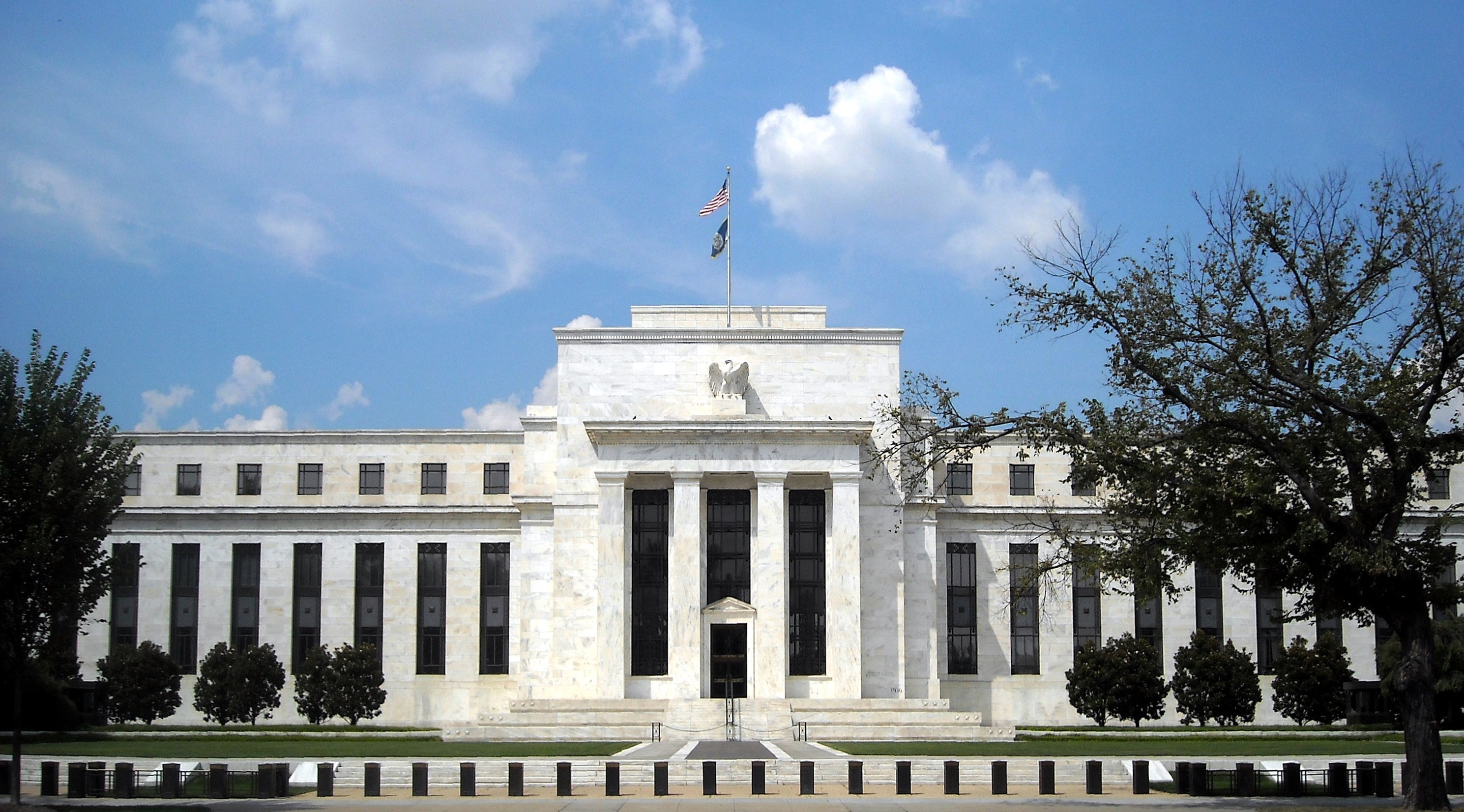
The Marriner S. Eccles Federal Reserve Board Building in Washington, D.C., headquarters of the Federal Reserve's Board of Governors. Photographed by AgnosticPreachersKid, Wikimedia Commons, CC BY-SA 3.0.
The next scheduled FOMC meeting is October 27-28, with a final 2026 meeting set for December 8-9, according to the Fed's own published calendar. Given Wednesday's median projection of 4.1 percent by year-end, one of those two meetings is where the next hike, if it comes, most likely lands. Families budgeting around a rate cut that markets had once priced in are now budgeting around a Fed that says, in its own words and its own numbers, that the job of getting inflation back to 2 percent is not done.