A three-judge panel of the Eighth U.S. Circuit Court of Appeals sits in St. Louis this morning to decide whether Missouri Republicans get one more shot at the congressional map they spent a year building, or whether the fight is finally over. Attorneys call it the last realistic chance to put the 2025 lines back in place before ballots go out.
The case is Onder v. State of Missouri, No. 26-2827, filed by 3rd District Rep. Bob Onder, 5th District GOP nominee Rick Brattin, and two voters. They want the court to reinstate a federal restraining order that briefly forced the state to use the map Missouri lawmakers passed in a 2025 special session, the one drawn to send seven Republicans and one Democrat to Washington instead of six and two.
How Missouri got into this mess
Republicans in the legislature passed House Bill 1 in September 2025, reshaping Rep. Emanuel Cleaver's Kansas City-area 5th District to favor a Republican challenger and tightening the margin in Ann Wagner's suburban St. Louis seat. Gov. Mike Kehoe signed it, and the state used it for the August 4 primary, where roughly 1.2 million Missourians voted.
A group called People Not Politicians, led by Richard von Glahn, collected more than 330,000 signatures for a referendum to let voters decide whether HB 1 should stand. Secretary of State Denny Hoskins rejected the petition, arguing congressional maps cannot be put to a referendum under the Missouri Constitution. On September 3, the Missouri Supreme Court ruled unanimously against him, ordering the referendum onto the November 3 ballot as Proposition A and directing the state to use the 2022 map for this year's election.

Missouri Secretary of State Denny Hoskins, whose office has been caught between competing state and federal court orders for two weeks straight. (Official portrait, Missouri State Archives, public domain via Wikimedia Commons.)
One secretary of state, three court orders, seven days
What happened next is the part that turned a redistricting case into a genuine constitutional standoff. Hoskins initially emailed county clerks on September 8, the last day Missouri law allows ballot changes, telling them to use the 2022 map as the state Supreme Court ordered. Hours later, Chief U.S. District Judge Stephen Clark issued a 14-day temporary restraining order in a separate federal suit brought by Onder and Brattin, directing Hoskins not to use any map except the 2025 one.
Hoskins reversed himself again, telling clerks to use the 2025 map because it was the newest ruling he had. The Missouri Supreme Court was not persuaded that a federal order not to do something excused ignoring a state order to do something, and it scheduled a hearing to find out why.
Official record
Judgment of Civil Contempt, Von Glahn v. Hoskins, No. SC101805 (Mo. banc, issued Sept. 10, 2026).
"The secretary and all of those acting in concert with him are restrained and enjoined from implementing, using, or mandating the use of the congressional redistricting in HB 1 for the November 2026 general election or at any other time thereafter unless and until HB 1 is approved by the voters." — Missouri Supreme Court, quoting its own September 3 order
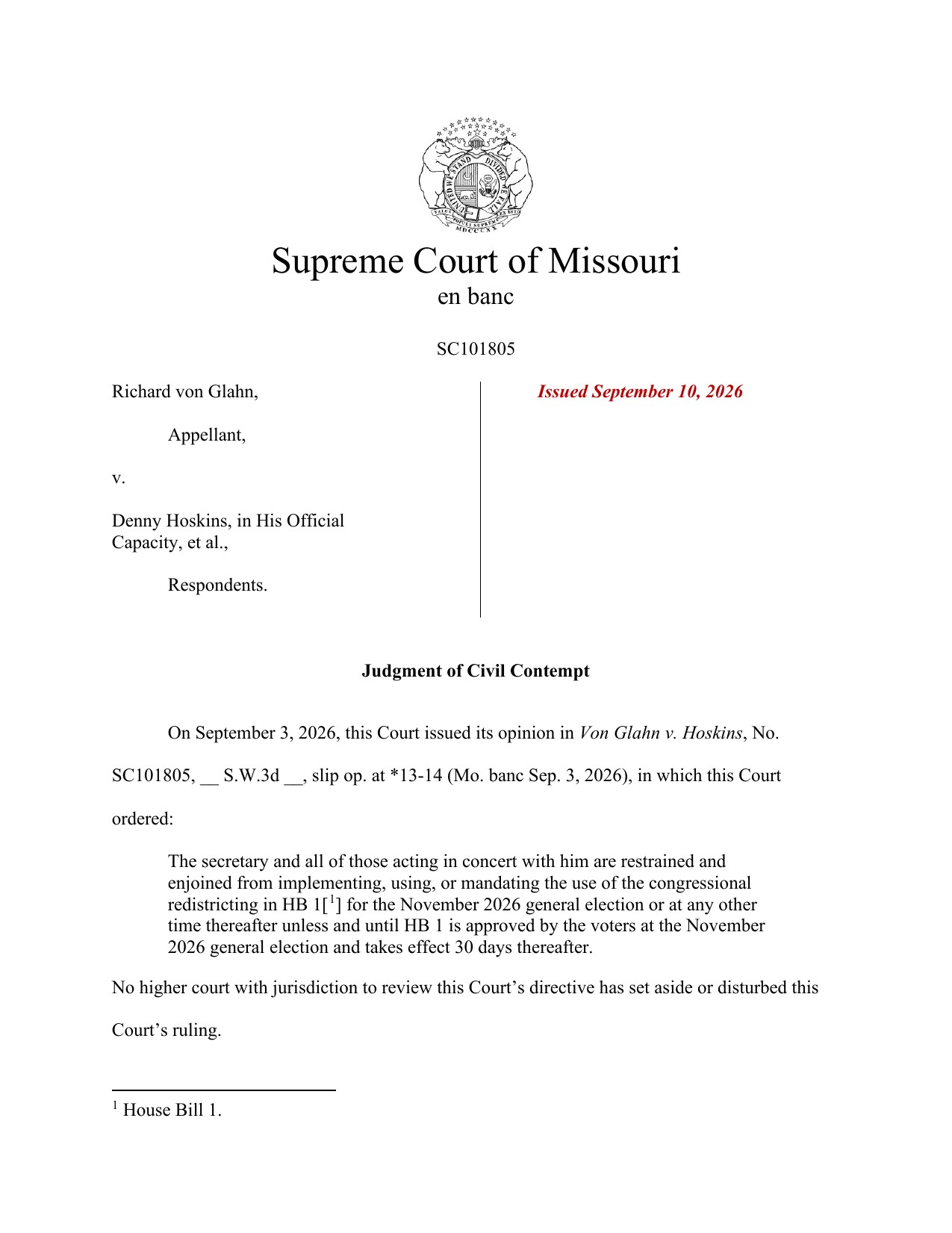
Read or download the full 5-page judgment (PDF) on Election Law Blog.
Held in contempt, then let off the hook
The court brought Hoskins in twice on September 10: once in the morning to hear arguments for a contempt finding, and again that afternoon after the U.S. Supreme Court, acting through Justice Brett Kavanaugh, stayed Judge Clark's order and cleared the way for Hoskins to comply with the state ruling. Chief Justice W. Brent Powell found Hoskins had been in contempt of the September 3 order, then ruled he purged it by sending a new email directing clerks to use the 2022 map.
Powell was blunt about what Hoskins could have done differently. "The secretary offers no explanation as to why he could not comply with both this court's order and the federal district court's temporary restraining order by simply telling the local election authorities to take no action until further clarification was received from the courts," he wrote, according to the Missouri Independent's account of the hearing. Judge Paul Wilson told Hoskins directly he did not want to "wake up tomorrow and read that the position of the secretary is that he can do nothing."
Attorney General Catherine Hanaway, asked afterward whether Republicans had any path left to revive the 2025 map, answered plainly: "As I stand here today, no."
Now it could cost him personally
Four days before that hearing wrapped up its aftershocks, five Missouri voters filed a proposed class-action lawsuit in Cole County Circuit Court seeking roughly $80 million from Hoskins directly. The suit leans on a 1945 state statute requiring the secretary of state to pay between $100 and $500 to anyone harmed when he "neglects or refuses to perform any of the duties enjoined on him by law." The plaintiffs want to represent the approximately 162,000 registered voters whose referendum signatures were verified by local election authorities, at the $500 maximum each.
The suit does not ask a judge to change which map Missouri uses. It argues Hoskins violated his statutory duty twice over: first by refusing to certify a petition the state Supreme Court later called legal and sufficient, then by directing clerks to use the 2025 map after that same court told him not to. A judge still has to decide whether the case can proceed as a class action at all.
What today's hearing actually decides

The Thomas F. Eagleton U.S. Courthouse in St. Louis, where the Eighth Circuit panel hears arguments in Onder v. Missouri today. (United States District Court for the Eastern District of Missouri, public domain.)
In a brief filed Tuesday, Missouri Solicitor General Lou Capozzi told the Eighth Circuit that Onder and Brattin have the stronger argument on the merits, that a referendum petition should never have been allowed to suspend a legislatively enacted map in the first place, and that a ruling for them would let the court declare the whole referendum unconstitutional under the Elections Clause. But Capozzi also acknowledged the practical reality: "the Supreme Court has already granted a stay forcing Missouri to use the 2022 congressional map for the 2026 general election," so his office is complying with that outcome regardless of what the panel decides.
Chuck Hatfield, the attorney for People Not Politicians, wants the judges to declare the case moot and leave the 2022 map alone. County clerks across the state filed their own brief warning that any further change would force them to reprint ballots days before the federal deadline to mail them to military and overseas voters, which lands Saturday under the Uniformed and Overseas Citizens Absentee Voting Act.
The districts actually on the line
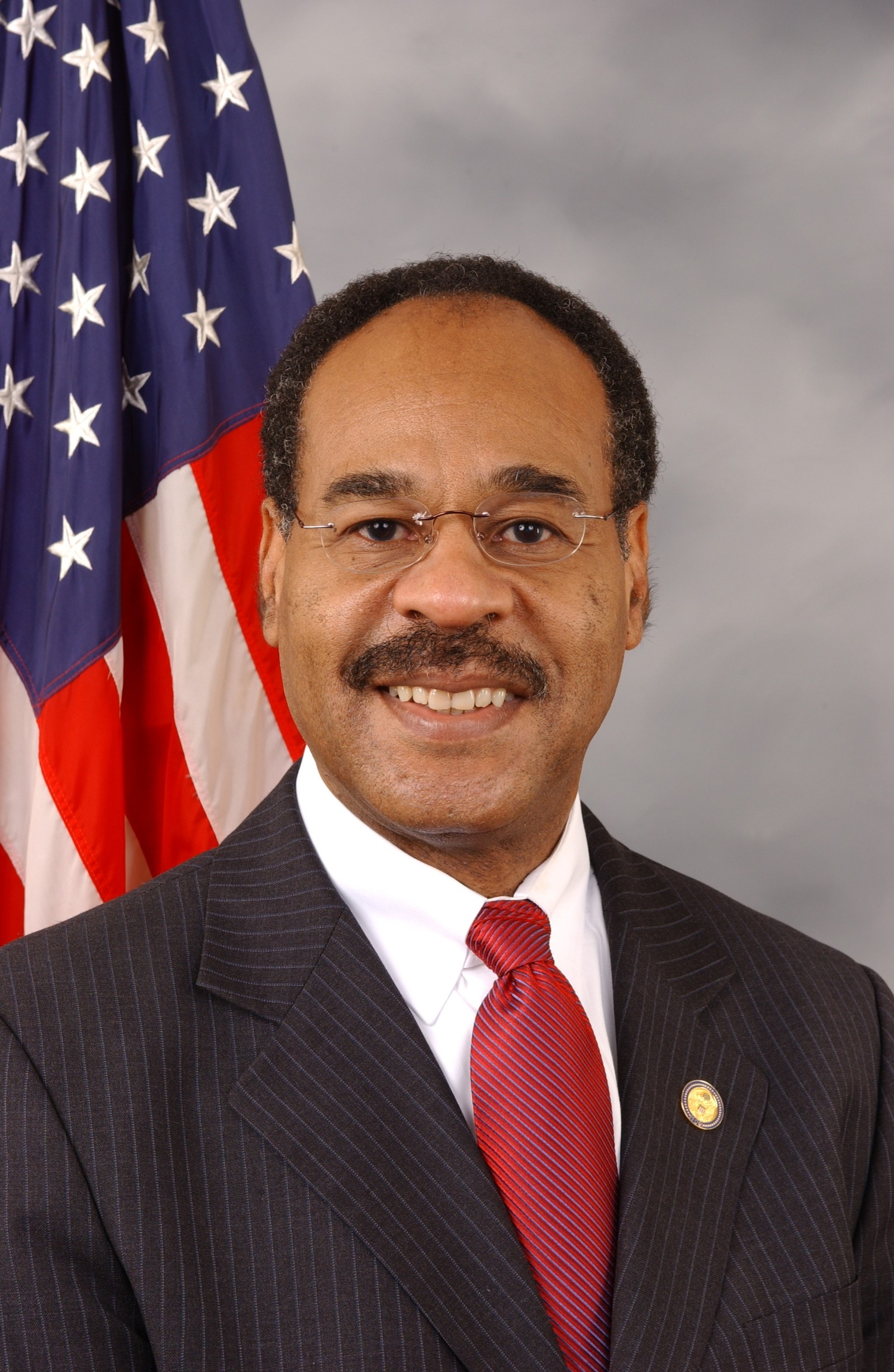
Democratic Rep. Emanuel Cleaver, whose Kansas City-area 5th District reverts from a rural-leaning HB 1 map back to its urban 2022 boundaries under the current ruling. (Official congressional photo, U.S. House of Representatives, public domain.)
The abstract legal fight has a concrete effect on two races. Under the 2022 map now in force, Cleaver keeps a district centered on urban Kansas City rather than the more rural, GOP-friendly version HB 1 drew for him. University of Missouri political scientist Peverill Squire told UPI that Brattin, the Republican challenger, "will now have to turn in an urban district focused on Kansas City rather than a district that had been gerrymandered to include mostly rural areas, including the part of the state where he resides." Wagner's suburban St. Louis seat also reverts to a narrower Republican margin against Democratic challenger Frederick Wellman, rather than the safer lines HB 1 gave her.
Squire called the federal judiciary's involvement in a state constitutional question "somewhat curious," and suggested the U.S. Supreme Court likely avoided overturning a unanimous state high court on state law this close to an election specifically to prevent the kind of chaos Missouri has now lived through twice in two weeks.
What happens after today
Whatever the Eighth Circuit rules, either side can appeal again to the U.S. Supreme Court, and Justice Kavanaugh's stay already signals where the majority is leaning. Missourians still vote on Proposition A on November 3 regardless of the outcome. A "yes" vote adopts the 2025 map for future cycles; a "no" vote keeps the 2022 lines in place for good. Washington University law professor Travis Crum told UPI he expects some Republican-controlled states to keep pushing mid-decade redistricting regardless of how Missouri's fight ends, though a visible backfire here could cool that appetite in others.
For now, the practical outcome is the one Hanaway already conceded on September 10: the 2022 map governs the November election. Today's hearing is about whether that stays true, and whether a state constitutional referendum process survives a direct challenge under the federal Elections Clause. Missouri's ballots go out to overseas troops by Friday no matter what the judges decide this week.