Two Michigan House Republicans introduced a bill on August 27 that would erase the state's own felony bans on suppressors, short-barreled rifles and short-barreled shotguns, and it exists because a federal judge in Texas ruled three weeks earlier that the federal registration process those state exceptions depend on no longer has a constitutional foundation. House Bills 6285 and 6284 are sitting in the House Judiciary Committee with no hearing scheduled, but the compliance gap they are aimed at is not hypothetical. It may already apply to some Michigan gun owners right now.
What Would HB 6285 and HB 6284 Actually Do?
Rep. James DeSana's House Bill 6285 rewrites three sections of the Michigan Penal Code. It strips the state-law definitions of "short-barreled rifle" and "short-barreled shotgun" out of MCL 750.222. It deletes "a muffler or silencer" from the short list of items MCL 750.224 bans outright alongside machine guns and bombshells. And in a single enacting sentence, it repeals MCL 750.224b entirely, the standalone statute that has made short-barreled rifles and shotguns a five-year felony in Michigan since 1978.
Rep. Mike Hoadley's companion, House Bill 6284, does the cleanup work. It is tie-barred to DeSana's bill, meaning it only takes effect if HB 6285 also becomes law, and it strips the matching classifications out of Michigan's felony sentencing guidelines so a crime that no longer exists does not still carry a sentencing range on the books.
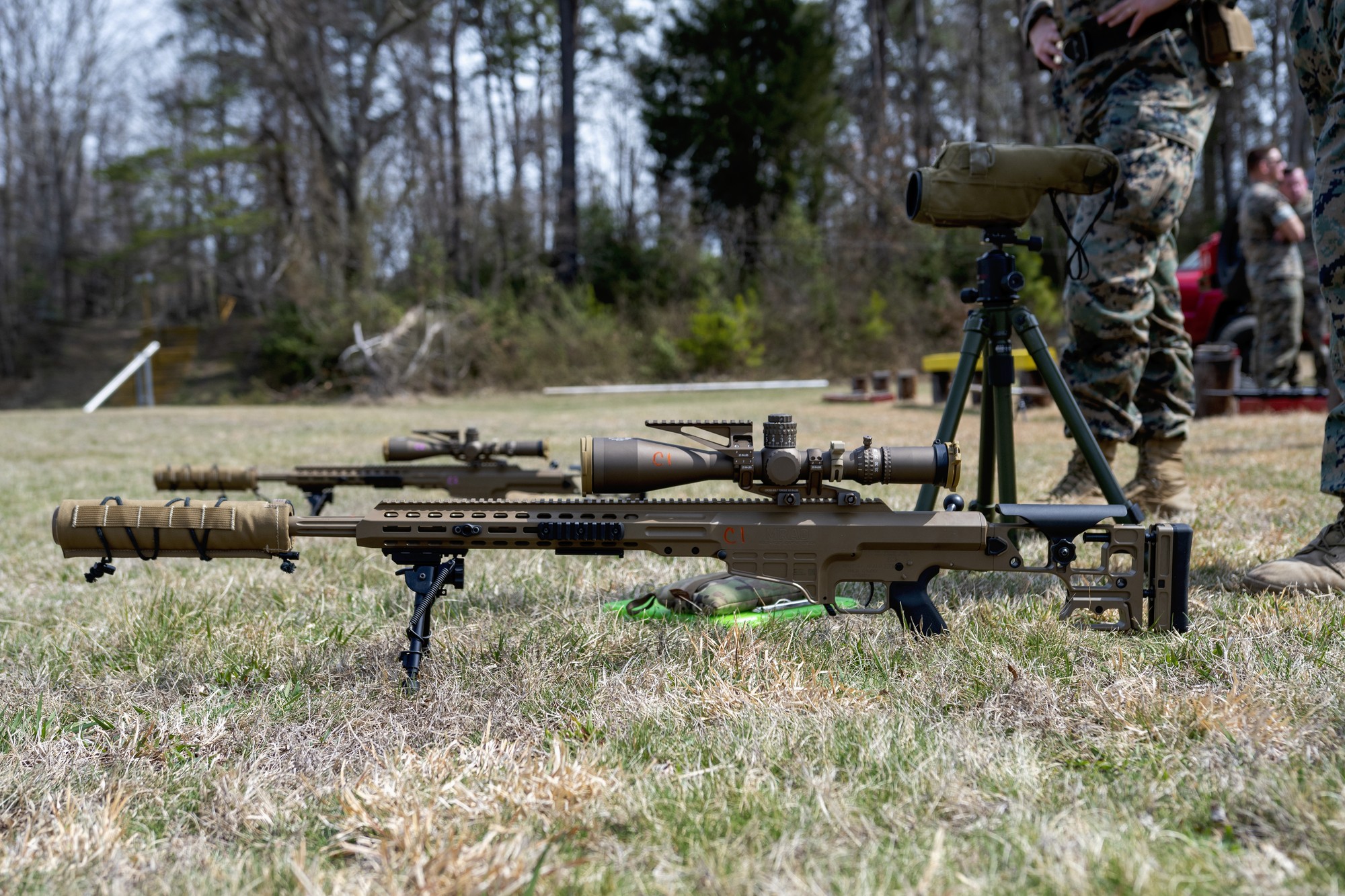
Suppressor-equipped Mk22 Mod 0 Advanced Sniper Rifles at a Marine Corps demonstration in Quantico, Virginia, March 22, 2022. (U.S. Marine Corps photo, public domain, Wikimedia Commons)
The Texas Ruling That Started the Clock
On August 5, U.S. District Judge James Wesley Hendrix of the Northern District of Texas, San Angelo Division, entered final judgment in two consolidated cases, Silencer Shop Foundation v. ATF, No. 6:25-CV-056, and Jensen v. ATF, No. 6:26-CV-227. PatriotAddict covered the ruling itself in detail on August 22, so the short version here: Congress used its taxing power to write the National Firearms Act's $200 making and transfer tax in 1934, and the Supreme Court upheld the whole registration scheme on that basis in Sonzinsky v. United States, 300 U.S. 506 (1937). The One Big Beautiful Bill Act zeroed that tax to $0 for suppressors, short-barreled rifles, short-barreled shotguns and the NFA's "any other weapons" category, but left the registration paperwork standing. Judge Hendrix ruled that once the tax was gone, the paperwork requirement had nothing left to stand on, and the government did not seek emergency relief from the Fifth Circuit before its seven-day stay window closed at midnight on August 13.
What matters for Michigan is what the ruling did not do. It is not a nationwide strike-down. The court permanently enjoined enforcement of the making, transfer, registration and identification requirements against the named plaintiffs, their members and their customers, and nobody else. The plaintiff list includes the Citizens Committee for the Right to Keep and Bear Arms, FPC Action Foundation, the Texas Rifle Association, Silencer Shop and Hot Shots Custom, all organizations with members and customers well outside Texas.
Why Michigan Law Still Calls These Felonies
Michigan never independently banned suppressors and short-barreled long guns on its own reasoning. It banned them and then wrote an exception that leans entirely on the federal system staying intact. MCL 750.224(1)(b) prohibits manufacturing, selling or possessing "a muffler or silencer," full stop, punishable by up to five years and a $2,500 fine. The only way around that ban for an individual owner is MCL 750.224(3)(c), which exempts "a person licensed by the secretary of the treasury of the United States or the secretary's delegate to manufacture, sell, or possess a machine gun, or a device, weapon, cartridge, container, or contrivance described in subsection (1)."
MCL 750.224b works the same way for short-barreled rifles and shotguns. Subsection (1) bans making, manufacturing, transferring or possessing one. Subsection (3) carves out an exception, but only for a gun "that is lawfully made, manufactured, transferred, or possessed under federal law." Both exceptions assume there is a functioning federal license or registration sitting behind an owner's paperwork. Neither one was written with the possibility that the federal government might be barred from creating that paperwork in the first place.
The Paperwork Trap Nobody's Spelled Out
This is where Michigan law gets more specific, and more dangerous for a gun owner who gets it wrong. MCL 750.224b(5) requires anyone possessing a short-barreled rifle or shotgun longer than 26 inches to carry "a copy of the federal registration of that short-barreled shotgun or short-barreled rifle" and produce it for a peace officer on request. Subsection (6) spells out the consequence: immediate seizure, a state civil infraction, and 45 days to display that registration to the seizing agency before the gun is subject to permanent forfeiture.
Read those two statutes against what Judge Hendrix actually enjoined. The court did not just lower a tax or waive a fee. It barred ATF from enforcing the underlying making, transfer and registration requirements against the Jensen and Silencer Shop Foundation plaintiffs, their members and their customers, which by SAF's own description covers a lot more than the handful of named parties on the docket. A Michigan resident who belongs to CCRKBA or FPC Action Foundation, or who buys from Silencer Shop, is arguably someone the federal government can no longer require to go through NFA registration at all for a newly made or acquired suppressor or short-barreled rifle covered by the ruling. If that person never generates a federal registration document because the government is barred from demanding one, Michigan's own statute gives them nothing to hand a police officer. Section 224b(3)'s exception was written for someone whose gun is "lawfully possessed under federal law." A federal court order saying the registration mandate itself is unconstitutional as applied to that person is about as lawful as it gets, but the separate documentation requirement in subsections (5) and (6) was not written with that scenario in mind, and neither DeSana's release nor the coverage that followed it walks through the gap in those specific terms.
The American flag and the Michigan state flag. (Tony Webster, Wikimedia Commons, CC BY 2.0)
What the Bill Would Actually Erase
DeSana's fix is not to rewrite the federal-contingent exceptions. It is to delete the underlying crimes so the exceptions stop mattering.
Official record
House Bill 6285 of 2026, as introduced, Michigan Legislature
"Enacting section 1. Section 224b of the Michigan penal code, 1931 PA 328, MCL 750.224b, is repealed."
"Michigan residents should not suddenly find themselves facing felony charges because the federal registration process our state laws have relied upon may be changing," DeSana said in the bill's rollout. "Responsible firearm owners who followed every rule should not be punished because an outdated Michigan statute failed to keep pace with changes in federal law." Hoadley put the sentencing side of it more plainly: "Law-abiding Michiganders should never face felony penalties for exercising their Second Amendment rights."
Who's Behind It, and Who Isn't Saying Anything Yet
HB 6285 carries 13 Republican cosponsors beyond DeSana, including Reps. Matthew Maddock, Angela Rigas, Josh Schriver and Steve Carra. Both bills were read for the first time and referred to the House Judiciary Committee on August 27, and the text was formally reproduced on September 1. As of this writing, no hearing has been scheduled in that committee, and none of Michigan's major gun-control organizations, Everytown, Moms Demand Action or Giffords, has issued a public statement on either bill specifically. That silence is worth noting rather than assuming; the same groups have been vocal on other Michigan gun bills within the past year.
Does This Bill Have Any Path to Becoming Law?
Lansing is divided in a way that makes a clean repeal harder than the bill's sponsors might like. Republicans hold the Michigan House 58-52 under Speaker Matt Hall. Democrats hold the state Senate 20-18 under Majority Leader Winnie Brinks. Gov. Gretchen Whitmer, a Democrat who signed a package of new gun-storage and background-check requirements into law in April 2023, would still need to sign anything that reaches her desk before her term ends in January 2027. A bill repealing two standing felony categories, even one framed around a federal-compliance gap rather than a request for new gun rights, is not the kind of measure that clears a Democratic Senate without resistance.

Gov. Gretchen Whitmer, who would need to sign any repeal before her term ends in January 2027. (Guliapickett, Wikimedia Commons, CC BY-SA 4.0)
None of that changes what is true on the ground today. Whether or not Lansing acts, a Michigan gun owner who did everything a federal court told them they were now allowed to do could still be standing on the wrong side of a state felony statute that was never written to account for a federal registry going selectively dark. DeSana and Hoadley's bills are a bet that the legislature will close that gap before someone gets charged for it. Nothing currently on the House Judiciary Committee's calendar says that bet will pay off before it matters.