The Justice Department has opened an antitrust investigation into ABC, CBS, CNN, NBC and Fox News over their September blackout of White House pool coverage, calling it a "group boycott" that may violate the Sherman Act. Press groups call the probe "nonsense." The Supreme Court's own record says it is not that simple, because the last time the Justice Department took a news cartel to court under the Sherman Act, it won.
What the Justice Department Says the Networks Did
The five networks share the White House television pool. They rotate crews through tight spaces like the Oval Office and Air Force One, then hand the footage to every other outlet. After President Trump pulled White House access from CNN, MS NOW and Politico in September, the White House kept CNN from working its pool shifts. The other four networks refused to fill in, and the pool went dark starting Monday, Sept. 21, TheWrap reported.
That blackout covered Chinese President Xi Jinping's White House visit, so there was no network pool video of Trump's summit with Xi. Coverage resumed Friday, Sept. 25, after Judge Timothy Kelly ordered access restored, then went dark again when the White House kept CNN off the next day's Tennessee trip. We covered that swap here.
On Friday, Oct. 9, Justice Department officials contacted the five networks and asked for communications and other materials about the pool, according to Newsweek, which credited The New York Times with the first report. Spokesperson Emily Covington told CBS News on Saturday: "Members of the television press pool have boycotted covering White House events. Group boycotts among commercial competitors can violate the Sherman Act. The Antitrust Division is simply investigating to determine whether these news organizations have violated the antitrust laws."
The version given to Newsweek and NPR is a little sharper. It says the networks "have proudly boycotted" White House events.
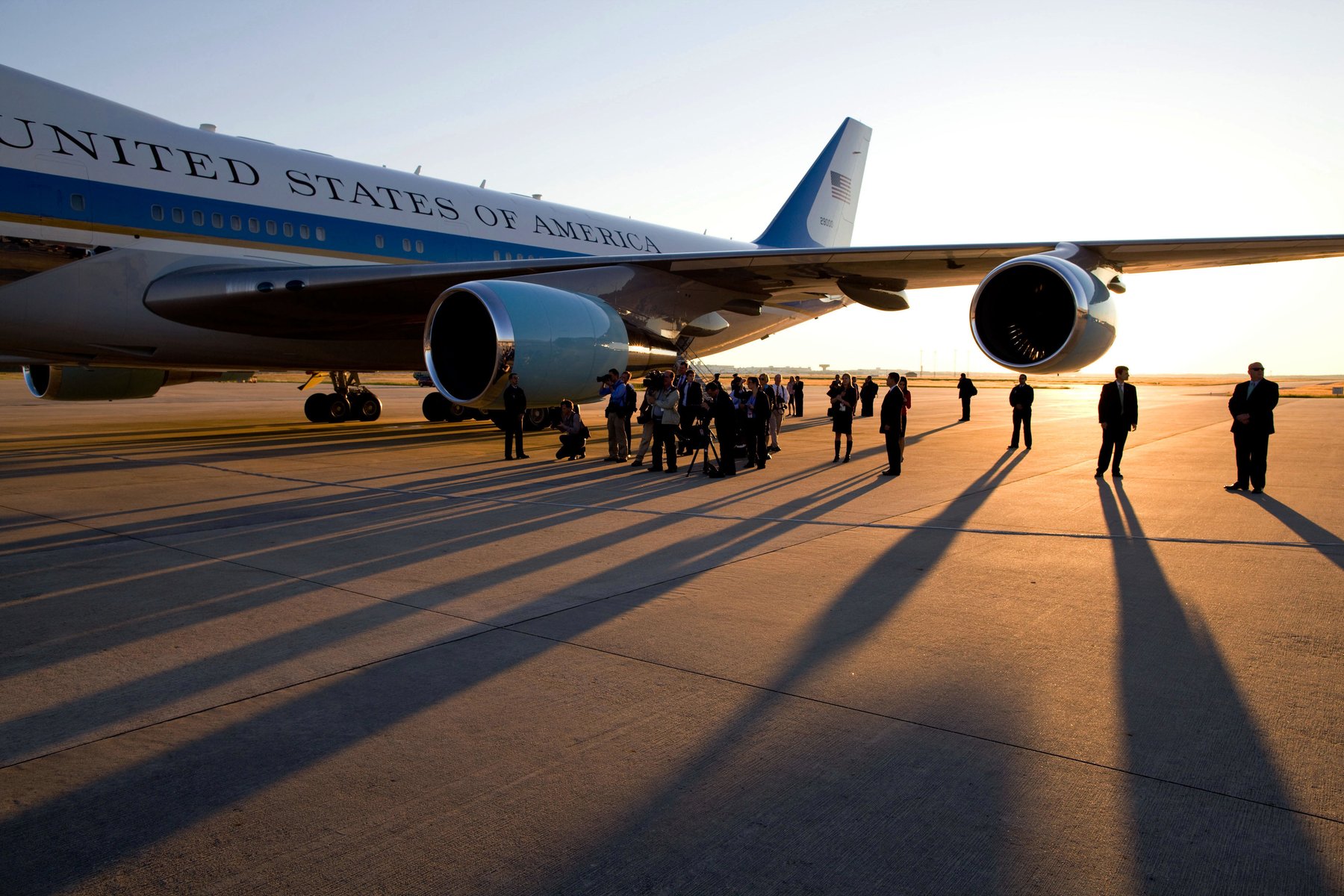
The White House press pool gathers under the wing of Air Force One in Houston, Oct. 16, 2009. Pool crews rotate through spaces like this one and share the footage with every other outlet. (Official White House photo by Pete Souza, public domain, via Wikimedia Commons)
The Networks Called It Solidarity
When the pool went dark, the five networks issued a joint statement. "The public has a vital interest in receiving accurate, independent information about its government," they said, as quoted by CBS News. "No administration should reject a news organization because it objects to its reporting." None of the five commented on the investigation itself.
Press advocates came out swinging. Bruce Brown of the Reporters Committee for Freedom of the Press told NPR the probe is "another and even more brazen attempt to try to intimidate journalists." Seth Stern of the Freedom of the Press Foundation said, "The investigation is nonsense."
Notice who was in that boycott. Fox News joined ABC, CBS and NBC in refusing to cover for CNN. Whatever DOJ concludes, it is investigating Fox right alongside the rest.
The Justice Department Has Done This Before, and Won
Listening to the press groups, you would think a Sherman Act case against news outlets is unheard of. It is not. During World War II the Justice Department sued the Associated Press, the biggest news cooperative in the country, under the same law. The AP's bylaws let member newspapers block their own competitors from joining and getting AP news. The AP argued that applying antitrust law to the press would violate the First Amendment.
The Supreme Court rejected that argument in Associated Press v. United States, 326 U.S. 1 (1945). Justice Hugo Black, writing for the Court, put it in the bluntest terms in the case. "The First Amendment affords not the slightest support for the contention that a combination to restrain trade in news and views has any constitutional immunity," he wrote.
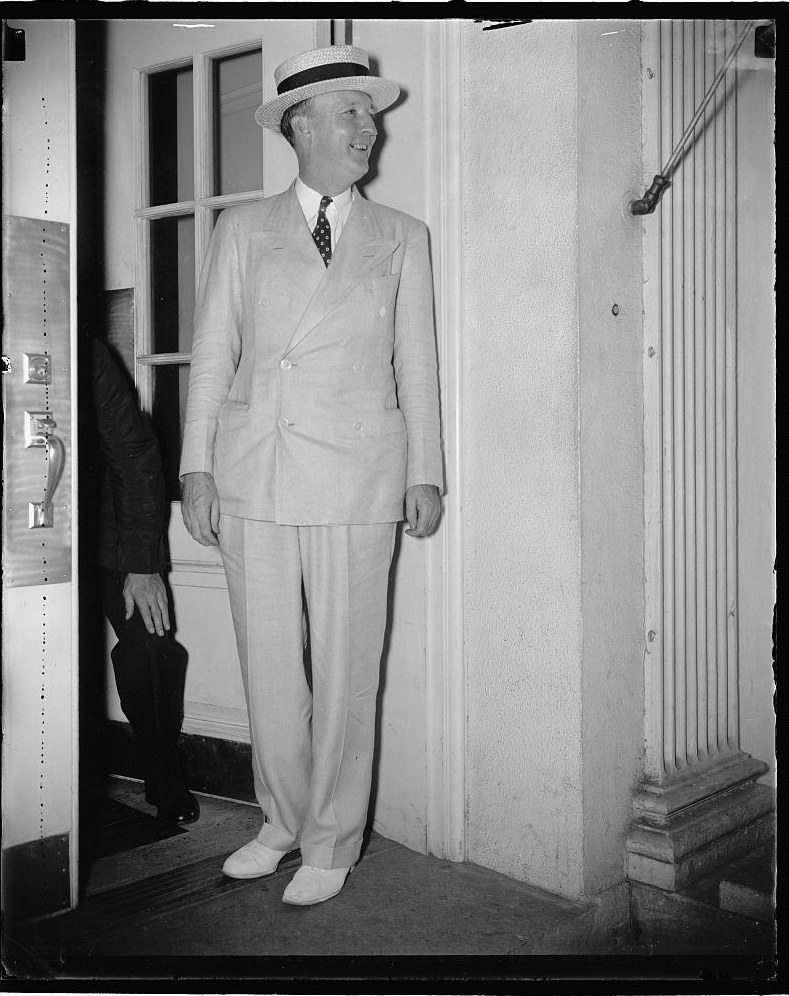
Justice Hugo Black in August 1937, the month he was nominated to the Supreme Court. Eight years later he wrote the majority opinion holding that the press has no First Amendment immunity from the Sherman Act. (Harris and Ewing, Library of Congress, no known restrictions on publication)
So the press groups calling this "nonsense" are skipping something. The Justice Department does not need a new theory to say news companies can break antitrust law. It has a Supreme Court ruling from 81 years ago that says exactly that.
Official record
Associated Press v. United States, 326 U.S. 1, decided June 18, 1945. Opinion of the Court by Justice Black, page 20, from the official United States Reports.
"Freedom to publish means freedom for all and not for some. Freedom to publish is guaranteed by the Constitution, but freedom to combine to keep others from publishing is not."
326 U.S. at 20
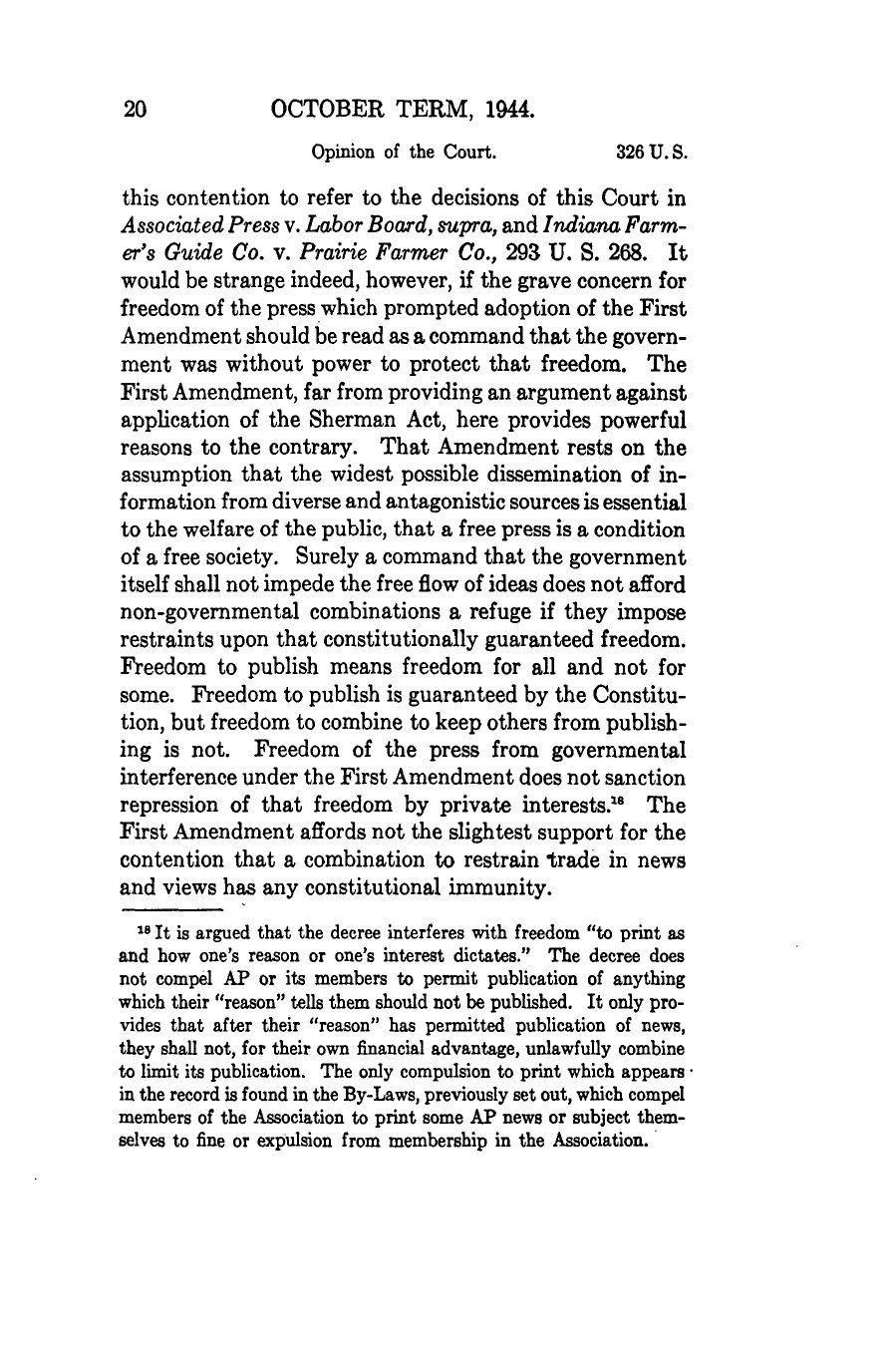
Read or download the full 60-page opinion (PDF) · official Library of Congress copy
Read the Footnote, Though
The same page carries a footnote that cuts the other way. Footnote 18 says the decree did not force the AP to publish anything. It said only that AP members "shall not, for their own financial advantage, unlawfully combine to limit" publication of the news. The 1945 case was about newspapers ganging up to keep rivals out of the news business and pocket the advantage.
The September blackout ran in the opposite direction. The four networks did not lock a competitor out. They stopped working, and gave up footage, to get a competitor back in. That is a strange fit for a law aimed at freezing out rivals.
The Real Test Is a 1990 Case About D.C. Lawyers
The closest Supreme Court match is not the AP case. It is FTC v. Superior Court Trial Lawyers Association, 493 U.S. 411 (1990). Private lawyers who took court-appointed criminal cases in Washington, D.C., agreed to stop taking new cases until the city raised their pay. The government was the party being boycotted, just as the White House is here. The lawyers said their boycott was political protest, protected the way the NAACP's civil rights boycott was protected in NAACP v. Claiborne Hardware (1982).
The Court ruled against the lawyers, unanimously on this point. Justice John Paul Stevens drew the line on page 426. The lawyers' "undenied objective" was "an economic advantage for those who agreed to participate," he wrote. The Claiborne boycotters were different, he said, because they "sought no special advantage for themselves."
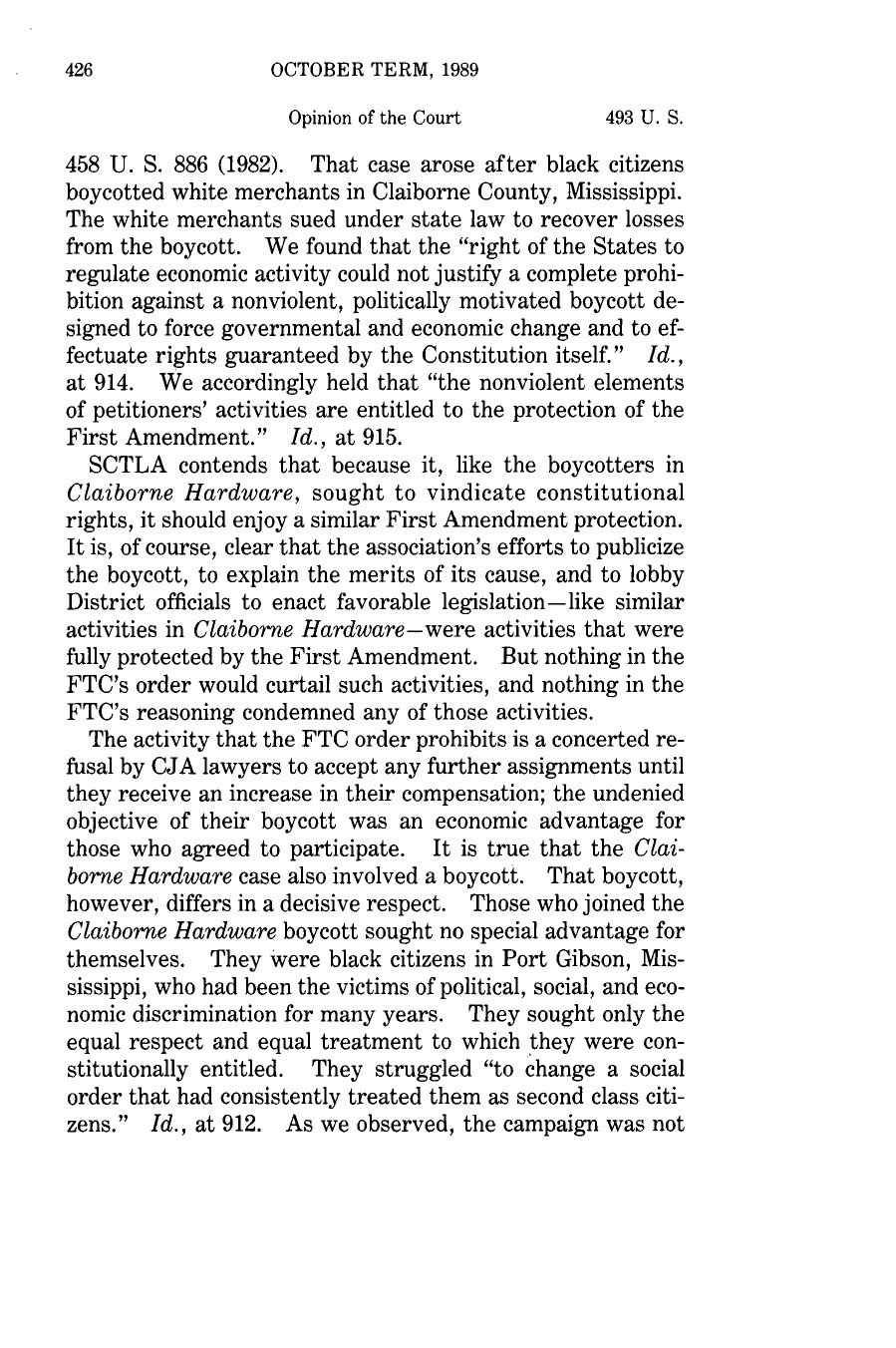
Page 426 of FTC v. Superior Court Trial Lawyers Association, 493 U.S. 411 (1990), where the Court says the protected civil rights boycott "sought no special advantage" for the people who joined it. Read the full opinion (PDF). (United States Reports via Library of Congress, public domain)
That one question decides a lot. What did ABC, NBC, CBS and Fox get out of refusing to cover for CNN? Not higher fees. They lost exclusive pictures of a state visit. On its face, that looks more like the protest the Court protected than the pay strike it condemned.
Where the DOJ Has a Real Argument
The government is not empty-handed, though. The same 1990 opinion quotes an earlier ruling warning that firms cannot "claim immunity for boycotts or horizontal output restrictions on the ground that they are intended to dramatize the plight of their industry." A pool blackout is an output restriction in plain terms. For several days, every station and website that relies on pool video got nothing, and the five networks decided that together.
The networks also have an obvious business stake in the pool's rules. Who gets in the room, and on whose terms, is a commercial question for companies that sell news. DOJ can argue the networks were protecting their shared arrangement, not just the First Amendment. CBS News pointed out in its own report that CBS and CNN now share a parent company, Skydance, after the Paramount and Warner Bros. Discovery merger closed this week, which shows how tangled the competitive lines already are.
And there is a fair question NPR raised through a Cornell constitutional law professor. "If the networks agreeing not to cover the White House is illegal, why isn't the press pool itself illegal?" he wrote. That cuts both ways. If DOJ pushes the theory far enough, it would put the pool itself under the antitrust microscope, and the administration relies on that pool every day.
What Happens Next
For now this is a request for records, not a lawsuit, and nobody has been charged with anything. The Sherman Act's Section 1 bans every "contract, combination ... or conspiracy, in restraint of trade," and DOJ will have to show this blackout fits that language before any court does.
The bigger date is Tuesday. Judge Kelly extended his order restoring access for CNN, MS NOW and Politico and said he would rule on longer-term relief by Tuesday evening, Oct. 13, NPR reported. The White House has still kept CNN and Politico out of the Oval Office and off Air Force One, CBS reported.
Trump's critics want this framed as a simple attack on the press. The networks want it framed as simple solidarity. The Supreme Court's own books say neither side gets off that easy. The 1945 ruling means the networks cannot hide behind the First Amendment, and the 1990 ruling means DOJ will have to prove the boycott was about money, not principle. If the documents DOJ just requested show the networks talking business, this case gets real. If they show the networks talking about press freedom, it probably ends quietly.
Top photo: President Donald J. Trump takes a question during a news conference in the James S. Brady Press Briefing Room, July 28, 2020. (Official White House photo by Shealah Craighead, public domain, via Wikimedia Commons)