Sen. Josh Hawley wants to know whether the FDA's abortion pill safety study is looking at the right years. In a letter sent Friday, he warned that the agency's main database may barely cover the mail-order era. We checked the database's own public statistics, and they back him up: Sentinel's enrollment fell by half the year before the Biden FDA dropped in-person dispensing, and it never came back.
Hawley Gave the FDA Until Oct. 22
The Missouri Republican sent his two-page letter on Oct. 9 to Kyle Diamantas, the FDA's acting commissioner. "I write with concern that FDA's long-promised safety study of the abortion drug mifepristone may be using incomplete data," it opens. He asked for written answers to four questions by Oct. 22, 2026.
The questions are specific. Does Sentinel include all data after 2021 or 2023, "such as that of the Medicaid population"? Has the FDA tried to get that data? What is the "additional data" outside Sentinel the agency says it is gathering, and what years does each source cover? And did the FDA once plan to buy a broader set of insurance data, then switch?
Congress is out until after the Nov. 3 midterms, so a letter is one of the few tools a senator has right now. Hawley has also filed his own bill. In March he introduced the Safeguarding Women from Chemical Abortion Act, which would withdraw the FDA's approval of mifepristone for abortion, KBIA reported.

Kyle Diamantas, the FDA's acting commissioner and the recipient of Hawley's Oct. 9 letter. (Official FDA portrait, 2025, public domain, via Wikimedia Commons)
What the FDA Told the Court
The letter grows out of a filing we covered last week. On Oct. 7, the Justice Department filed a five-page status report for the FDA in Louisiana v. FDA, the case over the 2023 rule change. It said the FDA "is using a variety of data sources contained within Sentinel, a distributed database, to conduct the study."
The report also said the agency checked for enough cases "across relevant time periods." It never said which periods. It said the study compares about 100,000 women in each group, and that results are due by mid-December 2026 with a final report by March 2027. Nowhere does it give a start or end date for the data.
Sentinel's Own Numbers Show the Gap
Hawley cited a public page run by the FDA's Sentinel Initiative, so we went to it. The Key Database Statistics page, last updated Oct. 13, 2025, has a chart of members enrolled in each year. Its caption says plainly: "The drop in members in 2021 reflects the current end date of Medicaid data. Data in 2024 and possibly 2023 is likely to be incomplete because of varying end dates."
The bars tell the story. Sentinel counted 151.2 million members in 2021. In 2022 it counted 77.0 million, a drop of 49 percent. It counted 75.5 million in 2023 and 77.2 million in 2024. Hawley's "nearly 50 percent" is accurate. In round numbers, about 74 million people fell out of the database after 2021.
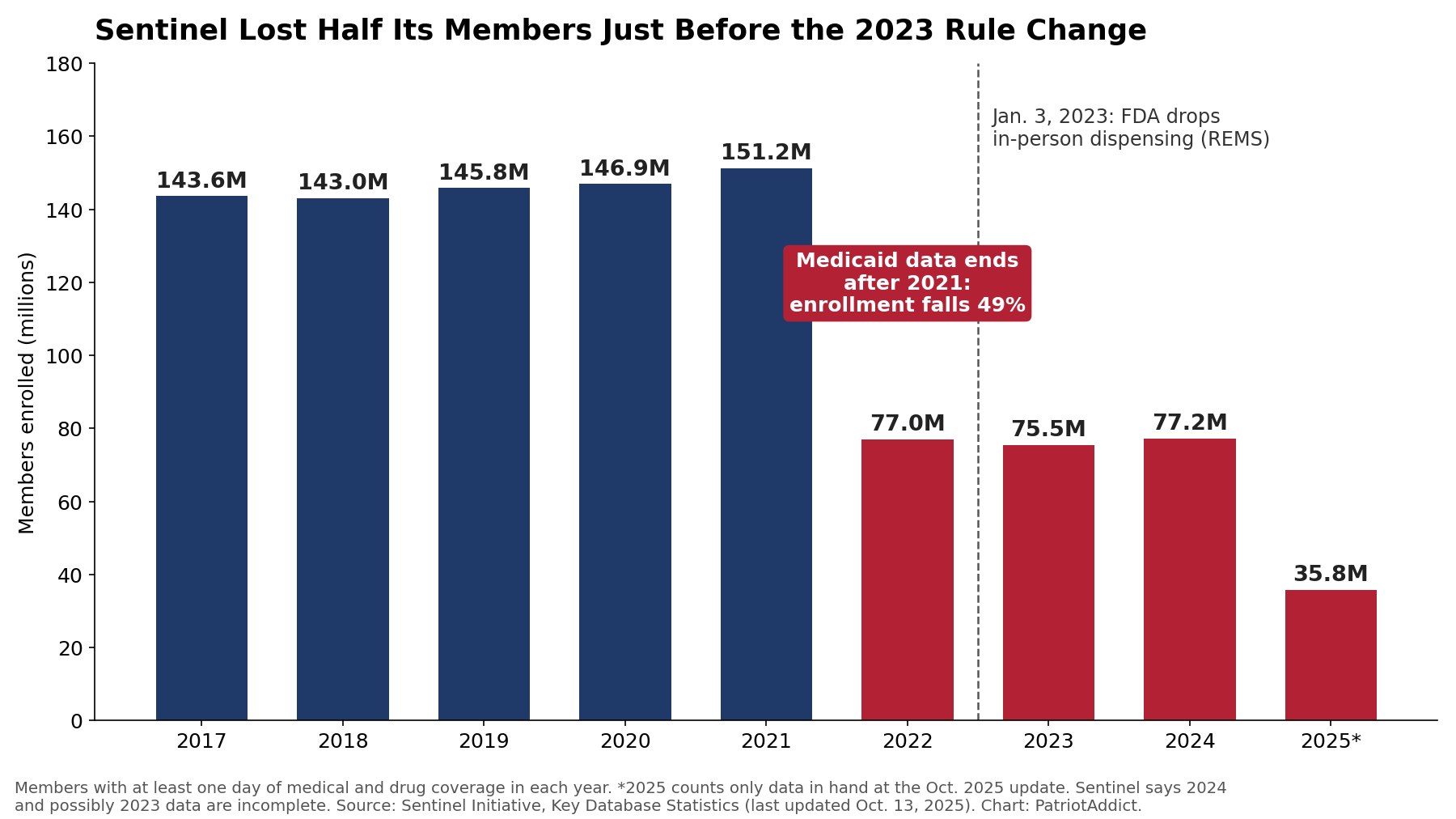
Members enrolled in the Sentinel Distributed Database by year, from the Sentinel Initiative's own published statistics. The 2025 bar reflects only data in hand at the October 2025 update. (Chart: PatriotAddict, data from Sentinel Initiative)
The Timing Could Hardly Be Worse
Line those numbers up against the rule change. The FDA formally removed the in-person dispensing requirement on Jan. 3, 2023, as Hawley's letter notes. That makes 2023 the first full year of the new rules. It is also a year when Sentinel held half the members it had in 2021, and a year Sentinel itself calls "possibly" incomplete.
So the database is thinnest for the years when the drug moved to the mail. If most of the FDA's 100,000 mifepristone cases come from 2017 through 2021, the study would mostly measure the old system, with a doctor visit, and say little about pills shipped after an online consult. That is Hawley's concern, and the public numbers give it weight.
Even Abortion Supporters' Data Shows Why It Matters
The mail-order boom is a post-2022 story, and the best count comes from the other side of the debate. The Society of Family Planning's #WeCount report, published June 10, found that telehealth abortion "grew from 5% of all abortions in April 2022 to 29% in December 2025." It counted more than 300,000 telehealth abortions in 2025 alone.
The same report says doctors began mailing pills into states with bans under so-called shield laws in July 2023, and that shield-law abortions reached 14,870 a month by December 2025. Every one of those happened after the 2023 rule change. A study built mostly on older claims would miss the women those changes affected most.
Official record
Letter from Sen. Josh Hawley (R-Mo.) to FDA Acting Commissioner Kyle Diamantas, Oct. 9, 2026 (2 pages), asking about the data behind the FDA's mifepristone safety study.
"This suggests that if the agency primarily relies on data from Sentinel, its analysis may rest largely on procedures that occurred before the 2023 REMS took effect and possibly exclude analysis of a large Medicaid population after that date."
Sen. Josh Hawley, letter to the FDA, pages 1 and 2
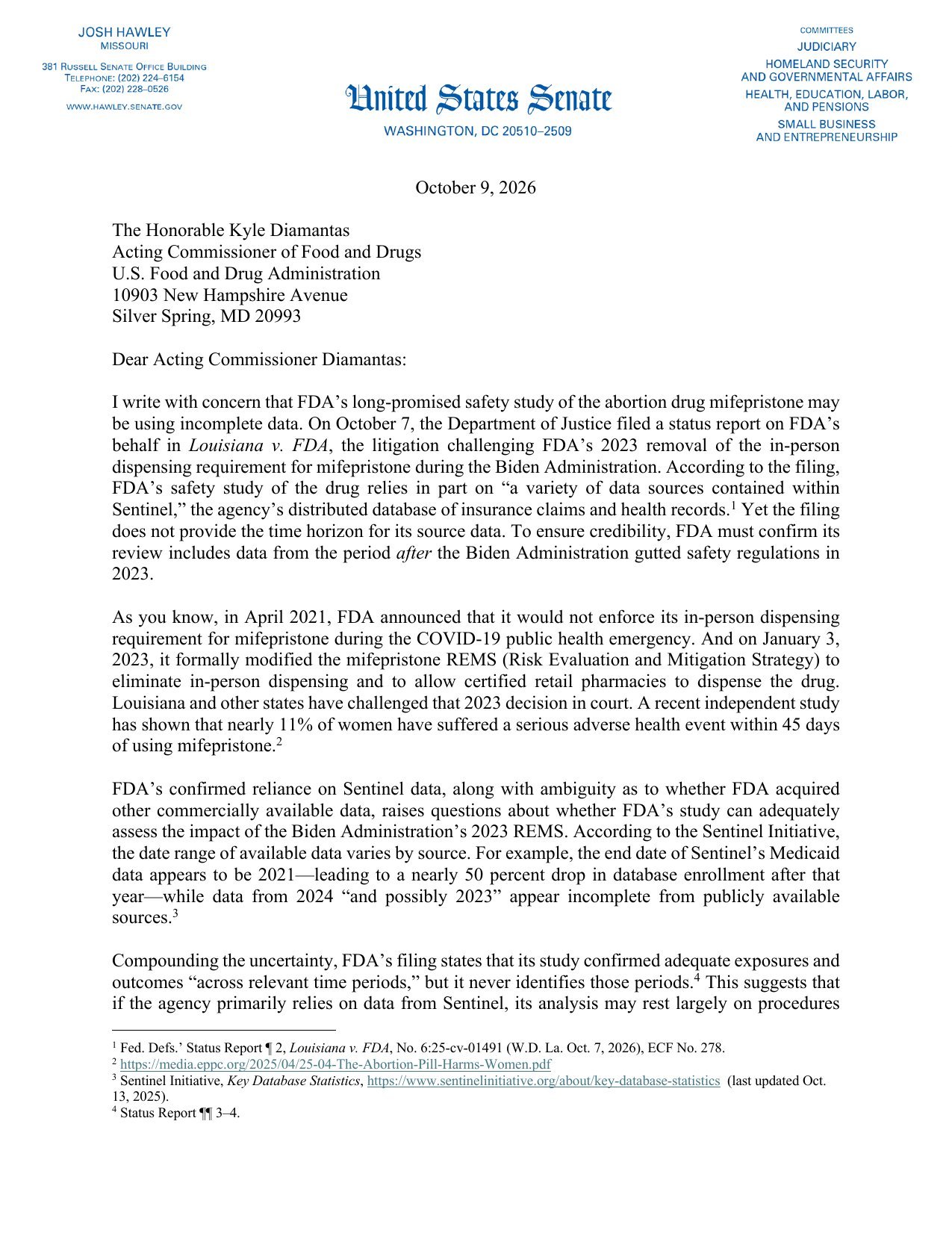
Read or download the full 2-page letter (PDF) · Sen. Hawley's official release · FDA status report, ECF No. 278
A Bigger Dataset Already Exists
Hawley's fourth question hints at what he thinks the FDA should be using. His letter says "commercially available data from all-payer claims could help fill the gap left by Sentinel's time-limited Medicaid data." That is the kind of data behind the study Hawley cites in the same letter.
The Ethics and Public Policy Center's 2025 report used "an all-payer insurance claims database that includes 865,727 prescribed mifepristone abortions from 2017 to 2023." It found that 10.93 percent of women had sepsis, infection, hemorrhaging or another serious adverse event within 45 days. EPPC is a conservative think tank, and the report is its own publication, not a peer-reviewed journal article. But its sample runs through 2023 and is several times larger than the roughly 100,000 per group the FDA described.
What We Still Don't Know
To be fair to the FDA, a public web page is not the agency's internal copy. The Sentinel page is a year old, and the FDA may hold newer data than what it shows. The status report also says the agency "continues to gather and analyze additional data that is outside of the Sentinel system." Those other sources could cover 2023 and later well.
The problem is that nobody outside the agency can tell. The FDA told a federal judge it has enough data "across relevant time periods" and then did not name a single year. That is exactly what Hawley asked it to spell out, and it costs the agency nothing to answer.
What Happens Next
The FDA's answers are due Oct. 22. If they come, they should tell the public how many of the women studied took the drug after Jan. 3, 2023, and how many got it by mail. If the answer is "not many," a study meant to decide whether mail-order abortion pills are safe would be built on the years before mail order took off.
That matters for women, and it matters for the court case, which is on hold until the FDA finishes. Pro-life voters have waited a long time for this review. They deserve to know it is looking at the right years before anyone calls the question settled.
Top photo: Sen. Josh Hawley (R-Mo.), official U.S. Senate portrait. (Photo by Rebecca Hammel, U.S. Senate, public domain, via Wikimedia Commons)