The FDA told a federal judge Wednesday that its abortion pill safety report will not be finished until March 2027, more than a year after Health Secretary Robert F. Kennedy Jr. ordered the review. But the agency's five-page filing never gives a date for the thing pro-life states actually want, a decision on whether to bring back in-person dispensing. It also reveals two other federal judges have added hoops the FDA must clear before it can tighten the rules at all.
Six Months Later, the FDA Reported Back
The filing is a court-ordered status report in Louisiana v. FDA, No. 6:25-cv-01491, in the Western District of Louisiana. Louisiana, through Attorney General Liz Murrill, sued in October 2025 together with Rosalie Markezich, a Louisiana woman represented by Alliance Defending Freedom. The suit targets the FDA's 2023 decision to drop the rule that mifepristone be handed over in person, which let the drug be prescribed by telehealth and sent by mail, according to KFF's case summary.
On April 7, U.S. District Judge David C. Joseph paused the case so the FDA could finish its review. He ordered the agency to come back within six months with "the status of its review in terms of process and any updated timeframe for completion of review." The report filed Oct. 7 is that answer.
What the FDA Actually Promised
The agency says it is running a safety study that compares about 100,000 women who took mifepristone with a comparison group of about the same size, using its Sentinel database of insurance and health system records. It is also running a "TreeScan" analysis, which the filing calls "a statistical data mining method" meant to surface "unknown safety concerns (if any)."
The key line is paragraph 5. "FDA is on track to obtain study results by mid-December 2026," it reads. "FDA will then need to review and evaluate/interpret the results and draft a report. FDA expects to complete that process not later than March 2027." That date is what made the headlines, including the Associated Press story carried by STAT on Thursday.

Health and Human Services Secretary Robert F. Kennedy Jr., who ordered the FDA's reevaluation of mifepristone. (Official HHS portrait, public domain, via Wikimedia Commons)
March Is a Report Date, Not a Decision Date
Read past paragraph 5 and the timeline gets longer. Paragraph 7 says that only after the study and the broader review are done will the FDA "decide whether changes to the Mifepristone REMS Program are necessary and, if applicable, initiate any such changes in accordance with established processes." No date is attached to that step. The filing says the FDA "anticipates that it will be able to provide an update to its estimated date of completion" later, "particularly in March 2027."
In other words, the judge asked for a timeframe for finishing the review, and the agency gave him a timeframe for finishing a report. The decision itself, and any rule change after it, has no date at all.
Judge Joseph's April order also requires the FDA to file a brief within 14 days after it "completes its REMS review." Because the agency has not said when that will be, that second deadline has no date on the calendar either.
Two Other Judges Added Hoops
Here is what the news coverage left out. Paragraph 6 of the filing says the FDA "has been directed to reconsider the 2023 decision modifying the REMS in two other cases." Both were brought by the other side. One is Purcell v. Kennedy in Hawaii, an ACLU case decided Oct. 30, 2025. The other is Whole Woman's Health Alliance v. FDA in the Western District of Virginia, decided July 23, 2026, a suit by abortion providers seeking to scrap the drug's remaining restrictions, as the Center for Reproductive Rights describes it.
According to the FDA's own summary, those rulings require the agency to apply statutory factors "it has not previously evaluated," compare mifepristone to other drugs with similar risks, consider publications beyond the ones it used in 2023, and "consider the views of patients, providers, and pharmacists if the Agency is considering imposing elements to assure safe use." A rule that a drug be dispensed only in certain health care settings is one of those elements under 21 U.S.C. 355-1(f)(3). So before the FDA could bring back in-person dispensing, two court orders won by abortion-pill advocates say it has to hear from the providers and pharmacists who mail the pill.
Official record
State of Louisiana v. U.S. Food and Drug Administration, No. 6:25-cv-01491-DCJ-DJA (W.D. La.), Federal Defendants' Status Report, Document 278, filed Oct. 7, 2026 (5 pages).
"Following completion of its study and review, FDA will decide whether changes to the Mifepristone REMS Program are necessary and, if applicable, initiate any such changes in accordance with established processes."
Federal Defendants' Status Report, paragraph 7, page 4
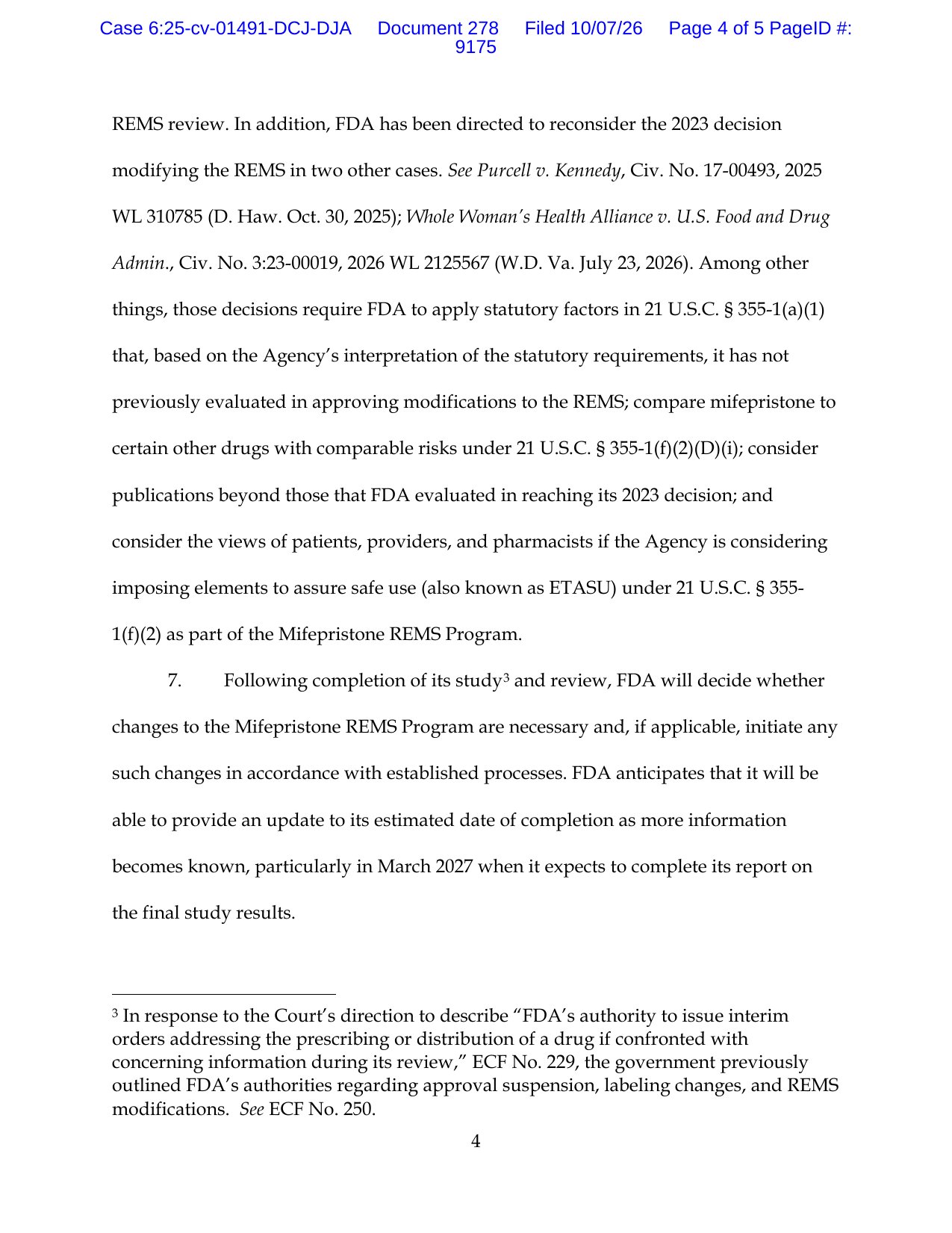
Read or download the full 5-page status report (PDF) · CourtListener copy of the filing · Judge Joseph's April 7 ruling
The Judge Already Warned the FDA
Judge Joseph, a Trump appointee, gave the agency room in April for a specific reason. In his 37-page ruling he wrote that "FDA does not defend its decision-making on the merits but instead acknowledges deficits and requests a stay to complete a fulsome review." He said the agency deserved "a time-limited period of deference."
Then he put the FDA on notice. "But the stay granted to FDA will not remain open-ended," he wrote. "FDA has an obligation to act with all deliberate speed to review its past actions and complete a thorough analysis that addresses the deficiencies it has acknowledged." If the agency fails to finish "within a reasonable timeframe," the judge wrote, "the Court's analysis ... will inevitably change."
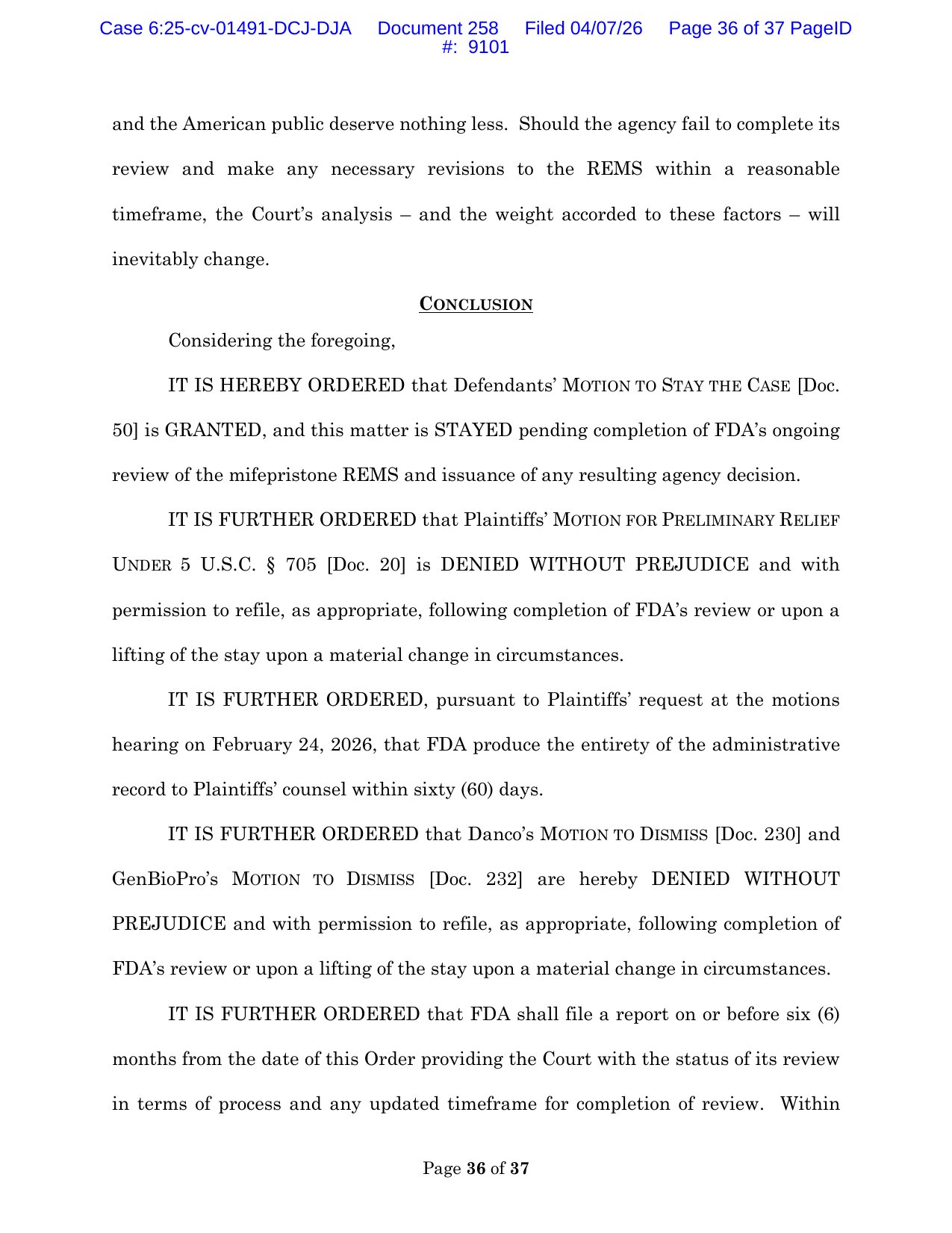
Page 36 of Judge David C. Joseph's April 7, 2026 memorandum ruling, warning that the court's analysis "will inevitably change" if the FDA does not finish its review in a reasonable time and ordering the six-month status report. (U.S. District Court, Western District of Louisiana, public court record via CourtListener)
Louisiana and its lawyers at ADF can now argue that "not later than March 2027," with no decision date behind it, is not reasonable. The state has asked the court to order in-person dispensing restored.
Pro-Life Groups Are Angry at Their Own Side
The sharpest reaction came from allies of the administration. "The American people deserve the thorough report on abortion drug safety that the FDA has promised for nearly two years, but the agency has again failed to deliver it," said ADF's Erin Hawley, who argued the Supreme Court's 2024 mifepristone case, in an Oct. 8 statement. She warned that "the lengthy regulatory work that will be required after the study concludes could push any potential solution to the next administration."
Hawley also said the study is "beside the point," because the 2023 decision is unlawful regardless, and urged the FDA to settle with Louisiana through a consent decree that would vacate the 2023 rules. Gavin Oxley of Americans United for Life told the AP the administration "continues to find itself on the wrong side of women's health."
That frustration has a paper trail. When the review was announced in September 2025, HHS said it was "informed by the lack of adequate consideration underlying the prior REMS approvals," according to the letter quoted by KFF. The agency has admitted the problem. It just has not fixed it.
Why the Courts Will Not Fix It First
Louisiana briefly won. On May 1, a Fifth Circuit panel reinstated the in-person requirement nationwide. On May 14, the Supreme Court blocked that order while the case continues, KFF reported, so mail-order pills are still flowing. In September, a Fifth Circuit panel hearing the state's appeal questioned whether Louisiana even has standing to sue, the AP reported.
That leaves the FDA as the most direct path to restoring in-person dispensing, and the FDA has just told a federal court it cannot say when it will decide. Every month of delay matters to this fight. Hawley, citing the abortion-rights Society of Family Planning's own #WeCount data, says each month of delay puts nearly 15,000 more babies at risk in states where mail-order abortion drugs are illegal.
What Happens Next
The FDA expects study results by mid-December and a report by March. Louisiana can ask Judge Joseph to lift the stay sooner, and his April ruling all but invited that if the agency drags its feet. The Fifth Circuit appeal and the two cases in Hawaii and Virginia are also still moving.
Pro-life voters gave this administration the power to fix the 2023 rule. Wednesday's filing gives a date for a report and cites two court orders from the other side that slow the agency down. What it does not give is a date to act.
Top photo: The main entrance of FDA Building 1 at the agency's White Oak campus in Silver Spring, Maryland, which houses the Commissioner's office. (U.S. Food and Drug Administration, public domain, via Wikimedia Commons)