A Montana judge has blocked the state's new birth-year check on absentee ballot envelopes, just as ballots go out for the Nov. 3 midterms. News reports say the judge found the law "disenfranchised nearly 6,000 Montana voters." The judge's own 17-page order says something very different: "there is no evidence anyone was prevented from voting due to the enactment of HB 719."
What the Judge Struck Down
House Bill 719 passed the 2025 Legislature and was signed by Gov. Greg Gianforte on May 5, 2025, according to the order. It asked voters to give their date of birth when registering and when requesting an absentee ballot, then to write it again under their signature on the return envelope. Secretary of State Christi Jacobsen's office trimmed the envelope piece to just the four-digit birth year, out of privacy concerns, a change the order says neither side disputed.
If the year was missing or did not match the voter's file, the county had to contact the voter, who could fix it until 5 p.m. the day after the election. Ballots that stayed unfixed were not counted. That is the same cure process Montana already uses for a missing or mismatched signature.
On the lawsuit brought by Disability Rights Montana and Big Sky 55+, District Judge Mike Menahan of Lewis and Clark County granted summary judgment and ordered that the State and Jacobsen "are enjoined from enforcing House Bill 719." Montana Free Press reported that counties begin mailing absentee ballots to voters on the absentee list today, Friday, Oct. 9.
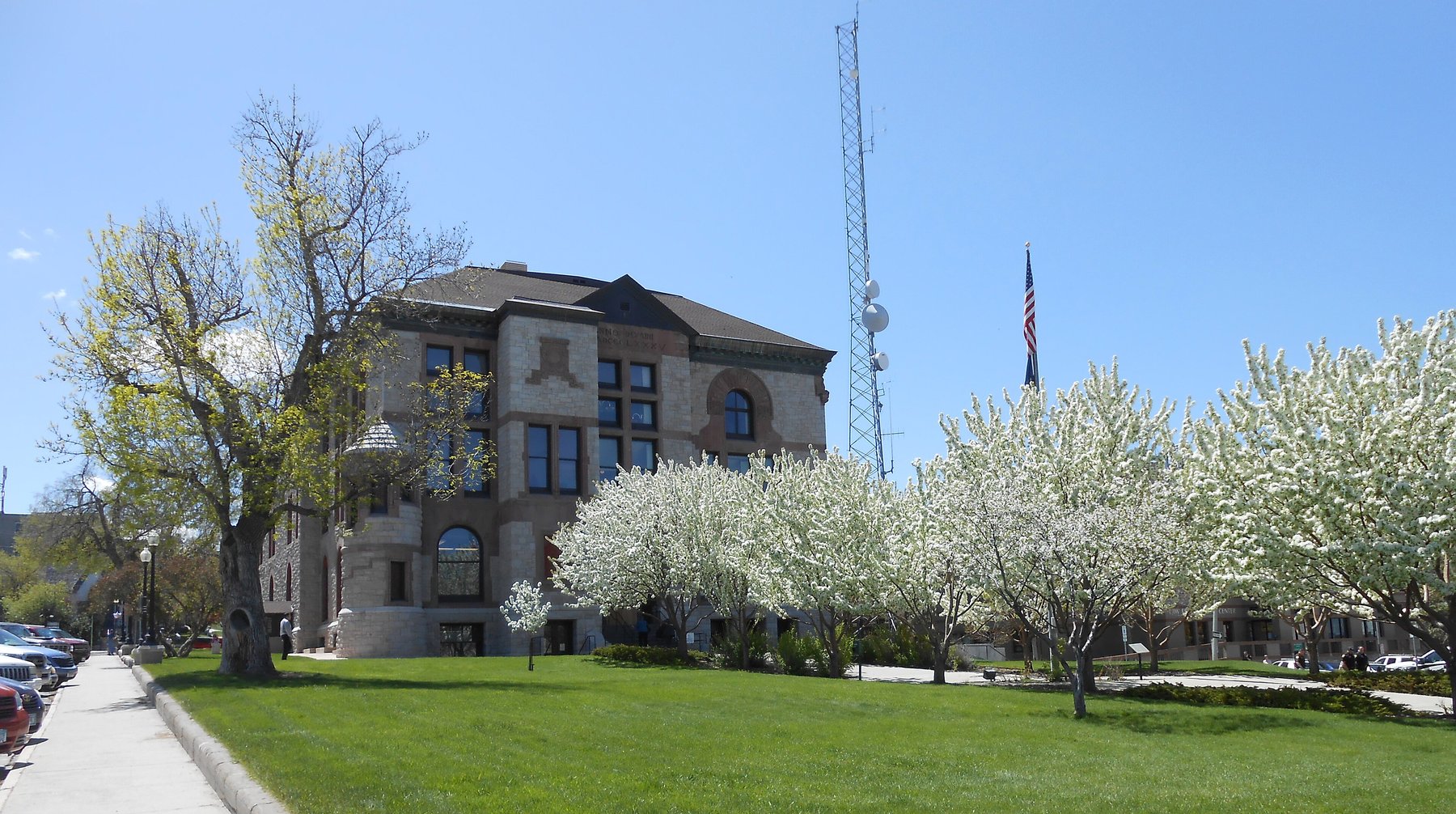
The Lewis and Clark County Courthouse in Helena. Judge Mike Menahan sits on Montana's First Judicial District Court, which covers Lewis and Clark County. (Photo by Montanabw, CC BY-SA 3.0, via Wikimedia Commons)
The Order Says Nobody Was Blocked From Voting
Here is the part the coverage skipped. Under Montana precedent, a law that "impermissibly interferes" with voting gets strict scrutiny, the toughest test there is. The plaintiffs asked for it. The judge said no. On page 8 of the order, he wrote that he "agrees with the State that strict scrutiny does not apply."
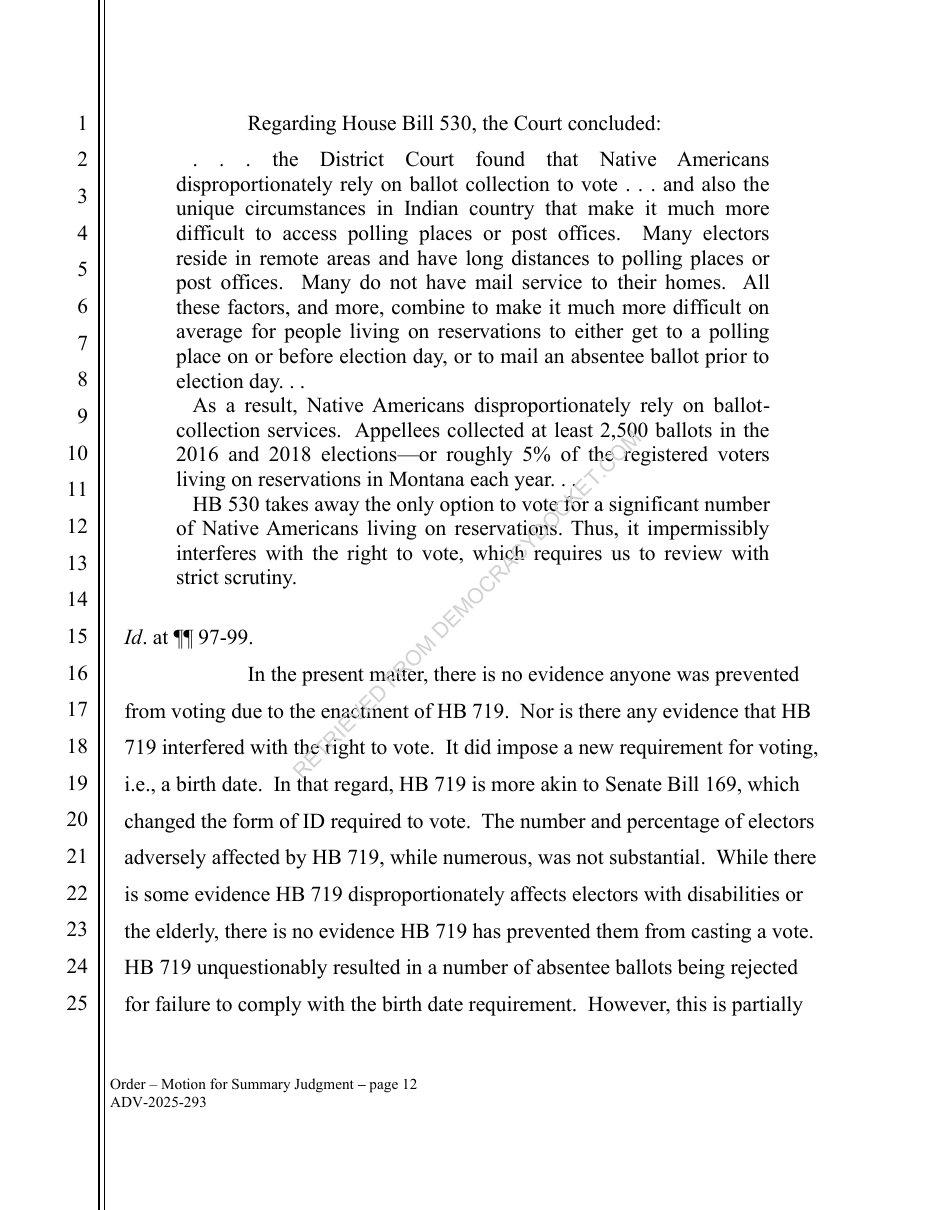
Then he went further. "Nor is there any evidence that HB 719 interfered with the right to vote," he wrote on page 12. He compared the birth-year line to the voter ID changes in Senate Bill 169 and called the number of affected voters "numerous" but "not substantial." He also wrote that "there is no evidence HB 719 has prevented" elderly or disabled voters "from casting a vote."
The word "disenfranchised" does appear in the order, but only in the judge's summary of an earlier Montana Supreme Court case about Election Day registration. It is never used to describe HB 719, and the "nearly 6,000" figure appears nowhere in the order. Montana Free Press, whose story ran in several papers, attributed both to the judge anyway.
Official record
Disability Rights Montana and Big Sky 55+ v. State of Montana and Christi Jacobsen, Cause No. ADV-2025-293, Montana First Judicial District Court, Lewis and Clark County. Order on Motion for Summary Judgment, filed Oct. 2, 2026 (17 pages).
"In the present matter, there is no evidence anyone was prevented from voting due to the enactment of HB 719. Nor is there any evidence that HB 719 interfered with the right to vote."
Judge Mike Menahan, Order, page 12
Read the full 17-page order (PDF, as posted by the case tracker Democracy Docket, which Montana's district courts do not publish online) · case page and filings
So Why Did the Law Lose?
Because the State did not bring proof. Under the middle-tier test the judge chose, Montana had to show the law was reasonable and that its goals outweighed a minimal burden. The State named two goals, public confidence and fraud prevention. Its brief said a birth year helps confirm "the person returning the ballot is the registered voter, particularly when multiple voters share similar or identical names."
The judge called the confidence argument "a conclusory statement" and said the State "does not offer any evidence in support of its position." On fraud, the brief said "Montana has documented instances of individuals casting ballots in more than one state and has obtained convictions for deceptive election practices." According to the order, the State "has not offered any proof in support of its assertion," and did not say how many cases there were or how a birth year would catch them.
The plaintiffs did bring numbers. Their expert, Dr. Kenneth R. Mayer, told the court he found a single case of absentee ballot impersonation in Montana in 40 years, a man who sent in his ex-wife's ballot in 2011. A birth year would not have stopped him, Mayer said, because he presumably knew it. Readers can weigh that claim for themselves, but the State left it unanswered on the record. A safeguard that might have survived with a sworn declaration from a county clerk or a list of prosecutions went down without either.
Where Does "Nearly 6,000" Come From?
The order lists three counts. Mayer put the November 2025 municipal election at 1,814 absentee ballots uncounted solely for the birth year. A declaration from the State's side put the May 2026 elections at 2,855 ballots and the June 2026 primary at 1,103. Add them up and you get 5,772.
But the judge flagged a problem with the last two. In footnote 3 he wrote, "It is unclear from the State's declaration whether the rejected ballots are the number of ballots rejected and uncured, or simply the number of ballots rejected with some number later cured." In other words, an unknown share of those 3,958 ballots may have been fixed by voters and counted. Calling all of them "voided" is a stretch the order does not support.
The trend line also matters. The order puts the birth-year rejection rate at 1.55% in May 2026 and 0.41% in the June primary. Mayer's own declaration found that 92% to 97% of rejected envelopes in Cascade, Gallatin and Missoula counties simply left the year blank, "clearly indicating that voters did not understand the administrative step." The judge agreed rejections "will likely decline" as voters learn the rule, and said the evidence "does suggest the number of rejected ballots is declining."
The Supreme Court Quote Was Cut in Half
To knock down the public-confidence argument, the judge quoted the U.S. Supreme Court's January 2026 decision in Bost v. Illinois State Board of Elections: the "discarding of lawful [votes] erodes public confidence that the election results reflect the people's will."
That case was brought by Republican Rep. Mike Bost of Illinois, represented by Judicial Watch, to challenge Illinois counting mail ballots that arrive up to two weeks after Election Day. And the full sentence in Chief Justice John Roberts's opinion starts with the other half. Roberts wrote that "the counting of unlawful votes" or "discarding of lawful ones" erodes that confidence. The line just before it quotes Crawford v. Marion County Election Board, the 2008 decision that upheld Indiana's voter ID law, on "integrity of the electoral process." The order keeps the half about rejected ballots and drops the half about ballots that should never be counted.

Rep. Braxton Mitchell (R-Columbia Falls), who carried HB 719 in the 2025 Legislature. (Official Montana Legislature portrait by the House Creative Committee, CC0, via Wikimedia Commons)
The Ruling Came Down Friday, Not Monday
Several outlets, including Montana Free Press, described this as a "Monday ruling." The court's stamp on page 1 reads "FILED 10/02/2026," and the electronic signature on page 16 is dated "Fri, Oct 02 2026 12:41:30 PM." Democracy Docket also lists the order as Oct. 2. The public learned of it Monday, but the order was signed the Friday before.
The injunction is also broader than "the envelope rule." Its final line bars enforcement of "House Bill 719," full stop. The bill also covered the date of birth on registration and absentee applications. The judge's analysis focused on the envelope, so how counties read the order for those other steps is a fair question for Jacobsen's office.
What Happens Next?
The State says it will fight. "This duly enacted law bolsters election integrity and provides necessary safeguards to absentee voting in Montana," Montana Department of Justice spokesman Chase Scheuer said in a statement reported by Yellowstone Public Radio. "Writing your birthday on an envelope is not an unconstitutional burden on the right to vote." The station reported that Attorney General Austin Knudsen's office plans to appeal to the Montana Supreme Court.
The plaintiffs see it the other way. "The government should not throw out a Montanan's vote because of a paperwork mistake that does nothing to make an election more secure," said Disability Rights Montana Executive Director David Carlson. Montana Free Press noted that in Billings, the 2025 mayor's race was decided by 200 votes while 627 ballots went uncounted for a missing birth year.
For November, the practical effect is simple. Unless a higher court steps in, a missing birth year will not sink a Montana ballot. But the order itself is a warning to every state defending an election safeguard this fall. The judge found the law left no one unable to vote. It still lost, because the State showed up without evidence. Good election laws still need a record behind them when they get to court.
Top photo: The Montana State Capitol in Helena, March 2025. (Photo by Mattvw9287, CC BY 4.0, via Wikimedia Commons)