The Trump administration wants colleges to pay $70,000 before a foreign student can work in America under the Optional Practical Training program. But DHS's own 35-page proposal admits the biggest reason employers prefer those graduates is a payroll tax break no fee can touch, and the bill to end it has sat untouched in the Senate for over a year.
What DHS Proposed This Week
The Department of Homeland Security published the "Optional Practical Training Fees" proposed rule in the Federal Register on Oct. 8, signed by Secretary Markwayne Mullin. Any school certified to enroll foreign students would pay $70,000 the first time it recommends an F-1 student for OPT, and $30,000 for each later recommendation, including the two-year STEM extension.
The money has to be paid before the school can enter the recommendation in the federal student database, and USCIS could not issue the work permit without it. Once the permit is issued, the fee is not refundable "under any circumstances," according to the proposed regulatory text.
DHS did not mince words. "Optional Practical Training was never meant to be a back door into the American workforce, a subsidy for cheap labor, or a prize for those who game the system," a DHS spokesperson said, as quoted by Newsweek. "American workers should not have to compete against a program that has been turned into a pipeline for cheap foreign labor."
OPT Grew 21 Percent in One Year
OPT lets foreign students work in the U.S. in their field for 12 months, and STEM graduates can stay on for 24 more. Congress never created it. Work-based practical training for foreign students has rested on regulations, not a statute, since 1947, a point the proposal makes by quoting a 2020 DHS ombudsman report that said OPT lacks protections "that would have been legislated in" had Congress written it.
The program has exploded. DHS says 194,554 F-1 students were granted OPT work permits and reported working in 2024, up from 160,627 in 2023. That is a 21 percent jump in one year, by our math. Another 95,384 were on STEM extensions in 2024.
The fraud cases in the proposal are ugly. DHS cites a probe that found more than 10,000 OPT students working for "highly suspect employers," with residential addresses listed as worksites and "phantom employees" who never showed up. It also cites a Chinese businesswoman sentenced in 2020 for supplying fake job paperwork to at least 2,693 foreign nationals, most of them Chinese students seeking OPT.
DHS Names the Tax Break, Then Leaves It Alone
Here is what the coverage skipped. On page 64574, DHS spells out why companies like OPT workers. Under 26 U.S.C. 3121(b)(19), most F-1 students and their employers pay no Social Security or Medicare tax during the student's first five calendar years in the country.
DHS does the math itself. An employer "saves an amount equal to 6.2 percent" of the student's salary up to the Social Security wage base, plus "an additional 1.45 percent" for Medicare. That is 7.65 percent off the payroll cost of every OPT hire compared with an American graduate at the same salary. The student skips the same 7.65 percent from his own paycheck.
Official record
Department of Homeland Security, "Optional Practical Training Fees," Notice of Proposed Rulemaking, 91 FR 64566 (Oct. 8, 2026), DHS Docket No. ICEB-2026-0100, RIN 1653-AB01. Page 64574 shown.
"As such, an employer saves an amount equal to 6.2 percent of the F-1 nonimmigrant student's salary up to the taxable wage base and an additional 1.45 percent of the total salary that would have been the employer's contribution to the Social Security and Medicare trust funds."
91 FR 64574
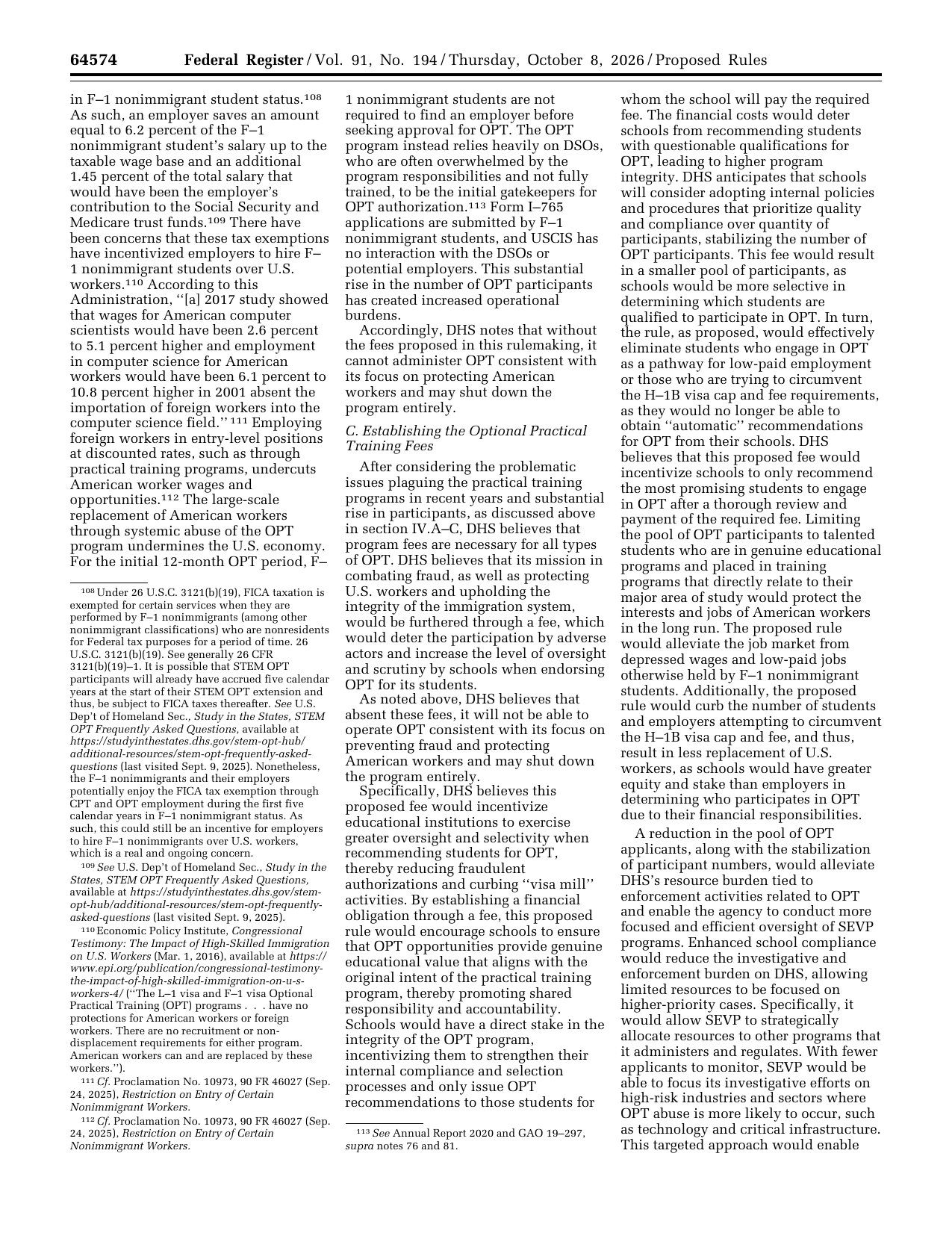
Read or download the full 35-page proposed rule (PDF) · official GovInfo copy · FederalRegister.gov page
But a DHS rule cannot rewrite the tax code. The fee changes who gets into OPT. It does nothing to the discount for those who get in. In its own benefits section, the best DHS can offer is that if some OPT students are "replaced with FICA-subject workers, there could be additional transfers for federal taxes collected." Ending the exemption outright is a job for Congress.
Tom Cotton Wrote the Fix. Nobody Signed On.
Congress has a bill. Sen. Tom Cotton (R-Ark.) introduced the OPT Fair Tax Act, S. 2940, on Sept. 30, 2025. It would make OPT workers and their employers pay FICA like everyone else. "Our tax code shouldn't incentivize businesses to hire foreign workers," Cotton said in his announcement.
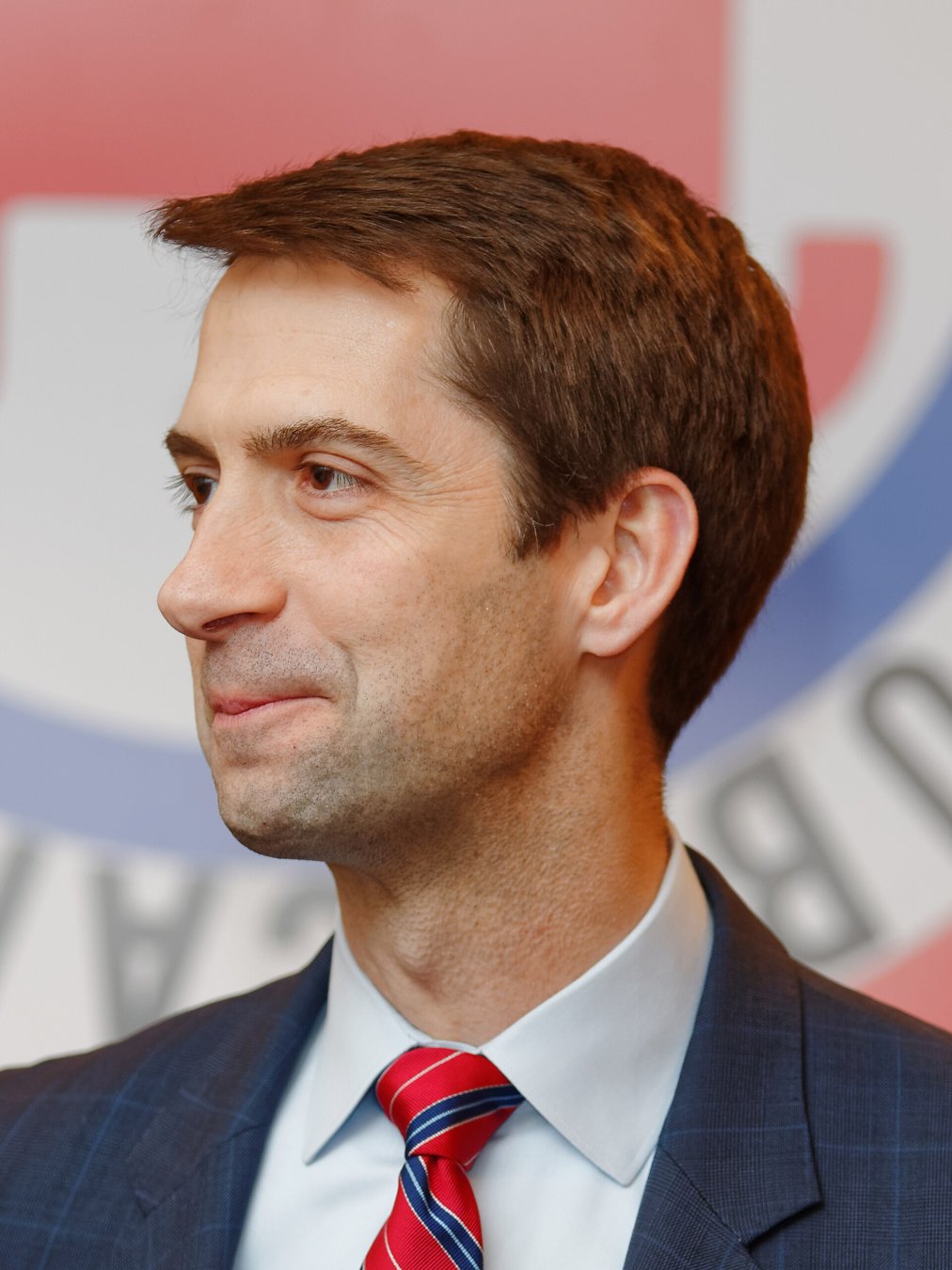
Sen. Tom Cotton (R-Ark.), sponsor of the OPT Fair Tax Act, S. 2940, pictured in 2016. (Photo by Michael Vadon, CC BY-SA 4.0, via Wikimedia Commons)
Congress.gov shows the bill has zero cosponsors. It was referred to the Senate Finance Committee the day it was introduced, and that is still its last action more than a year later. Rep. Glenn Grothman (R-Wis.) filed an identical House version, H.R. 8972, on May 21, 2026. Congress.gov lists no cosponsors for it either, and it sits in the Ways and Means Committee.
Cotton is the same senator President Trump publicly pressured last week over daylight saving time, as we reported. On this issue, Cotton and the administration are on the same side, and the White House now has a rule on the books that makes his case for him.
The Proposal Cites a Different Bill
DHS lists four House bills that would limit or end OPT. The one from this Congress is Rep. Paul Gosar's (R-Ariz.) Fairness for High-Skilled Americans Act, H.R. 2315, which would scrap OPT unless Congress expressly authorizes it. That bill has 39 cosponsors and has sat in the House Judiciary Committee since March 2025.
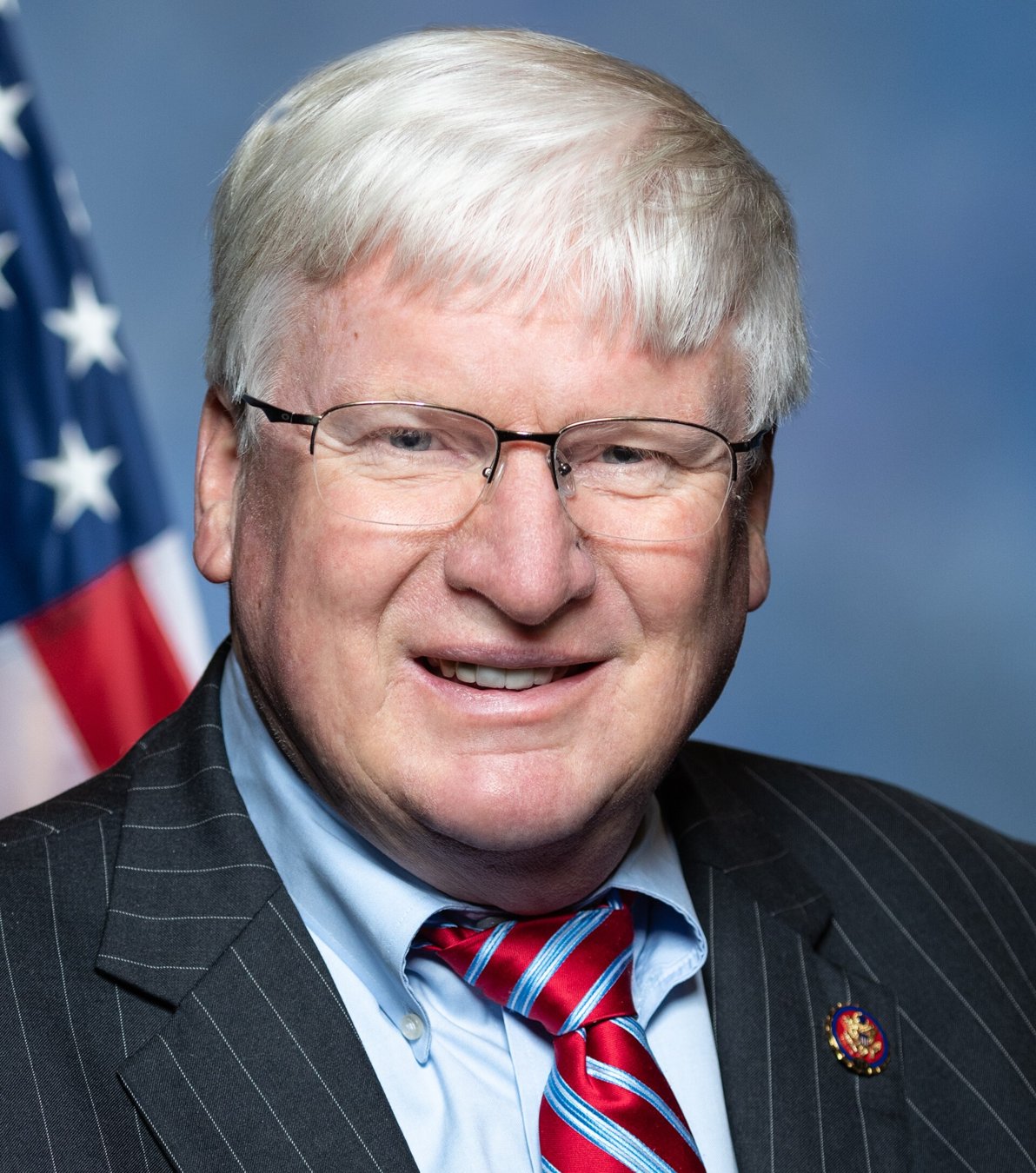
Rep. Glenn Grothman (R-Wis.), who introduced the House version of the OPT Fair Tax Act, H.R. 8972, in May 2026. (Official congressional portrait, public domain, via Wikimedia Commons)
The OPT Fair Tax Act appears nowhere in the 35 pages. We searched the full text for "2940," "Cotton" and "Fair Tax" and found no match. A rule that leans this hard on the payroll tax argument never mentions the one bill that would end the payroll tax break.
The Fine Print Schools Will Notice First
The regulatory text holds a few surprises. During the transition, anyone recommended for any kind of OPT on or after the effective date pays the full $70,000 if no fee was paid before. DHS's cost analysis confirms that in the first year it assumes everyone pays $70,000, "including those in STEM OPT." A graduate already working on regular OPT who applies for the STEM extension after the rule kicks in would cost his school $70,000, not $30,000.
DHS also expects schools to game the timing. Pre-completion OPT followed by post-completion OPT would cost $100,000, while taking all 12 months after graduation costs $70,000. DHS writes that it "anticipates that institutions would encourage F-1 nonimmigrants to use only post-completion OPT."
And DHS is not shy about the scale. Its primary estimate is $12.4 billion a year in fees, with a range of $8.4 billion to $16.5 billion. In its low scenario, schools pay only for STEM students eligible for the extension, which would mean non-STEM OPT largely dries up. DHS also warns that without the fees, it "may shut down the program entirely."
Who Gets the Money, and When Can You Comment?
Not ICE. The proposal says the fees would go to the general Treasury "because the statute does not provide legal authority for ICE to retain the funds collected." Doug Rand, a former DHS official, told Newsweek that makes the fee "an unlawful tax." Expect that argument in court if the rule is finalized. NAFSA, the international educators' group, said through CEO Fanta Aw that the plan would "hurt American innovation," according to the Associated Press.
The deadline is getting garbled, too. The AP story said the public has "60 days to comment," and a widely shared law firm explainer passed along a Nov. 7 date. The Federal Register notice itself sets the general comment deadline at Nov. 9, 2026, through Regulations.gov under Docket No. ICEB-2026-0100. The 60-day window, ending Dec. 7, applies only to comments on the paperwork burden.
Why the Tax Break Still Matters
The fee is a serious swing at a program that grew with almost no guardrails, and DHS's fraud record makes a strong case for it. Schools that have treated OPT as a recruiting perk would finally have skin in the game.
But a fee is a toll at the front door. The 7.65 percent payroll discount stays in place for every OPT worker who gets through it, and DHS says plainly that the discount pushes employers toward foreign students over Americans. Congress returns around Nov. 9, the same day the comment period closes. If Republicans want to finish the job for American graduates, S. 2940 is already written. It just needs a few cosponsors.
Top photo: Graduates of Colorado State University's Walter Scott, Jr. College of Engineering at their May 14, 2022 commencement in Fort Collins, Colo. (U.S. Space Command photo by Petty Officer 1st Class John Wagner, public domain, via Wikimedia Commons)