As of Friday, ATF has stopped enforcing National Firearms Act registration for suppressors, short-barreled rifles, short-barreled shotguns and "any other weapons," and the policy covers every gun owner in America, not only the people who won in court. It is the biggest change in how Washington treats these items since the NFA became law in 1934. But the agency's own seven-page FAQ has a warning on its last page that gun owners should read before they ask ATF to take an item off the registry.
ATF Took a Court Win for a Few and Gave It to Everyone
In an open letter dated Oct. 9, ATF Director Robert Cekada wrote that "effective October 9, 2026, ATF will no longer require individuals to seek ATF approval under the NFA before making or transferring" those four categories of items. "ATF will also no longer require such items to be registered in the National Firearms Registration and Transfer Record," he added. "These policies apply uniformly to anyone otherwise subject to these requirements, not just to the plaintiffs in the litigation."
That last line is the news. Judge James Wesley Hendrix's Aug. 5 ruling in Silencer Shop Foundation v. ATF held that once the One Big Beautiful Bill Act cut the $200 making and transfer tax on these items to zero, the registration scheme could no longer stand on Congress's taxing power. But his injunction only protected the plaintiffs, their members and their customers. PatriotAddict covered that gap in August. Friday's guidance closes it by policy.
Cekada's letter says 47 members of the House and Senate had asked ATF to apply the ruling nationwide, citing an Aug. 11 letter led by Rep. Andrew Clyde of Georgia. The Justice Department let its window to appeal Hendrix's ruling close on Oct. 5, AmmoLand reported.

Robert Cekada, now ATF Director, who signed the Oct. 9 open letter. This official ATF portrait dates from 2025, when he was deputy director. (Bureau of Alcohol, Tobacco, Firearms and Explosives, public domain, via Wikimedia Commons)
What You Can Do Now That You Couldn't Do Last Week
According to the ATF FAQ that accompanies the letter, a law-abiding buyer can now walk into a gun store and take home a suppressor the same way he buys a deer rifle, with a Form 4473 and a background check. No Form 4, no fingerprint cards, no wait of months for approval. An individual can build his own suppressor or short-barreled rifle without filing a Form 1.
ATF also says it will not enforce the NFA's ban on carrying an unregistered item across state lines, 26 U.S.C. 5861(j). The FAQ's own examples are target shooting in another state and moving to a new home. The marking rules for these items are gone too, and dealers no longer need a Form 3 to ship suppressors to each other.
Director Cekada put it plainly in ATF's press release, as quoted by Bearing Arms: "The direction from the President, Congress, and the courts is clear. ATF is now following suit with our enforcement posture while continuing to ensure we remain focused where we are needed the most: combatting violent crime in American communities."
What Still Applies
This is not repeal. Machine guns and destructive devices still carry the $200 tax and every NFA rule. Businesses that make, import or sell these items still owe the special occupational tax. All of the Gun Control Act still applies, including background checks and the ban on sales to prohibited persons.
Short-barreled rifles and shotguns have one extra wrinkle. Bearing Arms flagged what looked like a conflict between ATF's press release and its FAQ on carrying an SBR across state lines. The FAQ itself clears it up. The NFA travel ban is not being enforced, but a separate Gun Control Act rule, 18 U.S.C. 922(a)(4), still requires a Form 20 before you take an SBR or SBS to another state, "even if it is unregistered." Dealers selling SBRs face a similar Gun Control Act approval rule, 922(b)(4), which ATF says it will not enforce until it writes a new non-NFA approval process.
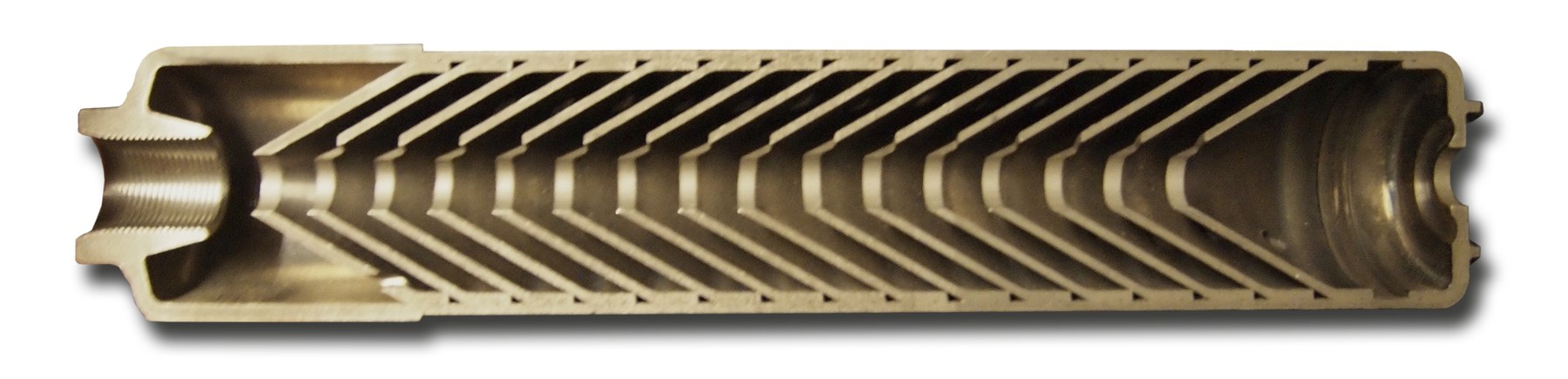
A cutaway of a suppressor showing the internal baffles that slow and cool expanding gas. (gar2chan, CC BY-SA 4.0, via Wikimedia Commons)
State law is the biggest hazard. The FAQ says "most states" require NFA items to comply with federal law or be registered under the NFA, and ATF "cannot opine" on whether an unregistered item held under this policy counts as lawful for those state laws. In his letter, Cekada also warned that "it is unclear whether state courts will apply the safe harbor created by 18 U.S.C. § 926A" to travelers passing through states that ban these items.
The Warning on Page 7
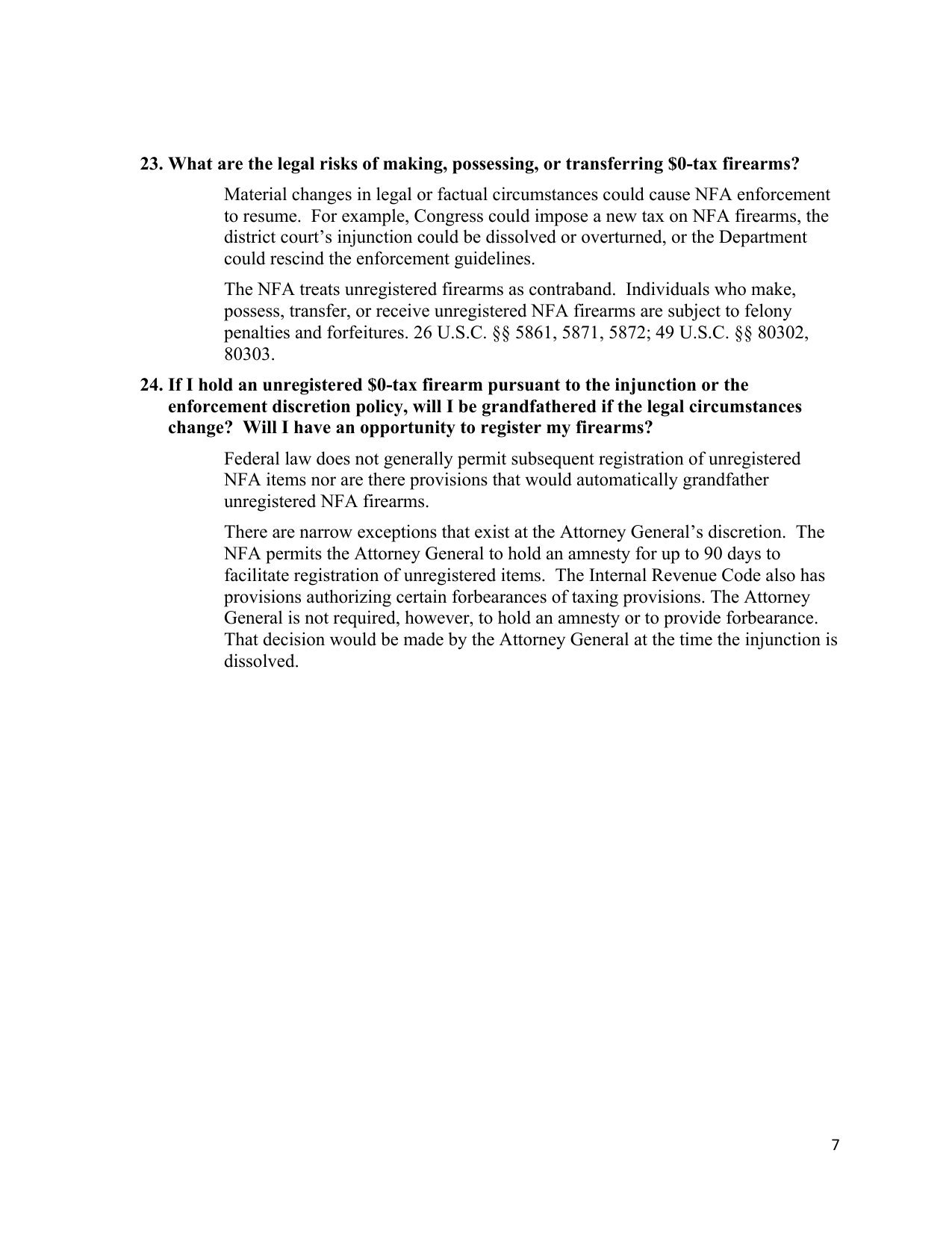
Here is the part most of Friday's coverage moved past quickly. Question 22 of the FAQ tells owners how to pull a registered item, or a pending application, out of the system: email the NFA Division. Then it adds one sentence: "Please note that once an item is removed, it cannot be re-registered unless the Attorney General declares an amnesty."
Question 23 lists how the good times could end. "Congress could impose a new tax on NFA firearms, the district court's injunction could be dissolved or overturned, or the Department could rescind the enforcement guidelines." The FAQ then reminds readers that "the NFA treats unregistered firearms as contraband," with felony penalties and forfeiture. Among the laws it cites are 49 U.S.C. 80302 and 80303, the federal contraband-transport statute. That law defines contraband to include "a firearm involved in a violation of" the NFA, and it allows the government to seize and forfeit the vehicle, vessel or aircraft used to carry it.
Question 24 asks the obvious follow-up: if things change, will owners be grandfathered? ATF's answer is no, "Federal law does not generally permit subsequent registration of unregistered NFA items nor are there provisions that would automatically grandfather unregistered NFA firearms." The only out is an amnesty of up to 90 days, which the Attorney General "is not required" to hold.
Official record
ATF, "FAQs to Accompany the Open Letter Regarding the National Firearms Act Making and Transfer for Certain Firearms and Devices," Oct. 9, 2026 (7 pages), page 7.
"The Attorney General is not required, however, to hold an amnesty or to provide forbearance. That decision would be made by the Attorney General at the time the injunction is dissolved."
ATF FAQ, Question 24
Read or download the full 7-page FAQ (PDF) · copy posted by the Second Amendment Foundation · Director Cekada's open letter
How Often Has That Amnesty Actually Happened?
We went to the statute ATF is describing. The amnesty power comes from Section 207(d) of the Gun Control Act of 1968, printed at 82 Stat. 1236. It lets the government, "after publication in the Federal Register of his intention to do so," set "periods of amnesty, not to exceed ninety days in the case of any single period." The power was given to the Treasury Secretary in 1968 and now sits with the Attorney General.
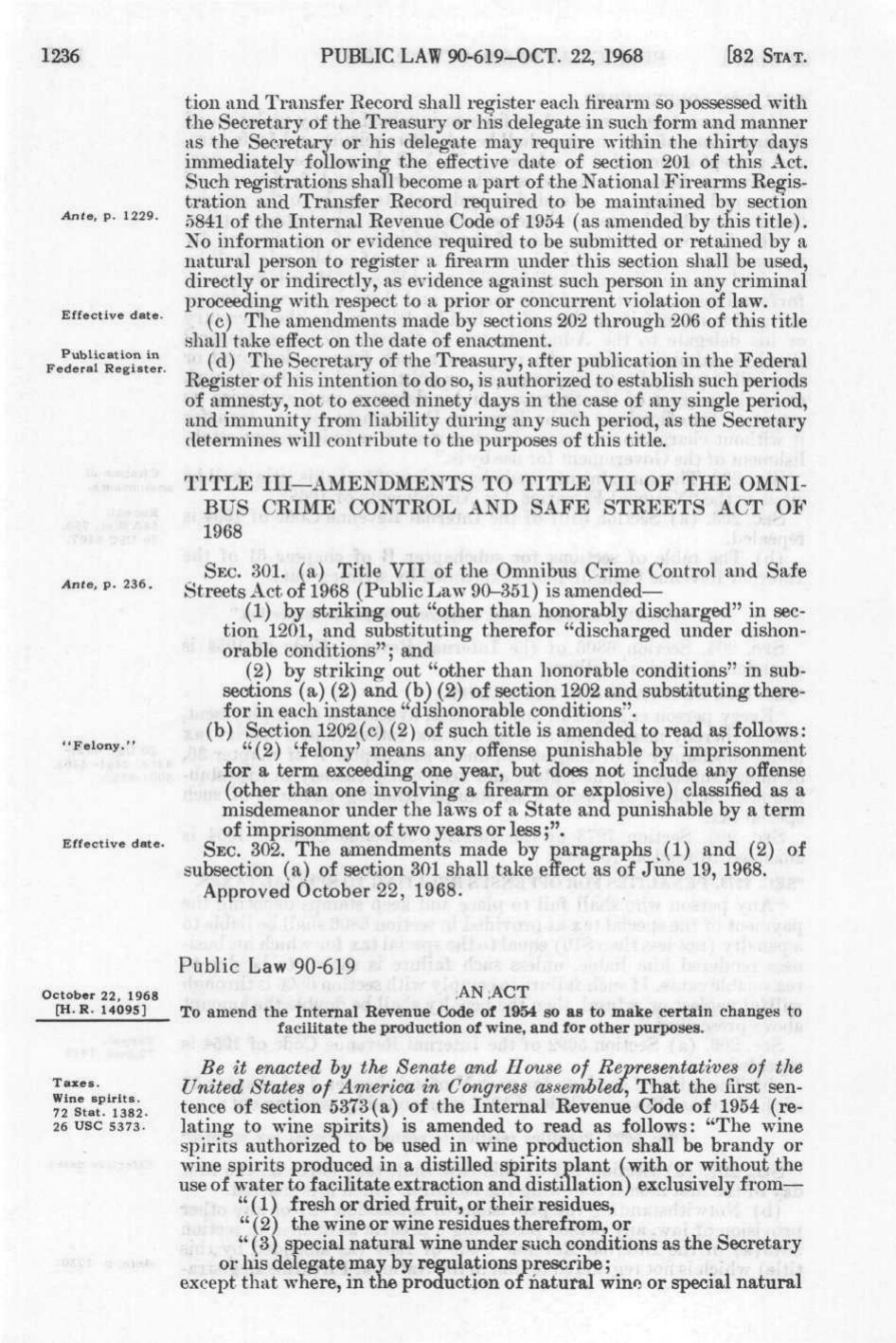
82 Stat. 1236, the final page of the Gun Control Act of 1968, with the one-time 30-day registration window in Section 207(b) and the standing amnesty power in Section 207(d). (U.S. Government Publishing Office, public domain)
The same page shows the one amnesty Congress actually wrote into law. Section 207(b) gave owners of unregistered NFA firearms 30 days to register them. A 2007 Justice Department Inspector General report says that window ended Dec. 1, 1968, and that any NFA weapon not registered then "is considered contraband, cannot be registered, and must be forfeited or voluntarily surrendered to ATF." An ATF fact sheet from 1979 says the same: "There is no provision now for an individual to register an unregistered NFA weapon."
Neither document mentions any amnesty after 1968, and we found no record of one. The power ATF is pointing to as the safety net has sat unused for about 58 years.
Who Is Protected by a Court, and Who Is Protected by a Policy?
There is a second line in the FAQ that matters. The amnesty decision, it says, "would be made by the Attorney General at the time the injunction is dissolved." But the FAQ lists three ways enforcement could come back, and only one of them is the injunction ending. If a future Justice Department simply rescinded Friday's guidelines, Hendrix's injunction would still protect the plaintiffs, their members and their customers. Everyone else would be relying only on a policy that no longer existed.
That is why the Second Amendment Foundation said it is not done. "By its very nature purely as 'guidance' it cannot, and does not, provide a permanent fix for many remaining elements of the NFA," SAF Executive Director Adam Kraut said in a Friday statement. SAF's other NFA suits, Brown v. ATF and Roberts v. ATF, will continue. AmmoLand reported that Hendrix gave the Justice Department until Oct. 12 to answer a motion from the plaintiff states on how far the injunction reaches.
What Gun Owners Should Take From It
This is a real win, and the Trump administration deserves credit for choosing to extend it to every law-abiding American instead of only the people who sued. A suppressor is a hearing-safety device, and for the first time in 92 years the federal government is treating it that way.
But ATF has been unusually honest about the risk, and owners should take the agency at its word. If you already hold an approved Form 4 or Form 1, that paper is the one thing that keeps an item legal no matter who runs the Justice Department next. ATF's own FAQ says that once you give it up, getting it back depends on an amnesty that Washington has granted once, in 1968. The registry is voluntary now. Leaving it is permanent.
Top photo: The "suppressed" setting on the adjustable gas valve of a SIG Sauer MCX-SPEAR rifle, a control built for shooting with a suppressor attached. (Tony Webster, CC BY 2.0, via Wikimedia Commons)