Two Liberty University students have sued Virginia over a new law that makes it a crime for any adult under 21 to buy a handgun or an "assault firearm," even from a private seller. Read the one-page law Gov. Abigail Spanberger signed in April and something else jumps out: its list of exceptions for soldiers, National Guard members, police officers and ROTC cadets does not apply to the new under-21 purchase ban at all.
Two College Students Took Virginia Back to Court
The case is Boyer v. Katz, e-filed Oct. 6 in the Circuit Court for the City of Lynchburg, according to the court's own filing stamp on the 62-page complaint. The plaintiffs are Melody Boyer, 19, and Natasha Rousseau, 18, joined by Gun Owners of America, Gun Owners Foundation, the Virginia Citizens Defense League and the Virginia Citizens Defense Foundation. The defendant is Col. Jeffrey S. Katz, superintendent of the Virginia State Police, sued in his official capacity.
The complaint is specific about what the two women want to do. Boyer has agreed to buy a Glock 19 from a Lynchburg man named Ryan Thomas for $650. Rousseau has agreed to buy a Smith and Wesson Shield from him for $300. Both also want to buy an AR-15-style rifle from him for $900. Thomas is a member of both GOA and VCDL, and the complaint says both sales would happen "immediately" if the law allowed it.
The suit targets two statutes. One is the new under-21 purchase ban, Va. Code 18.2-308.7(C). The other is Virginia's "universal" background check law for private sales, Va. Code 18.2-308.2:5. A violation of either is a Class 1 misdemeanor.

Lynchburg's former courthouse on Monument Terrace, now a museum. The city's circuit court has twice ruled that 18-to-20-year-old Virginians have a right to buy handguns. (Northern-Virginia-Photographer, CC0, via Wikimedia Commons)
This Court Already Said Young Adults Have the Right
Lynchburg is not a random venue. The same circuit court ruled in 2020, in Elhert v. Settle, that Article I, Section 13 of the Virginia Constitution protects "the right of adults under 21 to purchase a handgun, the 'quintessential self-defense weapon.'" In December 2024 it "reaffirm[ed]" that "[i]n Virginia, persons 18 to 20 years of age have a right to bear arms," the complaint quotes.
The problem in that earlier case was a catch-22. Virginia's 2020 background check law required every private sale to go through a background check. Federal law bars licensed dealers from selling handguns to anyone under 21, so the FBI's system rejects those checks automatically. The result, as the court put it, was that young adults had "no lawful mechanism" to buy a handgun at all. The court enjoined the law and, in 2025, struck it in its entirety.
Richmond's Fix Was to Ban the Sales Outright
The General Assembly answered with HB 1525, now Chapter 1102 of the 2026 Acts of Assembly, "Approved April 22, 2026." It does two things. It adds a new subsection C making it "unlawful for any person younger than 21 years of age to knowingly and intentionally purchase a handgun or assault firearm anywhere in the Commonwealth." And in a separate section it orders the State Police to "administer, enforce, and otherwise implement" the background check statute the court had struck down. An emergency clause put it in force the day it passed.
In other words, the court found the old law illegal because it blocked young adults from buying handguns. Richmond's response was to block them on purpose. At a June 3 hearing, the Lynchburg judge said the new law "essentially ... reviv[es] a ... statute that the Court struck in its entirety as being unconstitutional," according to the transcript quoted in the complaint.
Attorney General Jay Jones saw it the other way. When the court dissolved its injunction in June, effective July 1, Jones said HB 1525 "resolves the underlying cause of the injunction," WDBJ reported. The underlying cause, by the court's own reasoning, was that 18-to-20-year-olds could not buy a handgun. The new law resolves that by making it a crime.
The Exceptions List Skips the Under-21 Ban
Here is the part the coverage has missed, and the complaint never raises. The same section of the law has a list of exceptions. It covers anyone "engaged in official training or carrying out his duties as a law-enforcement officer or as a member of the Armed Forces of the United States or the National Guard," cadets in the Corps of Cadets or ROTC at a public college, and active participants in a State Police Trooper Basic Academy session.
But read the sentence that opens that list. Subsection E says: "The provisions of subsection B shall not apply to" those people. Subsection B is the old ban on gun possession by minors under 18. The new under-21 purchase ban is subsection C, and nothing in the law carves anyone out of it. There is no exception for a 20-year-old soldier, and none for a 19-year-old ROTC cadet who trains with rifles every week.
The complaint does argue that 18-to-20-year-olds can "join the military, where they are entrusted with a whole host of deadly weapons." It does not point out that the legislature itself wrote a military exception into this same section and then aimed it only at minors. By the plain words of Chapter 1102, the state trusts a 20-year-old Marine with a rifle overseas but makes it a misdemeanor for him to buy a pistol from his neighbor in Virginia.
Official record
Virginia Acts of Assembly, 2026 Reconvened Session, Chapter 1102 (HB 1525), "Approved April 22, 2026," one page, published by the Virginia Legislative Information System.
"C. It is unlawful for any person younger than 21 years of age to knowingly and intentionally purchase a handgun or assault firearm anywhere in the Commonwealth. ... E. The provisions of subsection B shall not apply to: ... 4. Any person while engaged in official training or carrying out his duties as a law-enforcement officer or as a member of the Armed Forces of the United States or the National Guard"
Va. Code 18.2-308.7, as amended by Chapter 1102
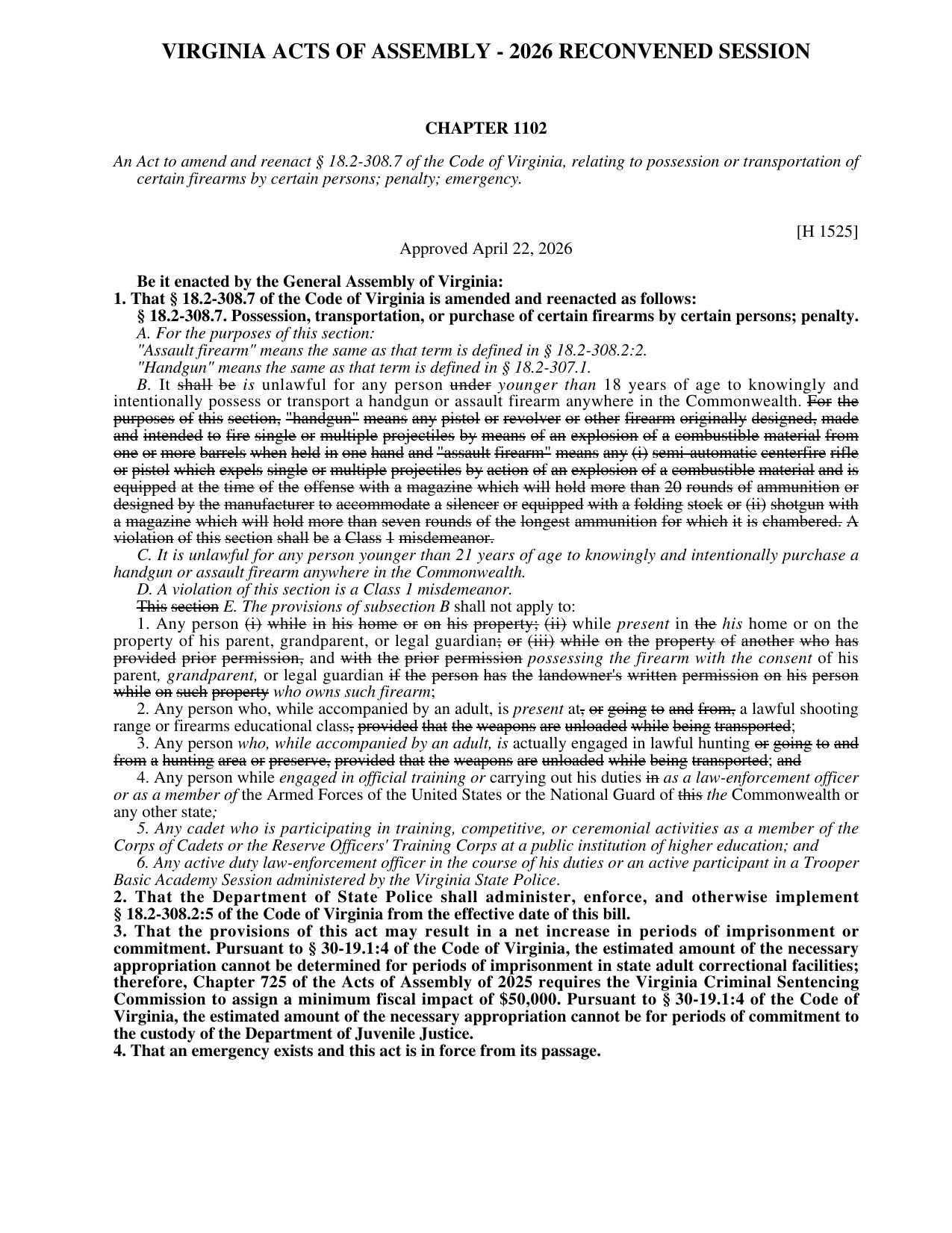
Read or download the full one-page chapter (PDF) · official LIS copy
The Gun Show Option Is Gone Too
A second detail sits on page 5 of the complaint. Under the old setup, private buyers and sellers could get a background check from State Police at gun shows without a dealer. The plaintiffs argued back in 2020 that this State Police access to the FBI's system was unlawful under federal law and "could be revoked at any time."
According to the new complaint, that has now happened. "Following a recent audit, the FBI has now restricted the Virginia State Police's use of the NICS system," it says, and "the Virginia State Police are not, in fact, conducting these 'voluntary' gun show checks at this time, because they cannot." We have not seen the FBI audit itself, and this is the plaintiffs' allegation. If it holds up, every private sale in Virginia now has to run through a licensed dealer, and every dealer check on an under-21 handgun buyer comes back denied.
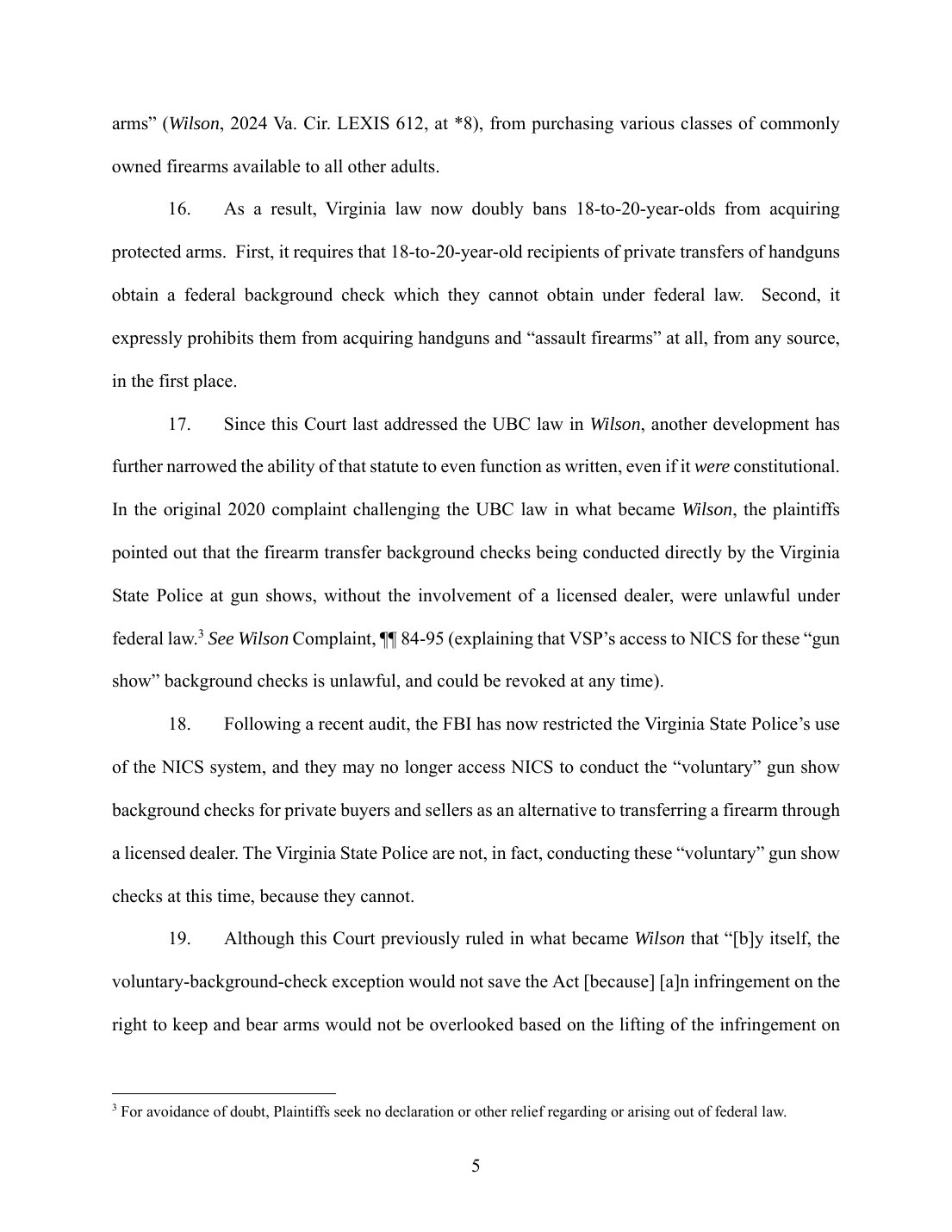
Page 5 of the Boyer v. Katz complaint, filed Oct. 6, 2026 in Lynchburg Circuit Court, alleging the FBI cut off State Police gun show background checks. Read the full 62-page complaint with exhibits (PDF). (Court filing, public record)
Why a State Court and Not a Federal One?
The plaintiffs bring no Second Amendment claim at all. "Plaintiffs do not bring any claim or seek any relief under the Second Amendment to the U.S. Constitution," the complaint says. They sue only under the Virginia Constitution, which has said since 1776 that "a well regulated militia, composed of the body of the people, trained to arms, is the proper, natural, and safe defense of a free state," and since 1971 that "the right of the people to keep and bear arms shall not be infringed."
The reason is the Fourth Circuit. As Bearing Arms' Cam Edwards noted, a federal suit would run into two Fourth Circuit decisions upholding the federal under-21 handgun sales ban and Maryland's assault weapons ban. Lynchburg's circuit court has already ruled for young adults twice. That is a far friendlier room.
Washington, meanwhile, has moved the other way. The Justice Department's Office of Legal Counsel concluded in September that the federal ban on dealer handgun sales to 18-to-20-year-olds is unconstitutional, which we covered here. That opinion does nothing to a state law, so Virginia's ban stands on its own.
This Is Not the Assault Weapons Case
Footnote 6 of the complaint draws a line. The plaintiffs are not challenging Virginia's general limits on "assault firearms." Those are already blocked by preliminary injunctions in two other state cases, Crump v. Katz in Lancaster County (June 30) and Santolla v. Katz in Washington County (June 29), the complaint says. The ask here is narrower: "whatever the rule is with respect to 'assault firearms' for adults ages 21 and older, it should be the same for adults ages 18 to 20."
The background check challenge is broader. The plaintiffs argue that requiring government paperwork on "every single firearm transaction in the Commonwealth" amounts to registration, and they ask the court to strike 18.2-308.2:5 for all adults, not just young ones.
What Happens Next
The plaintiffs filed for a temporary restraining order and preliminary injunction the same day, according to AmmoLand's review of the Gun Owners Foundation case page. Attorney General Jones has yet to respond in court. Edwards wrote that he would not expect a ruling on the injunction request before the end of the year.
Whatever the judge decides on the history, the text of Chapter 1102 is already settled. The legislature knew how to write an exception for the men and women who carry guns in uniform. It wrote one, and it pointed it at 17-year-olds. Virginia's 18-to-20-year-olds in uniform got nothing, and two college students from Lynchburg are now asking a judge to fix what Richmond would not.
Top photo: Gov. Abigail Spanberger (D-Va.) in her official portrait as a member of the 118th Congress. Spanberger signed HB 1525 into law in April 2026. (U.S. House of Representatives, public domain, via Wikimedia Commons)