The Justice Department told the country on September 18 that a federal felony on the books since 1968 no longer applies: licensed dealers can sell a handgun to a law-abiding 18, 19, or 20-year-old, and the Department will not prosecute them for it. The Office of Legal Counsel's opinion doesn't tweak the rule or carve out an exception. It says the ban was unconstitutional the whole time.
What the Justice Department Actually Said
The opinion, signed by Assistant Attorney General T. Elliot Gaiser and addressed to Attorney General Todd Blanche, concludes that 18 U.S.C. § 922(b)(1) and (c)(1), the provisions barring federally licensed dealers from selling handguns or handgun ammunition to anyone under 21, cannot be enforced against 18-to-20-year-olds without violating the Second Amendment. Gaiser didn't soften it in the Department's press release: "Eighteen-year-olds may vote, serve on juries, be drafted, and face adult criminal penalties, including capital punishment. The Constitution protects the people's right to keep and bear arms. The Department of Justice may not constitutionally seek to impose criminal penalties on dealers who sell handguns to law-abiding adults who, in nearly every other relevant respect, are members of the political community."
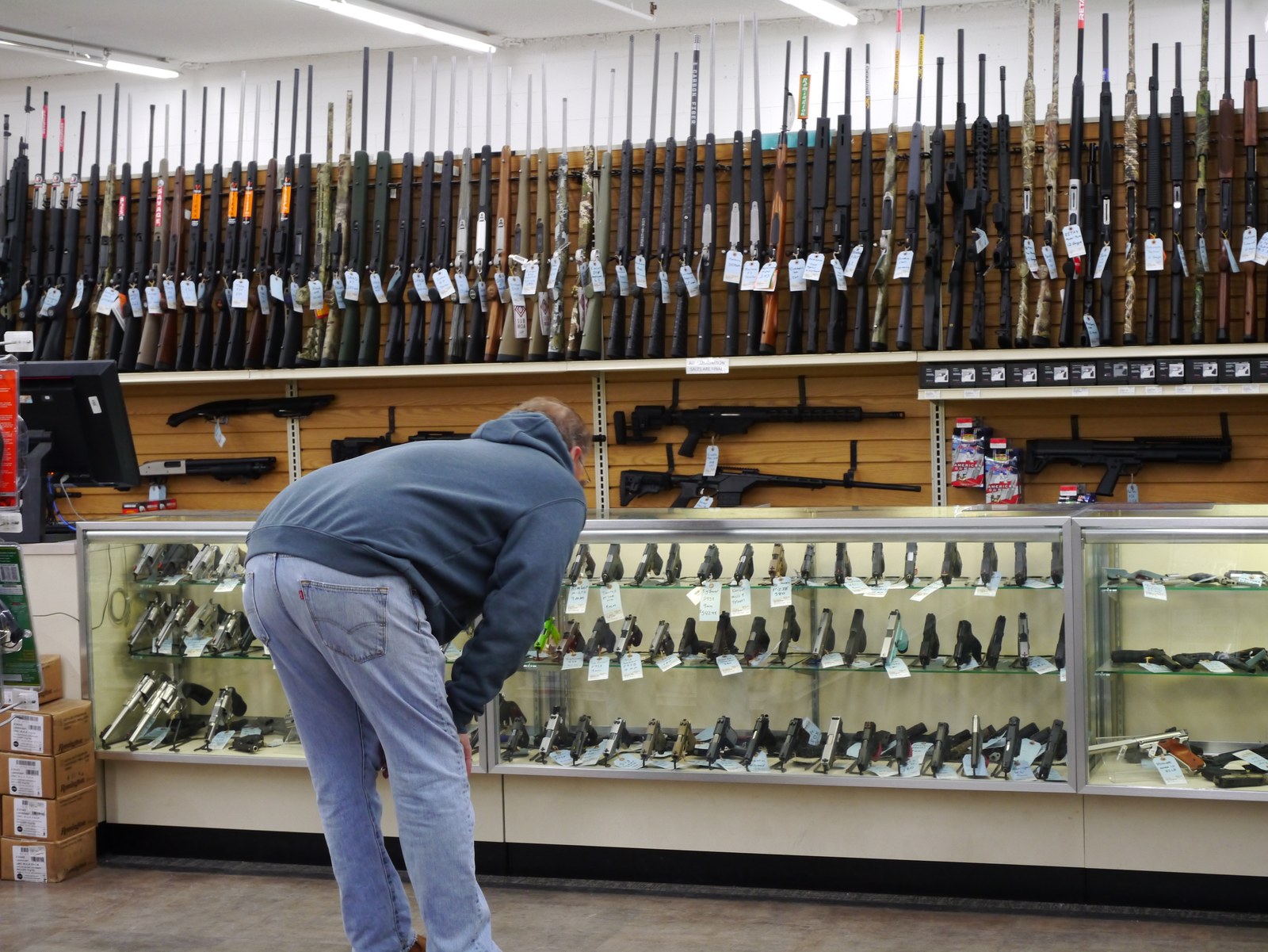
Federally licensed dealers, not private sellers, are the ones bound by the age restriction the Justice Department just said cannot be enforced against 18-to-20-year-olds. (Thayne Tuason/Wikimedia Commons, CC BY-SA 4.0)
The opinion is blunt about the age of the law it's dismantling. It walks through the actual statutory text Congress wrote into the Omnibus Crime Control and Safe Streets Act of 1968, which declared that "the ease with which" handguns reached "juveniles without the knowledge or consent of their parents or guardians" was "a significant factor in the prevalence of lawlessness and violent crime." That reasoning has sat unchallenged inside federal law for 58 years. It won't be enforced by this Justice Department anymore.
"Mature Enough to Be Drafted, Vote, and Be Sentenced to Death"
The opinion opens with a specific, almost personal example instead of an abstract legal standard. It describes an 18-year-old who represented the United States at the 2020 Tokyo Olympics in skeet shooting, then notes that it would have been a federal felony for a licensed dealer to sell her a handgun before she left for the Games or after she came home to finish her studies at the University of Texas at Arlington. The opinion's own words: "Our laws deem an eighteen-year-old 'mature enough to be drafted, vote, serve as a juror, and be sentenced to death.'"
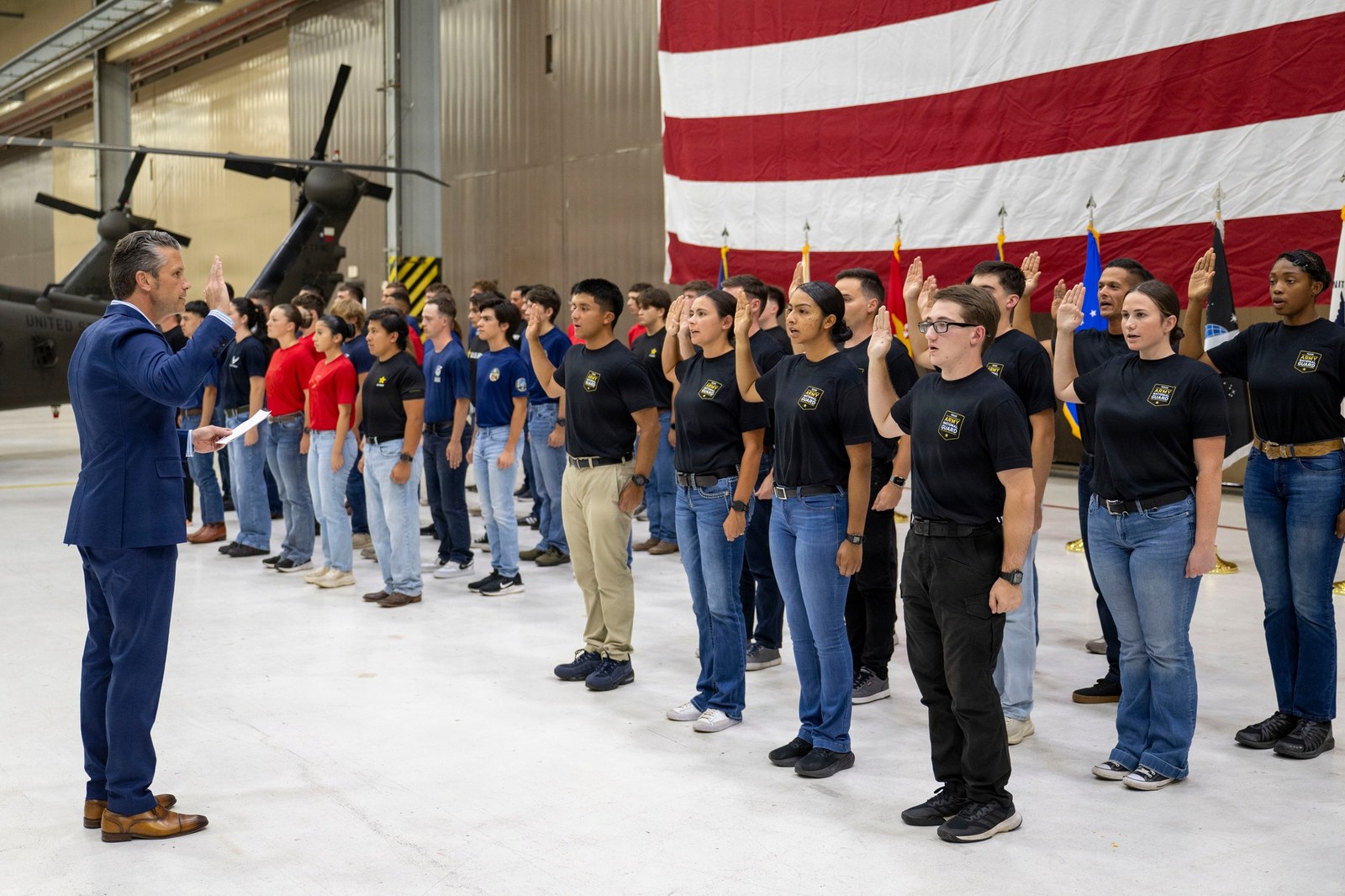
Secretary of War Pete Hegseth swears in future service members, several of them 18 to 20 years old, at Austin Armed Forces Reserve Center on September 18, 2026, the same day the OLC opinion came out. (DoW photo by Petty Officer 1st Class Eric Brann/DVIDS, public domain)
That's the core of the Department's legal argument, not just its rhetoric. The opinion goes back through Founding-era militia statutes and finds that 18-year-olds were overwhelmingly expected to enroll and show up already carrying their own weapons. A narrow exception barring minors from serving as constables existed, the opinion notes, but it excluded the elderly, clergy, attorneys, and physicians too. It was about who ran the militia call-up, not who was trusted to own a gun.
Official record
Application of 18 U.S.C. § 922(b)(1) and (c)(1) to Young Adults, 50 Op. O.L.C. __ (Sept. 17, 2026), Office of Legal Counsel, U.S. Department of Justice.
"Because the modern federal age restrictions limit young adults between the ages of eighteen and twenty from obtaining arms, they 'fall[] within the plain text of the Second Amendment' and are 'presumptively unconstitutional.' ... We conclude only that section 922(b)(1) and (c)(1) may not be enforced to impose criminal penalties on dealers who sell handguns, the 'quintessential self-defense weapon,' to a class of law-abiding adults who in nearly every other domain are full members of the political community." — T. Elliot Gaiser, Assistant Attorney General, Office of Legal Counsel
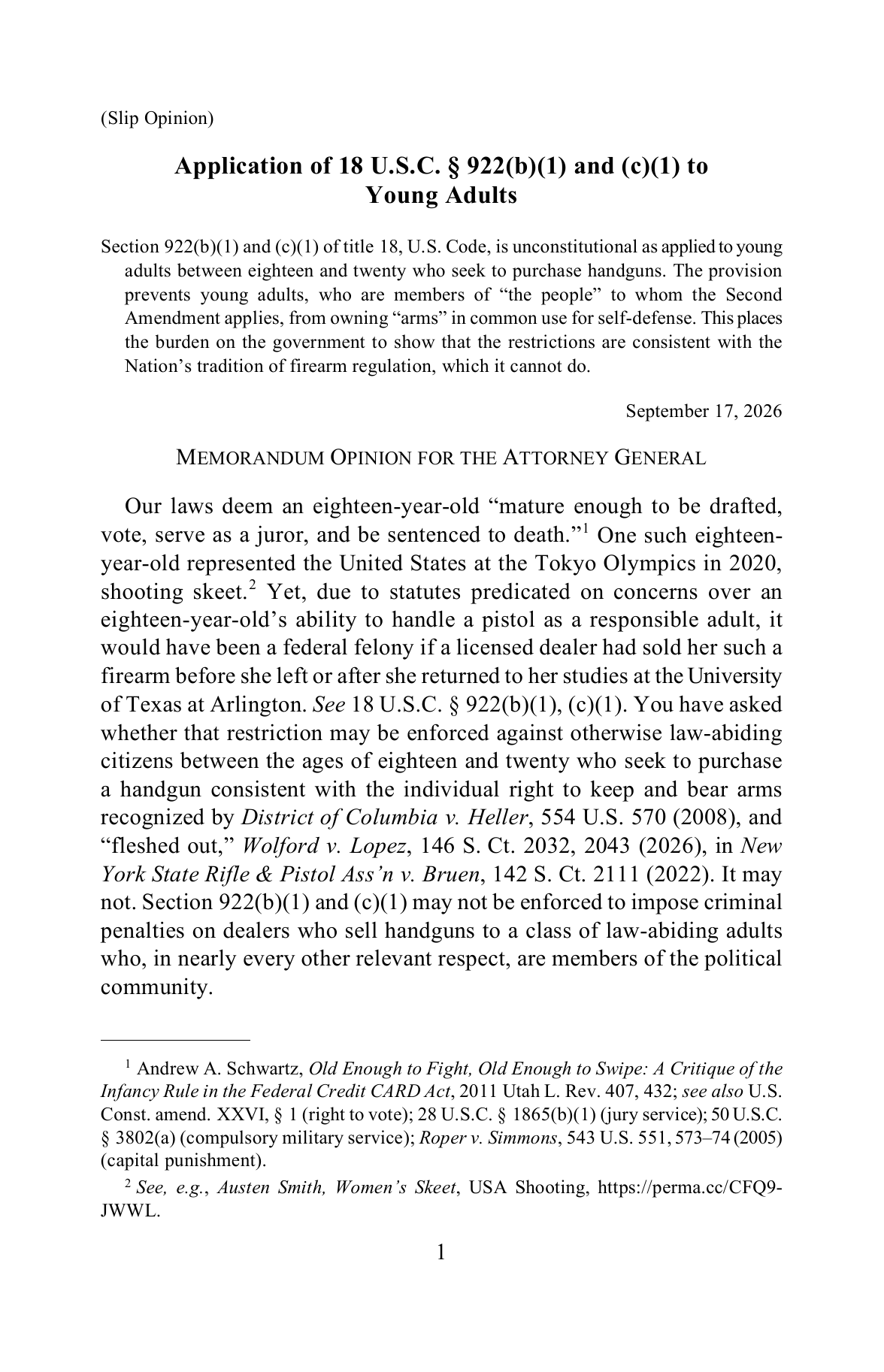
Read or download the full 49-page opinion (PDF) · issued by the Office of Legal Counsel
Federal Courts Have Been Split on This for Years
The Justice Department isn't inventing a new legal theory out of nothing. The opinion leans hardest on Reese v. ATF, a Fifth Circuit decision that already struck down these same federal age restrictions. It stacks that against rulings the other way: the Fourth Circuit upheld the federal restrictions, and the Tenth and Eleventh Circuits upheld similar state-level age limits in Colorado and Florida. Meanwhile the Third and Eighth Circuits have ruled against comparable state rules. Gaiser's opinion argues that the courts that upheld the age limits got the analysis wrong under the framework the Supreme Court laid out this year in Wolford v. Lopez, and that OLC isn't bound to follow a circuit split when advising the Attorney General on what the Justice Department itself will enforce.
That's an important distinction to sit with. An OLC opinion doesn't overturn a statute, doesn't bind any court, and doesn't create precedent anyone else can cite. What it does is tell federal prosecutors how the Department views the law, and federal prosecutors tend to listen. The opinion states plainly that Section 922(b)(1) and (c)(1) "may not be enforced to impose criminal penalties on dealers" in this age bracket, which as a practical matter means a licensed dealer who sells a handgun to a 19-year-old customer isn't going to face a federal case brought by this administration.
Not Everyone's Cheering
Gun control groups reacted within hours. GIFFORDS Executive Director told CBS News the decision was "the latest move by the Trump administration to refuse to defend the law to please the gun lobby," adding: "This is yet another illegal and dangerous action by the Trump administration to please their gun lobby CEO donors. People ages 18 to 20 are responsible for a disproportionate share of school shootings, public mass shootings, and gun homicides overall. There is a reason minimum age laws exist. We will do everything we can to fight this."
The opinion doesn't leave that argument unaddressed, though it answers it with constitutional analysis rather than a policy rebuttal. Gaiser writes that the government carries the burden of showing the restriction matches the nation's historical tradition of firearm regulation, and concludes flatly that it "cannot do" so. The opinion also draws careful lines around what it isn't deciding: it doesn't touch the ban on handgun possession by anyone under 18, doesn't address the extra background-check waiting period Congress set for buyers under 21, and doesn't cast any doubt on the felon-in-possession law the Supreme Court recently upheld.
The Same Day, a Second Win in the Fifth Circuit
The OLC opinion landed the same day a three-judge Fifth Circuit panel handed gun-rights groups a separate victory, striking down the federal ban on direct interstate handgun sales in Elite Precision Customs v. ATF. That 2-1 ruling, covered in depth by RedState and Bearing Arms, is a different case built on a different legal theory, but it lands in the same week the Justice Department confirmed it won't appeal the Fifth Circuit's earlier ruling deregulating suppressors and short-barreled rifles under the National Firearms Act. Three separate fronts, one pattern: this Justice Department keeps siding with gun owners over the government's own historical restrictions when a court, or its own lawyers, tells it the history doesn't hold up.
What Changes for an 18-Year-Old Walking Into a Gun Store
Nothing changes in the statute books tomorrow morning. Section 922(b)(1) and (c)(1) are still sitting in the U.S. Code exactly as written, and a dealer in a state with its own stricter age law is still bound by that state's rule regardless of what OLC concluded about the federal one. What has changed is enforcement risk. A federally licensed dealer who sells a handgun to an otherwise law-abiding 18, 19, or 20-year-old customer is not going to be the target of a federal prosecution brought by this Department of Justice, because the Department's own top legal office has now said, in writing, that doing so would be unconstitutional.
Whether that holds is a question for the next administration, the next OLC memo, or eventually the Supreme Court, which has so far declined to resolve the circuit split GIFFORDS and gun-rights groups keep fighting over. For now, an 18-year-old who can vote for president and get drafted into a war can also walk into a gun store and buy a handgun, without the dealer risking a federal felony charge for selling it to her.