Treasury's July statement shows $931 billion of net interest in ten months of fiscal 2026, or 39 cents of every individual income tax dollar collected. That is not a think tank projection. It is a line in the government's own monthly ledger, and it is the fastest-growing thing Washington buys.
Scott Bessent has spent the summer telling anyone who will listen that the number does not matter much. When the gross debt crossed $40 trillion in August, the Treasury Secretary told CNBC's Sara Eisen that "there's nothing magic about the $40 trillion number," and added, "we can grow our way out of that," per Fortune's account of the interview. On Wednesday he starts spending real money to make the bond market agree.
What Treasury's own July statement actually says
Table 9 of the July 2026 Monthly Treasury Statement puts net interest at $931,356 million through ten months of fiscal 2026, against $840,760 million for the same ten months a year ago. That is up 10.8 percent, and it works out to about $3.06 billion a day across 304 days.
Set it beside the rest of the budget. National defense over those same ten months was $803,702 million, so interest beat the entire defense function by $127.7 billion. Medicare was $954,525 million, putting interest within $23.2 billion of passing that too. Divide $931,356 million by the $2,368,957 million of individual income taxes collected and you get 0.393. Thirty-nine cents on the dollar, before a single soldier is paid.
Official record
Monthly Treasury Statement of Receipts and Outlays of the United States Government, July 2026, Bureau of the Fiscal Service. Table 9, page 37.
"Net Interest · 104,159 · 931,356 · 840,760" — July 2026 Monthly Treasury Statement, Table 9 (in $ millions: current month, fiscal year to date, comparable prior-year period)
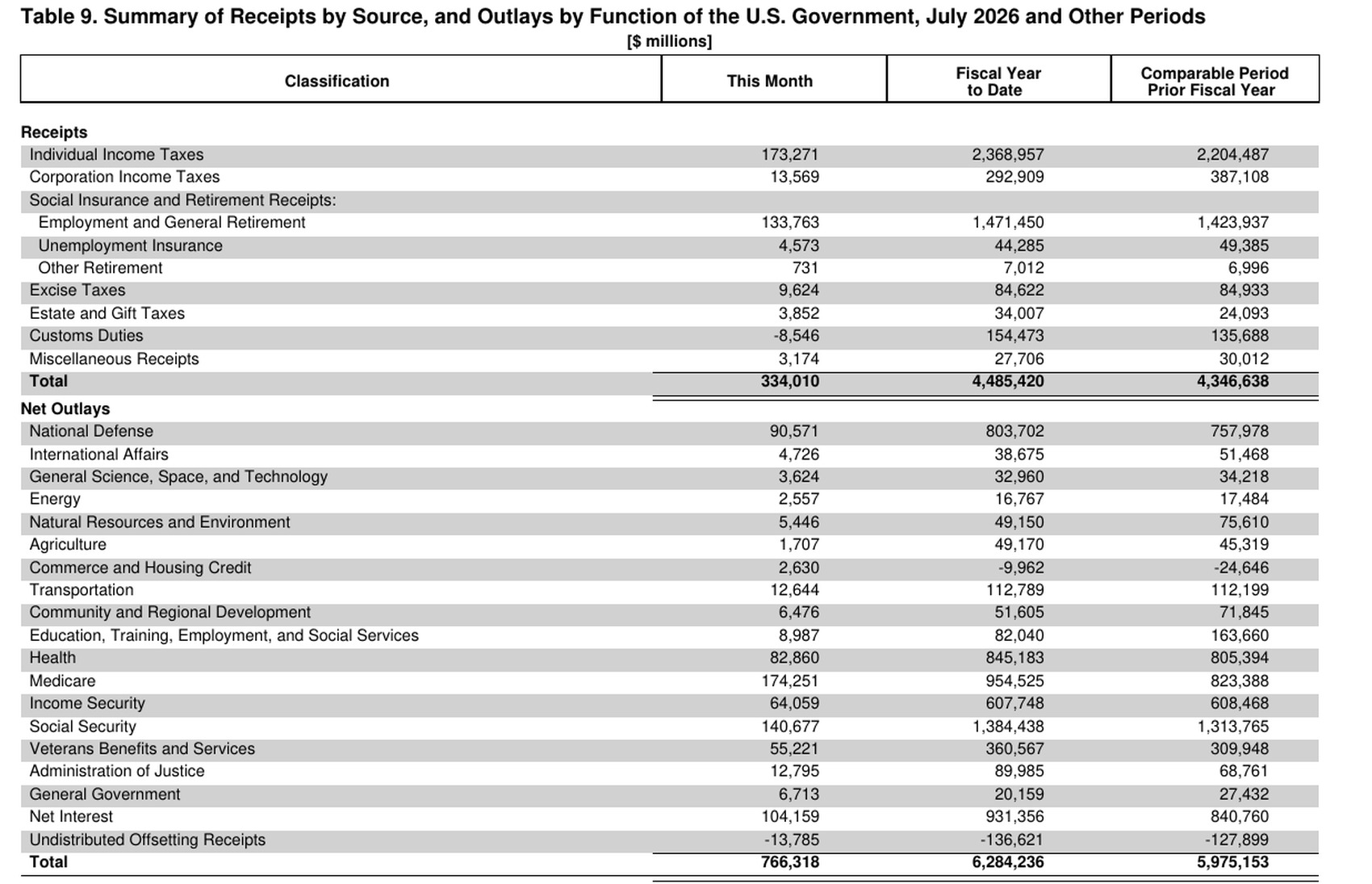
Read or download the full 39-page statement (PDF) at Treasury's Fiscal Data site.
Why does the bill climb when short-term rates fell?
Here is the part almost nobody is writing about. Over the past year the interest Treasury pays on its bills went down, and the total interest bill went up anyway.
Treasury's average interest rate series shows bills at 3.788 percent on Aug. 31, 2026, down from 4.283 percent a year earlier. Notes went the other way, 3.087 percent to 3.345 percent. Bonds went 3.311 to 3.453. The whole marketable book rose from 3.415 percent to 3.475 percent. Short money got half a point cheaper and the average cost of the debt still went up.
The interest expense data says it in dollars. Through eleven months of fiscal 2026, bills cost $231.8 billion, down 7.2 percent, even though the pile of bills outstanding grew by $879 billion. Notes cost $463.4 billion, up 17.3 percent. Bonds cost $164.3 billion, up 13.3 percent. Eleven months of fiscal 2026 have now cost $1,267.8 billion, more than the $1,220.0 billion Treasury paid across all twelve months of fiscal 2025.
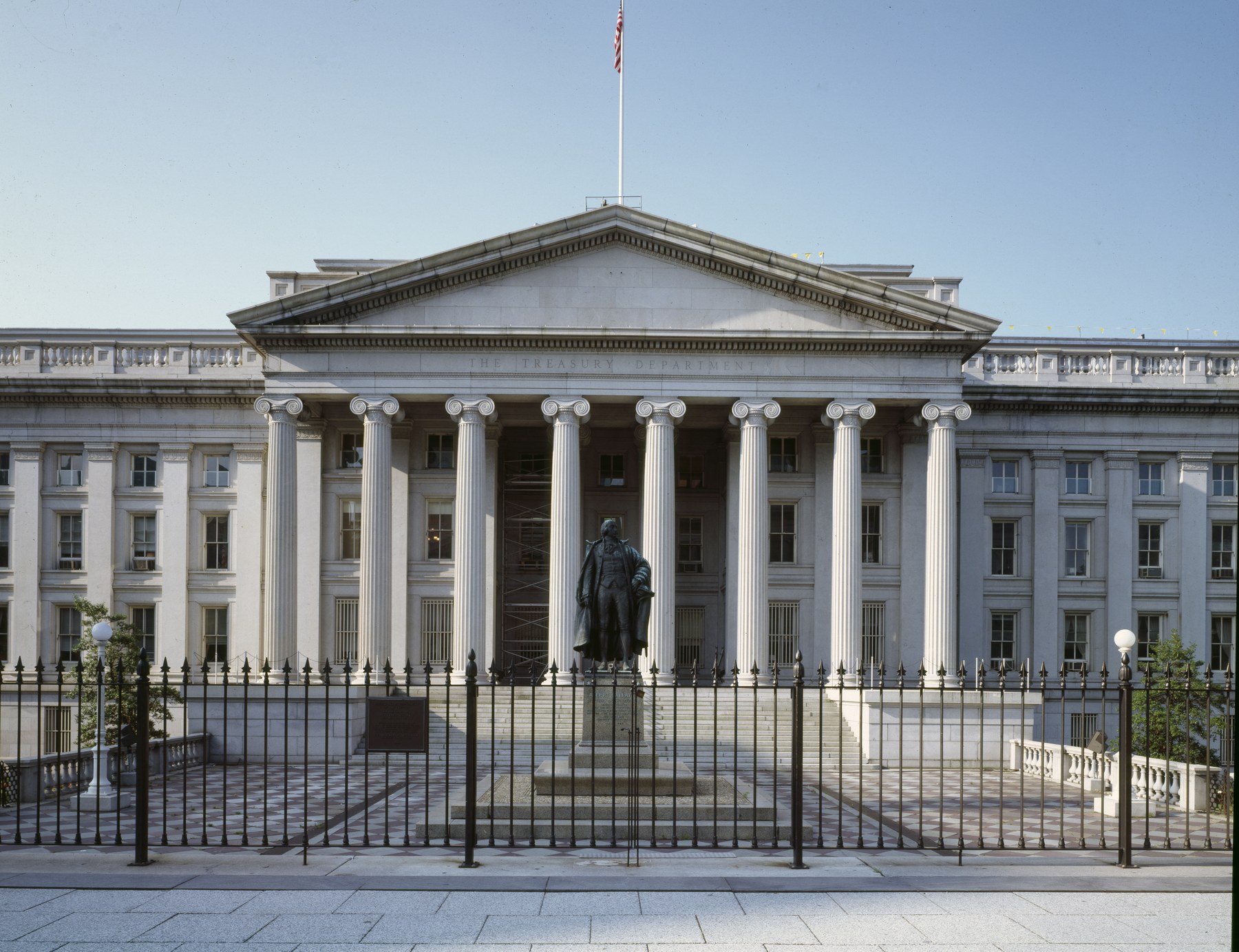
The U.S. Treasury Department building in Washington, D.C. Photo by Carol M. Highsmith, Library of Congress, via Wikimedia Commons (public domain).
The reason is maturity. A Treasury bill reprices inside a year, so the Fed's cuts already show up in what bills cost. The $16.2 trillion note book does not work that way. It still carries coupons set in 2020 and 2021, and it rolls over a slice at a time. A new 10-year note priced at 4.78 percent on Sept. 4, per Treasury's daily par yield curve. The existing note book averages 3.345 percent. Closing that 143 basis point gap across $16.2 trillion is $233 billion a year in added interest, and it happens whether Congress passes anything or not.
Wednesday's buyback has already been tested once
On Aug. 19 Treasury announced that buyback operations in the 10-to-20-year and 20-to-30-year sectors go from $2 billion to "at least $4 billion per operation," effective Sept. 9 through Nov. 4. Treasury's own release calls the purpose "greater liquidity support," not debt reduction. Hold onto that. These operations do not retire debt. Treasury reissues.
The market already answered. The 30-year yield opened 2026 at 4.86 percent, peaked at 5.31 percent on Aug. 17, then fell to 5.19 percent on Aug. 19 when the buyback news landed. Nine basis points. By Sept. 4 it had drifted back to 5.24 percent, so eleven trading sessions bought four basis points of durable relief. Bessent told Eisen, "we have a big toolkit, so we will see."
Can Washington actually grow its way out?
Give the man his due, because for one quarter the arithmetic worked. BEA's second estimate put current-dollar GDP growth at an 8.0 percent annual rate in the second quarter. Total federal debt went from $39.0654 trillion on March 31 to $39.4624 trillion on June 30, a 4.1 percent annual rate. The denominator outran the numerator.
Now look at how. Real GDP grew 1.5 percent. Divide 1.080 by 1.015 and you get 1.064, so roughly six and a half of those eight points were prices rather than output, and BEA's gross domestic purchases price index rose 5.8 percent in the quarter. That is the growth doing the work in "we can grow our way out of that," and it is the same growth showing up on your receipt. Across the full year to Sept. 3 the debt still rose 7.2 percent, from $37.4127 trillion to $40.1030 trillion. We covered the $40 trillion crossing last month.
One number going around does not survive a check
Fortune reported Monday that interest payments have risen to "$1.25 trillion a year," citing a Doubleline finding that fiscal 2025 net interest hit 18.5 percent of federal revenue, past the 18.4 percent record set in 1991. The ratio checks out exactly: $970.4 billion of net interest against $5,234.6 billion of receipts is 18.54 percent. But 18.5 percent of revenue is $970 billion, not $1.25 trillion. The bigger figure is closer to gross interest expense on all Treasury securities, which is a different measure. Both are real. They are not the same number.
The borrowing is not buying anything
Run it forward. If the last two months of this fiscal year follow the seasonal shape of fiscal 2025, net interest lands near $1.075 trillion, the first trillion-dollar interest year in American history. It is already 20.76 percent of receipts through July, up from 19.34 percent at the same point last year, and 51.8 percent of the $1,798.8 billion deficit.
CBO's February 2026 outlook reaches the same place from the other direction. The primary deficit, meaning everything except interest, runs 2.6 percent of GDP in 2026 while net interest runs 3.3 percent. More than half of what Washington borrows this year buys nothing at all. It pays for having borrowed before. Bessent can double the buybacks again in November, and the note book will keep repricing underneath him at four and three-quarters.