Washington's Supreme Court ruled 5-4 in June that two DUI convictions in seven years can cost you your guns. A week later the U.S. Supreme Court threw out a gun ban built on old "habitual drunkard" laws. On Friday the justices will decide whether to take up Washington's case, and the Court's own footnote suggests neither side should be too sure how that goes.
What did Washington's court actually decide?
The case is McLellan and Holloway v. Brown, No. 103799-6, filed June 11, 2026. Under the opinion, state law temporarily bars gun possession for anyone convicted of DUI twice within seven years. The ban can be lifted by petition after five years of law-abiding behavior. Geoffrey McLellan had three DUI convictions in seven years and Jackson Holloway had two. Both applied for concealed carry permits and were denied.
The trial court did not throw out the law, but it also refused to rule for the state on the pleadings. It wanted facts on whether each man "poses a credible threat to public safety," the Rahimi standard. The state asked the Supreme Court to step in, and Justice Gonzalez wrote that the question could be settled as a matter of law, "without an individualized assessment of each person's dangerousness."
Official record
McLellan and Holloway v. Brown, Washington Supreme Court, No. 103799-6 (June 11, 2026), 21 pages of majority and dissent.
"None of these traditions in isolation might be sufficient to justify disarming recidivist DUI offenders like McLellan and Holloway, but we do not consider our nation's historical traditions in isolation." — Justice Gonzalez, majority opinion
"RCW 9.41.040(2)(a)(i)(D) is an outlier. It violates the respondents' constitutional rights under the Second Amendment to the U.S. Constitution." — Justice Whitener, dissent
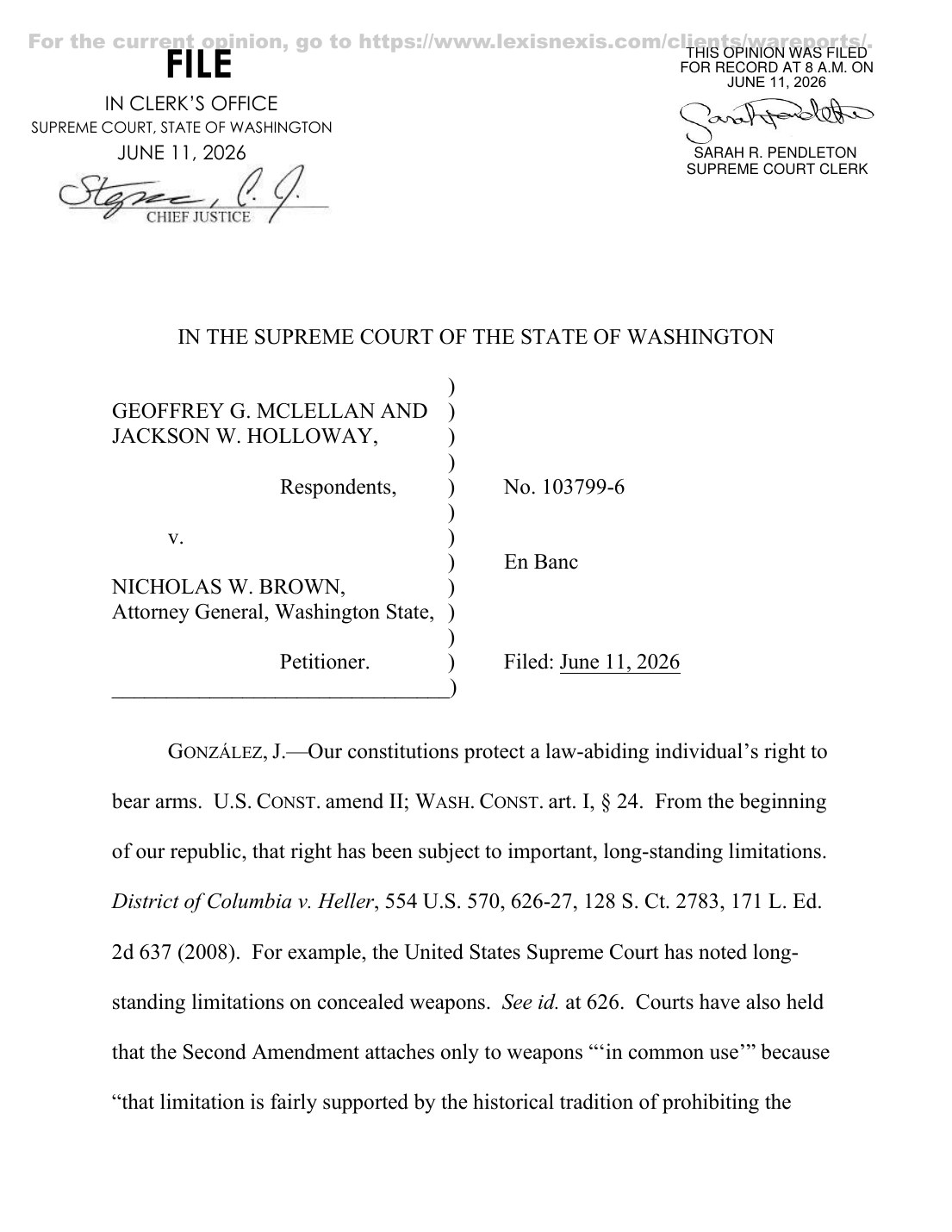
Read or download the full opinion (PDF) · original on courts.wa.gov
Who was in the 5-4 majority?
I checked the signature pages. Gonzalez wrote for himself, Chief Justice Stephens, Justice Melody, Justice Montoya-Lewis and Justice Madsen, who sat as a justice pro tempore. Justices Whitener, Johnson, Gordon McCloud and Mungia dissented. The majority did not claim a history of disarming drinkers. It said no single tradition was enough and stacked three together: disarming groups the legislature deems dangerous, disarming people convicted of serious crimes, and limiting guns for people who abuse alcohol.
That stacking is the part gun-rights lawyers will attack. The dissent says the founding-era record is "limited to preventing violent behavior by people who were individually found to be dangerous," and a repeat DUI is a dangerous but nonviolent offense. The majority's answer, in a footnote, is that a drunk driver's conduct has "a plausible link to physical violence."
What did the U.S. Supreme Court say a week later?
In United States v. Hemani, decided June 18, the justices affirmed the dismissal of a federal charge against a Texas man who admitted using marijuana about every other day. Justice Gorsuch wrote for seven justices. Justices Alito and Kagan agreed with the result in a separate opinion. The government had pointed to historical "habitual drunkard" laws, and the Court rejected the comparison: those laws "targeted different kinds of people, did so for different purposes, and operated in different ways."
Washington's court knew this was coming. Its own footnote 7 notes that Hemani was pending. Holloway's lawyers point out that the court released its opinion on June 11 anyway.
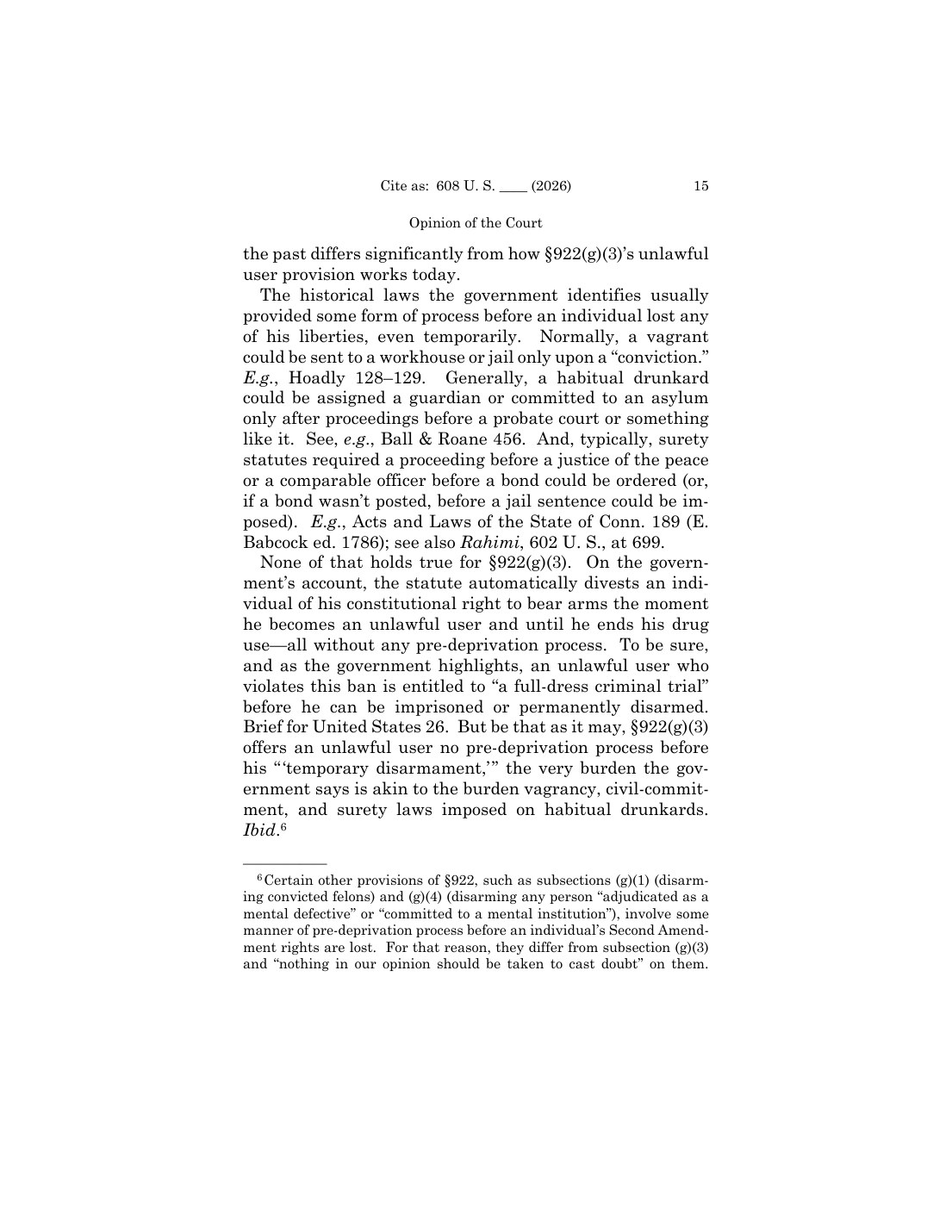
Page 15 of the Hemani opinion, including footnote 6. U.S. Supreme Court opinions are public records.
Does Hemani sink Washington's law, or save it?
Both camps can quote it. Hemani held that the old drunkard laws usually came with process: a conviction, a probate hearing or a bond proceeding. The federal drug-user ban worked "without any pre-deprivation process." Footnote 6 then says provisions such as the felon ban, which "involve some manner of pre-deprivation process," differ from the drug-user ban, and that "nothing in our opinion should be taken to cast doubt" on them. A DUI ban that follows a criminal conviction looks closer to that side of the line.
The syllabus also says the decision does not reach laws against people "presently intoxicated," addicts, or felons. UNC law professor Marcus Gadson wrote on July 8 that "Holloway could be on a collision course with Hemani." His point is that once convicted, a Washington driver gets "no individualized hearing" on gun risk. He called it a closer question than Hemani, since the state allows restoration after five years. Nobody on the Court has said which reading is right, because the Court has not yet looked at the case.
What happens Friday?
Holloway, not McLellan, took the case up. His petition asks one question: does a total gun ban after a second DUI within seven years violate the Second Amendment? It concedes Hemani is "not dispositive" because it did not involve a conviction, and argues the Court should not simply send the case back for another look, since Washington decided knowing what was coming.
The docket for No. 26-300 shows Washington's attorney general waived a response on Oct. 8 and the petition was distributed on Oct. 14 for the Nov. 6 conference. As of my check, the Court had not requested a response. The Duke Center for Firearms Law's weekly tracker counts 24 firearms petitions on that conference list. The Court has turned away other conviction-based challenges, and Holloway's petition suggests why: those petitioners had all been convicted of felony-level offenses, which the Court has called presumptively lawful grounds for disarmament. Holloway's predicate offenses are misdemeanors.
Why a state court election matters here
Five of the nine Washington Supreme Court seats are on Tuesday's ballot, KUOW reports. Chief Justice Stephens and Justice Melody, both in the majority, are running. Justice Montoya-Lewis is not seeking another term, and Madsen retired in April, according to Wikipedia's election page. That page also lists dissenting Justice Johnson as ineligible to run because of the mandatory retirement age. KUOW's coverage does not mention guns at all, so no one should read the campaigns as a referendum on this case.
The state constitution is a separate issue. The opinion says the men "do not address the state constitution, and we do not consider whether article I, section 24 requires a different analysis." That question is still open for a future case. Washington's permit-to-purchase law, E2SHB 1163, takes effect May 1, 2027, and I found no filed lawsuit against it yet.
What I could not verify
I did not locate the Court's Nov. 2 orders list, so nothing here reflects any action on the petition. I could not open the Ammoland and Washington Times pieces on the state court election, so I did not rely on them. I also did not confirm how many of the 24 conference cases will be decided that day, or whether Holloway's petition is being held for another case.
Header photo: the Temple of Justice, home of the Washington Supreme Court, Olympia. Photo: Joe Mabel via Wikimedia Commons, CC BY-SA 4.0. Resized to 3:2.