

Headlines this week said a federal judge "blocked" immigration stops in Southern California. The 84-page order is narrower than that. It bars stops based on "racial stereotyping" in one federal district, it is preliminary, and the Justice Department has already gone to the Ninth Circuit.
What does the injunction actually order?
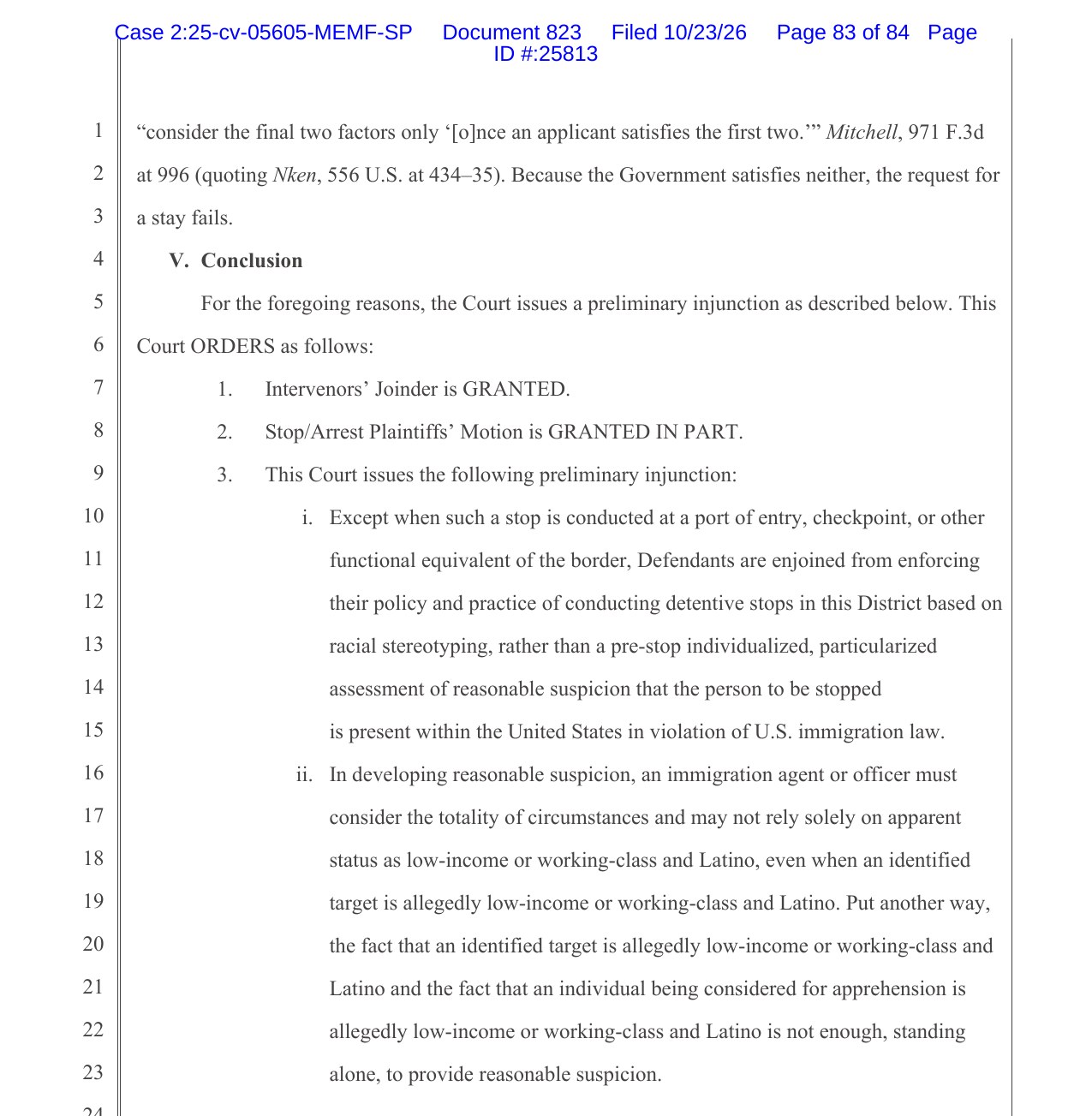
U.S. District Judge Maame Frimpong's order in Vasquez Perdomo v. Mullin, No. 2:25-cv-05605 (C.D. Cal.), was filed Oct. 23 and made public in redacted form this week. Its operative language is two short paragraphs on page 83. The first enjoins the government "from enforcing their policy and practice of conducting detentive stops in this District based on racial stereotyping, rather than a pre-stop individualized, particularized assessment of reasonable suspicion." Stops at a port of entry, checkpoint or "functional equivalent of the border" are carved out.
The second paragraph says agents "must consider the totality of circumstances" and "may not rely solely on apparent status as low-income or working-class and Latino." That is a ban on one shortcut. By its terms it does not halt immigration enforcement or stops where agents can point to specific facts about a specific person.
Official record
Amended Order Granting in Part Stop/Arrest Plaintiffs' Motion for Preliminary Injunction, Dkt. 823, Vasquez Perdomo et al. v. Mullin et al., No. 2:25-cv-05605-MEMF-SP (C.D. Cal., filed Oct. 23, 2026). Page 83 of 84 is shown below.
"Importantly, this Order is not a final decision on whether the Government is, in fact, following an unlawful policy. That question remains for later in this case." Order, page 3
Read the full 84-page order (PDF, hosted by the ACLU of Southern California)
What did the judge find, and what is still unproven?
At this stage, the court wrote, the plaintiffs "will likely be able to prove the Government does have a policy in the Los Angeles area of stopping people for immigration purposes just because they look Latino or because they look Latino and working class." The word "likely" matters. No trial has happened, and the court says so itself, in the passage quoted above.
Much of the finding rests on what the government did not file. The order says no evidence in the record refutes "the forty-five declarations from the individuals who were detained," and that the government "failed to provide evidence of a reasonable suspicion analysis regarding any one of the declarants." It also quotes recorded statements by agents, including one that reads, "Just plug us in wherever you see some tonks and we'll jump out."
The government sees it differently. DHS told reporters, in a statement posted by MyNewsLA, that its agents are focused on protecting Americans, "not entertaining performative outrage." At a September hearing, a DOJ attorney said the record was "the same" one the Supreme Court had already considered, according to the Los Angeles Times.
Why does the Supreme Court keep coming up?
Because the same judge, in the same case, was stopped once before. On Sept. 8, 2025, the Supreme Court stayed her earlier restraining order in Noem v. Vasquez Perdomo, No. 25A169, with no majority opinion. Justice Kavanaugh concurred on his own.
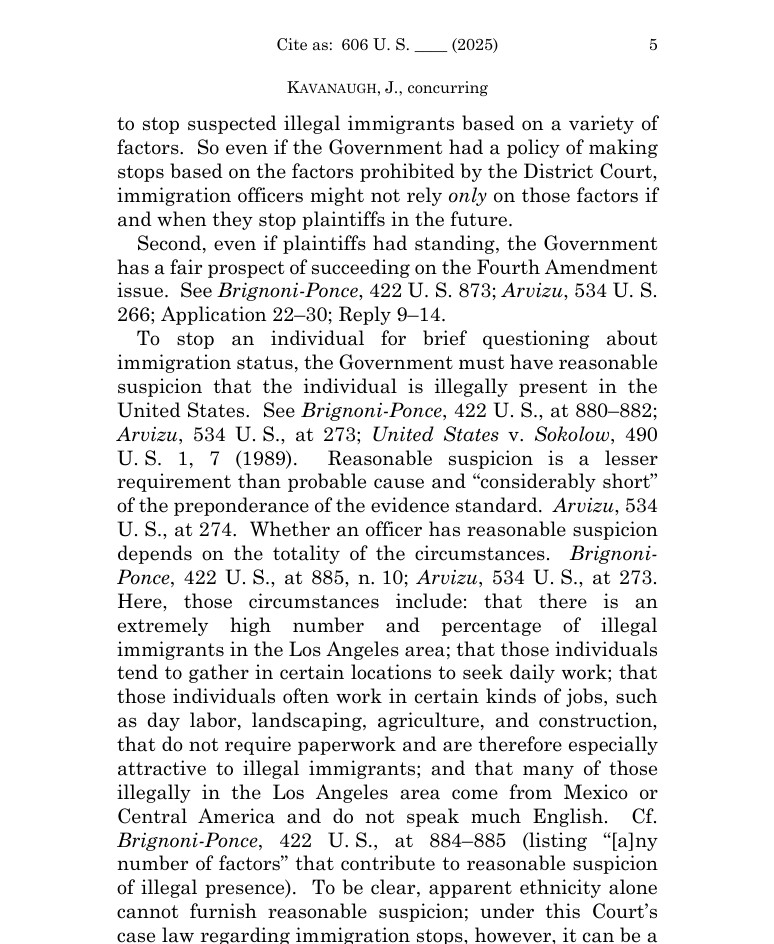
Page 5 of Justice Kavanaugh's concurrence in Noem v. Vasquez Perdomo (Sept. 8, 2025); the sentence at the bottom continues on page 6. Source: Supreme Court of the United States (public domain). Cropped.
His concurrence, citing a government estimate, said about 10 percent of the Los Angeles region's 20 million people are in the country illegally. He wrote that "apparent ethnicity alone cannot furnish reasonable suspicion" but "can be a 'relevant factor' when considered along with other salient factors." DHS has pointed to that opinion as support for its practices, the Times reports.
Judge Frimpong's answer is on page 53. A concurrence "has no precedential value," she wrote, and it "does not unsettle the binding Ninth Circuit" law. She leans on United States v. Montero-Camargo, where the Ninth Circuit wrote that Hispanic appearance has "such little probative value that it may not be considered as a relevant factor where particularized or individualized suspicion is required." Those two statements point in different directions. Which one governs is the question the appeal will test.
What happens next?
The court refused two requests from the government: a bond from the plaintiffs, and a 14-day pause. On the bond, it found the government offered "no evidence" of costs. On the pause, it said the request "falls far short" of the standard for an "extraordinary" remedy.
The Los Angeles Times reports that the Justice Department filed a notice of appeal with the Ninth Circuit on Wednesday, Oct. 28, and asked for a stay pending appeal, with DOJ's August Flentje arguing the injunction "gravely hinders the government's ability to conduct immigration stops." I could not find the Ninth Circuit docket, so I cannot say whether a stay has been ruled on. If the Supreme Court is asked again, it will decide whether this record changes anything after granting the government an interim stay last year.
For readers, the plain version is this. The injunction covers the Central District of California, which includes seven counties, it is interim, and its text bars reliance on appearance alone, not enforcement itself. The fight over how much weight appearance can carry is a legal one, and it has now reached its second round.
Header photo: The U.S. Supreme Court building, Washington, D.C. Photo: Carol M. Highsmith, Library of Congress, no known restrictions on publication. Cropped. File photo, not from the Los Angeles case.















