

A federal judge in San Francisco ordered the Justice Department and Homeland Security on Friday not to threaten election workers with prosecution over ballots cast by voters the government says are ineligible. CNN called it a "sweeping emergency order." The eight-page order is narrower than that, it was issued before DOJ filed a word in response, and it expires Nov. 16.
What did Judge Thompson actually order?
The case is Service Employees International Union v. Department of Justice, No. 3:26-cv-12800 in the Northern District of California. The plaintiffs are SEIU, AFSCME, the League of United Latin American Citizens and the NAACP. They named DOJ, Attorney General Todd Blanche, DHS and Secretary Markwayne Mullin. U.S. District Judge Trina Thompson signed a temporary restraining order on Oct. 30 under Federal Rule of Civil Procedure 65(b), which allows relief without notice when delay could cause immediate harm.
The order has six numbered parts. Four are prohibitions. The government may not threaten, intimidate or coerce election officials to halt processing a registered voter's ballot "solely on the basis that the ballot belongs to an individual alleged by Defendants to be ineligible to vote." It may not demand that officials remove specific voters from rolls, refuse them ballots or segregate their ballots on that same basis. And it may not threaten prosecution for refusing those demands or for counting ballots "in compliance with state and federal laws."
Official record
SEIU v. U.S. Department of Justice, No. 26-cv-12800-TLT (N.D. Cal.), Order Granting Temporary Restraining Order, Dkt. 26, filed Oct. 30, 2026. The operative language is on pages 6 and 7.
"When state and local government employees perform the work of distributing, processing, or counting ballots or otherwise administering the 2026 midterm election in the manner required by their state and federal laws governing the administration of elections, they do not violate federal criminal law even if a particular ballot belongs to a registered voter alleged by Defendants to be ineligible to vote." — Judge Trina Thompson, Order, p. 6
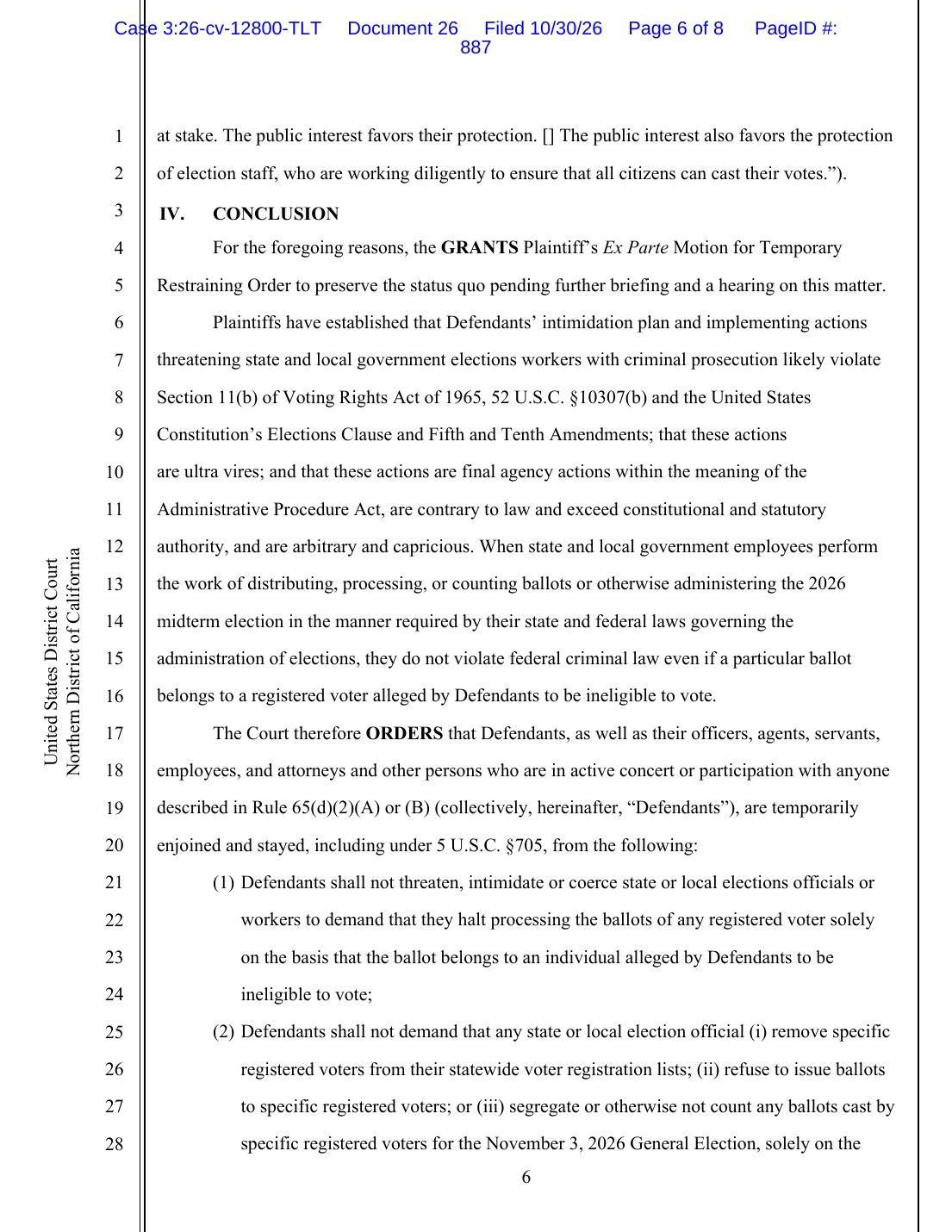
Read or download the full 8-page order (PDF), a copy of the filing as posted on DocumentCloud.
What does the order not do?
Read the qualifiers. Each prohibition turns on the words "solely on the basis" that a voter is merely "alleged" to be ineligible. Nothing in the text bars DOJ from investigating or prosecuting an actual noncitizen who votes, and nothing says a state may not remove a voter it has verified is ineligible. The order restricts demands and threats aimed at election workers. It does not quash any subpoena.
The sixth part cuts the other way for DOJ in a practical sense. The department must tell the court about "any pending search warrant applications, grand jury subpoenas, or other demands to access election materials or ballots" tied to its lists. The fifth part requires DOJ to notify every state or local government it wrote to that the demands in those letters "have been enjoined." By its terms the order is not limited to California, though the facts it recites come from California and Washington.
The judge also stopped short of a full merits ruling. She found the plaintiffs likely to win on a Voting Rights Act intimidation claim, 52 U.S.C. § 10307(b), and on an Elections Clause claim. On the Fifth Amendment and Administrative Procedure Act claims she wrote that, "given the urgency of the TRO," she did not find it necessary to analyze them "at this time."
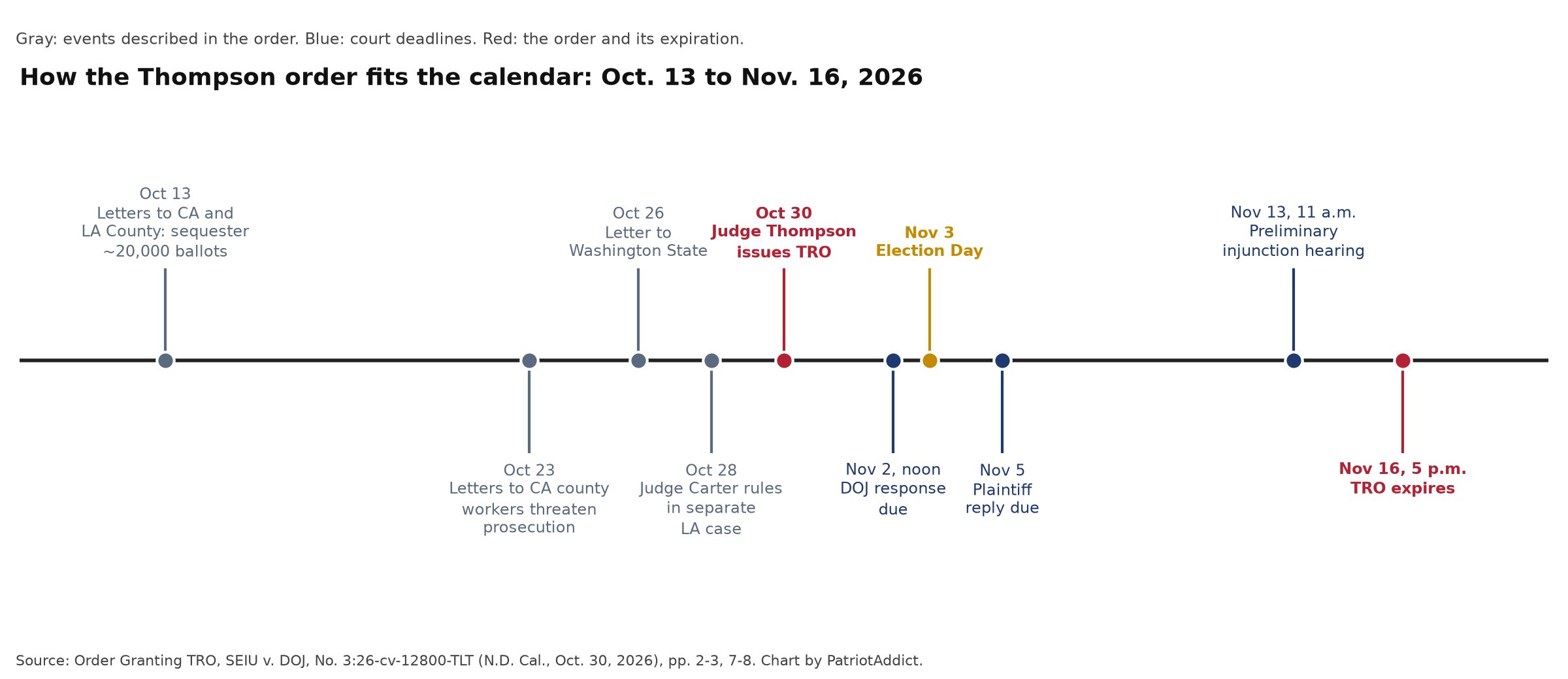
Dates taken from the order itself. Timeline built by PatriotAddict from the Oct. 30 order (federal court filing).
Whose facts are these?
This is the part most headlines skip. The order states that its background facts are "drawn from Plaintiffs' Ex Parte Motion for Temporary Restraining order and Complaint." DOJ had not answered. So the account of armed DHS officials delivering letters to California county workers on Oct. 23, grand jury subpoenas and an October criminal investigation of county election officials is the plaintiffs' account, adopted by the judge for purposes of a temporary order.
The order does cite a related ruling, and that one was contested. On Oct. 28, Judge David Carter in the Central District of California rejected DOJ's demand that California sequester ballots from about 20,000 voters officials say the department had flagged as likely noncitizens. The Ninth Circuit again turned down the administration on that Oct. 30, according to Al Jazeera. Those two rulings are separate cases from this one.
What does DOJ say?
A DOJ spokesperson told CBS News on Saturday that the judge issued an order "against the federal government without even waiting to hear from the United States," called it a "two-track system of justice," and said the department "is reviewing the order and evaluating all options." That is a fair procedural complaint. It is also what an ex parte order looks like by design. The judge found the Rule 65(b) test met "given the fast-approaching date of the Election," and set DOJ's answer for noon Monday, Nov. 2.
The administration's stated aim, per the judge's description of it, is stopping unlawful voting by noncitizens. Nothing in this order says that aim is illegitimate. What Judge Thompson held, at this early stage, is that threatening line-level election workers with federal crimes for following their own state's counting rules likely crosses a statutory line. Whether she is right gets tested Nov. 13 at 11 a.m., with the TRO set to lapse at 5 p.m. on Nov. 16, after the votes are cast.
What I could not verify
I read the full order but could not open CNN, Axios or Politico coverage, and I have no DOJ filing yet, so I cannot confirm any of the plaintiffs' allegations about armed DHS delivery or subpoenas beyond what the court recites. I also do not know whether DOJ has asked the Ninth Circuit to intervene. The order says the plaintiffs' reply is due Nov. 5, so more of the record will appear this week.
Header photo: the Phillip Burton Federal Building and United States Courthouse in San Francisco, home of the Northern District of California. Photo: Ken Lund via Flickr, CC BY-SA 2.0. Cropped and resized.















