At a Florida rally on Friday, President Trump said Republicans can afford a $5,000 check for every adult because "we've taken in massive amounts of money through tariffs." Treasury's own books say the tariff take is big but shrinking: $317.8 billion collected in fiscal 2026, $173.2 billion kept after refunds, which is 11% less than the year before.
What did the president actually say?
At his Oct. 30 rally in Daytona Beach, per the Roll Call Factba.se transcript, Trump promised that "if Republicans win the House of Representatives and the United States Senate, I am going to give all adult citizens in the United States $5,000." He added that a husband and wife would get $10,000, and that the money has to be spent in the United States.
Then came the funding explanation: "And only Republicans can do that because we're taking in massive amounts of money." A few lines later: "The $5,000 Trump dividend is approximately $1 trillion." The transcript does not say the checks would be paid from tariff revenue in so many words, but the "massive amounts of money" line is followed directly by "through tariffs and record-setting economic success." I am treating the tariff claim as his stated source of funds.
Official record
Rally remarks, Oct. 30, 2026, and the U.S. Treasury's Monthly Treasury Statement for September 2026 (Table 4, customs duties).
"But we've taken in massive amounts of money through tariffs and record-setting economic success." Donald Trump, Daytona Beach, Oct. 30
Fiscal 2026 customs duties: $317,804,367,753 gross, $144,585,753,110 refunds, $173,218,614,643 net. Treasury Fiscal Data, Monthly Treasury Statement, Table 4
Is the tariff money "massive"?
Partly, yes. Gross customs collections for fiscal 2026, which ended Sept. 30, were $317.8 billion. Fiscal 2025 was $202.4 billion and fiscal 2024 was $83.8 billion. Even after refunds, the $173.2 billion the Treasury kept is about 2.25 times the $77.0 billion it kept in fiscal 2024. Anyone who says tariffs raised real money has the data on their side.
The catch is the refund line. The Supreme Court struck down the emergency-powers (IEEPA) tariffs in February, and refunds to importers started in May. The Congressional Budget Office says the government collected about $166 billion under those tariffs and that most of it "will be refunded in fiscal year 2026." Treasury's table shows $134.4 billion going back out from May through September alone.
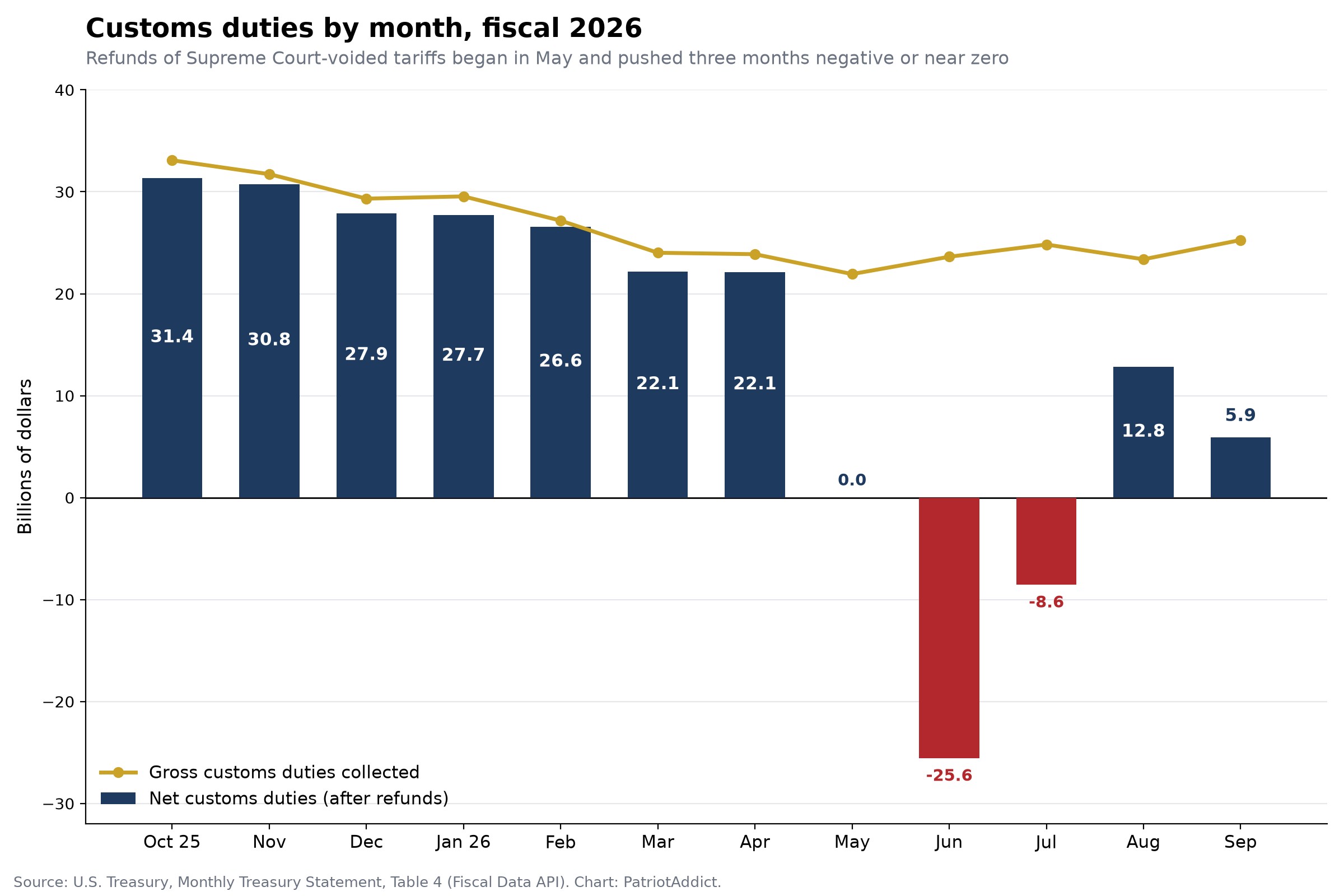
Gross and net customs duties by month, fiscal 2026. Chart built by PatriotAddict from Treasury Monthly Treasury Statement data (public domain U.S. government data).
What does "net" look like year over year?
Net customs duties were $173.2 billion in fiscal 2026 against $194.9 billion in fiscal 2025, a drop of $21.7 billion, or 11%. Gross receipts rose 57% over the same stretch. Refunds went from $7.5 billion to $144.6 billion.
June was the worst month: $23.6 billion collected and $49.2 billion paid back, for a net of negative $25.6 billion. July was negative too, at $8.6 billion below zero. By September, collections were $25.3 billion and refunds $19.4 billion, leaving $5.9 billion.
October looks lighter on refunds so far. Treasury's Daily Treasury Statement shows $26.6 billion of customs deposits through Oct. 29 and $8.7 billion in withdrawals through Customs and Border Protection. That daily line is cash accounting and covers all CBP payments, not only refunds, so it is a rough guide. The official October figure comes in the next monthly statement.
Does $1 trillion fit inside that?
Not close. At the fiscal 2026 net figure, $1 trillion is 5.8 years of tariff receipts. Suppose refunds end and collections hold near September's $25 billion a month, or about $300 billion annually. That is my own arithmetic, not a Treasury or CBO forecast, and it still means more than three years of every dollar tariffs bring in.
The federal deficit for fiscal 2026 was $1.99 trillion, according to Treasury's monthly statement summary. The dividend, at the president's own price, would equal about half of that. Checks sent without new revenue would be borrowed.
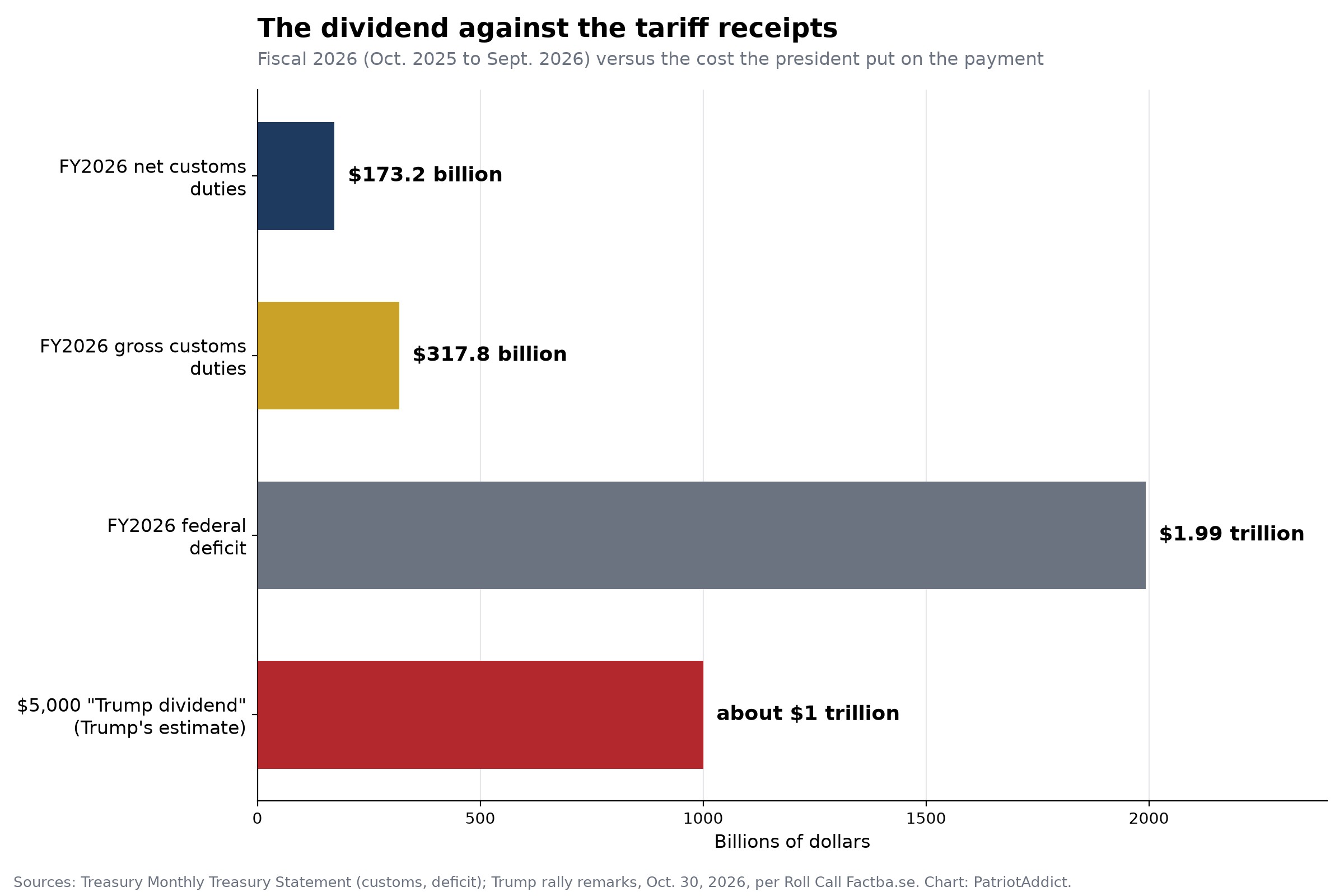
Fiscal 2026 customs receipts and the deficit, next to the president's roughly $1 trillion cost estimate for the payment. Chart built by PatriotAddict from Treasury data and the Roll Call Factba.se rally transcript.
Who got the refund money, and what comes next?
Refunds go to the importers who paid the duties, not to households. The Atlanta Fed surveyed more than 1,100 executives in August and found that 70% expect to keep at least some of their refund as cash. About 17% plan customer rebates and 15% plan lower prices. The bank puts the total at stake at nearly $170 billion.
CBO says the loss shows up in the long-run numbers too. Its August update projects 2027 through 2036 deficits $0.9 trillion larger than its February baseline, "largely driven by" the removal of the IEEPA tariffs after the Court's ruling.
What I could not verify: whether Republicans have drafted any bill for the $5,000 payment, who would qualify beyond "adult citizens," and how much of the replacement tariffs the administration has put in place will survive court challenges. The president has also said at other events, according to press accounts I could not date, that the country is taking in "trillions of dollars" from tariffs. Treasury's data does not show that: the three-year total for fiscal 2024 through 2026 is $604 billion gross and $445 billion net.
The tariff money is real, and so is the refund bill. Voters hearing "massive amounts" on Tuesday should know the Treasury's own bottom line for the year is $173 billion, not a trillion.
Header photo: aerial view of the shipping container port in Miami, Florida. Photo: Carol M. Highsmith, Library of Congress, no known restrictions on publication. Cropped.