

The State Department cleared a possible $2.1 billion sale of 500 Patriot PAC-3 MSE interceptors to Ukraine on Friday, and the notice says "No U.S. funds are involved in this sale." It also says nothing about when a single missile ships. Zelensky says the first ones come "ONLY IN A FEW YEARS," while Kyiv wants 100 a month this winter.
What does the State Department notice actually say?
The Oct. 30 congressional notification (transmittal 26-113) covers "five hundred (500)" PAC-3 Missile Segment Enhancement missiles, plus spare parts, logistics and program support. Lockheed Martin of Bethesda, Maryland, is the principal contractor. The $2.1 billion is an estimate for the whole package, not a price tag on the missiles alone.
Ukraine would pay with donations from Canada, Germany and Norway routed through a program called JUMPSTART, plus its own funds backed by the European Union's Ukraine Support Loan. The department's finding is that Ukraine "will have no difficulty absorbing these articles and services" and that the sale causes no adverse impact on U.S. defense readiness.
Official record
U.S. Department of State, Bureau of Political-Military Affairs, notice of a possible Foreign Military Sale to Ukraine, Oct. 30, 2026.
"No U.S. funds are involved in this sale." – State Department notice
The notice lists no delivery schedule, no contract date and no production allocation.
Is this a done deal?
No. This is a notification to Congress of a possible sale, not a signed contract. UNITED24 Media reports that lawmakers generally get 30 calendar days to object before an offer can be issued. I did not see that period spelled out in the notice text I read, so treat the 30 days as reported, not confirmed.
The practical point for American readers is the money. By the department's own wording, the bill goes to Ukraine and its European backers. The work goes to a U.S. contractor. That is the "Europe carries more of its own defense" argument in a single line item.
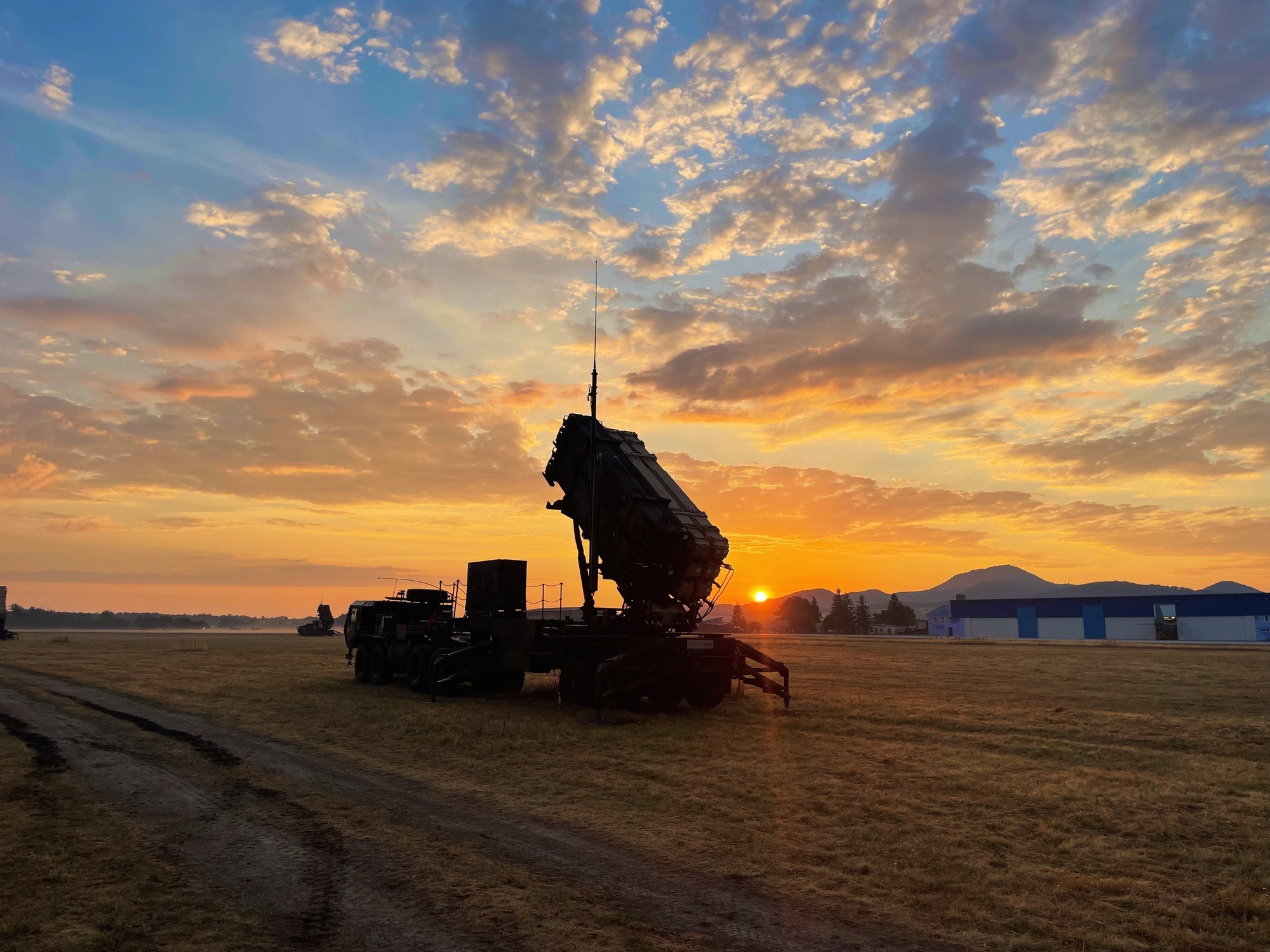
A U.S. Army 10th AAMDC Patriot launcher at sunrise in Slovakia, on NATO's eastern flank. Photo: 2nd Lt. Emily Park, U.S. Army, via DVIDS (public domain).
Why does "possible sale" not mean missiles this winter?
Zelensky welcomed the approval on X, then flagged the catch: "It has been stipulated that deliveries may begin ONLY IN A FEW YEARS," as Kyiv Post quoted him. He asked Washington to "find a solution for the time when there is a real danger." Kyiv's proposal is to borrow missiles from U.S. and allied stocks now and replace them from this new production later.
Radio Liberty correspondent Alex Raufoglu, quoted by Kyiv Post, cites unnamed diplomatic sources saying these are newly built missiles with deliveries "not expected until after 2030." That is a sourcing limit, not a documented date. The State Department notice gives none, and I found no on-the-record U.S. official who does.
Zelensky says Russia fired 17 ballistic missiles at Ukraine overnight on Oct. 30 and more than 100 at Kyiv and the surrounding region since Oct. 14. Those are his government's figures, and I could not verify them independently.
How big is 500 next to what Lockheed can build?
Lockheed says it delivered 620 PAC-3 MSEs in 2025, and a seven-year framework with the Pentagon aims to lift capacity from about 600 a year to 2,000. So 500 missiles is roughly ten months of the company's entire 2025 output. Kyiv's request of 100 a month is about double the 2025 monthly average of 52.
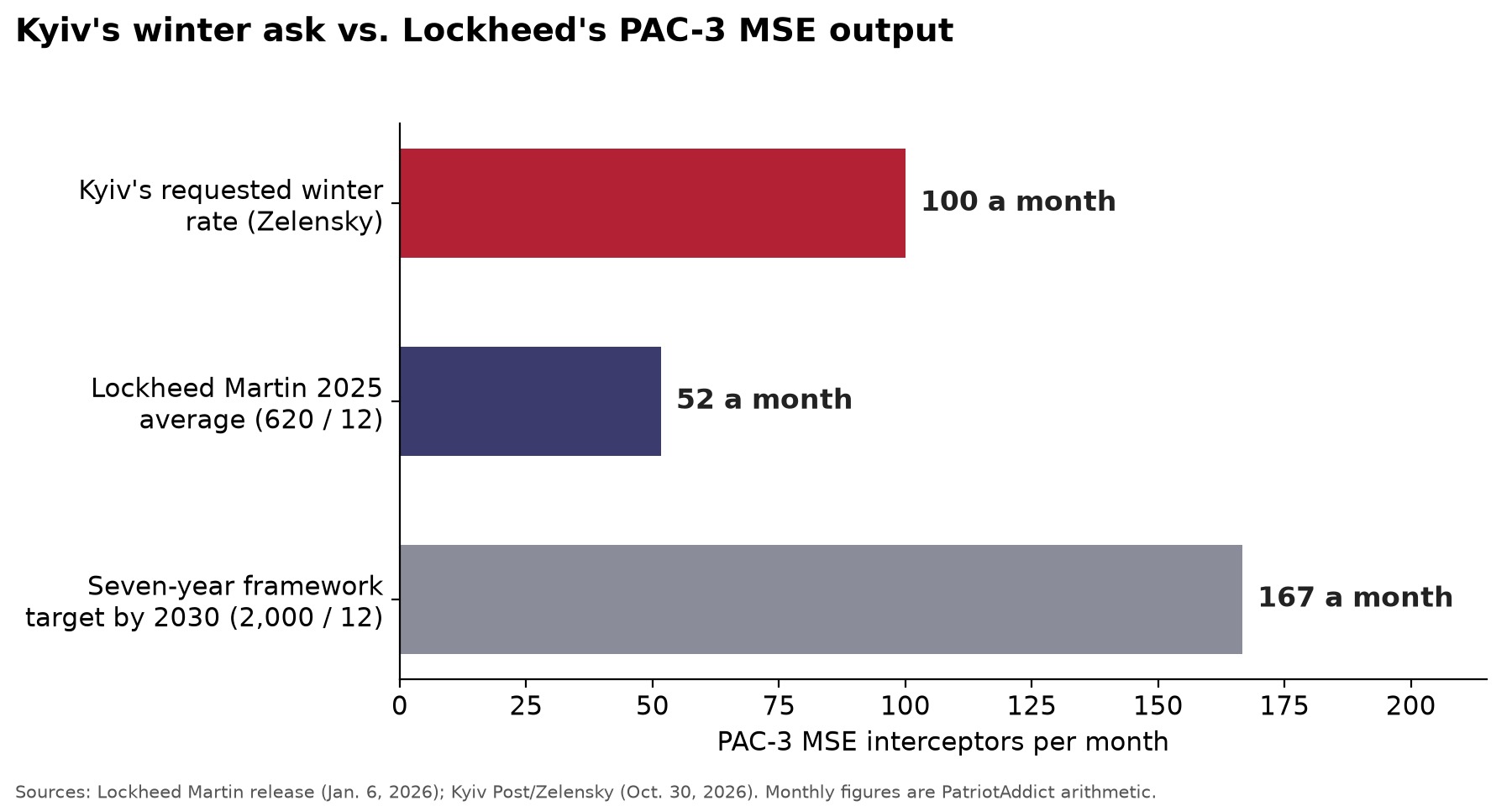
Chart built by PatriotAddict from Lockheed Martin's reported 2025 deliveries and 2,000-a-year target, and Zelensky's 100-a-month request. Monthly figures are our division by 12.
Ukraine is also not first in line. The Foreign Policy Research Institute counts a backlog of over 4,300 Patriot rounds for allied customers, about seven years of output at 2025 rates. I could not confirm where this order sits in that queue.
What to watch next
Three things decide whether the approval means anything for Ukraine's winter: whether Congress lets the 30 days run quietly, whether the Pentagon agrees to the stock-swap Kyiv is asking for, and whether it grants the manufacturing licenses that Kyiv Post says are still under review. None has an answer yet. Until one does, the headline number is 500 and the delivery date is blank.
Header photo: Soldiers of Delta Battery, 5th Battalion, 7th Air Defense Artillery use a forklift to load rockets onto a Patriot launcher at Sochaczew, Poland, March 2015. Photo: Sgt. 1st Class Randall Jackson, 10th AAMDC Public Affairs, U.S. Army, via DVIDS (public domain). Cropped.















