President Trump says "a vast Majority of the Country" wants permanent daylight saving time and that the Senate is letting the bill die. Polls do find a big majority that wants clocks to stop changing. They split on which time to keep, and Sen. Tom Cotton's claim that Congress has tried this before is half right.
What did Trump and Cotton actually say?
The fight went public on Oct. 3. According to the Associated Press account on PBS News, Trump posted that Arkansans should "tell Tom to, GET IT DONE!" and included what appeared to be Cotton's personal cellphone number. The AP called it. Nobody answered and the voicemail box was full. I am not reprinting the number.
Cotton replied the same day: "No one likes changing the clock, me included, but Congress has enacted permanent Daylight Savings Time multiple times before and repealed it each time once Americans experienced absurdly late sunrises in the winter. Arkansans don't want their kids going to school in the pitch dark, and I'll always put Arkansas first." Trump answered that "if Tom Cotton were putting Arkansas first, he would give them an extra hour of daylight."
The push has not let up. Newsweek reported on Oct. 27 that Trump called the clock change "ridiculous" at a Mississippi rally and quoted a Truth Social post saying, "The United States Senate is letting the Daylight Saving Bill die, when a vast Majority of the Country want it." I could not open the original posts, so those quotes come from AP and Newsweek.
Official record
H.R. 139, the Sunshine Protection Act of 2025, as passed by the House on July 14, 2026 (Roll Call 238, 308 to 117). The engrossed text is two sections long.
"Section 3 of the Uniform Time Act of 1966 (15 U.S.C. 260a) is hereby repealed." — H.R. 139, Sec. 2(a)
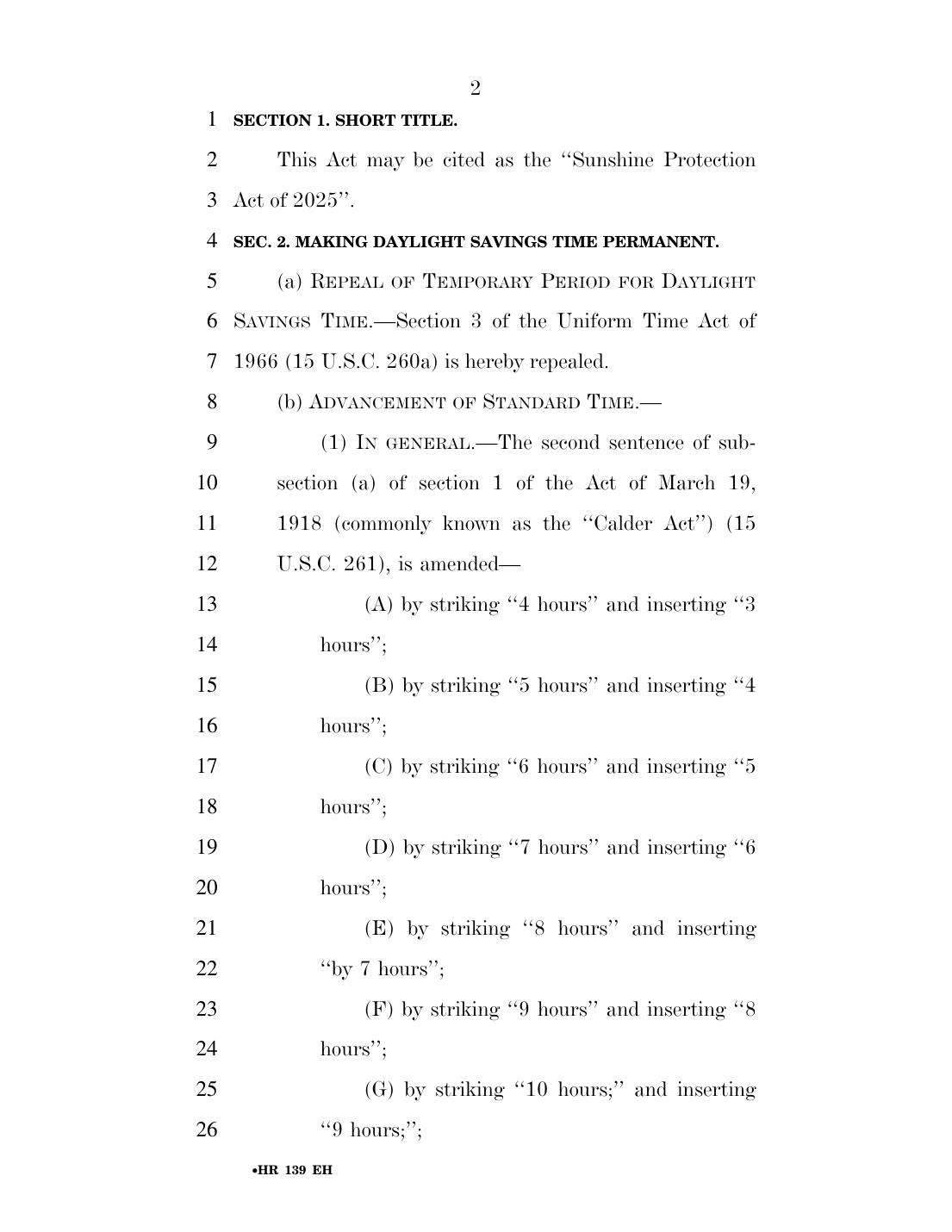
Read or download the full 6-page engrossed bill (PDF) · view the text on GovInfo
What does the bill do, and who voted for it?
It repeals the section of the 1966 Uniform Time Act that sets the seasonal daylight period, then moves each U.S. standard time zone one hour ahead. The result is daylight time all year in most of the country. A state that has already exempted itself, as Arizona and Hawaii have, can keep standard time. The text has no delayed start date, so it would apply on enactment.
The Clerk's roll call shows 193 Republicans and 114 Democrats voting yes, along with the chamber's one independent. Twenty-two Republicans and 95 Democrats voted no. The bill's sponsor is Rep. Vern Buchanan, R-Fla., according to this report on the vote. The Congressional Research Service says 19 states have already passed laws that would switch to permanent daylight time if Congress allows it.
Does a "vast majority" want this bill?
Part of the claim holds. Gallup's January 2025 poll found 72% of Americans prefer no clock changes at all. Only 19% want to keep switching.
The part that does not hold is the idea that they agree on what comes next. In that same Gallup survey, 48% chose year-round standard time and 24% chose year-round daylight time. Gallup's sample was 1,001 adults, with each question asked of about 500 people and a margin of error of plus or minus 6 points.
The AP-NORC poll of Oct. 9 to 13, 2025 points the other way. It found 56% preferring permanent daylight time and 42% preferring permanent standard time, with just 12% favoring the current system. That survey had 1,289 adults and a margin of error of plus or minus 3.8 points. I have not compared the exact question wording in the two polls, and the gap suggests the framing matters. Neither one tested a "vast majority" for this specific bill.
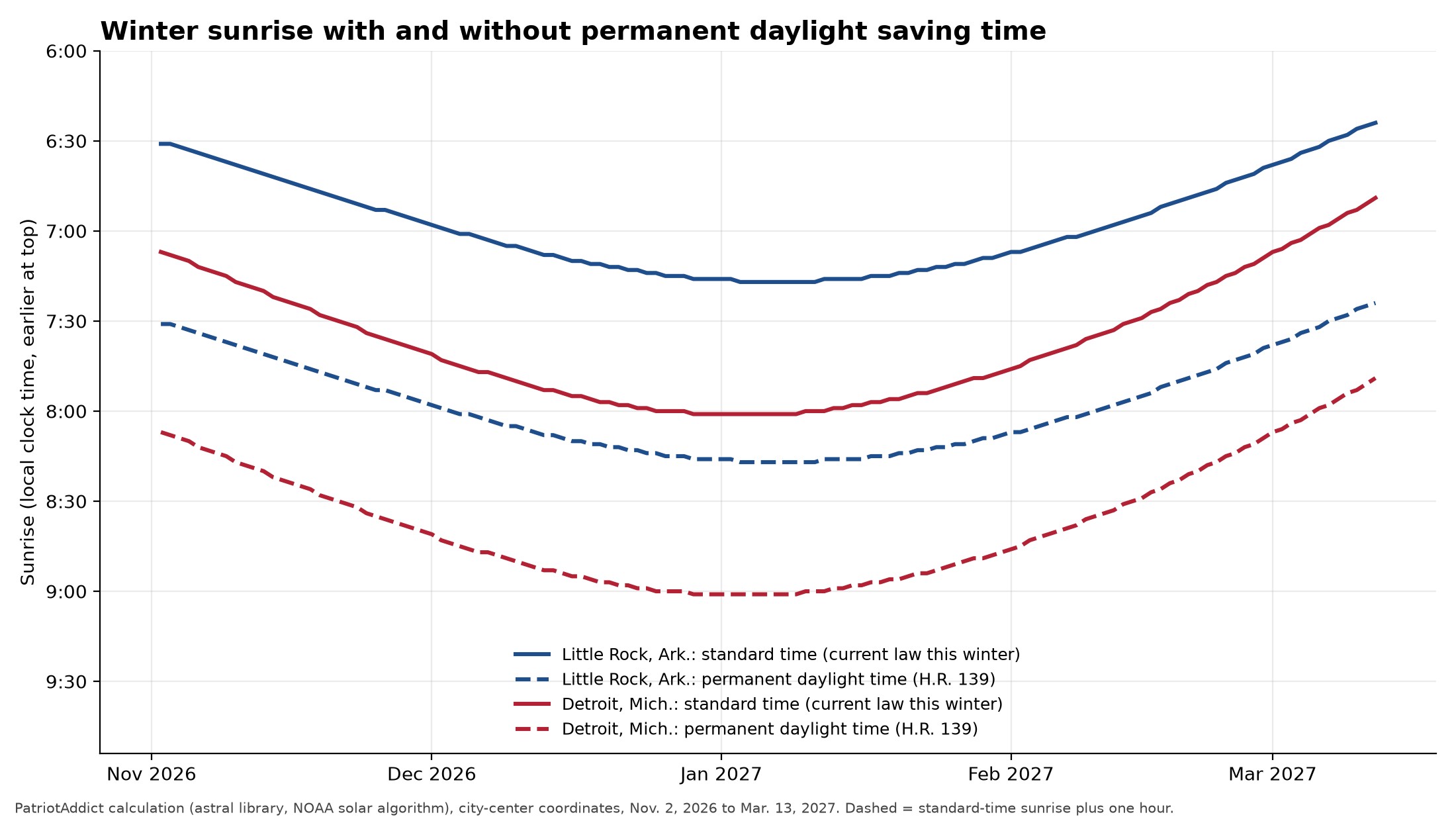
Winter sunrise in Little Rock and Detroit with and without the bill. Chart built by PatriotAddict from a standard solar-position calculation (astral library) for city-center coordinates. The permanent-daylight lines are standard-time sunrise plus one hour.
Is Cotton right that Congress already tried this?
On the count, yes. The Congressional Research Service says year-round daylight time has been tried twice. In 1942 Congress enacted year-round "War Time," and a later law ended it in September 1945. That ending followed the war, not complaints about dark mornings.
The second try fits Cotton's story better. The Emergency Daylight Saving Time Energy Conservation Act of 1973 set a trial of year-round daylight time starting Jan. 6, 1974. CRS says an interim Department of Transportation report recommended adding four months of standard time, and Congress amended the law in October 1974 to send clocks back on Oct. 27. The trial otherwise ran until April 27, 1975. So Congress adjusted the experiment rather than repealing it outright, and CRS attributes the change to the DOT report. I did not find a source in that report for the specific claim that public reaction to late sunrises drove it.
The sunrise numbers show why the objection has teeth. By my calculation, on Jan. 4 the sun rises around 7:17 a.m. in Little Rock under standard time and around 8:17 under permanent daylight time. In Detroit the same swap moves sunrise from about 8:01 to about 9:01.
What happens next in the Senate?
Not much soon. KOTA reports the Senate returns from recess Nov. 9, that the bill would need 60 votes to reach a final vote, and that Majority Leader John Thune has said it is unclear whether that many senators back it. Newsweek quotes Thune as saying there is "no clear path forward or consensus." The Senate does have a record here: it passed a similar bill four years ago, and the House never acted, per the AP.
Outside the chamber, the American Academy of Sleep Medicine opposes H.R. 139 and wants permanent standard time. Its president, Dr. Fariha Abbasi-Feinberg, said the House "ignored the overwhelming evidence supporting the health and safety benefits of permanent standard time." That is an advocacy group's position, and it points opposite to the bill.
Cotton, who chairs the Senate Intelligence Committee, is also up for re-election this month, per the AP. He is not alone among Republicans in opposing the bill, but he is the one the president has named. Trump's argument is simple: nobody likes resetting clocks. The Senate's problem is that agreeing on that gets no one to 60 votes.
Header photo: Senate Sergeant at Arms Charles Higgins turns forward the Ohio Clock in the U.S. Capitol for the first daylight saving time, 1918, with Sens. William Calder (N.Y.), William Saulsbury Jr. (Del.) and Joseph T. Robinson (Ark.) looking on. Harris and Ewing photograph, Library of Congress, public domain. Cropped.