

More than 53 million Americans had voted by Sunday morning, and registered Democrats are ahead of registered Republicans in the states that report party. That is a real gap. It is also not a result, because early ballots show who showed up, not who they voted for, and Republicans have long saved their vote for Tuesday.
How big is the early vote?
Big. A University of Florida tally, as reported by Al Jazeera on Nov. 1, counted 53.14 million early votes as of 6:56 a.m. Eastern on Sunday, about 29 million in person and 23 million by mail. Al Jazeera puts the comparable 2022 figure at 46 million.
The AP's Oct. 30 analysis, carried by local stations, had 43 million voted, nearly 10 million more than at the same point in 2022. Texas was at more than 6.3 million against 4.2 million four years earlier, up 50 percent. South Carolina was up 83 percent, Maine 44 percent, Kansas 34 percent and Michigan 32 percent.
UF's Michael McDonald, who runs the tracker, told NPR that turnout is up over both 2022 and 2018. NPR noted that 2022 ended with nearly 122 million voters, so this is a large share of a full midterm electorate already banked.
Primary data source
The University of Florida Election Lab's 2026 Early Voter Tracker (last updated Nov. 1, 2026, 1:28 p.m. Eastern per the page). When I loaded it, the page showed placeholder values instead of totals, so every national figure in this post comes from the news reports linked here, not from my own read of the tracker.
What does the party split actually show?
In states that record party registration, the AP counted about 6.8 million Democrats and 5.2 million Republicans among early voters. Al Jazeera's Sunday report put it at more than 11 million Democrats and about 8 million Republicans. The AP attached a warning to its own numbers: they "do not account for all early voters nationwide or indicate which candidates received their votes."
That warning matters. A registered Republican can vote for a Democrat, a registered Democrat can vote for a Republican, and a growing pile of voters are registered with neither party. North Carolina, which reports all three, is a useful test case.
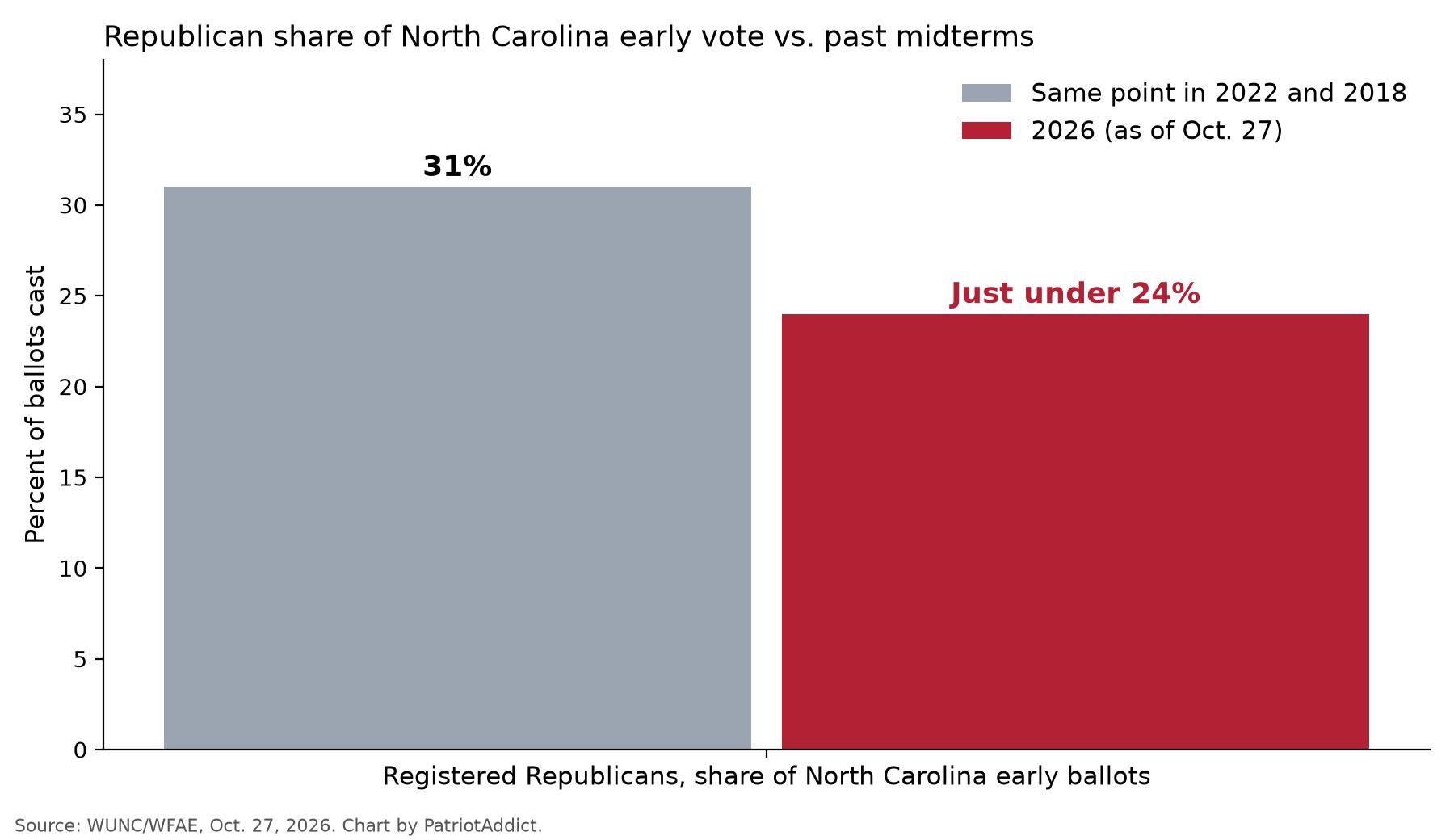
Registered Republicans as a share of North Carolina early ballots. Chart built by PatriotAddict from figures in WUNC/WFAE reporting (Oct. 27, 2026).
Why is North Carolina the number to watch?
According to WUNC and WFAE on Oct. 27, nearly 1.6 million North Carolinians had voted, against 1.16 million at the same point in 2022. Registered Republicans were just under 24 percent of ballots cast. At this point in both 2022 and 2018 they were 31 percent. Democrats, near 42 percent, were roughly where they were in those years. The share that moved was unaffiliated voters, which the report called "way, way up."
That is a more worrying number for Republicans than the raw national headcount, because it compares the party's share against its own past. WUNC also noted that mail voting is down in the state and tied part of that to President Trump's claims that mail voting is fraudulent. If those voters are holding their ballots for Election Day, the plan only works if they actually show up Tuesday.
Can Republicans make it up on Election Day?
History says some of it, yes. NPR's reporting stated that Republicans have traditionally voted more on Election Day while Democrats bank early votes, and that early totals are often a poor predictor of the final result. Nobody can yet say whether Tuesday's turnout is large enough to close the gap.
Speaker Mike Johnson is betting it will be. In Fox News's Nov. 1 live coverage, he said Republicans would "defy history," arguing polls undercount GOP enthusiasm and admitting close races will come down to turnout. Trump spent Sunday rallying in Iowa and Kansas for the same reason.
What this means before Tuesday
Two readings are both fair. Democrats have built an enthusiasm advantage in the early window, and Republicans cannot wave that away. And the early vote is not the vote, so nobody should treat a registration gap as a scoreboard. The side with the lever left to pull is the one that still has to get its people out.
Election Day is Tuesday, Nov. 3. Check your state's polling hours and ID rules before you leave the house, and bring a neighbor.
Header photo: voters wait in line in Philadelphia on Nov. 8, 2016, a file photo and not from this year. Voice of America, public domain, via Wikimedia Commons.















