Virginia gave ICE until September 1 to accept twelve new conditions or lose all thirty of its immigration enforcement agreements in the state. A federal judge in Richmond voided that deadline the day before it hit, and the 53-page opinion explaining why arrived last Thursday. It calls the Commonwealth's central defense "sophistry." It also leaves standing the one piece of the law that bars any Virginia sheriff who sat the program out from ever joining.
Senior U.S. District Judge Robert E. Payne entered the injunction on August 31 and filed his reasoning on September 3 in United States v. Commonwealth of Virginia, No. 3:26-cv-00545 in the Eastern District of Virginia. Payne was nominated by George H.W. Bush in 1991. The news coverage ran off his four-page order. The reasoning is where the interesting parts sit.
What Virginia actually told ICE to sign
Senate Bill 783, sponsored by Sen. Saddam Azlan Salim of Fairfax alongside an identical House Bill 1441 from Del. Alfonso Lopez of Arlington, became Va. Code § 15.2-1726.1 on July 1. Section C lists twelve provisions every federal immigration enforcement agreement in Virginia had to contain. Section D gave existing agreements until September 1 to be rewritten and signed, and declared any that were not "void and unenforceable."
ICE would have to hand a local agency the names and ranks of every federal agent in any Virginia operation seven days before it happened. Agents could not wear a uniform or display the word "police." No enforcement at any school, faith-based organization or courthouse, no license plate readers or drones, no home entry without a judicial warrant. Any shooting by an agent on duty would be investigated by the Virginia State Police and prosecuted in Virginia court.

Virginia state Sen. Saddam Azlan Salim, D-Fairfax, at a Fairfax City candidates event in October 2023. Payne's opinion quotes Salim's own public statements about his bill package back at the Commonwealth as evidence of what the law was for. (Photo by Commons contributor Lime10001, released under CC0 public domain dedication.)
The sentence diagram that decided the case
Payne did something neither side's briefs did. He parsed all twelve provisions grammatically. The subject of every one is "U.S. Immigration and Customs Enforcement," an "agent of U.S. Immigration and Customs Enforcement," or a "federal agent," and the verbs are commands or prohibitions. "On the other hand," he wrote, "not one of those twelve required provisions mentions state or local law enforcement officials."
That ended Virginia's theory of the case. Attorney General Jay Jones argued the conditions bind Virginia's localities rather than ICE, and that Dillon's Rule lets the General Assembly take back a contracting power it once granted. Payne answered that Dillon's Rule "does not operate to alter the intergovernmental immunity doctrine," and noted that "Virginia erroneously refers to itself as the contracting party."
Official record
Memorandum Opinion, United States v. Commonwealth of Virginia, No. 3:26-cv-00545-REP (E.D. Va. Sept. 3, 2026), ECF No. 103, 53 pages, signed by Senior Judge Robert E. Payne at Richmond. Public on CourtListener's free RECAP archive; the August 31 order it explains was posted by the Virginia Mercury.
"In fact, Virginia's 'no obligation exists because the modification is voluntary' argument is sophistry. Were coercion of that sort sufficient to permit a finding that no obligation exists, the entire concept of contractual impairment would be set at naught. All a State would ever have to do to evade the proscription of the Contracts Clause is to pass a law that says 'change the contract or it's void.'" — Memorandum Opinion at 30
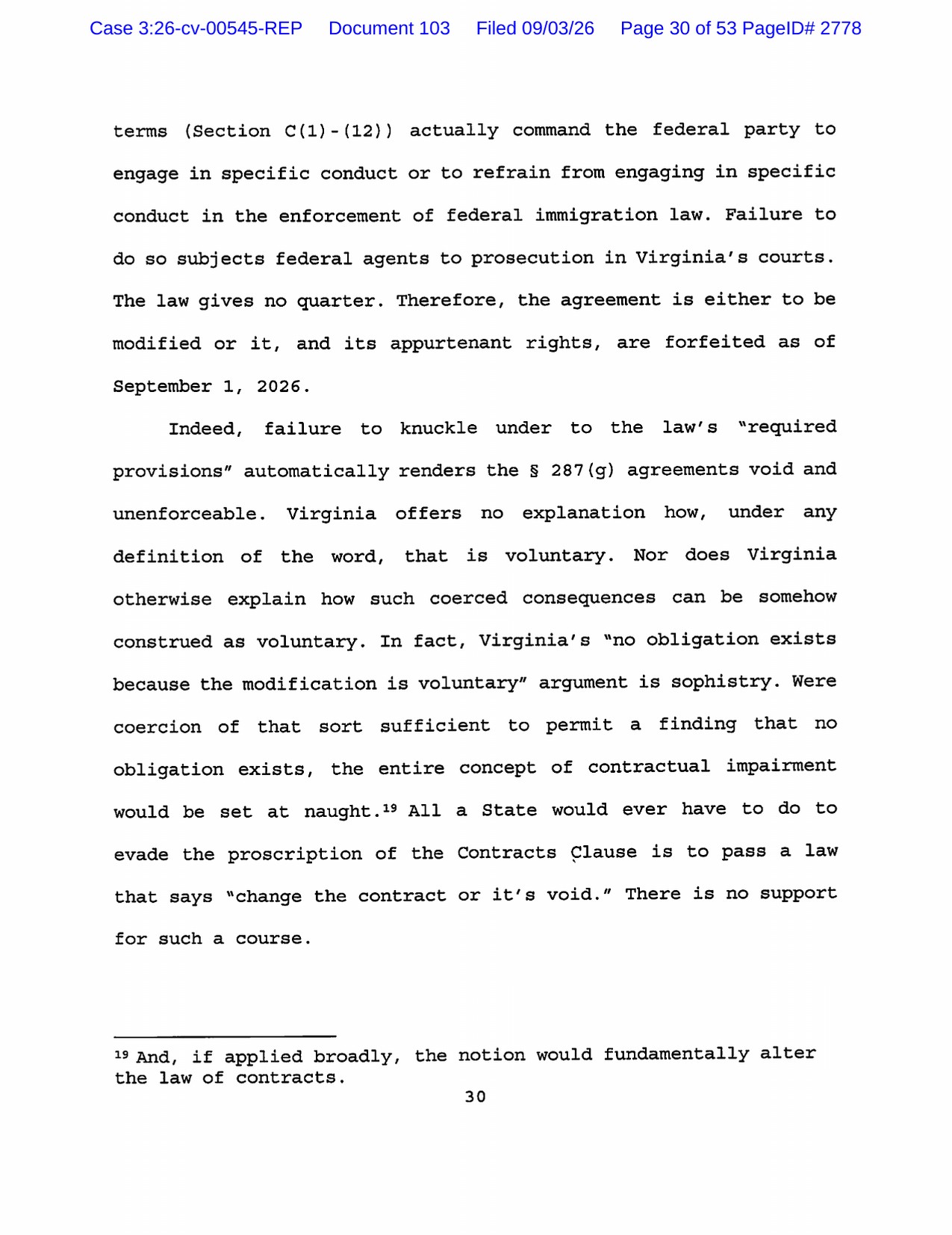
Read or download the full 53-page memorandum opinion (PDF), or view the docket on CourtListener.
The coverage said the administration won. Half the complaint is undecided.
The Justice Department pleaded six counts when it sued in June. Payne granted relief on two: Count III under the Contracts Clause and Count V under intergovernmental immunity. He refused to reach Count IV, conflict preemption, or Count VI, discrimination against the federal government, writing that the briefs on those counts "are not well developed. Nor is the record."
The win has a hole the judge cut himself. Footnote 16 says the United States "is not likely to succeed" on the Contracts Clause claim as to the part of the law "that withdraws authority for localities to enter into new § 287(g) agreements," since there has to be a contract before there can be an impairment. So the order grants relief "except to the extent that the law prohibits the entering of new § 287(g) agreements," and footnote 23 calls the remainder "an open issue still to be decided."
Virginia lost the deadline and kept the door. No Virginia locality that sat the program out can join it now.
The escape hatch is in the opinion itself
The record puts thirty contracts with twenty-six Virginia agencies in play, and footnote 9 breaks down the timing in a way nobody printed. Twenty-four of the thirty were signed in a single four-month burst from March through June 2025, three later that year, two in spring 2026, and one carries no execution date at all. Before SB 783, exactly one Virginia agreement had ever been terminated by either side, Prince William County's in 2020.
Every one of the thirty can be ended at will or on ninety days' notice, and Payne says so. He then writes that enjoining the statute lets localities keep participating "without the artificial impetus to give notice to terminate." Virginia does not need this law to unwind the agreements. It needs a differently drafted one telling its localities to give the notice their contracts already allow.
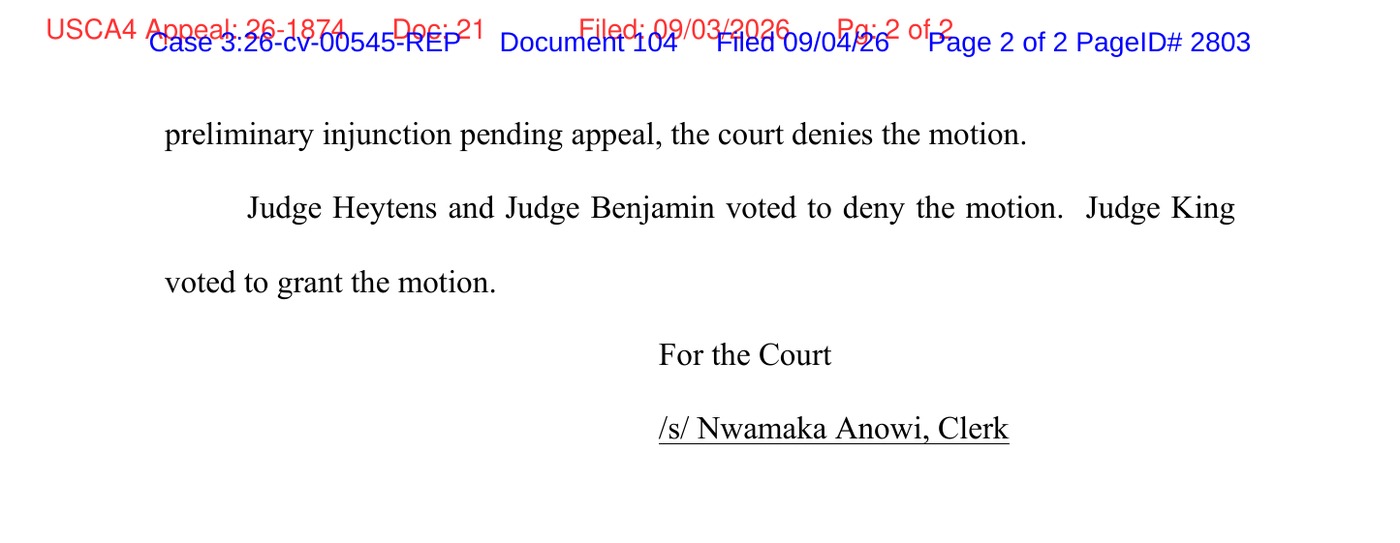
Page two of the Fourth Circuit's September 3 order in No. 26-1874, denying Virginia's motion to stay the separate injunction against its law enforcement mask ban. The vote lineup is recorded in one sentence. (U.S. Court of Appeals for the Fourth Circuit via CourtListener, public domain.)
The Fourth Circuit already ruled once, and not the way you would guess
The companion fight in the same lawsuit is over Virginia's ban on law enforcement officers wearing facial coverings, which Payne enjoined on July 1. Virginia appealed, moved for a stay pending appeal on August 14, and on September 3 a Fourth Circuit panel denied it. Judges Toby Heytens and DeAndrea Gist Benjamin voted to deny. Judge Robert B. King voted to grant.
Heytens and Benjamin are Biden appointees. King is a Clinton appointee who took senior status in 2021. Heytens spent 2018 through 2021 as Virginia's own Solicitor General before Biden put him on the bench. The same day the panel refused the stay, the clerk calendared the appeal for argument on October 27.
The judge who ruled for ICE wrote this too
None of it reads as a brief for the administration. In footnote 11, Payne wrote that "it is also rather obvious from the public record that there is much not to like about the methods being used by the federal enforcement agencies," and that whether those methods "warrant criticism, approval, approbation, or even elimination, is not a matter before the Court."
His closing is federalism, not policy. A state that objects to how Washington enforces immigration law can press its congressional delegation or sue in federal court, but it cannot write the enforcement rules itself. Then comes the question that carries the opinion: what happens when Virginia decides it dislikes how the FBI, the DEA or the ATF handle searches and undercover work, and writes Section C conditions into those contracts too. "Where would the Balkanization stop?"
Getting there took a break with the Seventh Circuit, which upheld an Illinois ban on immigration detention agreements in McHenry County v. Raoul. Payne followed the Third Circuit's CoreCivic and the Ninth Circuit's King County instead, both of which look past a statute's form to its "self-evident operation."
September 1 came and went with the deadline dead and thirty agreements intact. Jones said he would seek a stay and appeal, and the Fourth Circuit's only word so far went against him. Virginia still holds the piece that matters most, because no new locality can sign on. The thirty already in place are safe until somebody gives ninety days' notice, and Payne's opinion explains who can.
Featured photo: the Lewis F. Powell Jr. United States Courthouse, home of the U.S. Court of Appeals for the Fourth Circuit, seen from the Virginia Capitol grounds in Richmond. Photo by Acroterion, Wikimedia Commons, licensed CC BY-SA 4.0.