A divided federal appeals court refused on September 4 to switch the expanded SAVE citizenship database back on, leaving it dark with 60 days to go before the midterms. Twenty-seven states use SAVE to check whether registered voters are citizens, running some 60 million of those queries since January 2025. The 2-1 order runs 53 pages, and almost none of it is about whether the program is legal.
Chief Judge Sri Srinivasan and Judge Robert Wilkins denied the stay. Judge Gregory Katsas, a Trump appointee, dissented, and his dissent is where those query figures come from. The case is League of Women Voters v. Department of Homeland Security, No. 26-5243, on appeal from Judge Sparkle Sooknanan's June 22 judgment in the District of Columbia. You can read the whole order yourself, and it rewards the effort.
The panel did not rule that SAVE is illegal
Sooknanan struck the program down on four grounds: no statutory authority, a Social Security Act violation, a Privacy Act violation, and arbitrary agency action. The panel reached one. Because the Social Security Act ruling "independently supports its judgment," it wrote, "we do not address the court's additional holdings concerning DHS's statutory authority, the Privacy Act, or arbitrary-and-capricious review."
Even that one ground turned on procedure, not substance. The government's central arguments about the confidentiality mandate at 42 U.S.C. section 405(c)(2)(C)(viii)(I) surfaced for the first time after it had already lost. The panel called them forfeited and declined to excuse the forfeiture at the stay stage.
The Justice Department did this to itself
Through months of summary-judgment briefing, DOJ never argued that modified SAVE actually complies with that mandate. It argued only that the mandate does not apply, because 8 U.S.C. section 1373(c) obligates DHS to answer state citizenship inquiries. Texas intervened as a defendant, briefed the same claim, and never raised the theories the government now leans on either.
When DOJ finally surfaced those arguments in its stay motion, Sooknanan declined to take them up on an expedited basis but invited the government to file a post-judgment motion so they could get real consideration. Twelve days remained in the 28-day window. DOJ filed nothing and went to the D.C. Circuit on July 8 instead.
Official record
Order and per curiam statement, League of Women Voters, et al. v. U.S. Department of Homeland Security, et al., No. 26-5243 (consolidated with No. 26-5301), U.S. Court of Appeals for the D.C. Circuit, filed September 4, 2026. Published by the court at media.cadc.uscourts.gov.
"When the government first aired those forfeited arguments in moving for a stay pending appeal, the district court declined to consider them in that expedited posture but expressly invited the government to submit a post-judgment motion . . . . The government did not do so, instead coming straight to our court." — Per curiam statement, September 4, 2026
Two details show how thin the filing was. Asked which provision of law the disputed records are kept under, DOJ named no statute, citing a 2009 Social Security Bulletin article by an SSA employee. And quoting the statutory definition of a protected "related record," DOJ swapped "directly or indirectly" for an ellipsis. The panel caught both.
Federal law already froze the voter purges on August 5
Here is the part no coverage of this ruling picked up. The panel's practical reason for refusing emergency relief is that the main election use of modified SAVE is already off the table this cycle. The National Voter Registration Act bars any program whose purpose is to systematically remove ineligible voters within 90 days of a federal election, under 52 U.S.C. section 20507(c)(2)(A). Ninety days before November 3 was August 5.
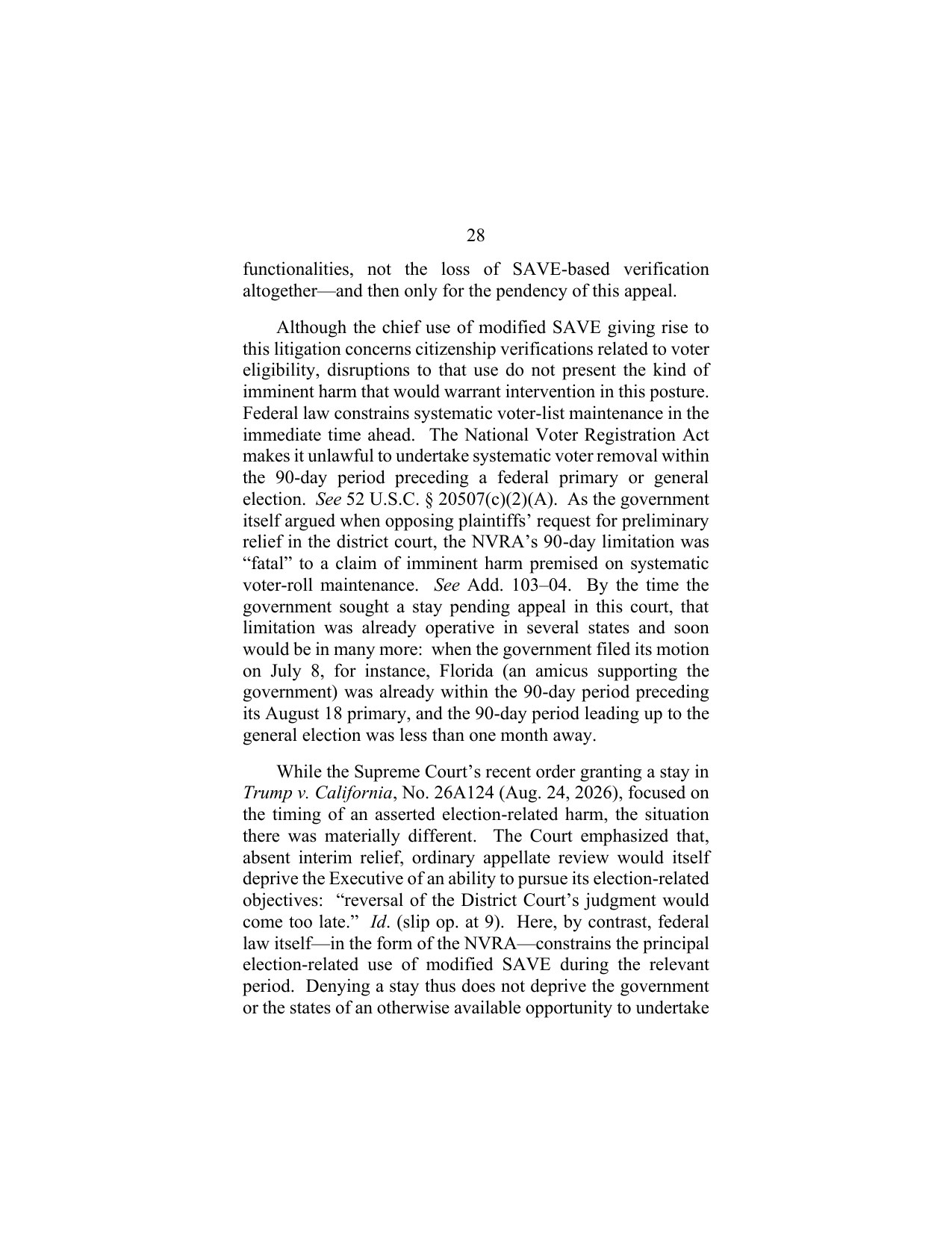
Page 28 of the September 4 per curiam statement, where the panel turns the government's own district-court position back on it. Florida, an amicus backing the government, was already inside its own 90-day window before its August 18 primary when the stay motion was filed. (U.S. Court of Appeals for the D.C. Circuit, public domain.)
The sting is where the panel got the idea. Fighting the plaintiffs' request for early relief last year, DOJ told Sooknanan that this same 90-day limitation was "fatal" to any claim of imminent harm from voter-roll maintenance. The panel quoted that back and used it against the government.
Katsas found the one removal the freeze does not cover
Footnote 4 on page 21 of his dissent answers the NVRA point with something worth reading twice. The 90-day bar has carve-outs, and one of them is death. Under section 20507(c)(2)(B)(i), states may run systematic removal programs for deceased registrants at any point, including the final 90 days.
Modified SAVE returns a deceased indicator alongside its citizenship result. So the one election function of the program federal law does not freeze before November is the one nobody in this case is fighting about. Katsas also notes that states can act on SAVE results individually rather than systematically, which the NVRA does not reach.
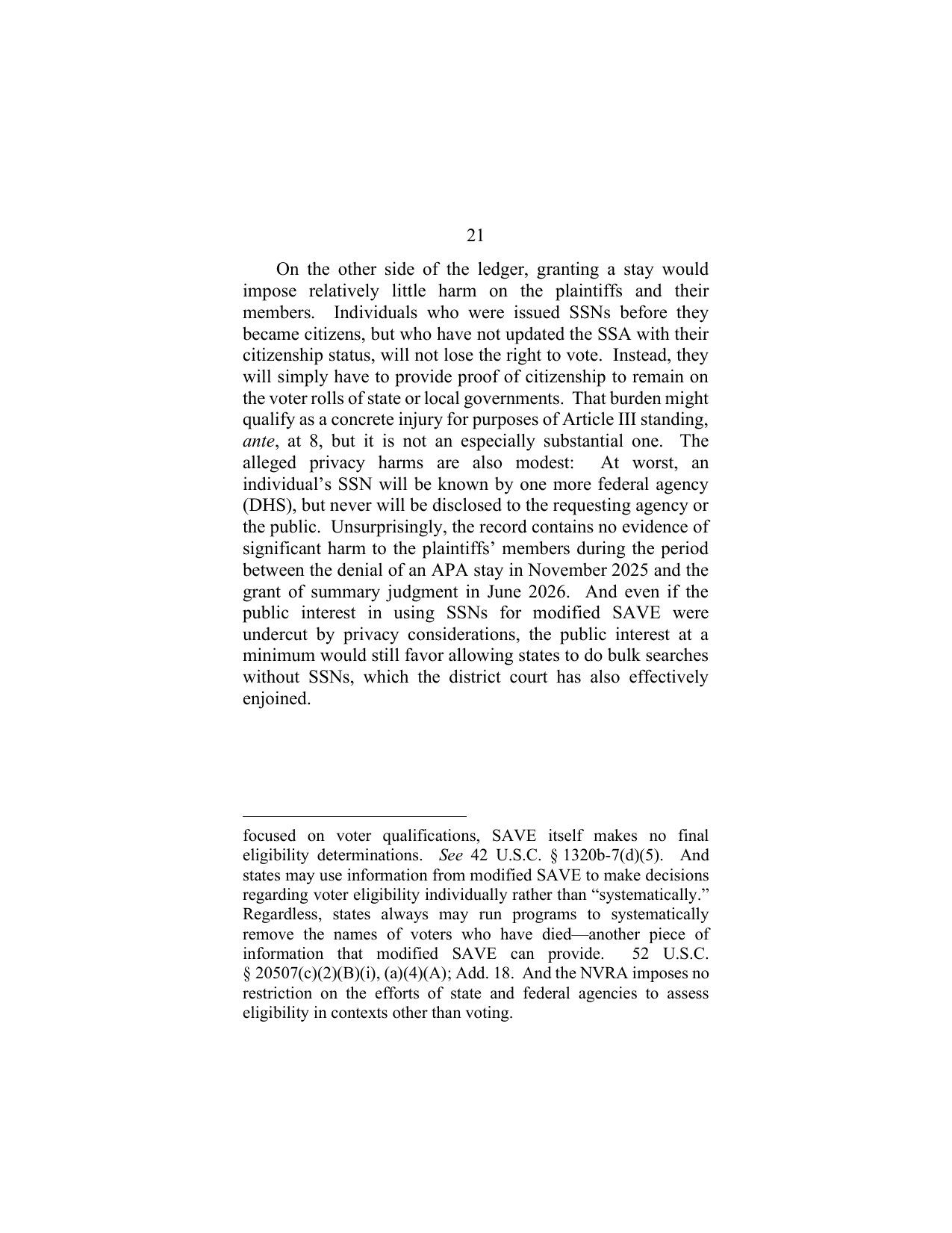
The second half of Judge Gregory Katsas's footnote 4. "Regardless, states always may run programs to systematically remove the names of voters who have died," he writes, "another piece of information that modified SAVE can provide." (U.S. Court of Appeals for the D.C. Circuit, public domain.)
DHS is under two federal orders that contradict each other
Florida, Ohio, Iowa, and Indiana sued DHS in 2024 over SAVE's limits and settled in November 2025. The court-approved agreement required bulk uploads and Social Security number searches. After Sooknanan vacated those functions nationwide, Judge T. Kent Wetherell II ordered DHS on July 7 to turn them back on for those four states. The agency has been stuck between the two rulings ever since.
The majority called the Florida order a settlement-enforcement matter and said it is "far from clear" the two proceedings conflict. Katsas answered in one sentence: "The respective orders unquestionably impose conflicting legal obligations." The Eleventh Circuit appeal, No. 26-12533, is still pending, and by the panel's own account the four states there opposed expediting it, arguing the appeal presents "many novel and complex questions."
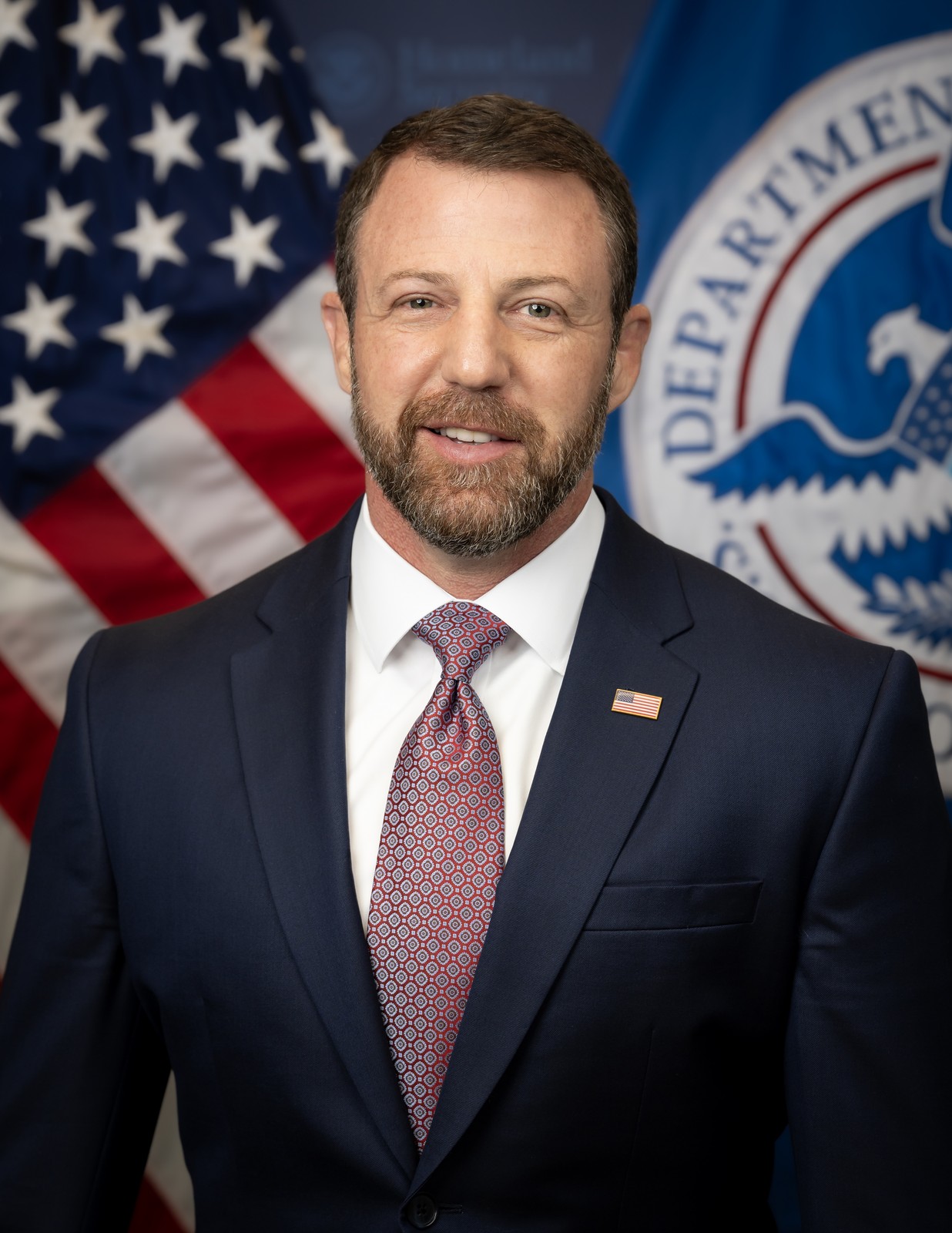
DHS Secretary Markwayne Mullin. His department is the named appellant in the D.C. Circuit case and the party under a Northern District of Florida order to restore the same features the District of Columbia court vacated. (U.S. Department of Homeland Security, public domain.)
The bigger program is not in this case at all
Search all 53 pages for Executive Order 14399 and you will not find it. Trump signed that order on March 31, and its Section 2(a) directs DHS, through USCIS and in coordination with the Social Security Administration, to send each state's chief election official a "State Citizenship List" built from "Federal citizenship and naturalization records, SSA records, SAVE data, and other relevant Federal databases," delivered "no fewer than 60 days before each regularly scheduled Federal election."
Sixty days before November 3 was September 4, the day this panel ruled. Section 4(c) gave DHS until June 29 to build the infrastructure, one week after Sooknanan's judgment landed. The case everyone is watching concerns states pulling data out of a federal system. The order nobody briefed pushes a list of names the other direction.
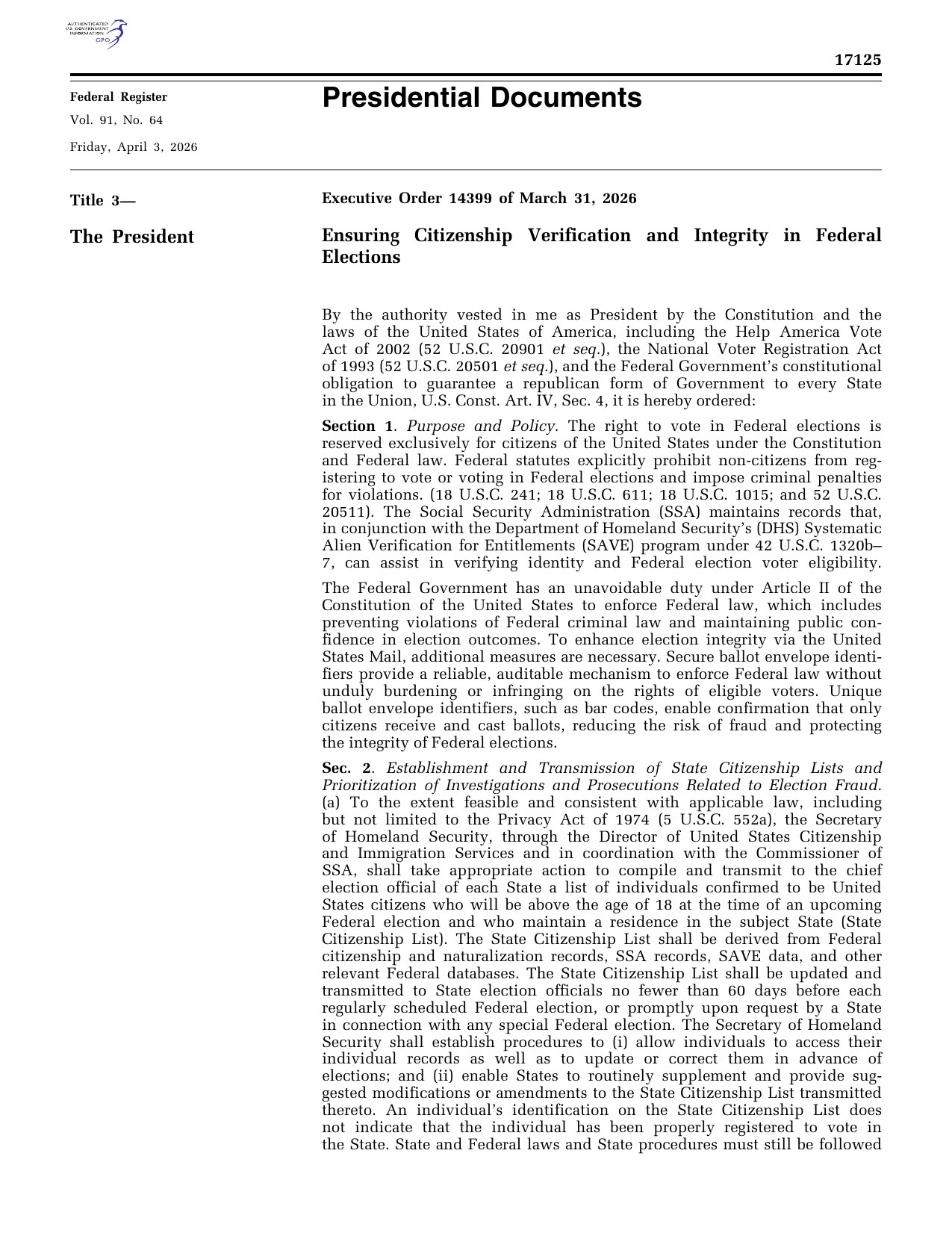
Page 17125 of the Federal Register, carrying Section 2(a) of Executive Order 14399. The State Citizenship List is to be drawn from SSA records and SAVE data and handed to state election officials at least 60 days before each federal election. (Office of the Federal Register, public domain.)
DHS missed the date. Justice Department lawyers told opposing counsel in two suits they would give 48 hours' notice before launching the portal instead, NPR reported. A "State Citizenship Lists Portal" page went live briefly on September 1 saying the lists were coming soon, then came down the same evening. The Electronic Privacy Information Center, already a plaintiff in the SAVE case, sued over the lists in Maryland that day, No. 8:26-cv-03457.
What actually decides this
Not the September 4 order. The panel expedited the appeal, gave both sides 10 days to propose a briefing schedule, and said outright that a merits panel "remains free to decide for itself whether to entertain the arguments after full appellate briefing." The forfeited theories are not dead. They are unbriefed.
Conservatives who want clean rolls should want clean data. Texas ran modified SAVE, flagged citizens as noncitizens off stale Social Security records, and reinstated voters it had cancelled. DHS acknowledged in August that noncitizen counts it had promoted were inflated. A tool that produces false hits hands the other side its best evidence.
Sixty days out, the expanded database stays off, the NVRA keeps systematic purges off through Election Day anyway, and the citizenship lists are still unbuilt. The government lost this round on the calendar, not on the merits.
Featured image: the E. Barrett Prettyman United States Court House in Washington, D.C., home of the U.S. Court of Appeals for the D.C. Circuit. Photo by Tony Webster, Wikimedia Commons, licensed CC BY 2.0.