The Education Department's new school civil rights survey drops five questions and adds thirteen. Both versions of the form are public, and we read them side by side. What came out is narrower than the coverage suggests, and what went in never got reported at all.
What actually came out of the 2025-26 survey?
The Civil Rights Data Collection is a mandatory survey the Office for Civil Rights has run on public schools since 1968. It is where the numbers on school discipline, restraint and seclusion, bullying allegations, and access to Advanced Placement courses come from. The Department publishes its own list of what changed between the two forms, and that list is short.
Five data elements were removed outright. Two are dead COVID questions about how much remote instruction teachers provided. The other three all concern gender identity: allegations of harassment or bullying on that basis, whether a district has a written policy prohibiting it, and the web link to that policy. A separate change strips the "nonbinary" reporting category out of 35 elements, everything from enrollment counts to out-of-school suspensions to who passed Algebra I. That second piece is what the Associated Press and NPR led with, and it is real.
Does the form still ask about bullying of gay and lesbian students?
It does. The AP ran its story under the headline "Trump administration scrubs gender-based bullying data from school civil rights survey," which a reader could take to mean schools no longer report harassment of LGBT kids at all. Page 112 of the 2025-26 school form says otherwise.
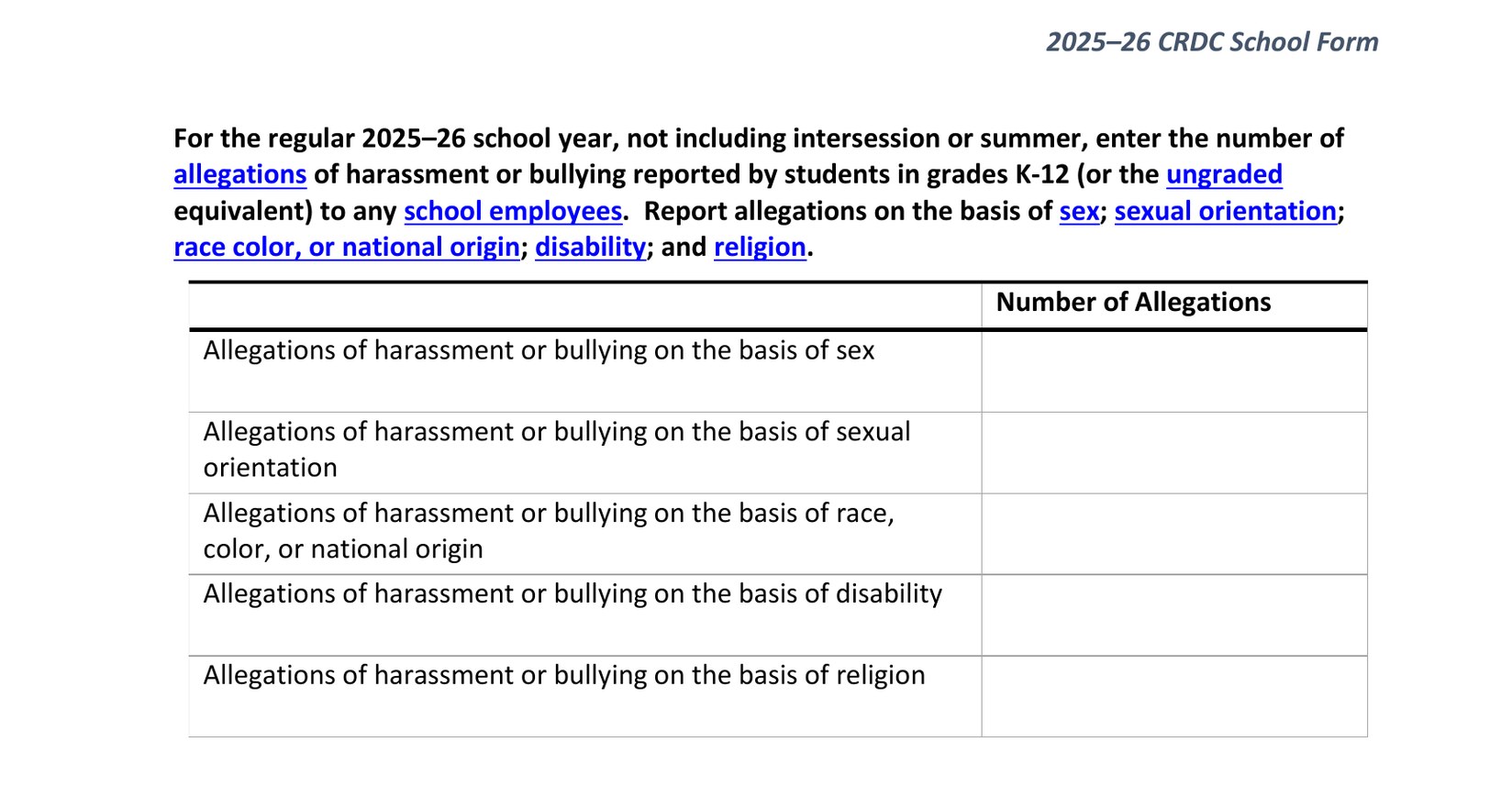
Item HIBS-1 on page 112 of the Education Department's 2025-26 CRDC school form. The sexual orientation row is still there. (U.S. Department of Education, public domain.)
The allegations table still carries five rows: sex, sexual orientation, race color or national origin, disability, and religion. The sexual orientation row survived intact, along with its own definition covering harassment of a student who "identifies as or is perceived to be gay, lesbian, bisexual, or heterosexual." The instructions still tell schools that sexual orientation harassment is a subset of sex-based harassment and belongs in both rows.
What changed in the underlying definition is two phrases. The 2023-24 form defined sex-based harassment as conduct based on actual or perceived sex "(including sexual orientation, gender identity, sex characteristics, sex stereotypes, and pregnancy)." The 2025-26 form, flagged REVISED, now reads "(including sexual orientation, sex stereotypes, and pregnancy)." Gender identity and sex characteristics are gone. Sex stereotypes stayed. California Attorney General Rob Bonta flagged both deletions in a comment letter last year, which is more precision than most of this week's coverage managed.
What did nobody count on the other side of the ledger?
Thirteen new data elements. The Department added an entire Threat Assessment module to the school form, and it is the first time this survey will count how many students get referred to a school threat assessment team, broken out by race, sex, disability, and English learner status. That includes preschoolers. Item THRE-2 asks schools to enter the number of preschool children referred for a threat assessment during the year.
Also new: restraint, seclusion, and enrollment counts for students a district places in facilities it does not run itself, a category disability advocates have complained about for years because those students drop out of the school-level numbers entirely. The words "threat assessment" appear 23 times in the 2025-26 school form and zero times in the 2023-24 version. Neither the AP nor the NPR story mentions any of it.
Official record
2025-26 Civil Rights Data Collection: General Overview, Changes, and List of Data Elements, U.S. Department of Education, Office for Civil Rights, version 1 dated July 20, 2026.
"OCR made some changes to the 2025-26 CRDC, including adding new data elements, removing the nonbinary category, and removing some data elements. The U.S. Office of Management and Budget (OMB) approved the changes to the CRDC under the Paperwork Reduction Act on July 20, 2026, under Control Number 1870-0504." — Office for Civil Rights, page 2
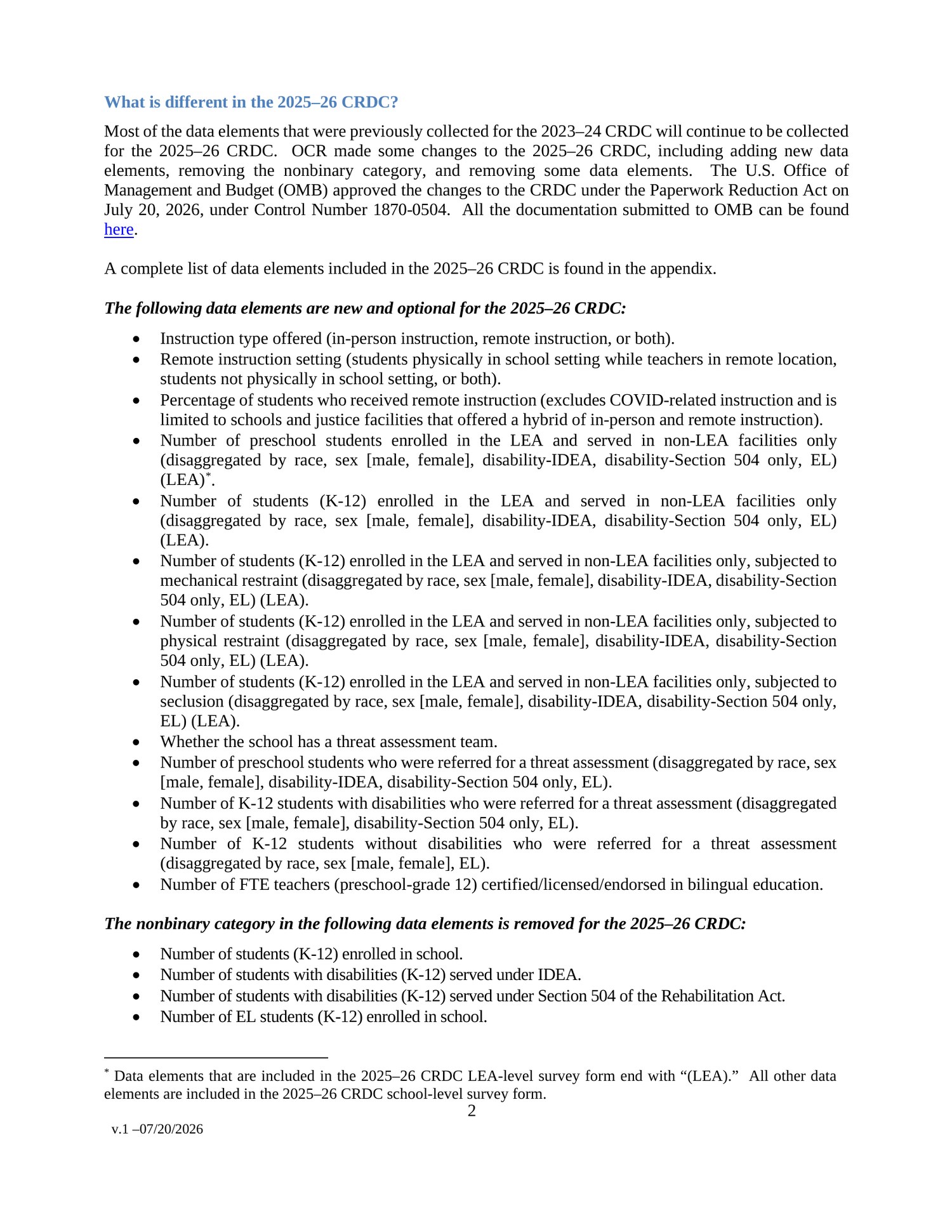
Read or download the full 13-page change document (PDF) at ed.gov
Was any of this actually quiet?
The survey change was not. The Department filed its Paperwork Reduction Act notice on August 7, 2025, took comments through September 8, and drew 36 of them on docket ED-2024-SCC-0128. Bonta and Illinois Attorney General Kwame Raoul filed opposition on the closing day with sixteen other attorneys general behind them. OMB signed off eleven months later.
The data release is a different story, and here the criticism lands. The 2023-24 numbers came out this week with no announcement and none of the plain-English "First Look" report that has accompanied every release for more than a decade. Catherine Lhamon, who ran the Office for Civil Rights under Obama and Biden, told NPR the raw files are fine for data scientists but useless to "somebody's mom" trying to argue with a school board. She is right, and the missing report hides the discipline and course-access numbers conservatives cite too.
The harder question is about data the government already has
For the 2023-24 cycle the questions were asked and the answers came back. Districts filled them in, and the Department then replaced those columns across all 37 published files with a code reading "Suppressed in Compliance with Executive Order." Declining to ask a question going forward is a policy choice. Collecting an answer, banking it, and refusing to publish it is a different thing, and it is fair to say so even if you think the two-sexes order was correct.
Keep the scale honest, though. Seth Galanter, a former Office for Civil Rights attorney now at the Edley Center on Law and Democracy, told the AP that only districts already tracking nonbinary enrollment had to report it, and roughly 1,800 of more than 13,000 did. The 2023-24 form said as much on its face: schools that do not already disaggregate enrollment that way skipped the category. Whatever was suppressed was never a national picture.
Both forms sit on ed.gov right now, 133 pages and 129 pages, free for anyone to open. The change list runs to a page and a half. Reporters had the same access, and what they wrote is accurate as far as it goes, which is not as far as the document.