President Trump pardoned four men convicted under the National Firearms Act late Friday, and two of them never spent a night in prison. Shane Cox and Jeremy Kettler of Chanute, Kansas, left their 2017 sentencing hearing with probation. What they also left with was a published federal appeals court ruling that silencers are not "arms" at all, and that ruling is still binding law across six states.
The grants went to Patrick "Tate" Adamiak, George Peterson, Kettler and Cox. Adamiak drew the coverage, and a 240-month sentence earned it. Cox and Kettler got a few paragraphs in the Kansas press. Their case is the one still doing damage.
Who was pardoned, and what the public record actually shows
White House pardon czar Alice Marie Johnson said Trump granted clemency to 30 people on September 4, per Reuters. Gun Owners of America named the four NFA recipients that afternoon, a list carried by AmmoLand. The Sunflower State Journal in Topeka confirmed the Kansas pardons, reporting that Kettler bought the silencer because military service had already cost him part of his hearing.
Four days on, none of it appears in the government's own ledger. The Justice Department's Office of the Pardon Attorney clemency page, which posts every warrant with the district, the sentence and the offense, still ends at July 3, 2026. There is no published warrant for any of the four.

Downtown Chanute, Kansas, in the southeast corner of the state. Shane Cox sold homemade silencers out of Tough Guys, an army-surplus store in town, with a copy of the Kansas Second Amendment Protection Act posted next to the display case. Photo by Wikimedia Commons contributor Ichabod, licensed CC BY-SA 3.0.
A surplus store, a state law, and a silencer sold over the counter
Kansas passed the Second Amendment Protection Act in 2013. Its operative section, K.S.A. 50-1204(a), declares that a firearm or accessory made and kept inside Kansas is not subject to federal law, "including any federal firearm or ammunition registration program." Cox read that and believed it. He printed it out and hung it in his store.
Kettler, an Army veteran from neighboring Humboldt, walked in, read the posted law, asked about the silencers and bought one. Then he praised it on Facebook. ATF opened an investigation in December 2014, and a grand jury returned a 13-count indictment. A jury convicted Cox on eight counts and Kettler on one. The district judge credited their reliance on the Kansas statute and gave Cox two years of probation and Kettler one.
The Tenth Circuit did not just affirm. It went further.
On appeal the court could have stopped at the taxing power, which is how federal judges had turned away NFA challenges for decades. It went to the threshold question instead and answered it against every suppressor owner in the circuit. "A silencer is a firearm accessory; it's not a weapon in itself," Judge Gregory Phillips wrote. "Thus, because silencers are not 'bearable arms,' they fall outside the Second Amendment's guarantee."
The same opinion put short-barreled rifles outside the amendment too, along with the business of making and selling silencers. Judge Harris Hartz wrote separately to warn against reading the silencer holding too broadly, since the panel had no occasion to decide whether ammunition is protected. That is the law today in Colorado, Kansas, New Mexico, Oklahoma, Utah and Wyoming.
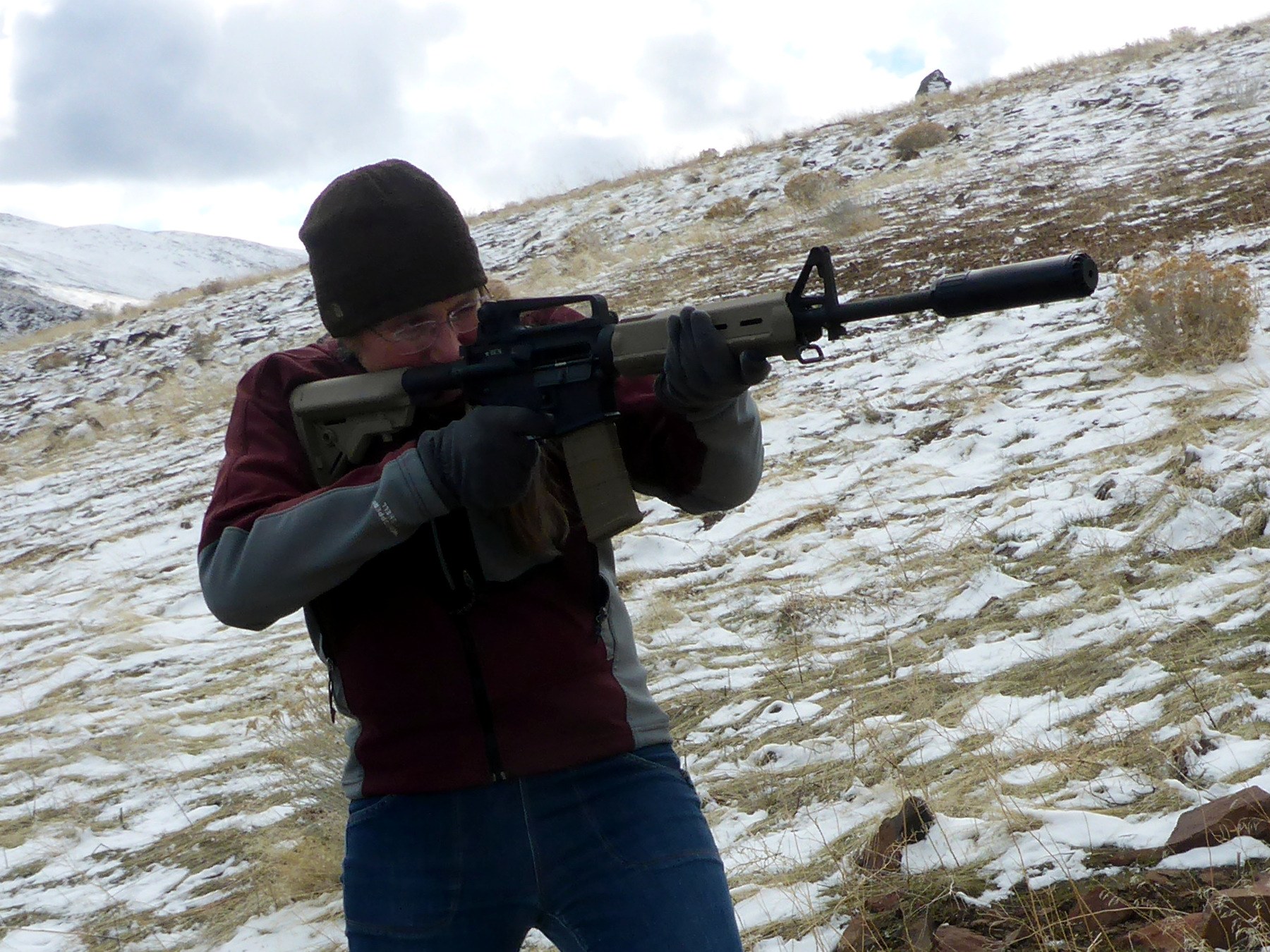
A suppressed AR-15. Under the Tenth Circuit's 2018 ruling in the Cox and Kettler appeals, the can on the muzzle is an accessory outside the Second Amendment, while the rifle it is threaded onto is protected. Photo by Mitch Barrie, Wikimedia Commons, licensed CC BY-SA 2.0.
The Fifth Circuit tried the same reasoning and then took it back
George Peterson, the third NFA defendant on Friday's list, is why this matters right now. Federal agents found an unregistered homemade suppressor in his bedroom closet safe in Louisiana, and he pleaded guilty while reserving his constitutional appeal. In a February 6, 2025 opinion, a Fifth Circuit panel held flatly that "suppressors are not 'Arms' within the Second Amendment's purview," borrowed the Tenth Circuit's accessory line word for word, and added in a footnote that although Cox predates Bruen, "Bruen did not abrogate its reasoning."
Then the panel withdrew that opinion. Its substituted opinion of December 9, 2025, by Chief Judge Jennifer Walker Elrod, assumes without deciding that suppressors are arms and upholds the NFA on different ground, as a presumptively lawful shall-issue licensing regime. It does not cite Cox once. The Supreme Court denied Peterson's petition on April 20, 2026 after the government waived its right to respond. The holding that suppressors are not arms now survives in one circuit, in the case of the two men just pardoned.
Kettler told the court in 2018 that a pardon was not what he wanted
Here is the part nobody wrote up. Kettler's opening brief argued he had been caught between two sovereigns, and it said plainly that he deserved "more than clemency or a pardon." The brief noted that the Kansas Attorney General had already written to the U.S. Attorney General asking him to dismiss the indictment or back a presidential pardon, and called that letter deferential rather than confrontational. Kettler wanted a ruling, and he said so on the record.
Official record
United States v. Cox, Nos. 17-3034 and 17-3035, 906 F.3d 1170 (10th Cir. Oct. 16, 2018), page 46. Slip opinion filed by Clerk of Court Elisabeth A. Shumaker.
"We're unable to give Kettler either as an appellate remedy. . . . Without such a claim, we can't simply order the executive branch to grant Kettler clemency or demand that Kansas grant him the protection of a republican form of government." — Judge Gregory Phillips, for the panel
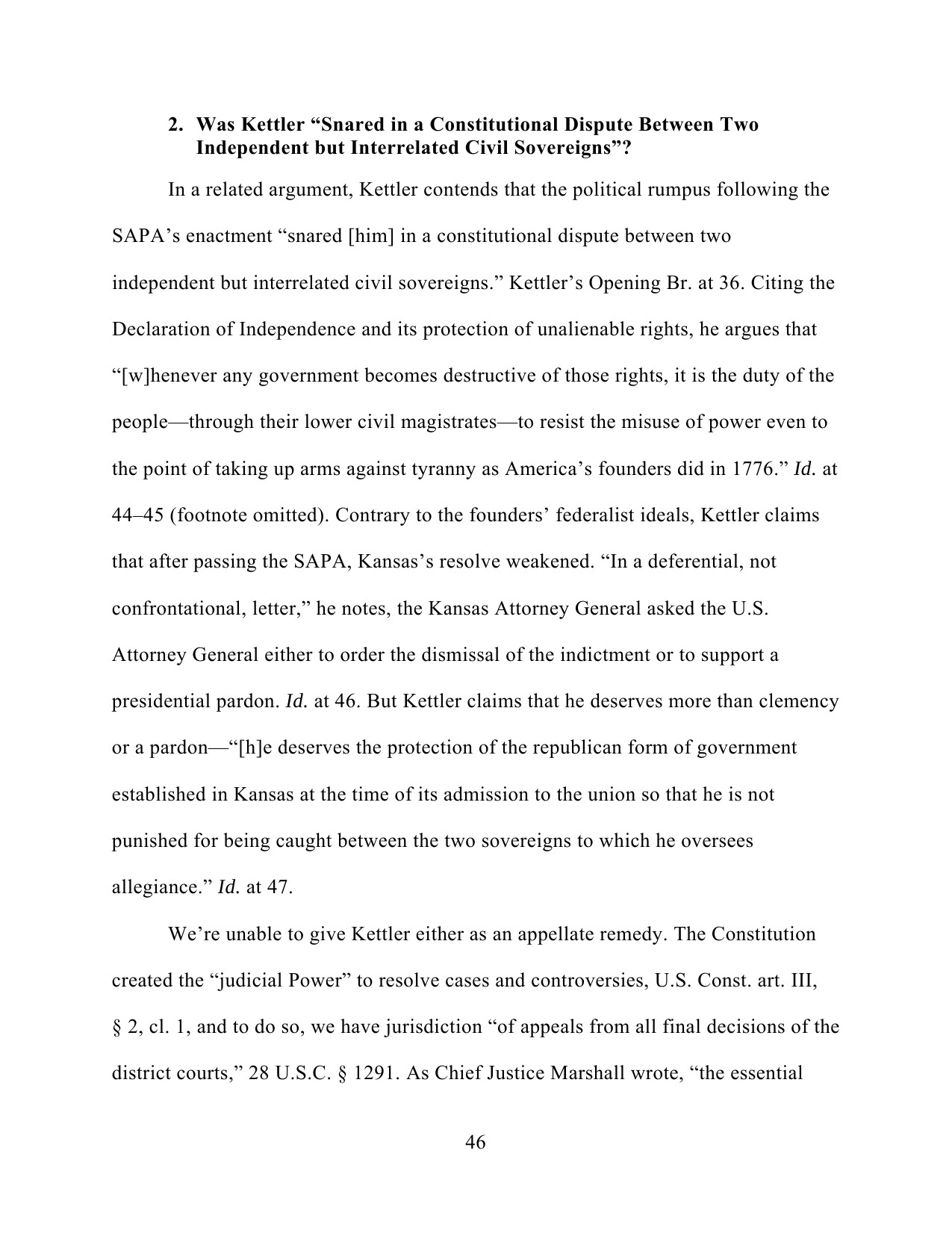
Read or download the full 48-page slip opinion (PDF). The Supreme Court denied Kettler's petition on June 10, 2019.
Eight years later he has the clemency and not the ruling. His conviction is gone and the felony bar on owning a gun comes off with it. The holding that cost him the argument sits untouched at 906 F.3d 1170, waiting for the next federal prosecutor in Wichita or Tulsa who charges a man over a solvent trap.
What actually settles this
Adamiak's file shows how little this had to do with a change of heart inside the Justice Department. The Fourth Circuit found the same item had been charged twice, so one count was vacated and the case went back for resentencing. Adamiak asked for 41 months, effectively time served. On June 11 the government asked for the full 240 months again. Judge Arenda L. Wright Allen struck the June 25 hearing from her calendar because 90 minutes would not cover the filings, and it was never rescheduled. Then the pardon arrived.
A pardon fixes one man. It does not move a citation. The Supreme Court has been handed the suppressor question twice, in 2019 and again this April, and passed both times. On Wednesday, December 2 the justices will hear Viramontes v. Cook County and Grant v. Higgins and decide whether AR-15 platform rifles are protected arms. Suppressors are not on that calendar. Until they are, four men are free and the rule that put them in federal court is still the rule.