Canada's counter-tariffs on American goods took effect at 12:01 a.m. Tuesday, and the product list Ottawa published with them runs 629 tariff lines. Twenty-one of those lines are the in-quota lines of Canada's dairy tariff-rate quotas, so the duty-free cheese and milk-powder access American negotiators bargained for in the USMCA now carries a Canadian surtax of 25 or 50 percent. That is the piece of the list nobody read out loud.
The trigger was August 22, when 50 percent tariffs President Trump ordered under Section 338 of the Tariff Act of 1930 took effect on Canadian goods after talks collapsed. Three days later, Finance Minister François-Philippe Champagne said Canada would match it "dollar for dollar, rate for rate," at 15, 25 and 50 percent, each product pegged to whatever rate Washington had put on the same good. Ottawa put the package at C$27.6 billion of American imports and added C$7.5 billion in support for Canadian firms.
What is actually on the 629 lines
The list Finance Canada published is a four-column table of tariff items, and it is worth counting. There are 413 lines at 50 percent, 195 at 25 percent and 21 at 15 percent. Iron and steel, chapters 72 and 73 of the tariff, account for 274 of the 629, or better than four in ten.
After that it gets less predictable than the press release suggests. Chapter 57, floor coverings, carries 32 lines, more than aluminum's 29. Perfume and toilet waters are on it at 50 percent, along with lip makeup, eye makeup and manicure preparations. So are video game consoles, golf clubs, fishing rods, natural honey, cane molasses, wool suits, cotton T-shirts and saris. Sixteen lines cover railway locomotives and rolling stock at 25 percent. Ottawa's own summary named "steel, dairy, appliances, agricultural equipment, pulp and paper, and electronics."
The 700 figure that ran everywhere is not on the list either. Global News published it as "the full list of 700 retaliatory tariffs," and Al Jazeera called it more than 700 products. The published table has 629 items. Finance Canada's consolidated counter-tariff page shows 648 for September 8, and the extra 19 are the passenger-car and truck lines that have been under a 25 percent Canadian surtax since April 9, 2025.

François-Philippe Champagne at a press conference in Toronto in June 2022, when he was Canada's industry minister. He is now Minister of Finance and National Revenue, and he announced the September 8 counter-tariffs on August 25. Photo by Collision Conf via Wikimedia Commons, licensed CC BY 2.0.
Twenty-one lines land on the quota the United States negotiated
Canada's tariff schedule splits supply-managed dairy into two kinds of line. "Over access commitment" is the punitive rate on anything above quota. "Within access commitment" is the in-quota volume, the duty-free access the United States actually gained in the USMCA. Both kinds are on Tuesday's list.
Thirteen in-quota cheese lines take a 25 percent surtax, running by name through Cheddar, Camembert, Brie, Gouda, Provolone, mozzarella, Swiss and Emmental, Gruyère, blue-veined, processed and fresh curd. Eight more in-quota lines take 50 percent: milk and cream in powder or solid form, powdered whey, and tariff item 3504.00.11, milk protein substances. Remission relief may still be granted case by case, but the schedule as published taxes the quota itself.
That is the same quota the American side spent the summer complaining about. Proclamation 11047 is built entirely on it.
Official record
Proclamation 11047 of July 20, 2026, "Imposing Additional Duties To Offset Canadian Discrimination Against the Commerce of the United States With Respect to Dairy," 91 FR 46653, published in the Federal Register on July 23, 2026.
"Canada maintains a tariff-rate quota (TRQ) on cheeses of all types under the United States-Mexico-Canada Agreement (USMCA) as well as a TRQ on cheese of all types under the Canada-European Union (EU) Comprehensive Economic and Trade Agreement (CETA). The TRQs provide duty-free access for the covered dairy products up to specified annual quantities (in-quota quantities) . . . . While Canada's eligibility criteria for the USMCA dairy TRQs, and specifically, the cheeses of all types TRQ, do not allow retailers to obtain and use TRQ quantities, the eligibility criteria for the CETA do grant retailers access to the TRQ quantity for cheese of all types." — Proclamation 11047, paragraphs 3 and 4
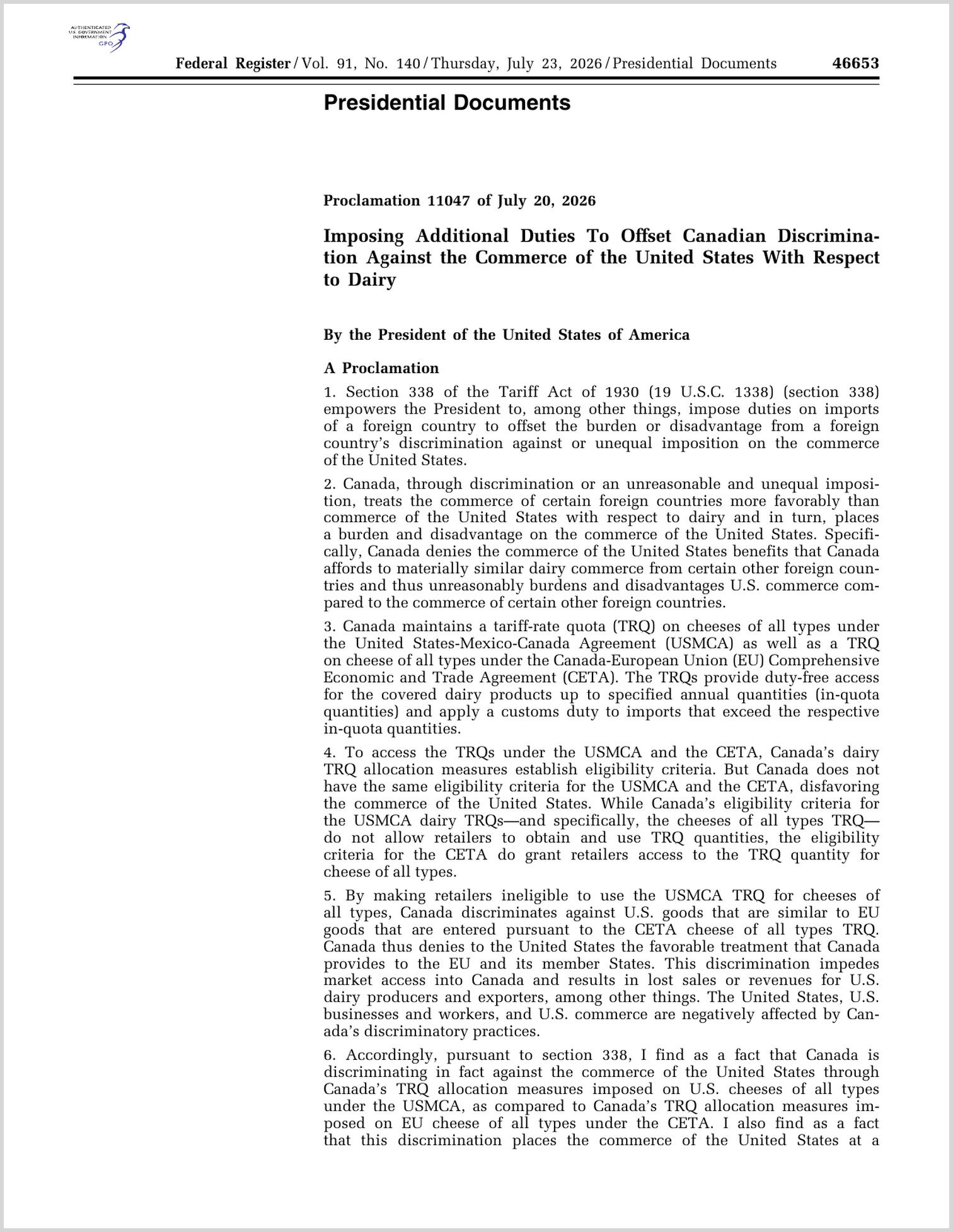
Read or download the full 9-page proclamation (PDF) · Proclamation 11056 later moved the effective date from August 19 to August 22.
The complaint was about who in Canada is allowed to use the quota. Canadian retailers cannot draw on the USMCA cheese quota; under the European agreement they can. Whatever happens to that argument now, the quota is no longer the duty-free lane it was on Monday.
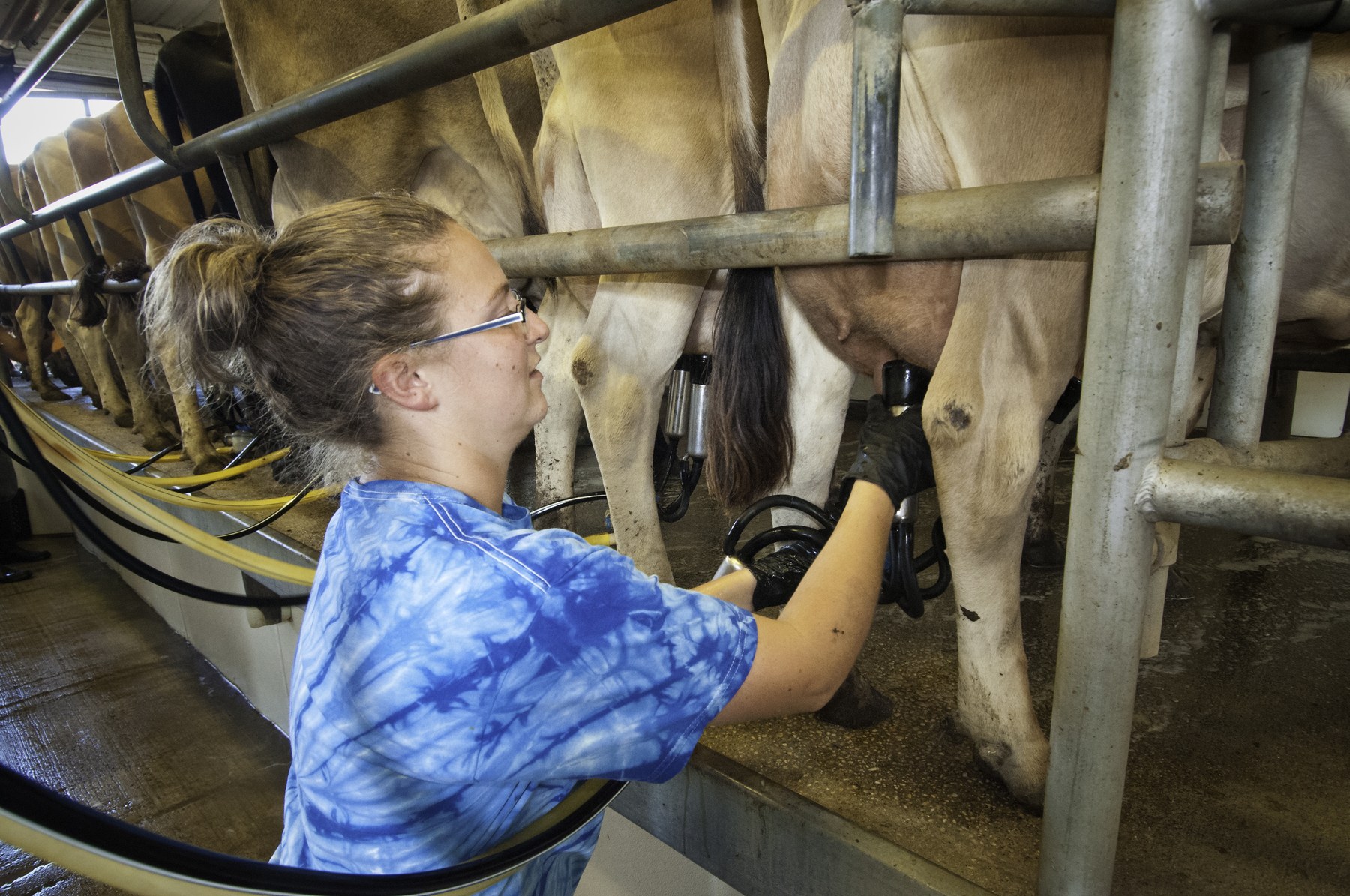
Farm manager Courtney Biggs prepares cows to be milked at Chapel's Country Creamery in Easton, Maryland, an artisan cheese dairy. Canada was the top buyer of American butterfat in 2025, with volume up 50 percent on the year. (Bob Nichols, U.S. Department of Agriculture, via Wikimedia Commons, public domain.)
Ottawa's own list shows 138 lines that do not go up
Cross-reference the 629 lines against Canada's 2025 counter-tariff schedules and the escalation thins out. Of the 629, 520 already carried a Canadian surtax, most of them since the United States Surtax Order (2025-1) took effect on March 4, 2025. Only 109 lines are goods Canada had not already taxed.
Break the 520 down and 382 go from 25 percent to 50 percent. Then 135 stay at exactly 25 percent, the same rate they have carried for eighteen months. And three go down, from 25 percent to 15 percent: dies for drawing or extruding metal, tools for pressing, stamping or punching, and "other mowers, including cutter bars for tractor mounting." A farm implement gets a tariff cut inside a retaliation package. Add the 135 and the three and 138 of the 629 lines are flat or lower on Tuesday than they were on Monday.
How big is C$27.6 billion against the real number
The match is being counted in Canadian dollars. Davis Wright Tremaine, writing for importers, sized the Section 338 action at roughly US$20 billion of Canadian goods a year, which is what C$27.6 billion converts to. Set that against USTR's tally of $333.6 billion in U.S. goods exports to Canada in 2025 and the counter-tariffs reach about 6 percent of what America sells north. Champagne's release also confirms Canada's "tariff remission framework also remains available to assess requests for exceptional relief," so even the 50 percent lines are not final for every importer.
The legal order is still not in the Canada Gazette
Surtaxes in Canada are imposed by order in council under the Customs Tariff and published in the Canada Gazette, Part II. The March 2025 round shows how that looks: SOR/2025-66, registered March 3, 2025, in force the next day, covering 1,256 tariff items on Finance Canada's consolidated list. A second order on March 13 added 539 more, and the auto order on April 9 added 19.
Nothing equivalent has appeared for Tuesday. The most recent Part II issue, Volume 160, Number 17, dated August 26, contains no surtax order. What American exporters and Canadian importers have to work from this morning is a news release and an HTML table on a government website.
Who actually pays
Steel is where the volume is, 274 lines of it, and those exporters were already facing a 25 percent Canadian surtax before dawn Tuesday. Dairy is where the sting is. The U.S. Dairy Export Council reported in February that Canada remained the top buyer of American butterfat in 2025, with shipments up 50 percent, or 14,225 metric tons, on the year. Much of that moves through the quota lines that just got surtaxed.
Washington's argument was that Canada rigged the rules on who may use the USMCA cheese quota. Ottawa's answer, published in a table and effective before sunrise, is to tax the quota. Nobody has to interpret that one. It is line 0406.90.11, Cheddar, within access commitment, 25 percent.