The State Department cut a South Korean company's weapons-proliferation sanctions from two years to seven months and never said why. The notice that ran in Tuesday morning's Federal Register is two paragraphs long, gives no reason, and sends anyone who wants to know what the company did to a document number that does not exist. The decision was made three days after Marco Rubio took Syria off the state sponsors of terrorism list.
The company is JS Research Inc. The notice is Public Notice 13119, at 91 FR 57207, signed by Christopher T. Yeaw, the Assistant Secretary for Arms Control and Nonproliferation. It was filed on Friday, September 4, and printed the day after Labor Day.
Seven months and five days out of twenty-four
The measures against JS Research took effect on January 22, 2026. State's own imposition notice said they "will remain in place for two years from the effective date." The U.S. government decided to end them on August 27. That is seven months and five days served out of a twenty-four-month term, with about seventeen months forgiven.
While the measures were live, JS Research was barred from selling to any federal agency, locked out of U.S. assistance programs and Munitions List items, and had every existing export license suspended. All of it is now gone.
Official record
U.S. Department of State, Public Notice 13119, "Termination of Iran, North Korea, and Syria Nonproliferation Act Measures Against ROK Entity," 91 FR 57207, published September 8, 2026. Read it on federalregister.gov or as the official GPO print edition.
"Pursuant to the Iran, North Korea, and Syria Nonproliferation Act (Pub. L. 106-178), the U.S. Government decided on August 27, 2026, to terminate measures imposed on January 22, 2026 (see Volume 91 FR Public Notice 3625) on the ROK entity JS Research Inc., and any successor, sub-unit, or subsidiary thereof." — Public Notice 13119, September 8, 2026
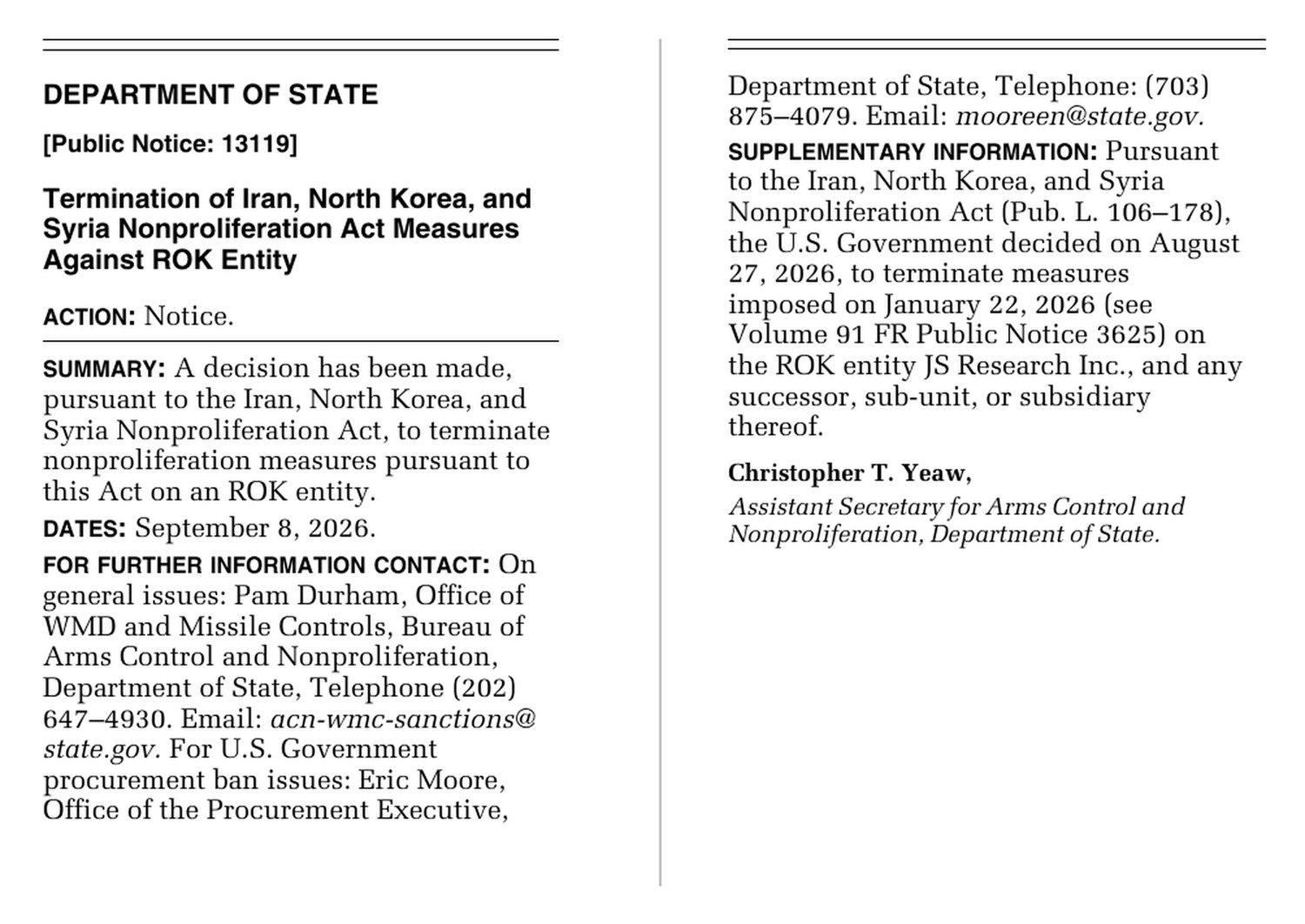
The entire notice, as printed across pages 57207 and 57208 of the September 8, 2026 Federal Register. The cross-reference in the second column reads "see Volume 91 FR Public Notice 3625." There is no Public Notice 3625 in Volume 91. The number 3625 is the page the January imposition notice starts on. Its actual public notice number is 12933. (U.S. Government Publishing Office, public domain.) Read or download the full two-page notice (PDF).
The law demands a written justification for every other exit
Here is what the wire coverage skipped. The statute State cited, the Iran Nonproliferation Act of 2000 as later broadened to cover Syria and North Korea, builds a paper trail into every route out of these sanctions except the one State used.
Section 4 says that if the President declines to sanction a company that shows up in the required proliferation report, he "shall so notify" the House Foreign Affairs and Senate Foreign Relations committees, with "a written justification describing in detail the facts and circumstances." Section 5 lets him exempt a company outright, but only fifteen days after reporting to those same two committees, and only on one of four specific findings. Two of the four fit South Korea on their face: that the company's government belongs to the relevant export-control regime and the transfer followed its rules, or that the home government "has imposed meaningful penalties on that person." Seoul belongs to both the Missile Technology Control Regime and the Wassenaar Arrangement.
Neither route was taken. Instead the sanctions were applied and then shortened, and Section 3 hands the President that power in nine words: he may apply measures "for such period of time as he may determine." No notification. No written justification. No finding of any kind. The two-year clock in the January notice is State's own boilerplate, not a deadline Congress wrote.
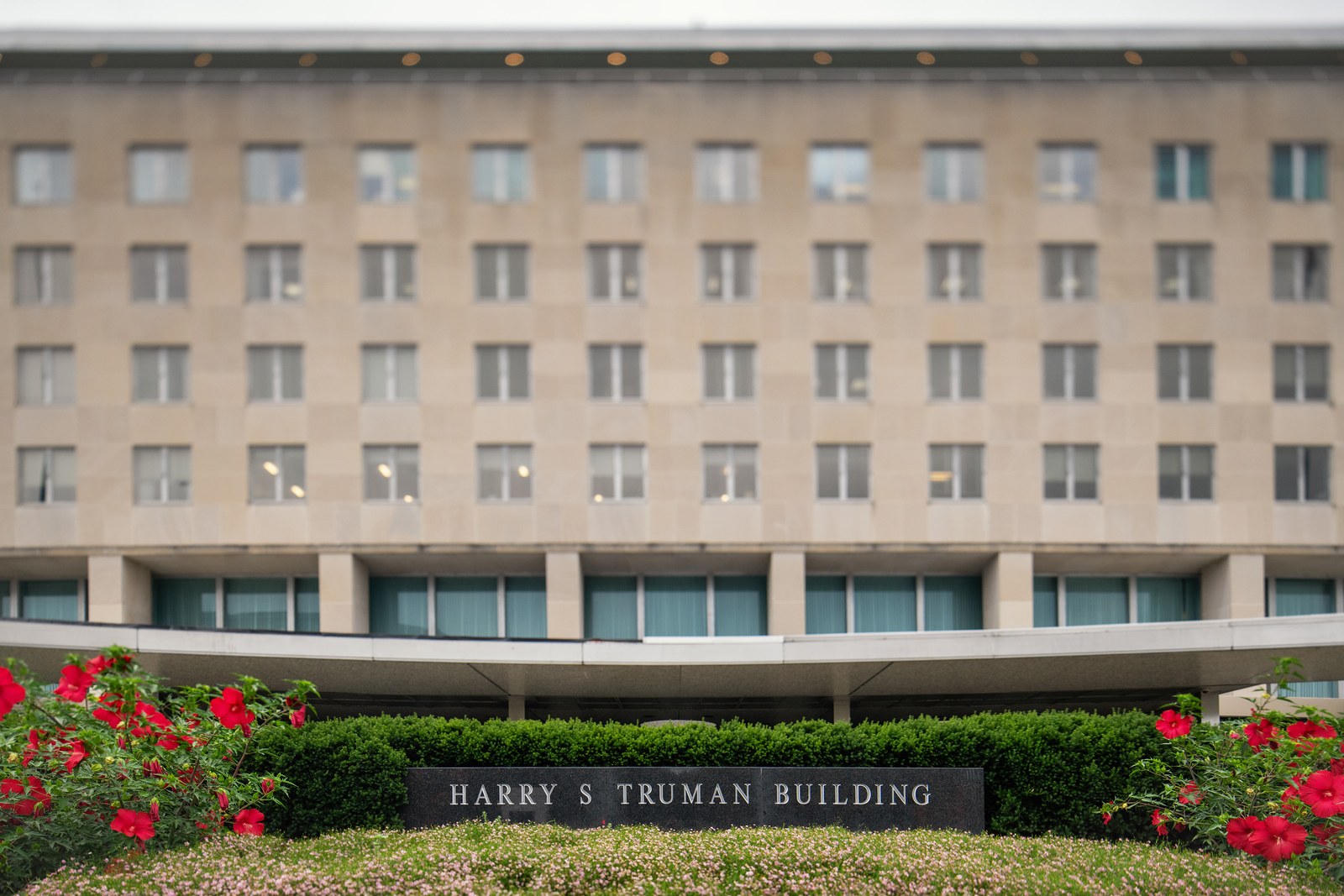
The front of the State Department's Harry S. Truman Building, where the Bureau of Arms Control and Nonproliferation runs the sanctions program that named JS Research in January and released it in August. Official State Department photo by Issac D. Pacheco, July 2, 2025 (public domain).
Compare that to what Rubio had to do to clear Syria itself. His August 24 press statement says he acted "following the conclusion of the mandatory 45-day Congressional notification period." Taking a country off the terror list took forty-five days of notice to Congress. Taking a company off the proliferation list took a two-paragraph notice and an assistant secretary's signature.
Five other names were on that January list, and all five are still on it
The January 22 action covered six foreign persons: North Korean national Ch'oe Ch'o'l-min, the Second Academy of Natural Science Foreign Affairs Bureau in North Korea, Futech Co. Ltd of China, EXPTRANS GMBH S.A.R.L. of Lebanon, International Biotechnology Services FZC of the United Arab Emirates, and JS Research of South Korea. Only JS Research got out. It was also the only one on the list based in a U.S. treaty ally.
Voice of America's Korean service reported that JS Research was founded in 2004 in Gongju, in Chungcheongnam-do province, makes laboratory and medical instruments, and was the first South Korean company hit under this law in roughly eighteen years, since the Yurin Tech case in 2008. VOA asked State for the reason and for the original basis of the designation, and is still waiting.
Seoul was not caught off guard in January. South Korea's foreign ministry told Ajunews then that it had been in continuous contact with Washington, knew the designation was coming, and that Korean authorities were investigating the company. If that investigation produced penalties, Section 5 was sitting right there, and Congress would have gotten a report.
Three terminations since 2000, and this is the fastest
Search the Federal Register for the heading State uses to impose these measures and twenty-six notices come back, running from 2003 to last month. Search for terminations and you get three. State lifted measures on the Russian aircraft maker Sukhoy in 2006, under the predecessor law. In January 2024 it released the Indian firm Synnat Pharma Pvt Ltd after about fourteen months. JS Research served seven.
That makes this the quickest release on the public record under the current statute, and the paperwork looks rushed to match. The January notice cited the law as Pub. L. 109-353, which is actually the North Korea Nonproliferation Act of 2006 that amended it. Tuesday's notice cites Pub. L. 106-178, the base act. Same signer, seven months apart, two different citations, plus a cross-reference pointing at a public notice number that was never issued.
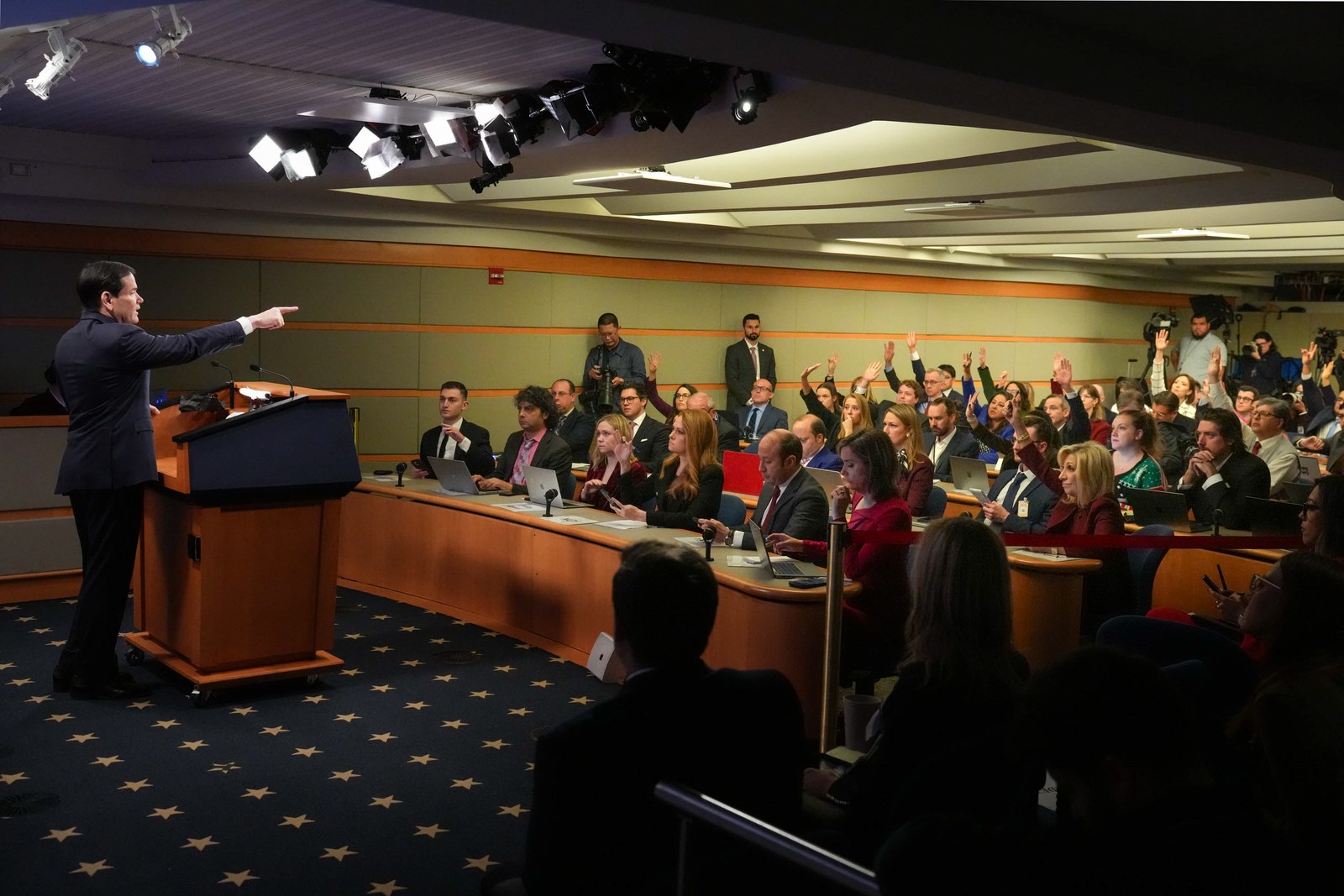
Secretary of State Marco Rubio takes questions in the State Department press briefing room. Neither the department's press office nor the September 8 notice has explained why JS Research was released after seven months. Official State Department photo by Freddie Everett, December 19, 2025 (public domain).
The Syria theory is probably right, and it still is not a legal reason
Korean outlets have connected the dots the obvious way. SBS and Financial News both reported that JS Research was accused of trading WMD and missile-related goods with Syria, and both noted the timing against the administration's fast unwinding of Syria sanctions. State has not confirmed the link.
Even if that is exactly what happened, it changes nothing about the statute. The Syria trigger here covers transfers to or from Syria since January 1, 2005 of controlled goods or anything that could materially contribute to WMD or missile systems. It is not keyed to whether Syria sits on the terror list. Rubio's rescission opened Syria to private investment. It did not make a past proliferation transfer legal, and it does not supply the finding Section 5 would have required.
Somebody can just ask
JS Research landed on the list because it appeared in the semiannual proliferation report the President has to send the House Foreign Affairs and Senate Foreign Relations committees. Both committees already hold the document that named it. They can ask what changed between January 22 and August 27, and they do not need State to volunteer it first.
Until somebody does, the record says this: the five others accused of feeding weapons programs in North Korea, Iran or Syria stay sanctioned until January 2028, the sixth walked in September, and the only official explanation on file is a page number where a document number should be.