Thomas Massie's discharge petition to force a House vote on the Epstein Files Transparency Act II has 106 signatures and needs 218. Read the Clerk of the House's signature list against the Clerk's own count of who sits in the chamber, and the petition is not simply 112 names short. Every Democrat who has not signed could sign tomorrow, the lone independent with them, and the total would stop at 217.
Massie filed the motion on August 31, the Monday the House came back from its August break. It drew 17 names that day and 89 more over the next three days. Then the House left town, and the ledger has not moved since.
Petition 27 is not actually aimed at the Epstein bill
The bill everyone is naming is H.R. 9694. The petition never mentions it. Discharge Petition No. 27, in its own text, moves to discharge the Committee on Rules from H. Res. 1430, described there as "a resolution providing for consideration of the bill (H.R. 185) to advance responsible policies."
H.R. 185 is a leftover shell that Jim McGovern, the ranking Democrat on Rules, introduced on January 3, 2025. Its first substantive section extends livestock reporting rules by a year. This Congress has hung four discharge petitions on it.
Section 4 of the resolution is where the real bill lives. It strikes everything after H.R. 185's enacting clause, inserts the Epstein Files Transparency Act II in full, and deems that substitute adopted the instant the rule passes. Section 3 then orders the Clerk to message the Senate "no later than one calendar day after passage." No standing rule sets that clock, so Massie wrote one in.
The arithmetic nobody has run
The Congressional Research Service is blunt about the threshold in its February 12, 2026 report on discharge procedure. "The requirement of 218 signatures is fixed," it says, "representing a majority of the total membership of the House (435)." Two seats are vacant right now. The bar does not slide down to 217.
Now count the room. The Clerk's roll call 295, gaveled at 10:24 a.m. on September 3, records 433 sitting members: 218 Republicans, 214 Democrats and one independent. Of the 106 names on Petition 27, 104 are Democrats. The two Republicans are Massie and Nancy Mace of South Carolina.
That leaves 110 Democrats unsigned. Add every one of them and the petition reaches 216. Add Kevin Kiley of California, who left the Republican Party in March and still caucuses with Republicans, and it reaches 217. Massie needs a third Republican before he needs anything else on this list.
Official record
Discharge Petition No. 27, filed August 31, 2026 by Rep. Thomas Massie on H. Res. 1430. The Clerk of the House maintains the running signature list, and the full roster as of the House's last day in session was printed at 172 Cong. Rec. H5516.
"Pursuant to clause 2 of rule XV, I, Thomas Massie, move to discharge the Committee on Rules from the consideration of the resolution (H.Res. 1430) entitled, a resolution providing for consideration of the bill (H.R. 185) to advance responsible policies, which was referred to said committee July 15th, 2026." — Discharge Petition No. 27
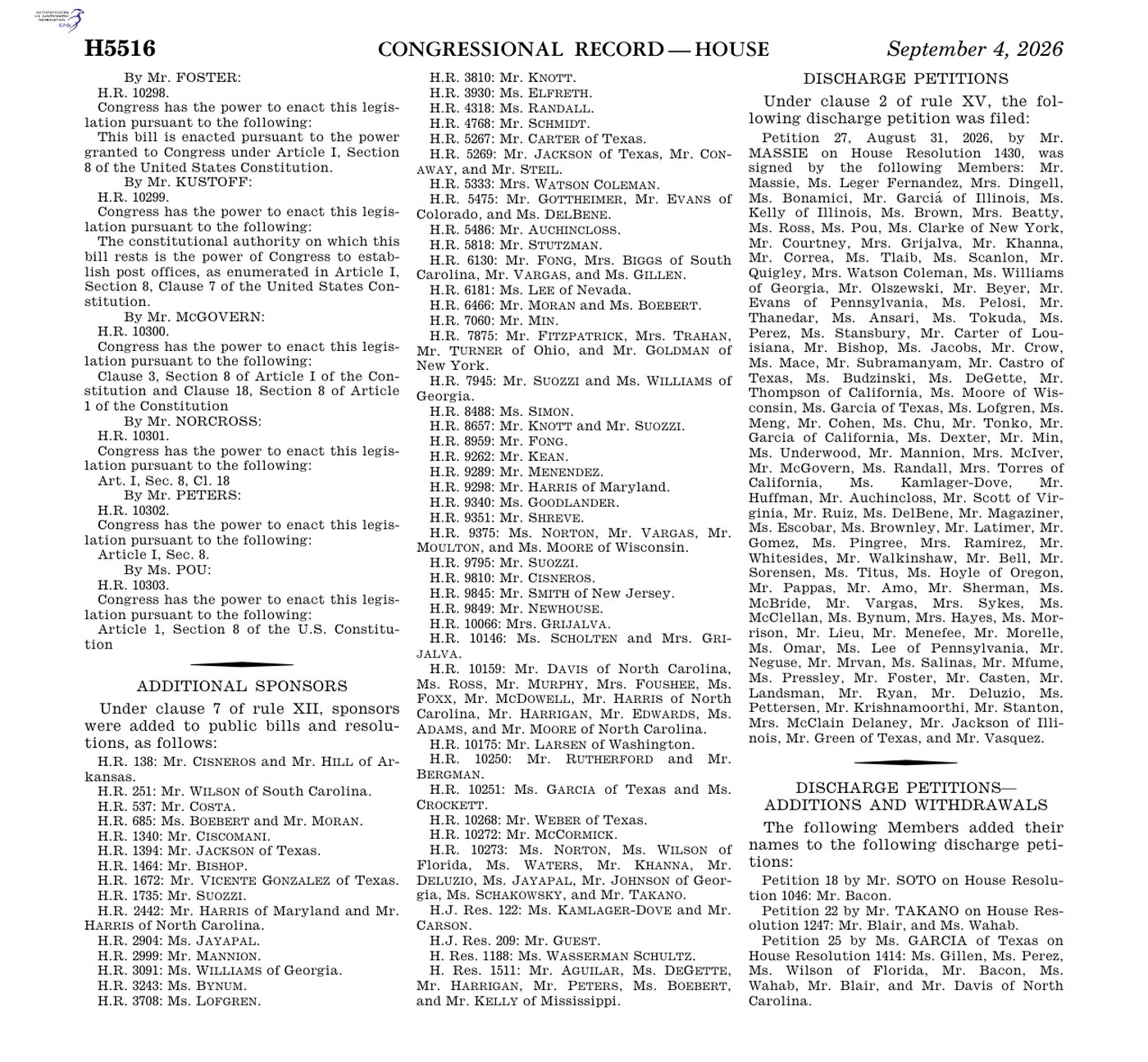
Read or download page H5516 of the September 4, 2026 Congressional Record (PDF), which prints all 106 names in the order they signed.
Last year's four Republicans are down to two
In November 2025 the first Epstein petition reached 218 with 212 Democrats and four Republicans: Massie, Mace, Lauren Boebert and Marjorie Taylor Greene. Greene has left the House. Boebert is still there and voted that September 3 morning. Her name is not on Petition 27.
One Republican did sign a discharge petition during the House's final week in session. The September 4 Record lists Don Bacon of Nebraska signing two, Petition 18 and Petition 25, both immigration measures. Neither was Massie's.
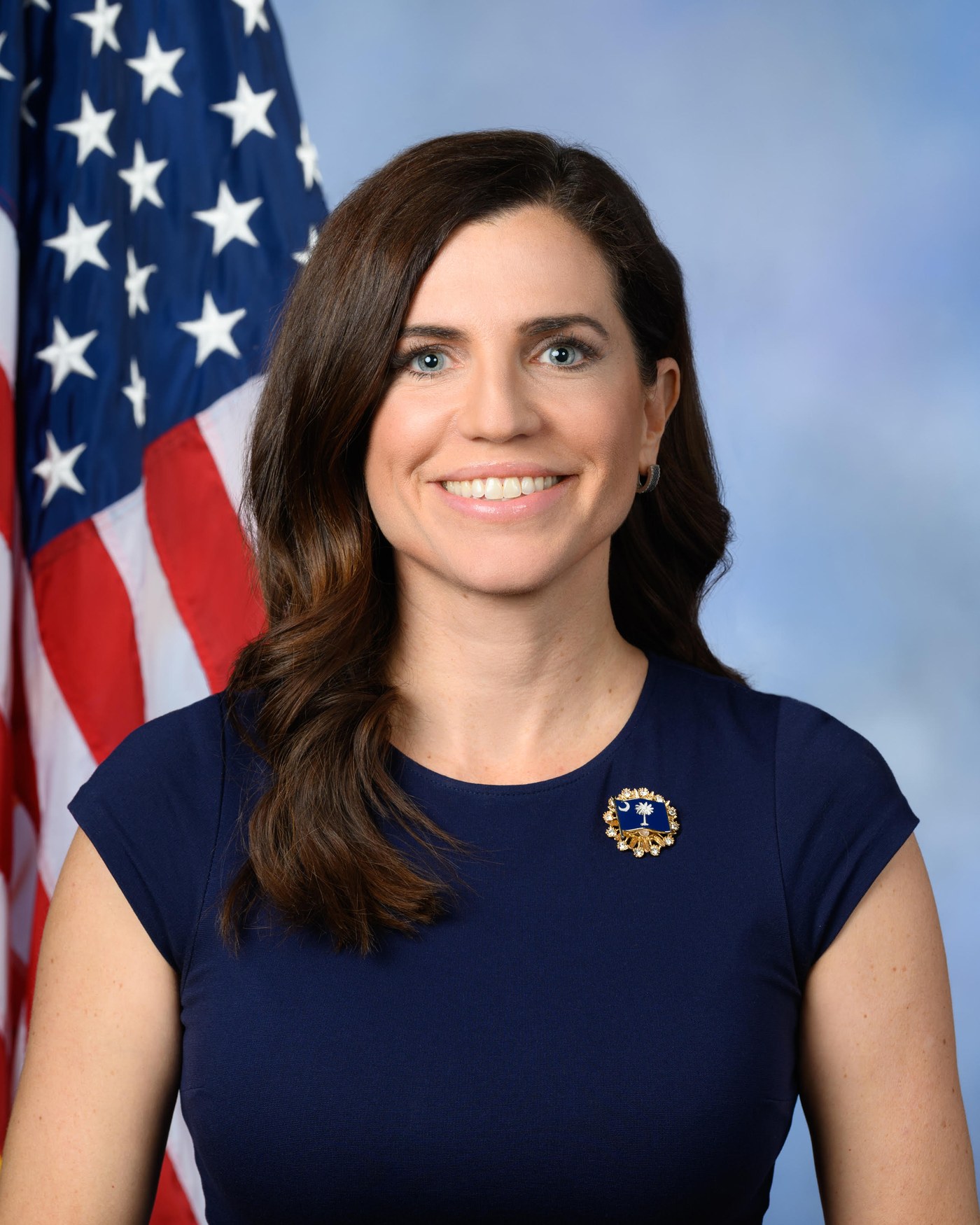
Rep. Nancy Mace of South Carolina, the only Republican besides Massie to sign Petition 27. She added her name on September 1 and cosponsored H.R. 9694 the same day. (Office of Congresswoman Nancy Mace via Wikimedia Commons, public domain.)
Four session days cannot hold seven legislative days
Reaching 218 is only the first gate. Under clause 2 of Rule XV the motion goes onto the Calendar of Motions to Discharge, seven more legislative days have to elapse, a signer gives notice on the floor, and the Speaker then has two legislative days to schedule the vote.
The House returns for votes the evening of Monday, September 14, works four days, then stays gone until November 9, the schedule change we covered last week. Four is not seven. Even a flawless September 14, with 112 members queuing at the rostrum in one afternoon, produces no floor vote before November 3.
One wrinkle cuts against the story everyone is telling. A legislative day runs from the moment the House convenes until it next adjourns, so a pro forma session counts. The September 4 Daily Digest says the House "will meet in Pro Forma session at 2 p.m." today, and CRS notes petitions stay "at the rostrum for Members to sign when the House is in session." The gavel is not what is holding this one at 106.
What the bill would do to Todd Blanche
Read the substitute end to end and the largest change is a deletion. Section 2(c) strikes subparagraph (E) from the Epstein Files Transparency Act. Subparagraph (E) is the classified-information exemption, the clause letting the Attorney General hold back anything "properly classified" under an executive order. New section 4(d)(3) shuts the same door from the other side. He "may not refuse, delay, or object to access" because material is classified, though he may still ask for protective handling.
Then a one-word amendment does more work than most of the section. Current law reads "All redactions must be accompanied by a written justification published in the Federal Register and submitted to Congress." Section 2(d) strikes "All redactions" and inserts "Each redaction." One blanket filing stops being enough.
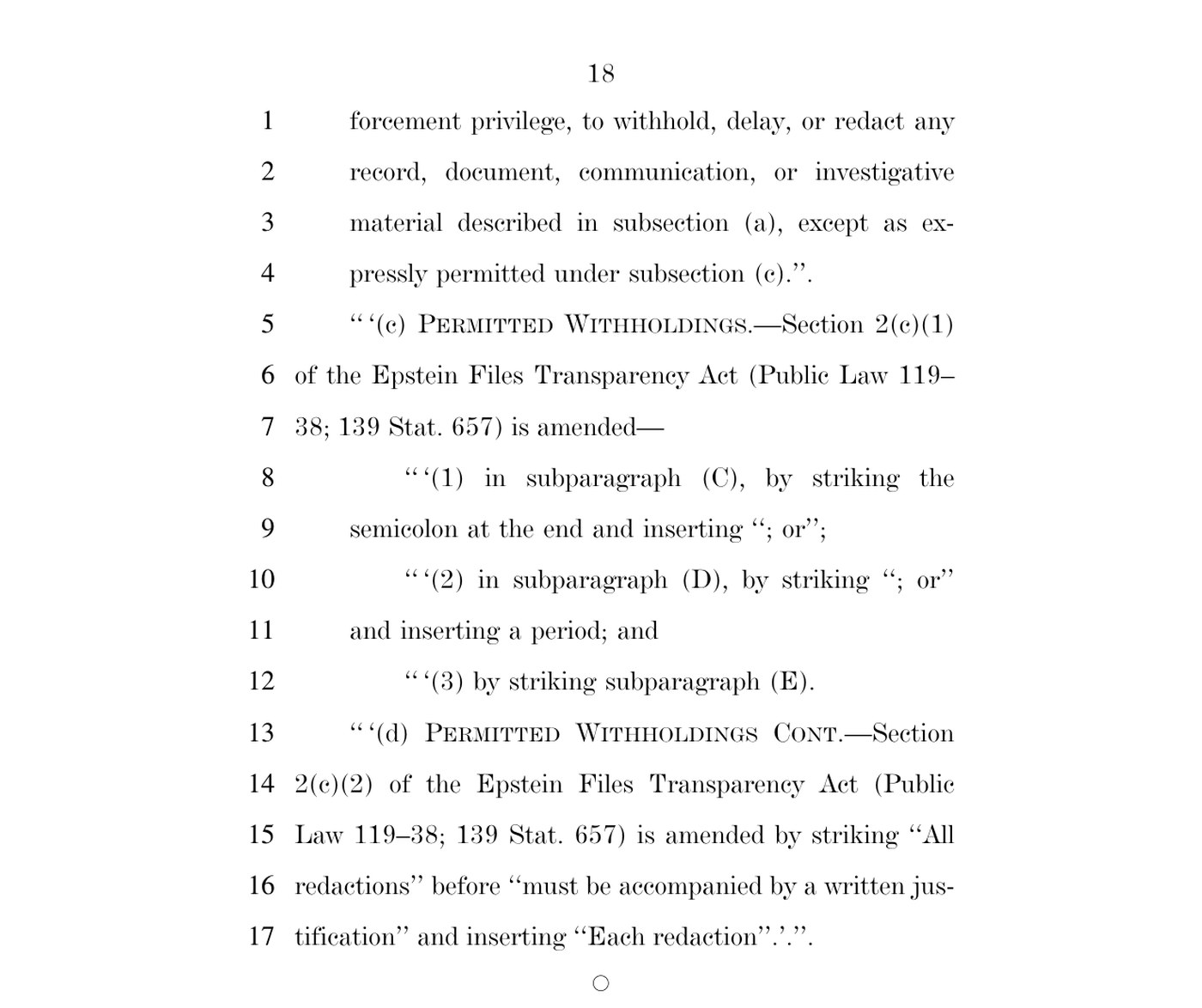
Page 18 of H. Res. 1430 as introduced, the last page of the substitute. Paragraph (3) strikes the classified-information exemption. The subsection below it replaces "All redactions" with "Each redaction" in the existing law. (U.S. Government Publishing Office, public domain.)
The rest dismantles the usual reasons an agency says no. Deliberative process, attorney-client, work product and law enforcement privilege are barred outright. The Justice Department's Touhy regulations at 28 C.F.R. 16.21 through 16.29 are switched off for covered records. A state clears the injury bar with "financial harm in excess of $100." Officials who conceal or falsify records get pointed at 18 U.S.C. 2071 and three other criminal statutes.
Any single member could demand the entire file
New section 4(e) is the provision most likely to cost Massie his third Republican. On the written request of any Member of Congress, the Attorney General gets seven calendar days to provide "full, unredacted access to, any record described in section 2(a)." Miss it and that member may sue him in any district court covering part of the member's own district.
Measure that against the law as it stands. CRS wrote last November that an individual member "may not unilaterally" open a committee investigation, "issue a subpoena, or seek enforcement of a subpoena through contempt." H.R. 9694 would hand all 435 of them a key to one specific vault, no committee gavel required.
Where this stops
The defendant the bill contemplates is Todd Blanche, confirmed Attorney General 50 to 49 at 4:17 a.m. on August 8. Massie says the Department is still withholding "over 3 million Epstein files" and keeping heavy redactions on what it does release. That is why a second bill exists ten months after President Trump signed the first one.
H. Res. 1430 has sat in the Rules Committee since July 15, and nothing obliges Virginia Foxx, who chairs it, to move it. That is the entire reason discharge petitions exist. Massie posted on X that "there are rumors @SpeakerJohnson will soon recess the House until after the midterm elections… to avoid the vote?!" The recess is real, and no vote happens this fall. The recess is also not the wall. The wall is a number, and the number is 217.